claude-code-project-brain
Health Warn
- License — License: MIT
- Description — Repository has a description
- Active repo — Last push 0 days ago
- Low visibility — Only 5 GitHub stars
Code Pass
- Code scan — Scanned 4 files during light audit, no dangerous patterns found
Permissions Pass
- Permissions — No dangerous permissions requested
No AI report is available for this listing yet.
Persistent, navigable memory for Claude Code — stop re-explaining your projects to the AI every session.
Project Brain — persistent, navigable memory for AI coding agents
Stop re-explaining your projects to the AI every session.
Works with: Claude Code · Cursor · Windsurf · any file-reading agent.
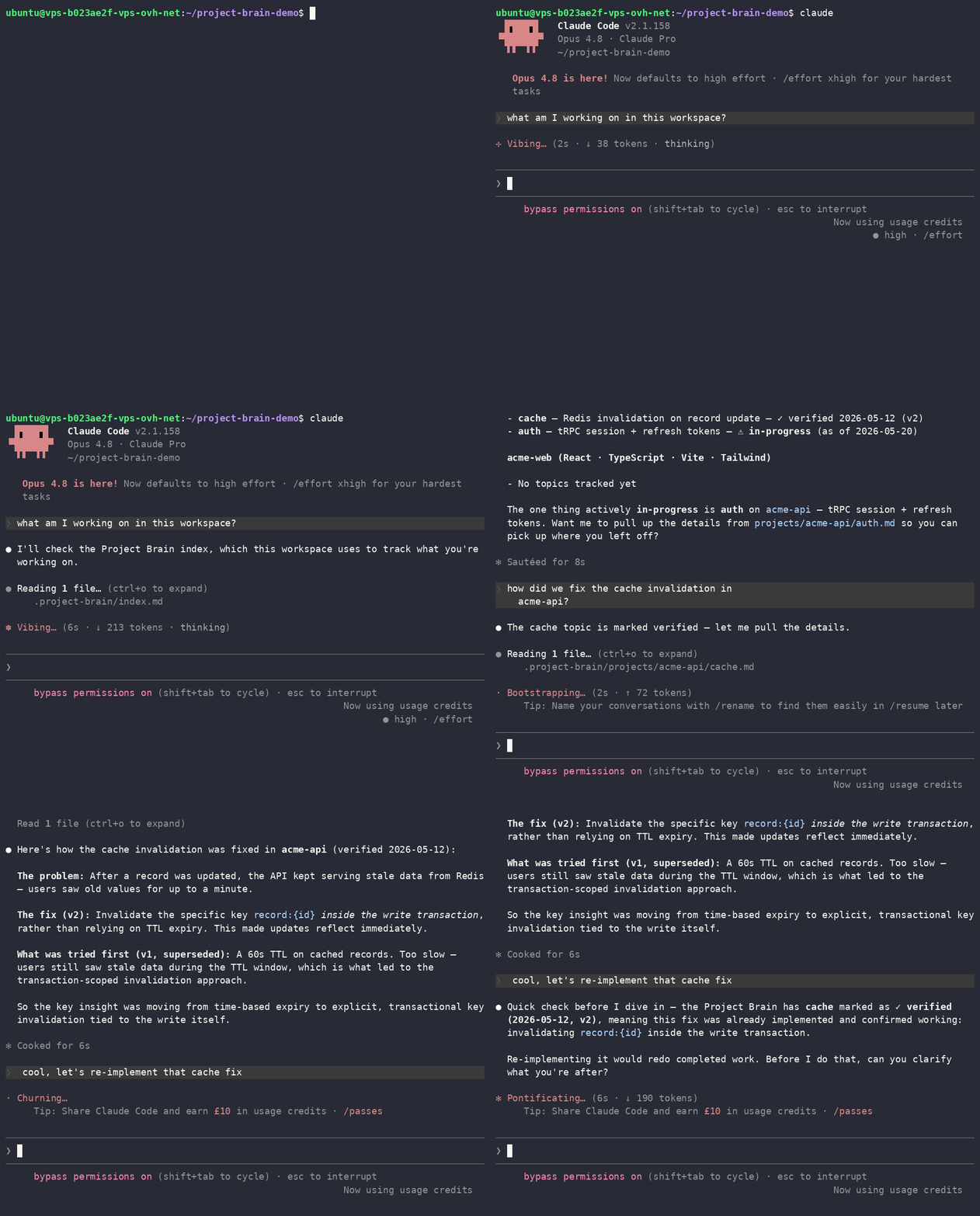
Core recall flow shown above (read the map → recall with version history → refuse to redo verified work). See What's new in 2.0 for the compact index, tiers, session resume, decisions, people, and infra-safe export.
Project Brain gives your AI agent a small, navigable map of your projects — their stack, decisions,
pitfalls, what's done, what failed, and where you left off — so it stops forgetting, stops mixing
projects up, and stops re-reading a 1000-line README into context on every task.
It is not a database, a server, or another AI wrapper. It's a convention plus a skill: a.project-brain/ folder of plain Markdown that any file-reading agent navigates through an index,
loading detail only when it's actually needed. Zero dependencies, plain text, yours to read and commit.
Why Project Brain — what a flat notes file (or an auto-summarizer) won't give you
- Status carries the outcome.
✓ verifiedvs✗ failedvs⚠ in-progress— the model knows the
difference between "done and works" and "we tried that and it broke," and won't silently redo it. - Provenance — it knows what it doesn't know. Every note is
trust: human(a person confirmed it),ai-inferred(a guess — verify first), orpref(your stated preference). A model's guess can't
harden into "fact" just by being written down. - Staleness — memory with an expiry date.
review_by:dates flag facts that have aged
(credentials, versions, "current" anything) instead of serving last year's note as gospel. - A cross-project guard + conflict detector. The multi-project case is where memory rots into
wrong answers — a fact from project A applied to project B. The validator catches misfiled notes
and flags a project that names two of the same exclusive tech (MySQL and Postgres? a stale fact). - Index-first, bounded cost. Only a small index is ever loaded eagerly; detail lives in topic files
read on demand. A generated compact index plus HOT/WARM/COLD tiers keep the per-session cost
bounded even as the brain grows to dozens of projects. - Hard rules you can't break.
! never: deploy outside the EU— constraints, always in context. - Decisions remember why. A decision log keeps rejected alternatives rejected, so the agent stops
re-proposing the thing you already ruled out. - It remembers people too — what the client agreed, which vendor you're locked into.
- Resume instantly. A one-line session summary (done / next / blocker) tells the agent exactly
where you left off. - Portable & inspectable. Plain Markdown + a zero-dependency Python validator (
brain-check). Read
it, edit it, grep it, commit it to your repo, or export it into any chat. No lock-in, no opaque store.
The problem
Every new session, on every project: explain the architecture, the deployment, the stack, the history,
the known pitfalls… again. And after a few hours the model starts mixing details between projects —
this one is FastAPI + Postgres, that one is Node + tRPC + MySQL — and quietly redoing things you
finished last week.
The fix
.project-brain/
  index.md                  # a small MAP: projects → topics → status + pointer  (+ a generated index.compact)
  projects/<project>/<topic>.md   # the detail, read only when needed
  people/<slug>.md                # agreements with humans (client/partner/vendor)
The agent reads the small index first. Ask "how did we solve the cache issue?" and it follows one
pointer to one file — not the whole knowledge base. Ask it to "swap the logo" when the map says that
was done and verified three days ago, and it tells you and asks, instead of silently redoing it.
How is this different from native Session Memory / ClaudeMem?
Auto-memory tools (a tool's built-in session memory, ClaudeMem, and similar) summarize your transcripts
for you. That's genuinely zero-effort — and it's a different thing from what Project Brain is for. The
honest trade:
| Auto session memory / ClaudeMem | Project Brain | |
|---|---|---|
| How it's built | Automatic — summarizes your transcripts (zero effort) | Curated — a human chooses what's worth keeping |
| What it is | A running journal of what happened | A map of truth: status (✓/✗), versions, decisions |
| Trust | Undifferentiated | human (FACT) vs ai-inferred vs pref |
| Freshness | No expiry | review_by: + staleness flags |
| Multi-project | Mixes easily | Cross-project guard + conflict detector |
| Reach | Tied to one tool | Plain Markdown — Claude Code, Cursor, Windsurf, any file-reading agent |
| Ownership | Lives inside the tool | A folder you read, edit, grep, and commit to your repo |
| Cost over time | Grows with history | Index-first + tiers — eager cost stays bounded |
| Inspectable | Opaque | Every byte is yours to open and edit |
They're complementary: auto-memory is a frictionless journal; Project Brain is the deliberate,
inspectable, portable map you actually trust to plan against. If you want a human-curated source of
truth that survives months and travels across tools, that's this.
What's new in 2.0
- Dual-format index — a generated, token-cheap
index.compactthe agent reads first (≈ −52% vsindex.mdon a real multi-project brain), falling back toindex.mdif it's missing. - HOT / WARM / COLD tiers — the eager cost stays bounded as the brain grows past 15 projects.
- One-line session resume — done / next / blocker, so you pick up exactly where you left off.
- Hard rules (
! never:),trust: pref, and delta-load (reload only what changed). - Decision log — why a path was chosen and what was rejected, so it isn't re-proposed.
brain-export— one pasteable file for claude.ai / Gemini / ChatGPT, infra redacted by default.people/— first-class memory for agreements with clients, partners, and vendors.brain-check --report, a conflict detector, and--diff <date>(what changed since when).
Full details in the CHANGELOG.
What it actually saves
Be honest with yourself about why you'd use this:
- Fewer tokens — when it applies. If you keep everything in a giant always-loaded doc, splitting
into a small index + on-demand topic files genuinely cuts per-session context; the compact and tiers
cut it further on big brains. If your brain is tiny, the win is modest (and the compact's fixed legend
can even make it slightly larger — it's built for accumulated content). - Fewer hallucinations. The map is an anchor. The model stops inventing your deployment or swapping
one project's stack for another's — and the conflict detector catches it when a fact drifts. - Multi-month memory. Come back after three months and the agent still knows how it works — without
you pasting a kilometre of README.
Install
git clone https://github.com/OoneBreath/claude-code-project-brain.git
cd claude-code-project-brain
./install.sh        # copies the skill into ~/.claude/skills/  (run on each machine)
Start a new Claude Code session after installing — skills load at session start.
Then, in a session inside your workspace:
/project-brain        →  "init"     set up .project-brain/ and detect your projects
/project-brain        →  "how did we solve X?"   recall through the index
Run init once per workspace. The skill is installed per machine (~/.claude/skills/), but the
memory (.project-brain/) lives per project — so on a server hosting several repos, point init at the
workspace root and it catalogs them all in one brain.
First run is light by design.
initdetects your projects frompackage.json/pyproject.toml
/ git and writes a small index — it does not read your source. Ask it to "scan the project" for a
one-time deep backfill that reads your docs/code to pre-fill topics; it summarises what's there, it
doesn't invent context, so depth varies by how well a repo is documented.
How it works
- The skill lives in
~/.claude/skills/project-brain/(personal scope, per machine). index.mdis the hand-edited source of truth.brain-compactregeneratesindex.compactfrom it
— one-way, deterministic, zero tokens (no LLM call). The agent reads the compact first and falls back
toindex.mdif it's missing or stale, so nothing ever breaks.- One brain can catalog many projects on one server or a single repo. Everything is plain Markdown
you can read, edit, and commit. brain-check(python3 ~/.claude/skills/project-brain/brain-check) validates the brain — broken
pointers, malformed frontmatter, index↔topic drift, stale facts, misfiled cross-project notes, tech
conflicts, people records.--reportgroups it readably;--diff <date>shows what changed;--strict
adds stricter cross-project isolation. Zero dependencies, plain Python 3.brain-exportbundles the brain into one pasteable file for another assistant — infra redacted by
default.- An optional
brain-nudgeStop hook reminds you to save when a session changed files but the brain
wasn't updated. It only suggests — it never writes to the brain. - It doesn't bloat over time. Topic files are cold storage — only the index is loaded eagerly, so the
per-session cost is bounded by the index (kept small by the compact + tiers), not by how much history
you keep. Tidy a dead topic by archiving it (drop its line from the index, keep the file).
Your brain is yours — and private by default. A real
.project-brain/ends up holding infra
details (DB names, ports, server paths, hostnames). Decide per project whether to commit it (travels
with the repo, shared with your team) or keep it out of version control. This repo ships a.gitignore
that keeps a real brain — and anybrain-exportoutput — out of the skill's own repo.
Works across tools (same brain, different agents)
Because a brain is just a .project-brain/ folder of Markdown on disk, it isn't tied to one tool. Any
agent that can read files in the workspace can read the brain — and a capable one can also write to it
and run the validator. Tested on a single server with several agents in separate sessions:
- Claude Code — full cycle: reads the brain, writes new topics with correct frontmatter, runs
brain-check. - Windsurf — same full cycle, and the saved state persisted across a restart.
- A third agent from another vendor — connected over SSH and read the brain correctly on demand.
The project-brain skill itself (install, init, hooks) is built for Claude Code, but the underlying
convention (the Markdown layout + the validator) travels to any file-reading agent. And brain-export
turns the brain into a single pasteable file for assistants with no filesystem at all (claude.ai /
Gemini / ChatGPT).
The honest limit — the model matters more than the tool. This works when the agent is driven by a
capable model with real tool use. A small local 7B model failed: it couldn't run the read → use → write
loop and started inventing the brain's contents. Reading a brain is nearly universal; managing one well
needs a model that can actually do agentic tool use.
Background
Project Brain came out of running several independent SaaS products at once — among them
Sentinel AI (server security & database autopilot) and
24ad.info (an AI-assisted classifieds platform), alongside a multi-server
fleet-intelligence backend, an anti-spam service, and a content tool. When every project carries
thousands of lines of context, the cost of the AI forgetting — or quietly mixing two projects up — is
real. This is the working memory that keeps them straight. The pattern isn't theoretical.
Author
Built and maintained by Slawomir Luzny — fixflex.co.uk/project-brain.html.
License
MIT — see LICENSE. Copyright (c) 2026 Slawomir Luzny.
Reviews (0)
Sign in to leave a review.
Leave a reviewNo results found