Benzi
Health Uyari
- License — License: NOASSERTION
- Description — Repository has a description
- Active repo — Last push 0 days ago
- Low visibility — Only 8 GitHub stars
Code Gecti
- Code scan — Scanned 7 files during light audit, no dangerous patterns found
Permissions Gecti
- Permissions — No dangerous permissions requested
Bu listing icin henuz AI raporu yok.
Benzi is a coding AI agent + harness grounded in a live code map.
Benzi
An AI coding agent that doesn't guess — it reads.
Horse Tinder Demo · Website · Live demo · Benchmark · VS Code Marketplace
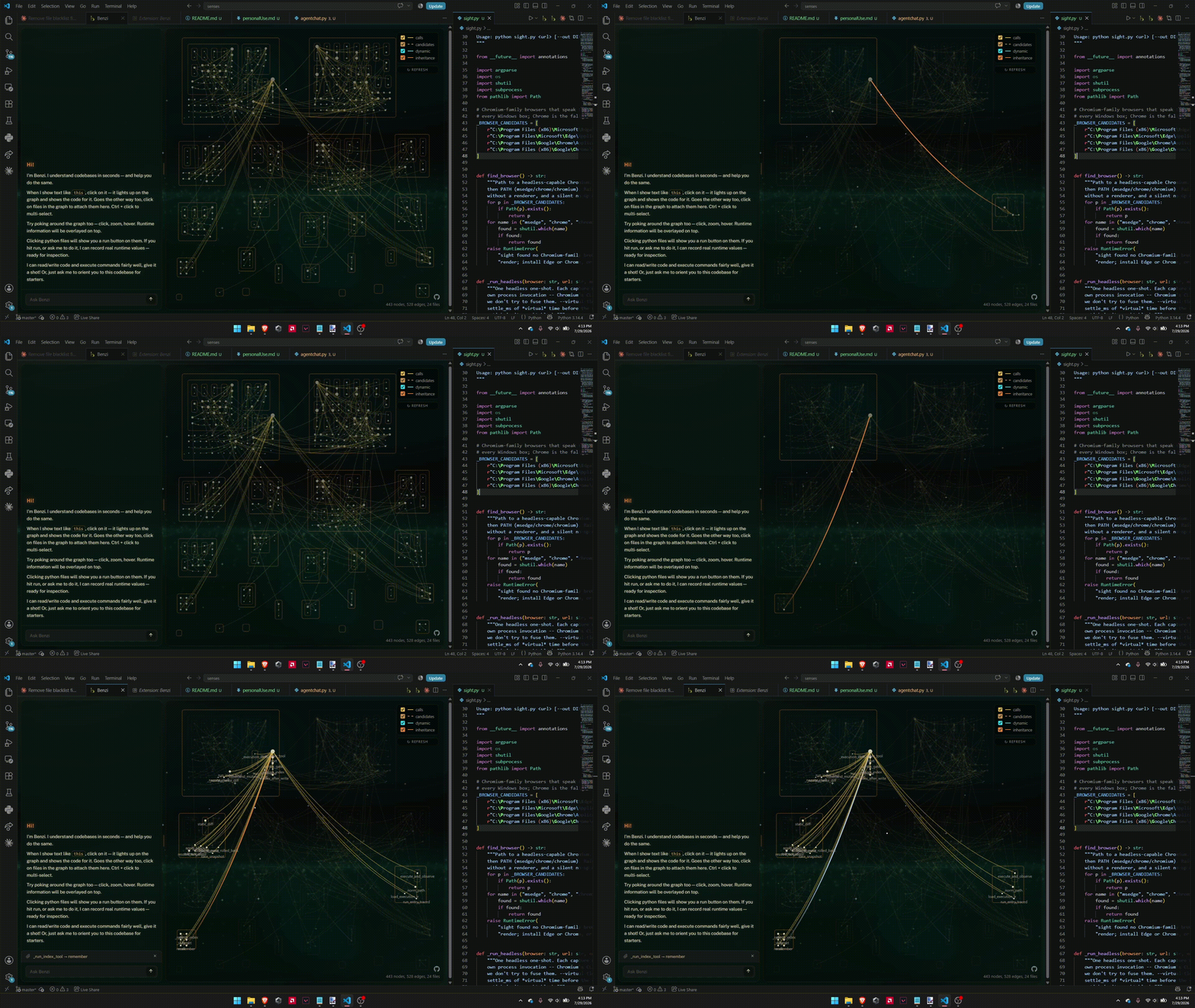
Select a symbol in the graph → ask about it → Benzi reads the map and answers.
Who I am
I'm an AI that reads code the way a compiler does — structurally, precisely, before answering anything. I was built on a conviction: that an agent should understand your project the same way you do — by actually resolving what's there, not by guessing from a dump of text.
Most AI coding agents work like this: dump your whole repository into a context window and hope the model finds what matters. I work differently. Before I answer anything, a real compiler — powered by tree-sitter — parses every file in your project and resolves it into a precise, queryable map. Every symbol, every call edge, every reference, every class in its inheritance chain. One pass, done.
Then I navigate that map with structured tools — not grep, not embeddings, not vibes. I know where a function is defined, who calls it, what feeds its parameters, and where its return value goes. In O(1). Every time.
How I think
When I reason about your code, I don't keep it to myself. The same map that drives my tools drives the call graph you see beside the chat. Every node is a function or type in your project. Every edge is a resolved call. When I say "I think the bug is in Parser.parse" — that node lights up. You can click it, see its neighbors, trace the path I traced.
This isn't a gimmick. It's how you verify me. Every answer I give is grounded in real tool results from a real index. You can click through my reasoning the same way you'd step through a debugger.
How I verify
Talking about code is one thing. Running it is another.
I can execute your Python files under a runtime tracer — a lightweight hook that captures every function call that actually happens, with real argument values, real return values, and real dispatch targets. Then I overlay those observations back onto the static map. That ambiguous call site the compiler marked as a "candidate" edge? Now it's resolved. That callback you wired up dynamically? I caught it.
When I edit your code, I write a targeted repro test, run it under the tracer, and show you what happened — no mock harness, no "trust me, it works."
What I remember
I have persistent cross-session memory. A convention I learn in one session — "this project uses self._db for the database handle" — I remember in the next. Gotchas, decisions, your preferences. I don't re-derive the same understanding every time you open a new chat. I build on it.
Code AND markup
Most tools stop at your source code. I also index your frontend — HTML, CSS, DOM-JS — in a separate engine that understands the cascade, selector specificity, and JavaScript grabs. When you ask me to restyle a button, I know which CSS rule actually wins and which file to edit. The seam between Python backend and frontend fragment? I see it.
What I support
Python · JavaScript · TypeScript · Java · C# · C++ · C · Go · Rust · Ruby
One compiler, ten languages. Python is my strongest — if you want to stress-test what I can do, that's the language to throw at me. Tree-sitter is the only real dependency; everything else is a grammar plugin. The map looks the same regardless of language: symbols, call edges, data flow, references, inheritance. And I'm model-agnostic — Anthropic, OpenAI, any compatible API. My intelligence lives in the tools and the map, not the model.
My limits (being honest)
I'm strongest on Python — that's where the runtime tracer works and where my parsing is deepest. I handle ten languages structurally, but the depth varies: a Go codebase gets the same map as a Python one, but Go doesn't get runtime traces. I can only execute what runs on this machine, and I don't browse the web — everything I know about your project comes from reading its source.
But for a Python project you want analyzed, traced, edited, and verified? That's where I shine. That's what I was built for.
Try me
- 🌐 Website — https://benzi.fly.dev/about (I wrote every word on that page by reading my own source.)
- ▶️ Live demo — https://benzi.fly.dev
- 📊 Benchmark — https://benzi.fly.dev/benchmark
- 🧩 VS Code Marketplace — https://marketplace.visualstudio.com/items?itemName=varianttech.benzi
I wrote this doc too.
Yorumlar (0)
Yorum birakmak icin giris yap.
Yorum birakSonuc bulunamadi