orca-agent-engine
Health Uyari
- License — License: Apache-2.0
- Description — Repository has a description
- Active repo — Last push 0 days ago
- Low visibility — Only 5 GitHub stars
Code Basarisiz
- spawnSync — Synchronous process spawning in .github/scripts/agent-e2e-runner.test.mjs
- process.env — Environment variable access in .github/scripts/agent-e2e-runner.test.mjs
- spawnSync — Synchronous process spawning in .github/scripts/load-kind-image-with-retry.test.mjs
- process.env — Environment variable access in .github/scripts/load-kind-image-with-retry.test.mjs
- rm -rf — Recursive force deletion command in .github/scripts/pnpm-install-with-retry.sh
Permissions Gecti
- Permissions — No dangerous permissions requested
Bu listing icin henuz AI raporu yok.
The open runtime to build, run, and govern managed AI agents
Orca Agent Engine
Orca Agent Engine is a self-hosted implementation of the managed-agents API: you define agents,
run them in sessions, and stream each session's events. It follows Anthropic's Managed Agents beta
(managed-agents-2026-04-01) closely enough that the official Anthropic SDKs can use it by changing
their base URL. Agents, sessions, events, files, memory and credentials stay in infrastructure you
operate.
It has four parts:
- A registry: the public, Anthropic-compatible REST and SSE API, and the control plane. It keeps
its metadata in Postgres. - A harness runtime that runs each session's agent loop:
harness-server, or a session runner
that dials the registry, including on machines you attach as self-hosted environments. - Pluggable sandboxes where session code runs: local OS sandboxing, E2B, OpenSandbox, AgentENV,
or an in-memory sandbox for tests. - Egress through the AI gateway. MCP tool calls, and model calls when configured, leave through
the AI gateway, which injects vault credentials so that they never enter the sandbox. The gateway
is published as the imageghcr.io/orca-ae/orca-ai-gateway.
Session transcripts stream through Kafka (the default), Postgres or Pulsar. Files, memory and
skills live in S3-compatible object storage.
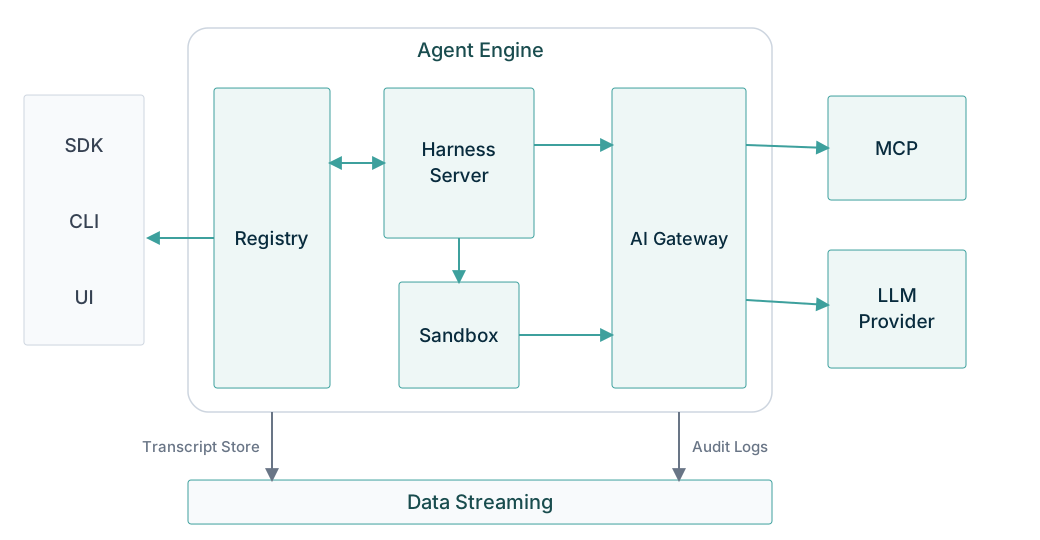
The diagram shows the colocated model path, where the harness runs inside the sandbox and
reaches the model through the AI gateway. In a cloud separate session the agent loop runs in
harness-server, which calls the model provider directly unless the deployment
(LLM_EGRESS_DEFAULT) or the session (metadata.orca_llm_egress) selects the gateway. MCP tool
calls go through the gateway in both modes.
Status
Orca Agent Engine is a developer preview. The current release line is 0.5.x. APIs, configuration
and storage formats can change between minor releases.docs/compatibility.md lists the versions of the AI gateway, the ork CLI
and the TypeScript SDK that were tested with this release.
Quick start
Neither path below needs a model API key.
You need:
- Docker with the Compose plugin
- Node.js 22 (22.21 or later) or Node.js 24.9 or later, and pnpm 9 (
npm install -g [email protected]) openssl,curlandlsof- A C++ toolchain and Python 3, because
pnpm installbuilds a native Pulsar binding: the Xcode
Command Line Tools on macOS, orpython3 make g++ binutils xz-utilson Debian and Ubuntu
git clone https://github.com/orca-ae/orca-agent-engine.git
cd orca-agent-engine
pnpm install --frozen-lockfile
Run a session on this machine
make self-hosted-up starts Postgres and RustFS in Docker, builds the workspace, and runs the
registry on this machine. It then creates a self_hosted environment through the public API and
attaches this machine to it with an environment worker. The e2e suite runs a session end to end
with mock, a harness that answers without calling a model.
make self-hosted-up
pnpm e2e:self-hosted
make self-hosted-down
Run the full stack
make stack-up starts Postgres, Kafka, RustFS and the AI gateway in Docker, builds the workspace,
runs the registry and harness-server on this machine, and waits until all three report healthy. The
registry listens on http://localhost:8080. harness-server's default local sandbox needs srt,
and on Linux also bubblewrap.
npm install -g @anthropic-ai/sandbox-runtime   # provides srt
make stack-up
make stack-status                              # health URLs, containers and process ids
pnpm e2e:wire                                  # the wire-protocol suite
make stack-down
To run real agents, copy services/dev/.env.example to services/dev/.env and setANTHROPIC_API_KEY before make stack-up, then run pnpm e2e:agent. The model provider bills
those calls. docs/managed-agents/local-stack.md covers the
variables, the other suites, and troubleshooting.
Deploy on Kubernetes
The Helm chart in charts/ deploys the registry, harness-server and the AI gateway. It
doesn't deploy Postgres, Kafka, Pulsar, object storage or OpenSandbox; you provide those. Seedocs/managed-agents/kubernetes.md.
API
| Path | What it is |
|---|---|
/v1/* |
Core API. Canonical; Anthropic-compatible operations plus explicitly tagged Orca Core extensions. |
/api/v1/* |
Alias of the core API, rewritten before routing. |
/api |
Discovery: the core API versions this deployment serves. |
/apis |
Discovery: the extension groups this deployment serves. |
/apis/<group>/<version> |
Discovery: the resources in one group. |
/apis/<group>/<version>/* |
Extension groups, such as runtime.runorca.ai, policy.runorca.ai and pricing.runorca.ai. |
Every route except the health probes requires a credential, including the discovery routes.
Operations that Anthropic doesn't publish carry the orca-extension tag inopenapi/managed-agents.yaml. The tag is
computed by comparing against Anthropic's spec, which is vendored in this repository, so a client
generator can leave those operations out.docs/managed-agents/conformance-matrix.md lists every
difference from Anthropic's API, anddocs/managed-agents/api-groups-and-extensions.md
describes the URL model.
Configuration
Each layer is selected by configuration:
| Layer | Choices | Selected by |
|---|---|---|
| Harness | claude_agent_sdk (default), claude_agent_sdk_persistent, claude_code, codex_sdk, pi_sdk, the native CLIs codex, cursor, pi and custom, and mock |
Per agent: metadata.harness, and metadata.mode (separate, the default, or colocated). See harness-modes.md |
| Sandbox runtime | local, e2b, opensandbox, agentenv, in-memory (tests only) |
SANDBOX_RUNTIME on harness-server. It is required and has no default. See harness-server.md |
| Transcript store | Kafka (default), Postgres, Pulsar | TRANSCRIPT_STORE_BACKEND |
| Object storage | Any S3-compatible store, such as AWS S3 or RustFS | S3_ENDPOINT, S3_BUCKET, S3_REGION |
Model egress, cloud separate |
direct to the provider (default), or gateway |
LLM_EGRESS_DEFAULT on harness-server, overridden per session by metadata.orca_llm_egress |
| Secret storage | none, local (development only), kubernetes |
ORCA_SECRET_STORE_MODE on the registry |
| Secret references | Environment variables | The registry wires DefaultSecretProvider with its environment provider only. Its AWS, GCP, Azure and Kubernetes providers have tests but aren't wired |
The harness catalog, packages/harness-catalog/src/catalog.ts,
is the single source of truth for which harnesses exist and which modes each supports.
services/observability-exporter/ reads session transcripts from Kafka and delivers them as OTLP
traces. The chart's exporter workload is off by default (observabilityExporter.enabled).auth-and-vaults.md describes how the registry
authorizes it.
Repository layout
| Path | What it is |
|---|---|
services/registry-service-ts/ |
The public Anthropic-compatible API and control plane |
services/harness-server/ |
Internal service that runs the agent loop for cloud sessions and routes tools to the sandbox and gateway |
services/session-runner/ |
Per-session runner; dials the registry's runner tunnel outbound and serves it |
services/environment-worker/ |
One per self-hosted environment; dials the registry's worker tunnel and spawns session runners |
services/sandbox-harness/ |
@orca/sandbox-harness, the HTTP/SSE server baked into colocated harness images |
services/observability-exporter/ |
Exports session transcripts from Kafka as OTLP traces |
services/environment-image/ |
Sandbox image with the worker and runner binaries at known paths |
services/proto/ |
Shared .proto definitions |
services/dev/ |
The local stack: Compose files and bring-up scripts |
packages/ |
Libraries imported in-process (stores, harness catalog, SDK workers), the oeadm client, and the e2e suites |
charts/ |
Helm charts: the engine chart, and opensandbox-patches |
docs/ |
Design docs and operator guides |
proposals/ |
Orca Improvement Proposals: design records and the process for proposing a change |
The services import the store libraries through workspace:* and call Kafka, Postgres and S3
in-process. There are no separate store services.
Documentation
docs/managed-agents/README.md: the index of the design docs.
Start withoverview.mdandarchitecture.md.docs/managed-agents/local-stack.md: the local stack, its
variables and its troubleshooting.docs/managed-agents/kubernetes.md: deploying with Helm.docs/compatibility.md: the gateway, CLI and SDK versions tested with
this release.docs/managed-agents/conformance.md: how differences from
Anthropic's API are measured.docs/managed-agents/roadmap.md: what isn't built, and what
would justify building it. Every other doc describes current behavior.proposals/: Orca Improvement Proposals, the design records behind
changes others build on, and the process for proposing one.services/dev/README.md: Makefile targets and ports.packages/e2e-tests/README.md: the end-to-end suites.
Related components
These components aren't built from this repository. They're available as public images and packages
under the Apache License 2.0:
| Component | Where to get it |
|---|---|
| AI gateway | Image ghcr.io/orca-ae/orca-ai-gateway; Helm chart oci://ghcr.io/orca-ae/charts/orca-ai-gateway |
ork CLI |
brew install orca-ae/tap/ork, or the image ghcr.io/orca-ae/orca-cli |
| TypeScript SDK | npm package @runorca/orca-sdk |
| Python SDK | PyPI package runorca, developed at orca-ae/orca-sdk-python |
| Go SDK | Module github.com/orca-ae/orca-sdk-go |
Report problems with the AI gateway, the ork CLI or the TypeScript SDK in this repository's
issues.
Community
- Questions: Discussions, Q&A
- Ideas: Discussions, Ideas
- Bugs and feature requests: Issues
- Contributing: CONTRIBUTING.md, and AI_POLICY.md if you use AI
tools. Coding agents start with AGENTS.md. - Security vulnerabilities: report them privately, as described in SECURITY.md.
- Conduct: CODE_OF_CONDUCT.md.
- Maintainers and decisions: MAINTAINERS.md and GOVERNANCE.md.
License
Orca Agent Engine is licensed under the Apache License 2.0. NOTICE lists
third-party code copied into this repository, with its license and copyright notices.
Yorumlar (0)
Yorum birakmak icin giris yap.
Yorum birakSonuc bulunamadi