gh-review-loop
Health Uyari
- License — License: MIT
- Description — Repository has a description
- Active repo — Last push 0 days ago
- Low visibility — Only 5 GitHub stars
Code Basarisiz
- eval() — Dynamic code execution via eval() in .github/workflows/eval-weekly.yml
Permissions Gecti
- Permissions — No dangerous permissions requested
Bu listing icin henuz AI raporu yok.
Clears AI reviewer findings on your PR, including the ones the bot did not flag. Verifies against your tests, capped at 3 rounds. Claude Code and Codex, MIT.
gh-review-loop
Your AI reviewer flagged two instances of a bug. There are five. This fixes all five, runs your tests, and stops after three rounds.


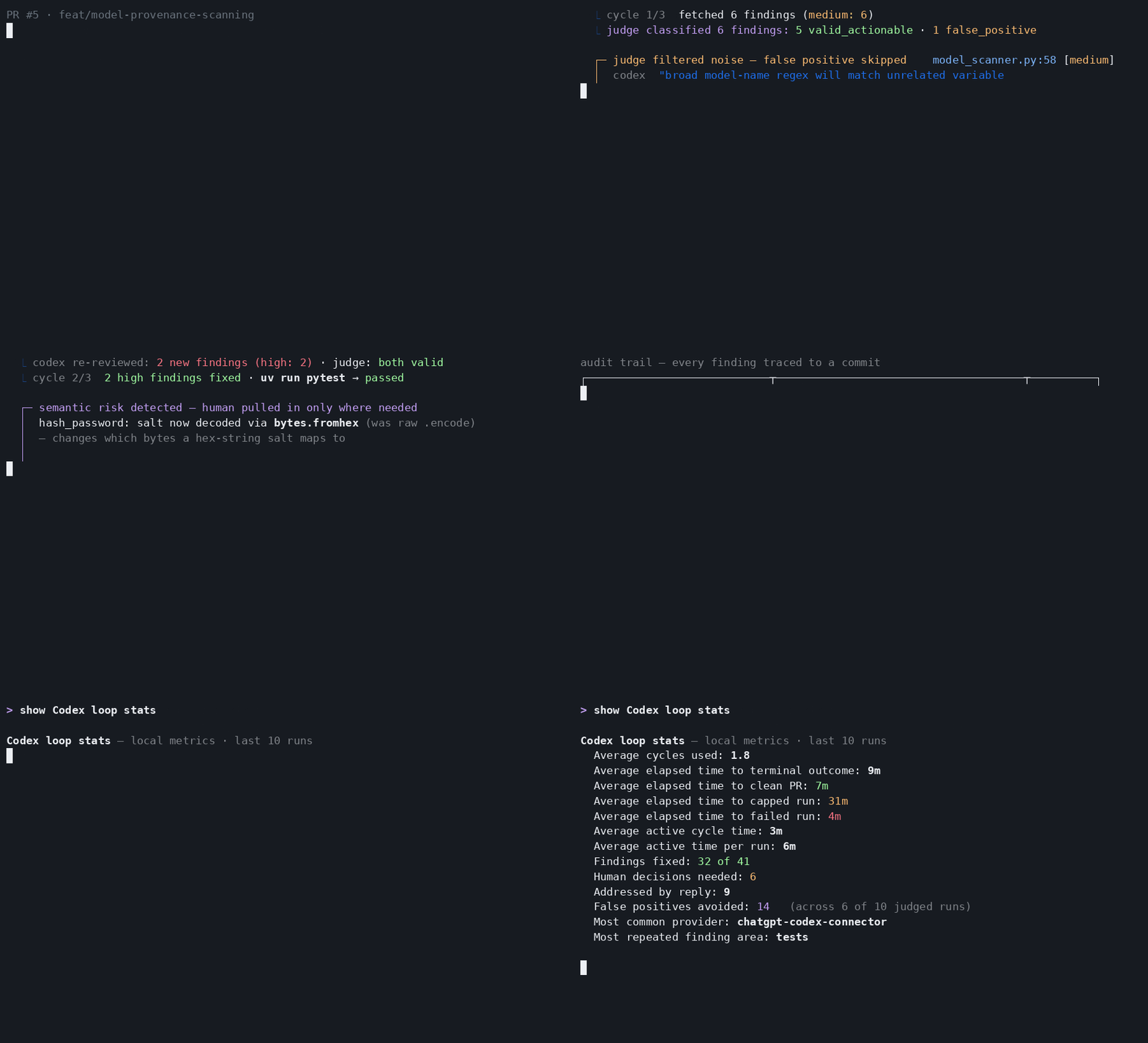
A skill for Claude Code and Codex that clears AI reviewer feedback on your PR without you leaving the terminal. It reads real GitHub review-thread state, fixes what's actionable, sweeps the sibling instances the reviewer didn't flag, gates every push on your repo's own tests, and asks for re-review, hard-capped so it can't spam the PR.
Works with whatever AI reviewer assistance your repo already has. MIT, no server, no account, no vendor plan.
Install
Claude Code — two slash commands:
/plugin marketplace add OrenAshkenazy/gh-review-loop
/plugin install gh-review-loop@gh-review-loop
Codex:
codex plugin marketplace add OrenAshkenazy/gh-review-loop
codex plugin add gh-review-loop@gh-review-loop
Then, from a repo with an open PR that a reviewer bot has commented on (the loop asks which bot the first time, and remembers):
Run the AI reviewer loop
That's the whole interface. Other install paths · Prerequisites
Why this exists
Bot reviewers expand. You fix the two instances of a pattern it flagged, push, and the next review flags three more in files it hadn't reached yet. Round three finds two more. Each round costs you a context switch, and the bot never tells you it's converging.
Three things in this loop attack that directly:
It sweeps the class, not the instance. Findings are clustered by a deterministic pattern signature. When one pattern is flagged at 2+ sites, sweep_siblings.py reduces those lines to tokens, intersects them, and reports every other line in the PR's changed files containing all of the shared tokens — the siblings the reviewer hasn't reached yet. A single multi-line finding can also fingerprint its normalized block and report exact copies as mirror candidates.
Intersecting across sites is the token sweep's safety property: a candidate has to match what the flagged sites have in common, not what any one of them happens to contain. Single-site mirror sweeps require a multi-line range and meaningful identifier-like tokens. The tool reports before anything is edited, refuses a single-line site or a too-generic shape, and never reads a file outside your diff. Swept patterns are tracked across cycles, so if one comes back you see ⚠ RECURRED after sweep instead of silently re-fixing it.
Mirror matching optimizes for precision over recall. By default, in every language, two blocks match only when their text is identical — no comment stripping, no whitespace collapsing, no per-language guessing. Comment-insensitive matching is enabled only for languages with a real tokenizer behind it, which today means Python alone, via the stdlib tokenize module (indentation is preserved, because it is semantic) — and only within a single file. Once comments are dropped, identical text can still mean different things in two different files: a .pyi stub versus a runtime module, one shebang or source encoding or from __future__ flag versus another. That list is the semantics of the whole toolchain and does not converge, so rather than enumerate it in the match key, normalized matching stays inside one file, where every such property is equal by construction. Those same files are still matched across files by raw matching, which claims only that the bytes repeat — a claim no shebang or encoding can falsify. So two .py files sharing a byte-identical block are still reported (as exact); two differing only in a comment are not. Python's raw index still carries the tokenizer's string tags, so it never matches a docstring's body against the code that docstring quotes. Blocks are never compared across language families, so identical text in build.sh and Makefile isn't called a duplicate. The trade is explicit: a duplicate in an unsupported language that differs only by a comment goes unreported. This is an advisory report — one that fires falsely stops being read, while a missed duplicate costs one informational finding.
It won't push red. Configure a verification profile once — a one-key menu pick on first run, auto-detected from your pyproject.toml / package.json / Cargo.toml / go.mod — and every cycle runs your own tests and linters before the commit goes up. A failed required check flips the run to verification: failed. Compare: CodeRabbit's autofix runs a build-verification step and ships the changes anyway when it fails.
It has a brake, not a timeout. The cycle cap is a hard count of re-review requests, default 3, and it counts only the agent's own pings — a human asking the bot to look again doesn't burn a cycle. That's a bound on rounds, not a "stop when the bot goes quiet for ten minutes" heuristic.
Everything else it does — reading isResolved/isOutdated off the reviewThreads GraphQL, honoring a maintainer's "wontfix" reply, sorting by severity, keeping one live-edited status comment instead of comment spam — is table stakes done carefully. Correct, but not why you'd pick this.
What's actually implemented
Checkable claims, with the honest scope of each:
| Capability | Scope | Where |
|---|---|---|
| Thread-state filtering | reviewThreads GraphQL, isResolved / isOutdated, plus ADDRESSED_BY_REPLY for maintainer "wontfix" replies |
fetch_gemini_threads.py |
| Pattern clustering + sibling sweep | Findings cluster by signature and by the shape of the code they anchor to, so one defect described two ways still counts as one pattern. Two-site token sweeps report lines matching the shared tokens; one-site ranged sweeps report duplicate blocks as mirror candidates — text-identical by default in every language, comment-insensitive only for Python via stdlib tokenize, never across language families. Refuses generic shapes and never reads outside the changed files |
cluster_findings.py, sweep_siblings.py |
| Verification gate | Auto-detects Python / Node / Rust / Go. Required-check failure flips the run to verification: failed. Skip is an offered menu option — pick it and there is no gate |
detect_profile.py, run_profile.py |
| Cycle cap | Hard count, agent-scoped: only the agent's own pings consume it. Enforced at the write — request_rereview.py counts prior pings and refuses past the cap, rather than trusting the agent to stop |
request_rereview.py |
| Severity ordering | Parsed for Codex ![P0]–![P3] badges and ![critical]–![low] image alt text only. A bot using neither convention yields unknown, which is kept by default |
thread_severity() |
| Optional judge | Second-model triage per finding (false_positive, needs_human, …). Off by default, needs an OpenAI key |
judge.py |
| Audit trail + local stats | One live-edited PR comment, per-run receipts, per-repo aggregates via --stats. Never transmitted |
metrics.py |
| Zero infrastructure | Stdlib Python + gh + git. No SDK, no server, no account |
all scripts |
Reproduce the sweep. python3 evals/replay/replay.py runs two captured Sourcery reviews of PR #67 through the clustering and sweep code — no network, no arguments, stdlib only. The fixtures are that reviewer's real payloads, copied verbatim from the GitHub API rather than written for the demo. Run 1 merges two differently-worded findings into one pattern and reports 3 unflagged siblings; run 2 yields one site and correctly no sweep, because the same reviewer returned different findings on identical file contents.
If you're comparing alternatives, the closest is pbakaus/agent-reviews — broader bot coverage and a nicer CLI, no test gate, no hard round cap, no sibling sweep.
Prerequisites
- Claude Code or Codex with plugin support.
ghCLI, authenticated against the repos you'll run this on.- Python 3.10+ and git.
- A reviewer bot that posts GitHub review threads on your PRs. Codex and Gemini Code Assist ship with full vendor knowledge. CodeRabbit, Copilot, Qodo, Sourcery and others work once you give the loop their author login and re-review mention. There is no assumed default: on a PR with no reviewer configured the loop asks instead of guessing.
Note on Gemini Code Assist. Gemini is a first-class reviewer here and works exactly as it always did, automatic first review included, on the enterprise GitHub app. Google deprecated the consumer app 2026-06-18 and shut it down 2026-07-17, so it can no longer be installed on the free tier. Nothing about its support here changed. Select it with
--reviewer gemini-code-assist.
Supported reviewers
| Reviewer | Support | Re-review trigger | Severity format |
|---|---|---|---|
Codex (chatgpt-codex-connector) |
Built-in, full support. Offered first on an unconfigured PR because it reviews on request, so accepting starts a cycle immediately | @codex review |
P0–P3, normalized |
| Gemini Code Assist | Built-in, full support. Needs the enterprise GitHub app (consumer app shut down) | @gemini-code-assist please review… |
critical / high / medium / low |
| CodeRabbit, Copilot, Qodo, Sourcery, … | Configurable | Supplied via --review-trigger-mention |
Not parsed — findings carry unknown severity |
--list-reviewers discovers which bots have commented on your PR; --reviewer persists your choice per PR.
Severity caveat, stated plainly: only two marker conventions are parsed today — Codex's ![P0]–![P3] and the ![critical]–![low] alt-text form Gemini uses. For any other bot every finding is unknown, so --min-severity high keeps everything and --drop-unknown-severity drops everything. Use severity filtering only with a bot whose format is parsed.
Other install paths
Agent Skills (npx skills)
npx skills add OrenAshkenazy/gh-review-loop -a claude-code codex
The -a flag selects target agents; omit it for the interactive picker. Requires a recent skills CLI. If codex doesn't appear in the picker, update the installer or use the Codex plugin flow above.
Upgrading
/plugin update gh-review-loop
Upgrading from
gh-gemini-review-loop? Uninstall the old plugin (/plugin uninstall gh-gemini-review-loop), re-add the marketplace, installgh-review-loop@gh-review-loop. Settings, verification profiles, and run history are untouched — they live in~/.config/gh-gemini-review-loop/, which the renamed plugin still reads.
Use it
From a repo with an open GitHub PR:
Run the AI reviewer loop
The agent will:
- Wait for the configured reviewer to finish, or ping it first if it only reviews on request.
- Fetch unresolved, actionable review threads.
- Skip stale, resolved, duplicate, or already-addressed threads.
- Cluster findings by pattern and sweep siblings in your changed files.
- Fix, in severity order.
- Run your verification profile. Stop here if it fails.
- Commit and push to the PR branch.
- Request re-review.
- Stop when the PR is clean, a human decision is needed, or the cap is used.
More specific phrasings:
| Say this | What happens |
|---|---|
| "Run the AI reviewer loop" | Full loop with defaults |
| "Only fix high-severity reviewer findings" | Skips lower severities (see the severity caveat above) |
| "Just audit reviewer comments, don't touch anything" | Read-only pass |
| "Show review loop stats for this repo" | Local aggregates |
See SKILL.md for the full workflow definition, stop conditions, and every phrasing.
Verification profiles
On the first cycle with actionable findings, the agent scans for build signals (pyproject.toml, package.json, Cargo.toml, go.mod) and offers a short preset menu: All detected · Tests only · Skip · Customize. Your pick persists under profiles["owner/repo"] in ~/.config/gh-gemini-review-loop/preferences.json; later runs are prompt-free.
Every saved check is a required gate — a failure flips the verify step to --verification failed. Skip is remembered and leaves the loop on ad-hoc verification with no gate; saying "set up a verification profile for this repo" re-runs detection and overrides it.
{
  "profiles": {
    "owner/repo": {
      "detected_stack": "python",
      "source": "confirmed",
      "working_directory": ".",
      "timeout_seconds": 300,
      "checks": [
        {"name": "tests", "command": "pytest", "required": true},
        {"name": "lint", "command": "ruff check .", "required": true}
      ]
    }
  }
}
Run metrics and local stats
Ask "Show review loop stats for this repo" (or run --stats). Metrics are local-only (~/.config/gh-gemini-review-loop/runs.jsonl), contain repo and PR number but no identity, and are never transmitted.
Per-run receipt:
[loop] Summary
Findings fetched: 7
Fixed: 4
Remaining actionable: 0
Needs human: 1
Cycles used: 2/3
Verification: passed
Outcome: clean
Time to clean PR: 12m
Aggregated stats (illustrative shape — the numbers below are an example, not measured telemetry):
Review loop stats — owner/repo
Last 10 runs

Average cycles used: 1.8
Average elapsed time to terminal outcome: 9m
Average active time per run: 6m
Findings fixed: 32 of 41
Human decisions needed: 6
Addressed by reply: 9
False positives avoided: 14   (across 6 of 10 judged runs)
Most repeated finding area: tests
Elapsed is wall-clock including bot waits; active is loop processing time only.
Optional: per-finding judge
A second model can label each finding (valid_actionable, false_positive, needs_human, explanation_only, duplicate, already_addressed) before you spend a cycle on it. Off by default; needs an OpenAI-compatible key. Calls go out over stdlib urllib — no SDK dependency.
python3 "$GGRL_PLUGIN_ROOT/skills/gh-review-loop/scripts/judge_doctor.py" --probe
See SKILL.md → Optional Judge Eval for the verdict schema.
Configuring the skill
Persistent settings live in ~/.config/gh-gemini-review-loop/preferences.json.
Set the loop cap
Default is 3 re-review requests per PR:
python3 - <<'PY'
import json
from pathlib import Path

path = Path.home() / ".config" / "gh-gemini-review-loop" / "preferences.json"
path.parent.mkdir(parents=True, exist_ok=True)
prefs = json.loads(path.read_text()) if path.exists() else {}
prefs["schema_version"] = 2
prefs["max_rereview_requests"] = 4
path.write_text(json.dumps(prefs, indent=2, sort_keys=True) + "\n")
PY
Resulting file:
{
  "max_rereview_requests": 4,
  "schema_version": 2
}
Judge settings live in the same file; the script preserves max_rereview_requests when saving them.
How it works
The skill drives a set of small stdlib Python scripts under plugins/gh-review-loop/skills/gh-review-loop/scripts/. Each is independently runnable and --json-clean on stdout with progress on stderr, so you can drive the loop by hand or from CI.
Every write the scripts make to your PR supports --dry-run, including the re-review request. The git push itself is an ordinary git command run by the agent, not a script write.
Feedback wanted
- Which reviewer bot are you on, and does the sibling sweep find real siblings or noise in your codebase?
- Is a cap of 3 the right default, or does your team converge in 2?
- Where does the verification gate get in your way?
Open an issue or a discussion.
Contributing
See CONTRIBUTING.md.
License
MIT — see LICENSE.
Yorumlar (0)
Yorum birakmak icin giris yap.
Yorum birakSonuc bulunamadi