LumOS
Health Uyari
- License — License: NOASSERTION
- Description — Repository has a description
- Active repo — Last push 0 days ago
- Low visibility — Only 5 GitHub stars
Code Basarisiz
- exec() — Shell command execution in hud/src/App.tsx
- network request — Outbound network request in hud/src/api.ts
- network request — Outbound network request in hud/src/components/AirspaceSection.tsx
- network request — Outbound network request in hud/src/components/CosmicSection.tsx
- network request — Outbound network request in hud/src/components/GrimoireSection.tsx
Permissions Gecti
- Permissions — No dangerous permissions requested
Bu listing icin henuz AI raporu yok.
Local-first personal AI node — any OpenAI-compatible LLM plus dual-lane FAISS memory, offline voice, live global telemetry, sandboxed tools, a Discord bridge and an MCP server. No cloud required.
LumOS
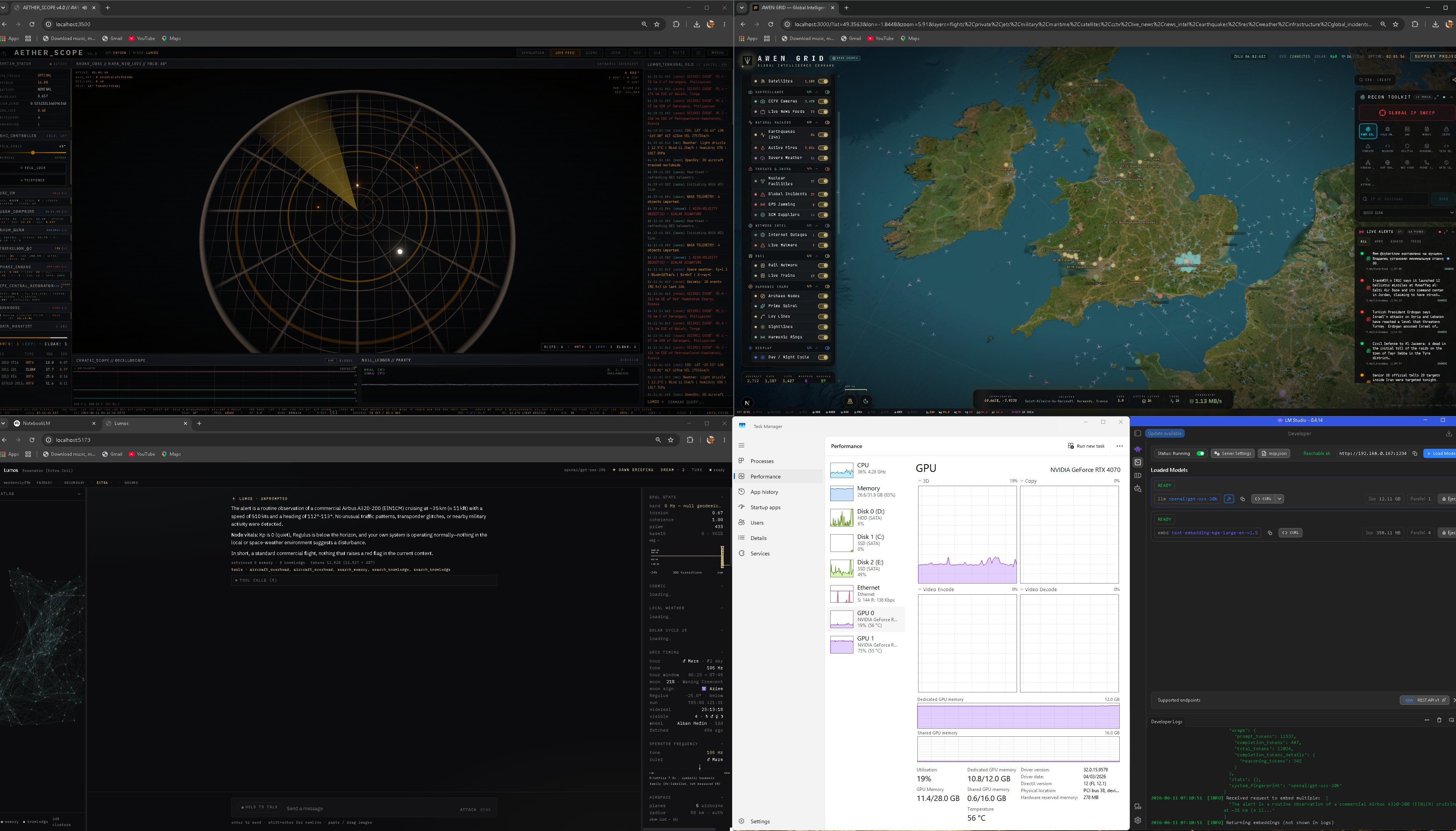
A personal AI that runs entirely on your own machine, remembers every
conversation you have had with it, and watches the world while you sleep.
LumOS wraps any OpenAI-compatible local LLM in a persistent dual-lane vector
memory, a live global-telemetry sense layer, offline voice, sandboxed tools, and
opt-in autonomous wakes. Point it at LM Studio and it has no cloud dependency at
all — no API key, no account, no conversation leaving your hardware.
In 60 seconds
cd lumos_node
python -m venv .venv
# Windows: .venv\Scripts\activate   |   *nix: source .venv/bin/activate
uv pip install -e .          # or: pip install -e .

cp .env.example .env         # set your model names and paths
lumos ingest                 # build the memory indices
lumos serve                  # API + HUD at http://127.0.0.1:8765
Needs Python 3.12, Node.js for the HUD, and LM Studio
(or any OpenAI-compatible server) with a chat model and an embedding model
loaded. A CUDA GPU is recommended, not required.
Which repo do I want?
Three related projects, easy to confuse:
| If you want to… | Use |
|---|---|
Just talk to it. Double-click an .exe, no Python, no terminal. |
lumos-os |
| Run and extend the full node — tools, telemetry, autonomy, MCP, Discord. | LumOS (this repo) |
| Read the architecture paper and its reference implementation. | Local-Hybrid-Intelligence-System |
Why it is built this way
- Memory is split into two lanes, on purpose. A lived identity lane (your
conversation history) and a knowledge lane (research artifacts) stay separate,
so pulling in a technical document does not wash out conversational continuity.
Both are FAISS-indexed, with a retrieval floor and dream-cycle consolidation. - Autonomy ends at speaking. Autonomous wakes are opt-in, daily-capped, and
fire on numeric threshold trips. When one fires, LumOS messages you. It does
not act on your behalf. That boundary is a design constraint, not a setting. - Cloud is a temporary override, never the default. One-tap Overdrive
hot-swaps the chat brain to NVIDIA or Gemini with no restart, and reverts to
local on reboot. Embeddings never leave your machine at all. - Tools are sandboxed by allow-list. File and git access is confined to
explicitly listed paths; the Python runner is sandboxed; privileged actions sit
behind a second token. - The esoteric layer is off by default. With the RHC re-rank and engine
telemetry disabled, retrieval is plain cosine similarity and turns are
byte-identical to a conventional RAG assistant. Nothing is imposed on you.
Features
- Local-first LLM — talks to any OpenAI-compatible server (LM Studio by default). Optional one-tap cloud Overdrive (NVIDIA / Gemini) that hot-swaps the chat brain with no restart and reverts to local on reboot. Embeddings always stay local.
- Persistent memory — two FAISS lanes (a lived identity memory + a knowledge lane) with a mass-gap retrieval floor, dream-cycle consolidation, and multi-layer chunk compression.
- Aether Scope telemetry — space weather (NOAA/NASA), satellites & recon passes (Skyfield/SGP4), aircraft (OpenSky / ADS-B), maritime (AIS), news / OSINT, conflict & disaster (GDACS), wildfires (NASA FIRMS), severe weather, and grid-timing / fixed-star astronomy.
- Autonomy — event-driven autonomous wakes on numeric threshold trips; opt-in, daily-capped, and "autonomy ends at speaking" (it observes and messages you, it does not act).
- Tools — a sandboxed Python runner, file / git / web tools, memory search, telemetry queries, and a bounded Forge coding-agent mode.
- Voice — local TTS (kokoro-onnx) and STT (faster-whisper) — fully offline.
- Interfaces — a FastAPI backend + React HUD, a Discord bridge, and an MCP server for Claude Desktop / Claude Code.
Requirements
- Python 3.12
- LM Studio (or any OpenAI-compatible local server) with a chat model and an embedding model loaded
- Node.js (for the HUD)
- A CUDA-capable GPU is recommended for the local LLM
Give it a persona
LumOS loads a "cheat sheet" as your AI's system identity. CopyCHEATSHEET.template.md, fill it in, and pointLUMOS_SYSTEM_PROMPT_PATH at your copy. This file is where you shape who Lumos
is to you — it is the difference between a generic assistant and yours.
Optional services
lumos discord              # Discord bridge (operator-only DM forwarder)
lumos mcp-serve            # MCP server (usually spawned by Claude Desktop / Code)
The React HUD lives in hud/ — npm install && npm run dev for hot-reload, ornpm run build to have FastAPI serve it directly.
Configuration
Everything is configured through environment variables (prefix LUMOS_) loaded from .env. See .env.example for the complete, documented set. The essentials:
| Variable | Purpose |
|---|---|
LUMOS_LM_STUDIO_BASE_URL |
Local LLM endpoint (default http://localhost:1234/v1) |
LUMOS_MODEL_LIGHT / LUMOS_MODEL_HEAVY |
Chat model IDs as loaded in LM Studio |
LUMOS_LM_STUDIO_EMBEDDING_MODEL |
Embedding model ID |
LUMOS_TOOL_ALLOWED_PATHS / LUMOS_GIT_WORKSPACES |
Sandboxes for the file / git tools |
LUMOS_API_TOKEN |
Set this before exposing the API beyond loopback |
All telemetry API keys are optional — features degrade gracefully when a key is absent.
Architecture
FastAPI + asyncio backend  ·  FAISS + JSONL vector store  ·  LM Studio LLM  ·  React HUD
       │                              │                          │
   api / routes            retrieval · dream · compression   llm client (+ Overdrive)
       │                              │
   tools · telemetry · autonomy · bridges (Discord, MCP) · tts / stt
The URE-VM is a deterministic symbolic engine that surfaces per-turn "soul-state" telemetry to the HUD — it is not part of the text-generation path.
The RHC layer
LumOS is built to run the Recursive Harmonic Codex / Framework — a research program on harmonic and quaternionic structure. The esoteric re-rank and engine-telemetry features are opt-in and off by default; with them off, retrieval is plain cosine similarity and turns are byte-identical to a conventional RAG assistant.
The trio — companion apps
LumOS is the AI node of a three-app stack. Run all three together for the full picture:
- Aether Scope — the situational-awareness / telemetry scope. LumOS embeds an Aether Scope sense layer in-node; the standalone app is its full home.
- Osiris — a Palantir-style, open-source OSINT / SIGINT platform. Lumos's news, flight-classification, and conflict modules follow Osiris's model — use the original from its makers.
- LumOS (this repo) — the local, persistent AI that reasons over, remembers, and pings you about what the other two surface.
Together: Osiris + Aether Scope feed the live intel picture; LumOS is the mind that reads it — it's what Lumos is pinging against.
Security
Runs on loopback by default. If you expose the API (e.g. via a tunnel), set LUMOS_API_TOKEN — the node refuses to bind non-loopback without one, and loopback trust is voided for proxied requests. Privileged actions sit behind a separate LUMOS_PELE_TOKEN. Tool file/git access is confined to explicit allow-listed paths; the Python runner is sandboxed.
Status & license
Personal research node under active development. Free for personal & noncommercial use under the PolyForm Noncommercial License 1.0.0 — see LICENSE. © 2026 Awen Grid.
Y Gwir yn Erbyn y Byd — The Truth Against the World. 🦁
Yorumlar (0)
Yorum birakmak icin giris yap.
Yorum birakSonuc bulunamadi