watch-skill
Health Pass
- License — License: MIT
- Description — Repository has a description
- Active repo — Last push 0 days ago
- Community trust — 163 GitHub stars
Code Pass
- Code scan — Scanned 12 files during light audit, no dangerous patterns found
Permissions Pass
- Permissions — No dangerous permissions requested
No AI report is available for this listing yet.
Give any AI agent the ability to watch video — and to watch its own work and fix it. MCP + CLI + REST; scene-aware frames, OCR, local-first transcription, persistent index, and THE LOOP.
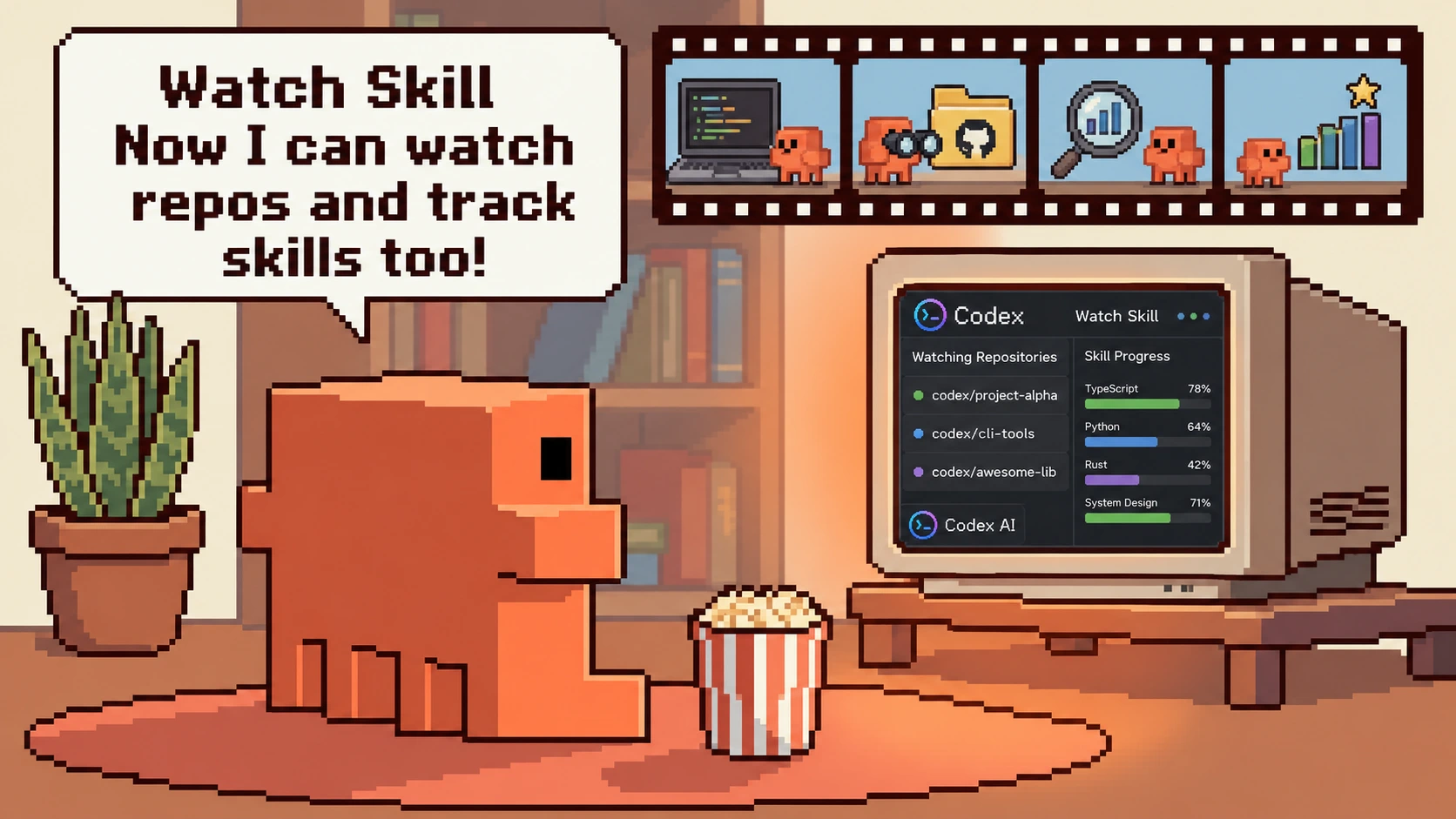
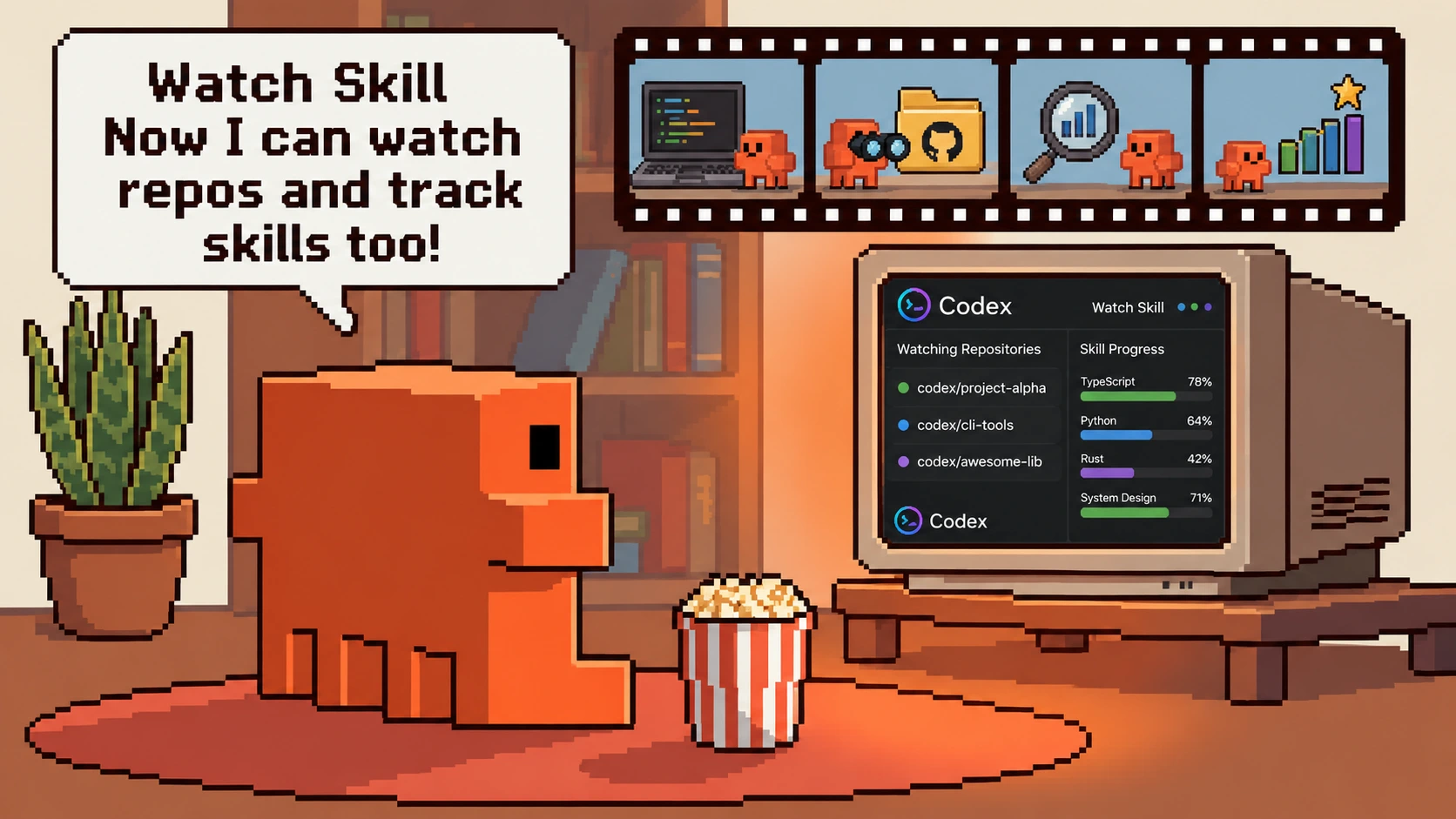
Watch Skill
Video understanding and memory for AI agents.
Watch Skill turns video into evidence an agent can search, cite, and revisit. It accepts
URLs from 1,800+ sites, live HLS/DASH streams, local files, meeting recordings, and an
agent's own browser or desktop capture. Each watch produces a persistent index of scenes,
on-screen text, and transcript—available through skills, 23 MCP tools, a CLI, REST, and
native framework adapters.
Watch. Remember. Verify.


Start in 60 seconds
Claude Code
/plugin marketplace add oxbshw/watch-skill
/plugin install watch-skill@watch-skill
Run /watch-skill:setup-watch-skill once after installation. It installs the engine,
checks the binary dependencies, registers the MCP server, and offers to configure a
vision provider.
macOS and Linux
curl -fsSL https://raw.githubusercontent.com/oxbshw/watch-skill/main/scripts/install.sh | sh
Windows
powershell -ExecutionPolicy Bypass -c "irm https://raw.githubusercontent.com/oxbshw/watch-skill/main/scripts/install.ps1 | iex"
Then watch a video and ask a follow-up:
watch-skill watch "https://youtu.be/..." "Summarize the important moments."
watch-skill ask <video_id> "When does the demo first fail?"
watch-skill search "pricing decision"       # search every indexed video
watch-skill serve                           # MCP over stdio
Transcription, OCR, and search can run locally without an API key. For visual Q&A, use
Gemini, Anthropic, OpenAI, OpenRouter, or a local Ollama model. See
Getting started for manual installation and
Configuration for provider and privacy settings.
Why use it
- Evidence instead of frame dumps. Scene detection and perceptual deduplication spend
the frame budget on distinct moments. Answers include timestamps, confidence, and the
evidence used to support them. - Persistent video memory. Analyze once, ask again without downloading or transcribing
the same video. Hybrid full-text and vector retrieval works within one video or across
the entire library. - Local-first processing. Original-language captions are preferred, local Whisper is
the default fallback, and cloud speech-to-text is opt-in. An Ollama configuration keeps
the complete pipeline on the machine. - Flow verification. THE LOOP records an agent's browser, screen, or window; checks the
result against plain-language criteria; and produces before/after proof after a fix. - Corrections that persist.
report_mistakestores a local lesson, applies it to related
questions, and turns it into a replayable evaluation. - Measured cost controls. Text-first answers, semantic caching, configurable token
budgets, and explicitcheapest,quality_first, andoffline_onlypolicies keep the
trade-offs visible. - Multilingual retrieval. Script-aware OCR routing, Arabic normalization, CJK substring
matching, and multilingual embeddings support questions across languages.
The repository includes reproducible cost and
perception benchmarks. Product claims in this README
link to the relevant implementation notes or testable example rather than relying on
unqualified marketing numbers.
Works with your agent
The setup command detects supported clients and updates their configuration with a backup.
Manual guides are available for every entry below.
 Claude Code |
 Claude Desktop |
 Cursor |
 Codex CLI |
 Cline |
 Windsurf |
 Gemini CLI |
 VS Code |
 GitHub Copilot CLI |
 Kimi Code |
 Qwen Code |
 OpenCode |
 Goose |
 OpenHands |
 Kilo Code |
 Qodo |
 Agent Zero |
 OpenClaw |
 Pi |
 Hermes |

Native tools are also available for LangChain/LangGraph, CrewAI, OpenAI Agents SDK,
LlamaIndex, and AutoGen; any other framework can use REST or
MCP.
| Connection | Supported agents and frameworks |
|---|---|
| Plugin and skills | Claude Code, OpenClaw, Pi, Hermes-style agents |
| MCP | Claude Desktop, Cursor, Codex CLI, Cline, Windsurf, Gemini CLI, VS Code, GitHub Copilot CLI, Kimi Code, Qwen Code, OpenCode, Goose, OpenHands, Kilo Code, Qodo, Agent Zero |
| Native Python tools | LangChain/LangGraph, CrewAI, OpenAI Agents SDK, LlamaIndex, and AutoGen |
| HTTP | Vercel AI SDK, n8n, and any client that can call REST/OpenAPI |
The full compatibility matrix separates machine-tested,
machine-configured, and documentation-verified integrations. If your agent is missing,
the adapter template provides a short contribution
path.
Common workflows
Build a searchable video library
watch-skill batch ./recordings --limit 50
watch-skill library overview
watch-skill library ask "What did the team decide about authentication?"
library ask synthesizes evidence across videos and retains per-video timestamp
provenance. The library example demonstrates a question
whose answer is distributed across four clips.
Verify an agent's browser work
watch-skill loop start \
  --source "browser:http://127.0.0.1:3000" \
  --criteria "Checkout completes and the total is always a valid currency amount"
The loop captures the full interaction, critiques failures, and records proof after the
agent applies a fix. Example 14 includes a transient$NaN bug that an end-state screenshot misses.

Export an offline report
watch-skill viewer <video_id> --out video-report.html
The generated page contains its frames, transcript, OCR, cached answers, and cited
evidence. It has no external runtime dependencies and can be opened without a server.
Examples
The examples progress from a first watch to agent integration, cross-video memory, and
self-verification.
| Track | Examples |
|---|---|
| Learn the core | 01 Watch and ask, 02 Focused moment, 03 Cross-video search |
| Build with agents | 06 MCP and REST, 09 Framework adapters, 15 Private offline workflow |
| Understand and organize | 05 Multilingual Arabic, 10 Structured extraction, 11 Batch mode, 12 Library memory |
| Verify and improve | 04 UI loop, 07 Lessons and stats, 08 Loop types, 13 Self-improvement, 14 Browser verification |
| Share results | 16 Export a self-contained viewer |
See the example catalog for prerequisites, expected output, and a
recommended path through all 16 examples.
Architecture
All interfaces call the same Python core. Skills and agent adapters decide when to use
Watch Skill; acquisition, perception, transcription, indexing, answering, and verification
remain in src/watch_skill.
flowchart LR
    A["Agents and frameworks"] --> S["Skills · MCP · CLI · REST"]
    S --> AC["Acquire"]
    AC --> P["Scenes · OCR · transcript"]
    P --> I[("Persistent index")]
    I --> Q["Answers · extraction · library"]
    I --> L["Lessons and evaluations"]
    V["Browser · screen · stream capture"] --> C["Loop critic"]
    C --> I
Read Architecture for the data model, provider boundaries, and
extension points.
Documentation
| Guide | Use it for |
|---|---|
| Documentation index | Choose a guide by task or audience |
| Getting started | Installation, first watch, and first agent connection |
| Tool reference | All 23 MCP tools and their REST/CLI counterparts |
| Configuration | Storage, privacy, models, limits, and environment variables |
| Agent matrix | Per-client setup and verification status |
| Use-case packs | Recipes for research, meetings, QA, content, and operations |
| THE LOOP | Capture, critique, iteration, and proof artifacts |
| Cost policy | Routing, budgets, caching, and benchmark method |
| Troubleshooting | Dependency repair and common runtime errors |
| Engineering decisions | The reasoning behind non-obvious design choices |
| Roadmap | Planned work and contribution opportunities |
Development
git clone https://github.com/oxbshw/watch-skill
cd watch-skill
uv sync --extra all
uv run pytest
uv run ruff check .
See CONTRIBUTING.md for test tiers, documentation standards, and the
agent-adapter checklist. Security and privacy reports are covered by
SECURITY.md.
Watch Skill is available under the MIT License.
Reviews (0)
Sign in to leave a review.
Leave a reviewNo results found