morfx
Health Uyari
- License — License: MIT
- Description — Repository has a description
- Active repo — Last push 0 days ago
- Low visibility — Only 6 GitHub stars
Code Basarisiz
- rm -rf — Recursive force deletion command in tools/scripts/dogfood-tfx.sh
- rm -rf — Recursive force deletion command in tools/scripts/smoke-standalone.sh
Permissions Gecti
- Permissions — No dangerous permissions requested
This tool provides safe, deterministic AST-based code querying and refactoring capabilities. It is designed for AI agents and automation runtimes to reliably modify source code by targeting syntax tree nodes instead of performing raw text manipulations.
Security Assessment
Overall risk: Low. The tool is written in Go and requires no dangerous system permissions. The automated scan did not find any hardcoded secrets, unwanted network requests, or evidence that it accesses sensitive user data. The only flagged issues are the presence of `rm -rf` commands found within testing and dogfooding shell scripts. These recursive deletion commands are standard for cleaning up temporary build directories during local development and do not pose a threat to end-users installing the binary.
Quality Assessment
The project is actively maintained, with its most recent code push occurring today. It is properly licensed under the standard MIT license, making it freely available for integration. However, it currently suffers from extremely low community visibility. With only 6 GitHub stars, it is clearly a very new or niche project, meaning it has not yet undergone widespread peer review or community battle-testing.
Verdict
Safe to use, but keep in mind that it is a young, low-visibility project.
Safe AST-based code transformations for MCP agents, standalone tools, and automation runtimes.
Morfx
Safe AST-based code transformations for MCP agents, with standalone JSON tools when you want direct automation.
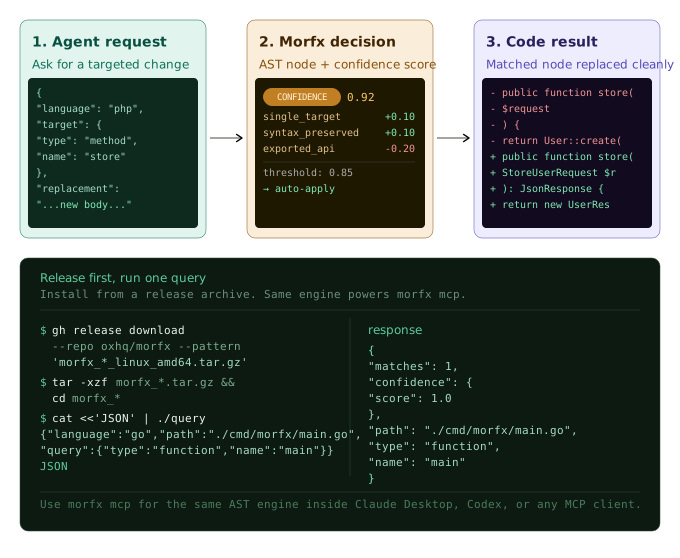
Morfx gives AI agents a deterministic way to query and rewrite code by AST node
instead of raw text. It ships as morfx mcp for MCP clients such as Claude
Desktop and Codex, and as standalone JSON tools such as query, replace,file_query, recipe, and apply for direct local automation.
30-Second Quick Win
If you want to understand Morfx fast, do not start by building from source.
Download a release, point query at a real file, and get back structured AST
matches:
cat <<'JSON' | ./query
{"language":"go","path":"./cmd/morfx/main.go","query":{"type":"function","name":"main"}}
JSON
You get JSON back with the matched node, confidence details, and file metadata.
The same engine is what morfx mcp exposes to MCP clients when you ask an
agent to replace, delete, insert, run a recipe, or stage a change safely.
Why
AI agents edit code by generating diffs or full-file rewrites. That works until it doesn't: off-by-one replacements, broken scope, wrong indentation, silent failures. Morfx solves this by operating on the actual syntax tree. Every transform is targeted by AST node, confidence-scored, and optionally staged for review before applying.
What it does
- Query — Find functions, structs, classes, methods, interfaces by type and name pattern (wildcards supported)
- Replace — Swap a matched code element with new code
- Delete — Remove a matched element cleanly
- Insert before / after — Add code relative to a target element
- Append — Smart placement at end of file or scope
- Stage / Apply / Rollback — Two-phase commit with SQLite audit trail
- Confidence scoring — Every transform gets a score with explainable factors
- Multi-language — Go, JavaScript, TypeScript, PHP, Python via tree-sitter
- Recipes / Rules - Named repeatable transformations composed from the same safe primitives
Modes
Start with morfx mcp unless you specifically want direct stdin/stdout
automation or repeatable local workflows. Morfx ships in three operational
shapes:
morfx mcpfor MCP-compatible AI clients such as Claude Desktop or Codex- Standalone binaries such as
query,replace,file_query,recipe, andapply
for direct local automation - A TFX-orchestrated runtime for repeatable flows such as smoke checks,
dogfooding, quality gates, and release packaging
For the standalone stdin/stdout contracts, see
docs/standalone-tools.md. For shell-level usage
patterns and TFX recipes, see
docs/standalone-recipes.md.
If you are just evaluating Morfx, you can ignore TFX at first. TFX is optional
runtime orchestration around the same standalone tools.
Morfx vs TFX
Morfx and TFX solve different problems:
- Morfx is the refactoring engine: AST query, replace, delete, insert, and
staged apply. - TFX is the terminal runtime around tools like Morfx: prompts, flow
selection, progress, logs, artifacts, and release-style orchestration.
That means TFX does not replace Morfx. It hosts Morfx more effectively when the
same standalone commands need to run as a product workflow instead of as ad-hoc
shell snippets.
Install
Release artifacts (recommended)
Prebuilt archives are the primary install path. Every GitHub release publishes:
morfx_<version>_linux_amd64.tar.gzmorfx_<version>_linux_arm64.tar.gzmorfx_<version>_darwin_amd64.tar.gzmorfx_<version>_darwin_arm64.tar.gzmorfx_<version>_windows_amd64.zip
Use the GitHub Releases page for
manual download, or pull the matching archive with GitHub CLI:
gh release download --repo oxhq/morfx --pattern 'morfx_*_linux_amd64.tar.gz'
tar -xzf morfx_*_linux_amd64.tar.gz
cd morfx_*
./morfx --version
On Windows:
gh release download --repo oxhq/morfx --pattern 'morfx_*_windows_amd64.zip'
Expand-Archive .\morfx_*_windows_amd64.zip -DestinationPath .
Get-ChildItem .\morfx_*\morfx.exe
Each archive includes morfx, the standalone tools, the standalone tool docs,
and tfx.yaml.
Build from source
Use a source build when you want to contribute, test local changes, or produce
custom binaries:
git clone https://github.com/oxhq/morfx.git
cd morfx
go build -o bin/morfx ./cmd/morfx
make build-standalone
Windows source-build notes
Windows support is practical, but current provider builds require CGO_ENABLED=1 and a compatible C compiler for tree-sitter grammars. The verified path in this repo uses Zig; set CC before running Go commands:
$env:CGO_ENABLED = "1"
$env:CC = "zig cc -target x86_64-windows-gnu"
go build ./cmd/morfx
go test ./...
For the canonical Windows verification path, run .\tools\scripts\verify-windows.ps1. For the standalone smoke path, run .\tools\scripts\smoke-standalone.ps1. The other PowerShell helpers in tools/scripts/ are the Windows-native path; the Unix make targets and .sh scripts remain for macOS/Linux.
Setup
Claude Desktop
Add to ~/Library/Application Support/Claude/claude_desktop_config.json:
{
  "mcpServers": {
    "morfx": {
      "command": "/path/to/morfx",
      "args": ["mcp"],
      "env": {
        "HOME": "/Users/you",
        "NO_COLOR": "1"
      }
    }
  }
}
OpenAI Codex
Add to ~/.codex/config.toml:
[mcp_servers.morfx]
command = "/path/to/morfx"
args = ["mcp"]

[mcp_servers.morfx.env]
HOME = "/Users/you"
NO_COLOR = "1"
Any MCP client
Morfx speaks MCP 2025-11-25 over stdio. Point any MCP-compatible client at the binary with mcp as the subcommand.
Standalone Tools
The standalone binaries are JSON-over-stdin tools, not flag-heavy CLIs.
Outside of -h/--help, you normally send them one JSON request on stdin and
read one JSON response from stdout.
| Tool | Description |
|---|---|
query |
Find code elements by type and name pattern |
file_query |
Search across multiple files |
replace |
Replace matched elements with new code |
file_replace |
Replace across multiple files |
delete |
Remove matched elements |
file_delete |
Delete across multiple files |
insert_before |
Insert code before a matched element |
insert_after |
Insert code after a matched element |
append |
Smart-place code at end of file or scope |
recipe |
Run a named repeatable transformation with confidence gates |
apply |
Apply a staged transformation |
Build them locally with:
make build-standalone
Usage examples
These are the JSON payloads your AI agent sends. You don't type these — your agent does.
Find all functions matching a pattern:
{
  "language": "go",
  "path": "/project/handlers.go",
  "query": {"type": "function", "name": "Handle*"}
}
Replace a method:
{
  "language": "php",
  "path": "/project/app/Http/Controllers/UserController.php",
  "target": {"type": "method", "name": "store"},
  "replacement": "public function store(StoreUserRequest $request): JsonResponse\n{\n    return new UserResource(User::create($request->validated()));\n}"
}
Insert a comment before a function:
{
  "language": "go",
  "path": "/project/service.go",
  "target": {"type": "function", "name": "DeleteUser"},
  "content": "// DeleteUser removes a user permanently. Use with caution."
}
Recipes and rules
Use recipe when a transformation should be repeatable instead of copied as an
ad-hoc shell snippet. A recipe is a named set of rules. Each rule maps directly
to an existing Morfx primitive: replace, delete, insert_before,insert_after, or append.
Apply-mode recipes always run a dry-run preflight first. Morfx only mutates files
after the step meets its min_confidence gate.
Recipes are available both as the MCP recipe tool and as the standalonerecipe JSON binary.
{
  "name": "replace-legacy-handlers",
  "dry_run": true,
  "min_confidence": 0.85,
  "steps": [
    {
      "name": "replace legacy handlers",
      "method": "replace",
      "scope": {
        "path": ".",
        "include": ["**/*.go"],
        "language": "go",
        "max_files": 100
      },
      "target": {"type": "function", "name": "Legacy*"},
      "replacement": "func Replacement() {}"
    }
  ]
}
cat recipe.json | ./bin/recipe
Confidence scoring
Every transformation returns a confidence score (0.0–1.0) with factors:
Confidence: █████████░ 90.0%
Factors:
  +0.10 single_target — Only one match found
  -0.20 exported_api — Modifying public API
When confidence exceeds the threshold (default 0.85), transforms auto-apply. Below threshold, they stage for manual review via apply.
Configuration
morfx mcp                           # Start with defaults
morfx mcp --debug                   # Debug logging to stderr
morfx mcp --db ./my.db              # Custom SQLite path
morfx mcp --auto-threshold 0.9      # Stricter auto-apply
TFX Dogfooding
This repository ships a root tfx.yaml so Morfx can run as a
product workflow, not only as an MCP backend or a pile of standalone binaries.
Typical flows:
tfx --flow ci --run
tfx --flow standalone --run
tfx --flow dogfood-tfx --run
tfx --flow quality --run
tfx --flow release --lane canary --run
The standalone flow builds the local binaries and exercises query,replace, and file_query against a temporary fixture throughtools/scripts/smoke-standalone.sh.
The dogfood-tfx flow targets a local checkout of oxhq/tfx throughtools/scripts/dogfood-tfx.sh, running
read-only queries on the real repo and a safe replacement against a temporary
copy of a TFX source file. Override the target checkout withMORFX_DOGFOOD_TFX_DIR=/path/to/tfx.
The important boundary is:
- Morfx owns AST edits and standalone JSON contracts.
- TFX owns flow control, prompts, runtime logs, progress, hooks, and artifacts.
Supported languages
| Language | Provider | Query types |
|---|---|---|
| Go | tree-sitter-go | function, struct, interface, variable, constant, import, type, method, field |
| JavaScript | tree-sitter-javascript | function, class, variable, import, export |
| TypeScript | tree-sitter-typescript | function, class, interface, type, variable, import, export, enum |
| PHP | tree-sitter-php | function, class, method, interface, trait, variable, namespace |
| Python | tree-sitter-python | function, class, variable, import, decorator |
Architecture
morfx mcp (stdio)
├── MCP Protocol (JSON-RPC 2.0, 2025-11-25 spec)
├── Tool Registry (10 tools)
├── Provider Registry
│   ├── Go provider (tree-sitter)
│   ├── JavaScript provider
│   ├── TypeScript provider
│   ├── PHP provider
│   └── Python provider
├── Base Provider (shared AST engine)
│   ├── Query (walkTree + pattern match)
│   ├── Transform (replace/delete/insert/append)
│   ├── Confidence scoring
│   └── AST cache + parser pool
├── Safety Manager (atomic writes, integrity checks)
└── Staging Manager (SQLite, stage/apply/rollback)
Development
go build ./...              # Build everything
go test ./...               # Run all tests
go test -race ./...         # Race detector
go test -cover ./...        # Coverage
make build-standalone       # Build standalone JSON tools
make smoke-standalone       # Run standalone fixture smoke tests
make verify                 # Strict local verification
Windows equivalents:
$env:CGO_ENABLED = "1"
$env:CC = "zig cc -target x86_64-windows-gnu"
.\tools\scripts\build-standalone.ps1
.\tools\scripts\verify-windows.ps1
.\tools\scripts\smoke-standalone.ps1
License
Licensed under the MIT License.
Yorumlar (0)
Yorum birakmak icin giris yap.
Yorum birakSonuc bulunamadi