forge
Health Gecti
- License — License: NOASSERTION
- Description — Repository has a description
- Active repo — Last push 0 days ago
- Community trust — 40 GitHub stars
Code Uyari
- fs module — File system access in .github/workflows/ci-skills.yml
- fs module — File system access in .github/workflows/domain-skill-staleness.yml
Permissions Gecti
- Permissions — No dangerous permissions requested
Bu listing icin henuz AI raporu yok.
Ship software with AI that knows your codebase, your standards, and gets better every sprint.
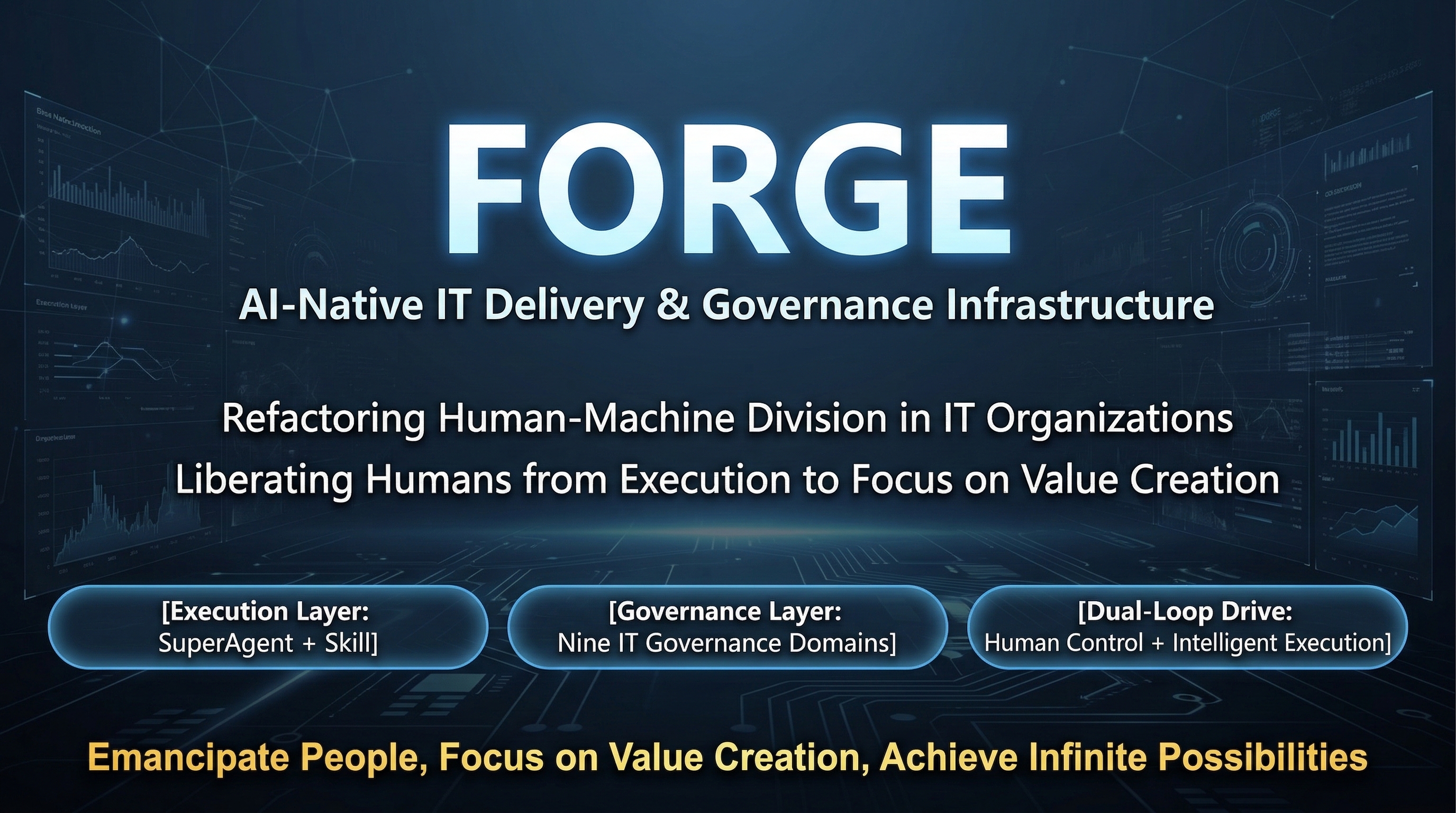
Forge — AI-Native IT Delivery & Governance Infrastructure
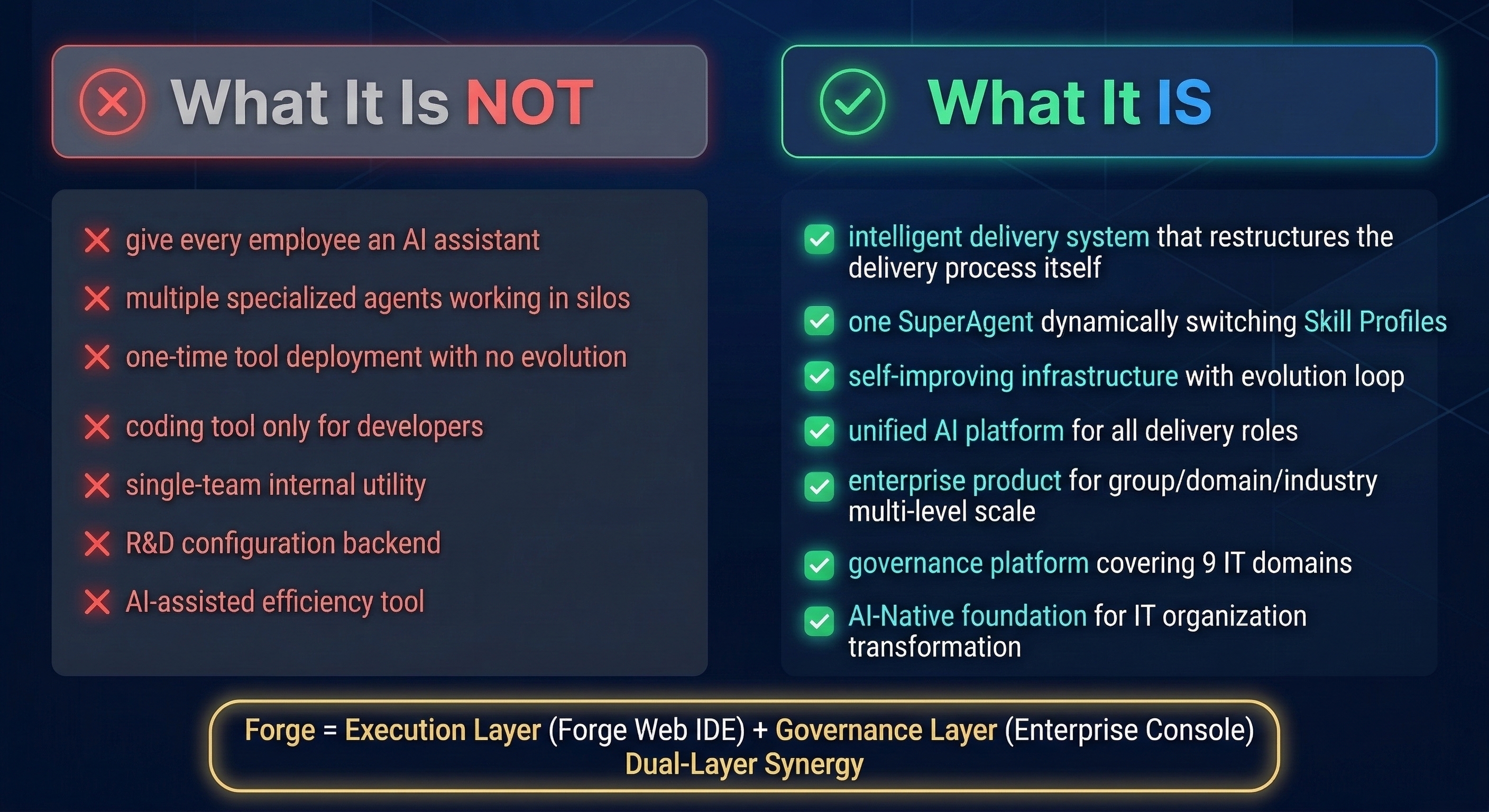
Not an AI coding assistant — an AI-Native infrastructure that deeply embeds AI across the entire software delivery lifecycle.




Overview
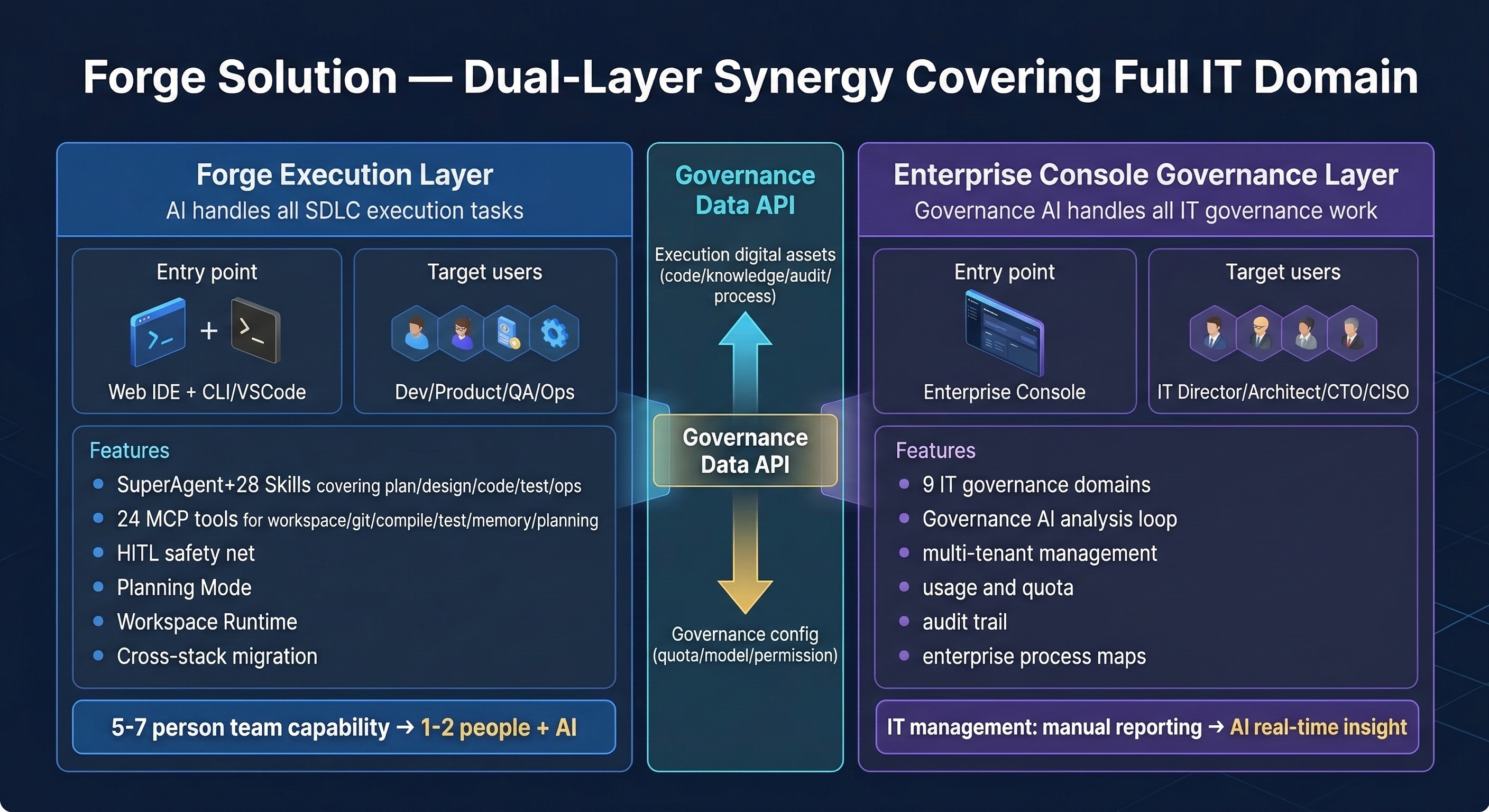
Forge is an AI-Native IT infrastructure with a dual-layer collaborative architecture:
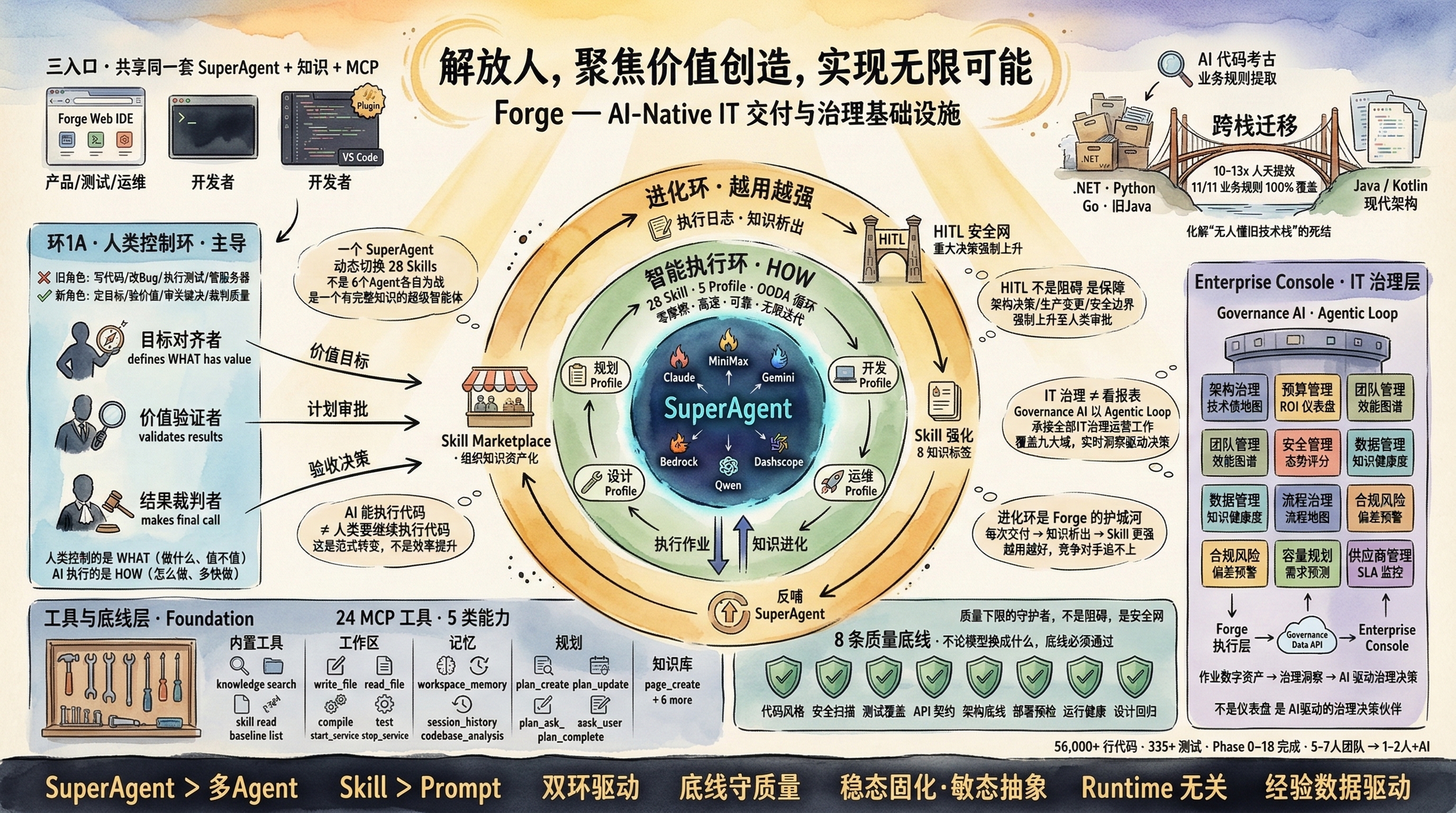
- Execution Layer (Web IDE): SuperAgent + 35 Skills + 24 MCP tools, three-loop architecture (human control loop + intelligent execution loop + evolutionary learning loop), compressing the delivery capacity of a 5-7 person team down to 1-2 people + AI
- Governance Layer (Enterprise Console): Governance AI covering IT governance domains (org/member/provider management), with Forge execution data driving governance insights and decisions
Core Philosophy
| Principle | Description |
|---|---|
| SuperAgent over Multi-Agent | One agent dynamically switches roles via Skills, avoiding multi-agent coordination complexity |
| Skills over Prompts | Professional knowledge encoded into 35 reusable, composable Skill assets |
| Baselines guarantee quality floor | Quality baseline scripts must pass regardless of model capability changes |
| Dual-loop drives continuous improvement | Delivery Loop solves "what to do", Learning Loop solves "getting better" |
| Human-In-The-Loop (HITL) | Critical decisions require human approval, not a fully automated black box |
Key Features
SuperAgent Autonomous Execution Engine
Users declare intent; SuperAgent autonomously completes the full cycle of planning → coding → verification → delivery:
- 50-turn autonomous execution: No step-by-step instructions needed — the agent decides tool calls, file operations, and code generation independently
- OODA Loop: Observe → Orient → Decide → Act, with real-time visualization of each phase
- 24 MCP tools: File operations, knowledge search, database queries, code compilation, test execution, service management, and more
- Self-repair on failure: When baseline checks fail, automatically analyzes the cause, modifies code, and re-validates (up to 2 rounds)
- Self-managed context: Automatically compresses message history when approaching token limits, without interrupting execution
6 Skill Profiles with Intelligent Routing
| Profile | Responsibility | Typical Skills |
|---|---|---|
| planning | Requirements analysis, PRD writing | requirement-engineering, delivery-methodology |
| design | Architecture design, ADR writing | architecture-design, api-design, database-patterns |
| development | Code implementation, code generation | code-generation, kotlin-conventions, spring-boot-patterns |
| testing | Test strategy, test case writing | test-case-writing, testing-standards |
| ops | Deployment, operations, troubleshooting | deployment-ops, logging-observability |
| evaluation | Progress evaluation, knowledge distillation, doc generation | progress-evaluation, knowledge-distillation |
Routing supports 4 priority levels: explicit tags (@development) → keyword detection → branch name patterns → default fallback.
35-Skill Asset Library
| Plugin Package | Skills | Description |
|---|---|---|
| forge-superagent | 14 | architecture-design, bug-fix-workflow, code-generation, delivery-methodology, deployment-ops, detailed-design, document-generation, git-workflow, knowledge-distillation, knowledge-generator, planning-mode, progress-evaluation, requirement-engineering, test-case-writing |
| forge-foundation | 16 | api-design, business-rule-extraction, codebase-profiler, convention-miner, database-patterns, deployment-readiness-check, design-baseline-guardian, environment-parity, error-handling, gradle-build, java-conventions, kotlin-conventions, logging-observability, security-practices, spring-boot-patterns, testing-standards |
| forge-knowledge | 3 | domain-model-knowledge, internal-api-knowledge, runbook-knowledge |
| forge-deployment | 2 | ci-cd-patterns, kubernetes-patterns |
Three-Layer Cross-Session Memory System
Solves the core pain point of AI agents "starting fresh every time":
| Layer | Name | Scope | Capacity |
|---|---|---|---|
| Layer 1 | Workspace Memory | Workspace-level | 4,000 chars |
| Layer 2 | Stage Memory | Profile × Workspace | 8,000 chars |
| Layer 3 | Session Summary | Single session | 2,000 chars/entry |
Effect: New sessions immediately have project context, saving 30-40% token consumption.
Quality Assurance System
- Automatic baseline checks: After code generation, automatically runs code-style / security / api-contract / architecture baselines
- HITL approval checkpoints: Pauses at key delivery nodes for human approval — supports Approve / Reject / Modify
- Four-dimensional evaluation learning loop: Intent understanding + Completion + Quality + Experience, auto-generates improvement suggestions
- Prompt Caching: System Prompt cached for 5 minutes, 90% cost savings on cache hits
Web IDE
┌─────────────────────────────────────────────────────────────────┐
│ Header — Role Switch + Model Selector + User Menu               │
├──────────┬──────────────────────────────┬───────────────────────┤
│ File     │ Monaco Editor                │ AI Chat Sidebar       │
│ Explorer │   - 25+ language highlights  │  4-Tab:               │
│          │   - Multi-tab file editing   │  [Chat|Quality|Skills │
│  CRUD:   │   - AI Explain button        │   |Memory]            │
│  Create  │   - 5s auto-save             │   - Streaming output  │
│  Rename  ├──────────────────────────────┤   - Tool call expand  │
│  Delete  │ Terminal Panel (collapsible)  │   - OODA indicator    │
└──────────┴──────────────────────────────┴───────────────────────┘
Frontend routes: workspaces (list), workspace/[id] (main IDE), knowledge (knowledge base), skills (skill management), workflows (workflow), evaluations (evaluation reports), login
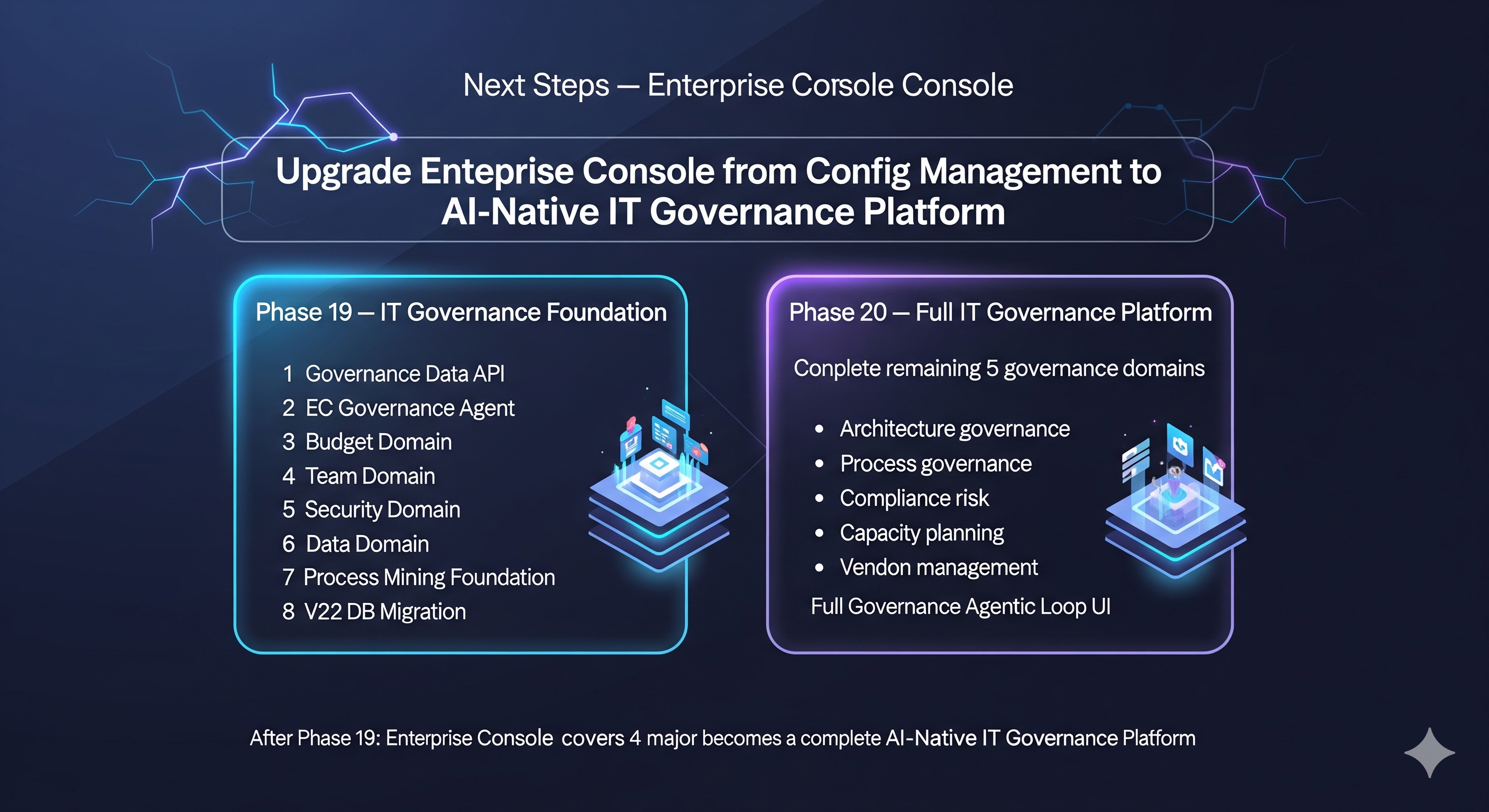
Enterprise Console (Governance Dashboard)
An independently deployed enterprise governance interface covering:
- Organization Management (
/orgs): Multi-org CRUD, member management - Invitation Management (
/invite): Invitation link creation and acceptance - Provider Management: AI model provider configuration and health checks
Multi-Model Support
| Provider | Supported Models | Context Window |
|---|---|---|
| Anthropic Claude | Opus 4.6 / Sonnet 4.5 / Haiku 4.5 | 200K |
| Google Gemini | Gemini Pro | 30K |
| Alibaba Qwen | Qwen2.5-7B / 72B | 32K |
| AWS Bedrock | Claude via AWS | Provider-specific |
| MiniMax | M2.5 / M2.5-lightning / M2.5-highspeed | 1M |
| OpenAI-compatible | Any service compatible with OpenAI API | Provider-specific |
Architecture
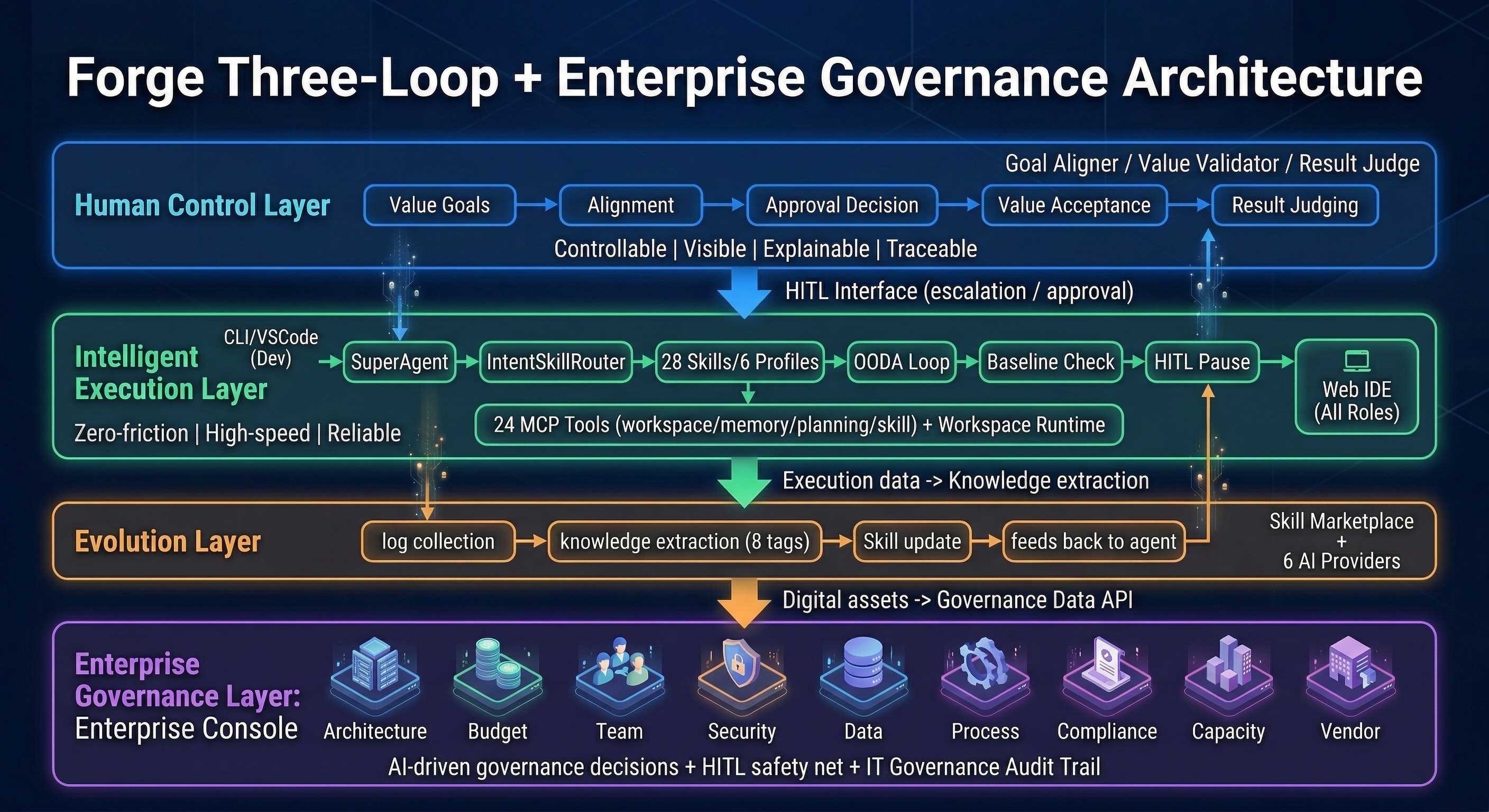
System Architecture Diagram
┌─ User Interaction Layer ─────────────────────────────────────────┐
│  Web IDE (Next.js 15)  │  Enterprise Console (Next.js 15)        │
│  CLI (Kotlin + GraalVM Native)                                   │
└──────────────────────────────────────────────────────────────────┘
                          │
┌─ Application Layer ──────────────────────────────────────────────┐
│  Spring Boot 3 Backend                                            │
│  ├─ AgenticLoopOrchestrator (50-turn autonomous execution)        │
│  ├─ ProfileRouter (6 Profile intelligent routing)                 │
│  ├─ SkillLoader (35 Skills dynamic loading)                       │
│  ├─ SystemPromptAssembler (dynamic prompt assembly)               │
│  ├─ McpProxyService (24 tool call proxy)                          │
│  ├─ MemoryContextLoader (three-layer memory injection)            │
│  ├─ HitlCheckpointManager (HITL approval management)             │
│  └─ LearningLoopPipelineService (learning feedback loop)         │
└──────────────────────────────────────────────────────────────────┘
                          │
┌─ MCP Tool Layer ─────────────────────────────────────────────────┐
│  forge-knowledge-mcp:8081  │  forge-database-mcp:8082            │
│  forge-service-graph-mcp   │  forge-artifact-mcp                 │
│  forge-observability-mcp   │  (built-in workspace/baseline tools) │
└──────────────────────────────────────────────────────────────────┘
                          │
┌─ Model Adapter Layer ────────────────────────────────────────────┐
│  ClaudeAdapter  │  GeminiAdapter  │  QwenAdapter                 │
│  BedrockAdapter │  OpenAIAdapter  │  (unified ModelAdapter interface) │
└──────────────────────────────────────────────────────────────────┘
Technology Stack
| Layer | Technology | Version |
|---|---|---|
| Backend Language | Kotlin | 1.9+ |
| Backend Framework | Spring Boot | 3.3+ |
| Runtime | JDK | 21 |
| Frontend Framework | Next.js + React | 15 + 19 |
| Frontend Language | TypeScript | 5.x |
| Database (Dev) | H2 file persistence | — |
| Database (Prod) | PostgreSQL | 16 |
| DB Migration | Flyway | 8 versions (V1-V8) |
| Code Editor | Monaco Editor | 4.6+ |
| Workflow Canvas | ReactFlow | 12.3+ |
| Diagram Rendering | Mermaid | 11.4+ |
| Authentication | Keycloak | 24.0 |
| Monitoring | Prometheus + Micrometer | — |
| Containerization | Docker Compose | 7 containers |
Gradle Module Structure
forge-platform/
├── web-ide/
│   ├── backend/          # Spring Boot 3 backend (Kotlin, 22 Controllers)
│   └── frontend/         # Next.js 15 frontend (TypeScript, 8 routes)
├── enterprise-console/   # Enterprise governance console (Next.js 15, standalone)
├── mcp-servers/
│   ├── forge-mcp-common/        # MCP protocol common library
│   ├── forge-knowledge-mcp/     # Knowledge base MCP server
│   ├── forge-database-mcp/      # Database MCP server
│   ├── forge-service-graph-mcp/ # Service topology MCP server
│   ├── forge-artifact-mcp/      # Build artifact MCP server
│   └── forge-observability-mcp/ # Observability MCP server
├── adapters/
│   ├── model-adapter/    # Model adapters (Claude/Gemini/Qwen/Bedrock)
│   └── runtime-adapter/  # Runtime adapter
├── plugins/
│   ├── forge-foundation/  # Foundation Skills (16: Kotlin/Java/Spring/API conventions)
│   ├── forge-superagent/  # SuperAgent Skills (14) + 6 Profiles
│   ├── forge-knowledge/   # Knowledge Skills (3)
│   ├── forge-deployment/  # Deployment Skills (2: K8s/CI-CD)
│   └── forge-team-templates/ # Team templates (backend/data/mobile)
├── cli/                   # Forge CLI (Kotlin + GraalVM Native)
├── agent-eval/            # SuperAgent evaluation framework
├── skill-tests/           # Skill validation framework
├── knowledge-base/        # Knowledge base documents (13+ docs)
└── infrastructure/
    └── docker/            # Docker Compose deployment configs (4 environments)
Quick Start
Prerequisites
| Item | Requirement | Verification |
|---|---|---|
| JDK | 21 (required! JDK 8/17 will fail to compile) | java -version |
| Docker Engine | 24+ | docker --version |
| Docker Compose | v2+ | docker compose version |
| Node.js | 20+ | node --version |
| Available Memory | ≥ 8 GB (allocated to Docker) | Docker Desktop → Resources |
| API Key | At least 1 Provider | See configuration below |
Step 1: Clone the Repository
git clone [email protected]:pan94u/forge.git
cd forge
Step 2: Configure Environment Variables
cp .env.example infrastructure/docker/.env
Edit infrastructure/docker/.env and fill in at least one Provider's API Key:
# Anthropic Claude (recommended)
ANTHROPIC_API_KEY=sk-ant-api03-your-key

# Or Google Gemini
# GEMINI_API_KEY=AIza...

# Or Alibaba DashScope (Qwen)
# DASHSCOPE_API_KEY=sk-...

# Or MiniMax
# MINIMAX_API_KEY=...

# Or OpenAI-compatible (Ollama/vLLM/LocalAI, etc.)
# LOCAL_MODEL_URL=http://localhost:11434
# LOCAL_MODEL_NAME=llama3.1:8b
Step 3: Build Locally
# Ensure JDK 21 (macOS example)
export JAVA_HOME=/opt/homebrew/opt/openjdk@21

# Build backend JAR (skip tests for speed)
./gradlew :web-ide:backend:bootJar -x test --no-daemon

# Build frontend
cd web-ide/frontend && npm install && npm run build && cd ../..

# Build Enterprise Console (optional)
cd enterprise-console && npm install && npm run build && cd ..
Step 4: Start with Docker
cd infrastructure/docker
docker compose -f docker-compose.trial.yml --env-file .env up --build -d
Step 5: Verify Startup
# Check all 7 containers (all should be healthy or running)
docker compose -f docker-compose.trial.yml ps

# Test API
curl -s http://localhost:19000/api/models | python3 -m json.tool
Step 6: Access the Platform
| Service | URL | Description |
|---|---|---|
| Web IDE | http://localhost:19000 | Main IDE interface |
| Enterprise Console | http://localhost:19001 | Enterprise governance dashboard |
| Knowledge MCP | http://localhost:19081 | Knowledge base MCP service |
| Database MCP | http://localhost:19082 | Database MCP service |
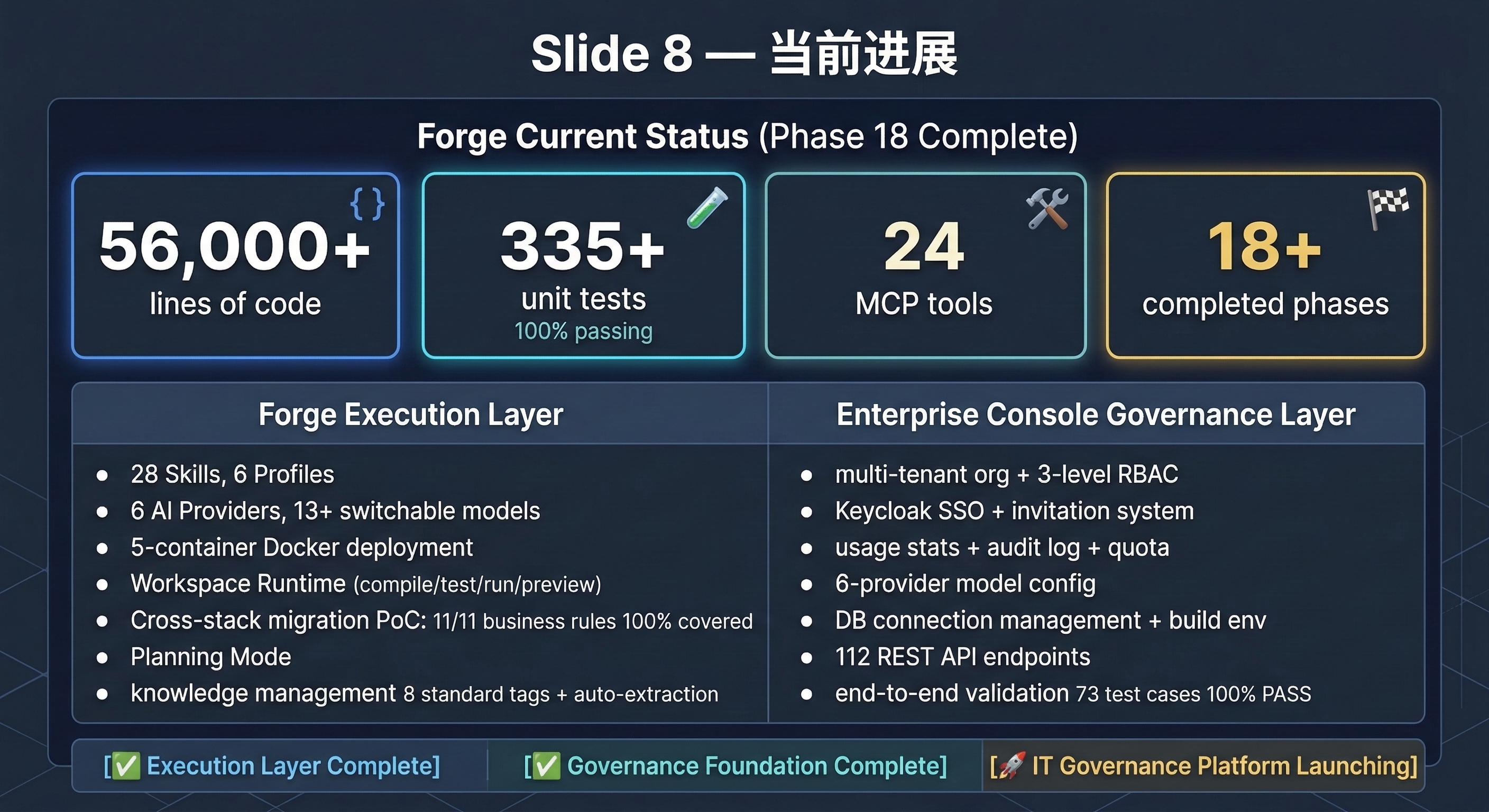
Technical Specifications
| Dimension | Value |
|---|---|
| REST API Controllers | 22 |
| REST API Endpoints | 70+ |
| SSE Event Types | 14 |
| MCP Tools | 24 (5 categories: builtin/knowledge/workspace/memory/planning) |
| JPA Entities | 12 |
| Flyway Migrations | 8 versions (V1-V8) |
| Total Skills | 35 (4 plugin packages, 6 Profiles) |
| Unit Tests | 156 (all passing) |
| Docker Containers | 7 (postgres + knowledge-mcp + database-mcp + backend + frontend + enterprise-console + nginx) |
| Knowledge Base Docs | 13+ |
| Code Volume | ~50K+ lines (Kotlin + TypeScript) |
| Frontend Routes | 8 (Web IDE) + 2 (Enterprise Console) |
| Supported Models | 6 Providers (13+ models) |
| Context Window | Up to 200K tokens (Claude Opus) |
| Autonomous Execution Turns | Up to 50 |
Roadmap
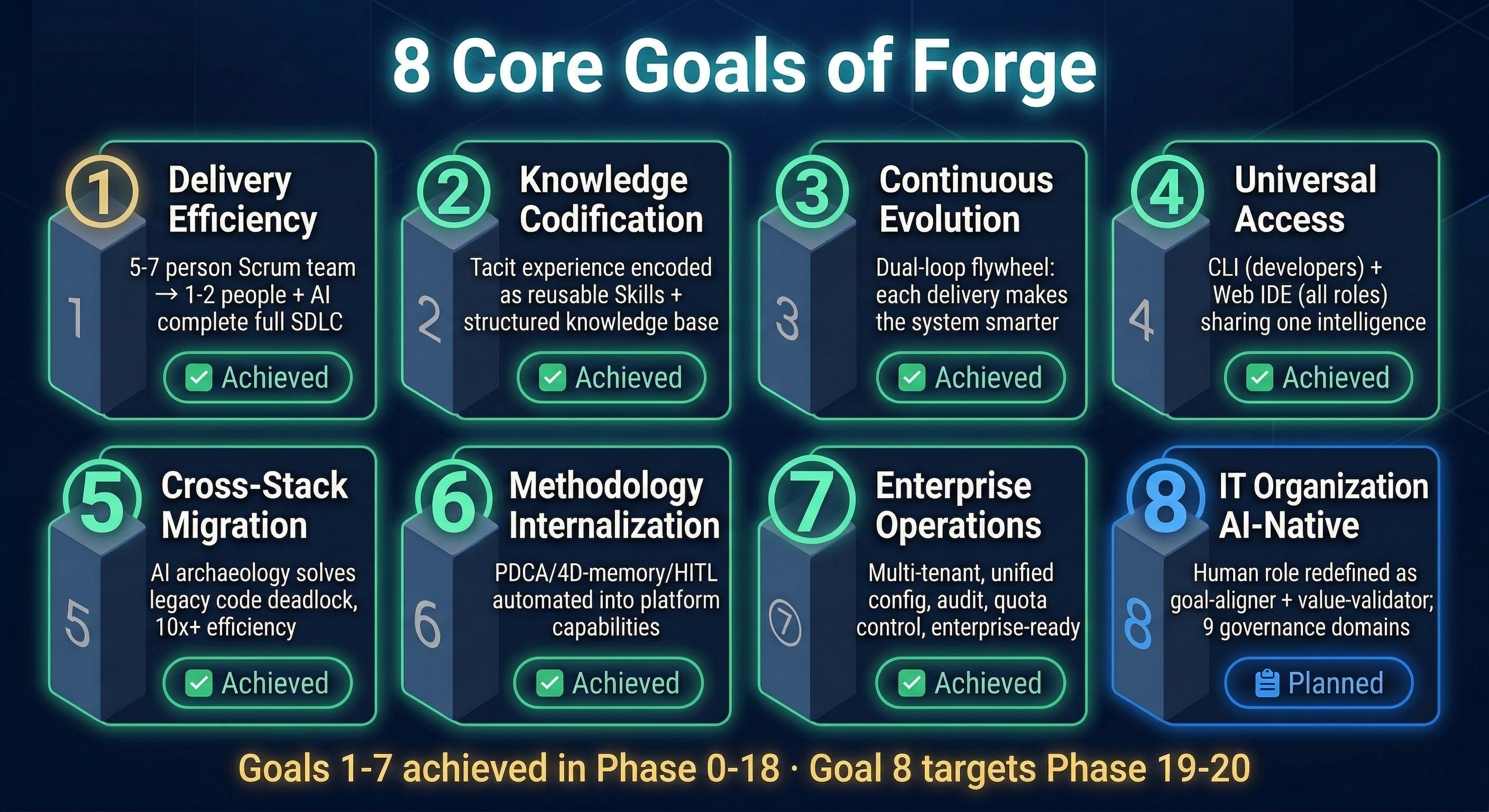
| Phase | Keyword | Status | Key Capabilities |
|---|---|---|---|
| Phase 0 | Foundation | ✅ | Foundation Skills + MCP Servers + CLI + Plugin system |
| Phase 1 | Web IDE Connected | ✅ | Real streaming + Agentic Loop + Cross-stack profiling |
| Phase 1.5 | Design Guard + Docker | ✅ | Docker deployment + E2E validation + Design baseline freeze |
| Phase 1.6 | AI Delivery Loop + SSO | ✅ | AI→Workspace file writing + Keycloak SSO + Context Picker |
| Phase 2 | Quality Infrastructure | ✅ | CI/CD + SkillLoader + Real MCP services + Multi-model |
| Phase 3 | HITL + Memory | ✅ | Three-layer memory + HITL approval + Learning loop + Quality panel |
| Phase 4 | Skill Architecture | ✅ | Progressive loading + Skill management + Usage tracking |
| Phase 5 | Product Usability | ✅ | Workspace persistence + Git Clone + User API Keys |
| Phase 6 | Knowledge Write + Multi-model | ✅ | MiniMax + Local knowledge write + 50-turn Agentic Loop |
| Phase 7 | Async + Knowledge Scope | ✅ | Async Git Clone + Three-tier knowledge scope + CRUD |
| Phase 8 | Enterprise Console | ✅ | Governance dashboard + Org management + Provider management |
| Phase 9+ | Learning Loop Closure | 🔄 | ForgeNativeRuntime + Methodology platformization |
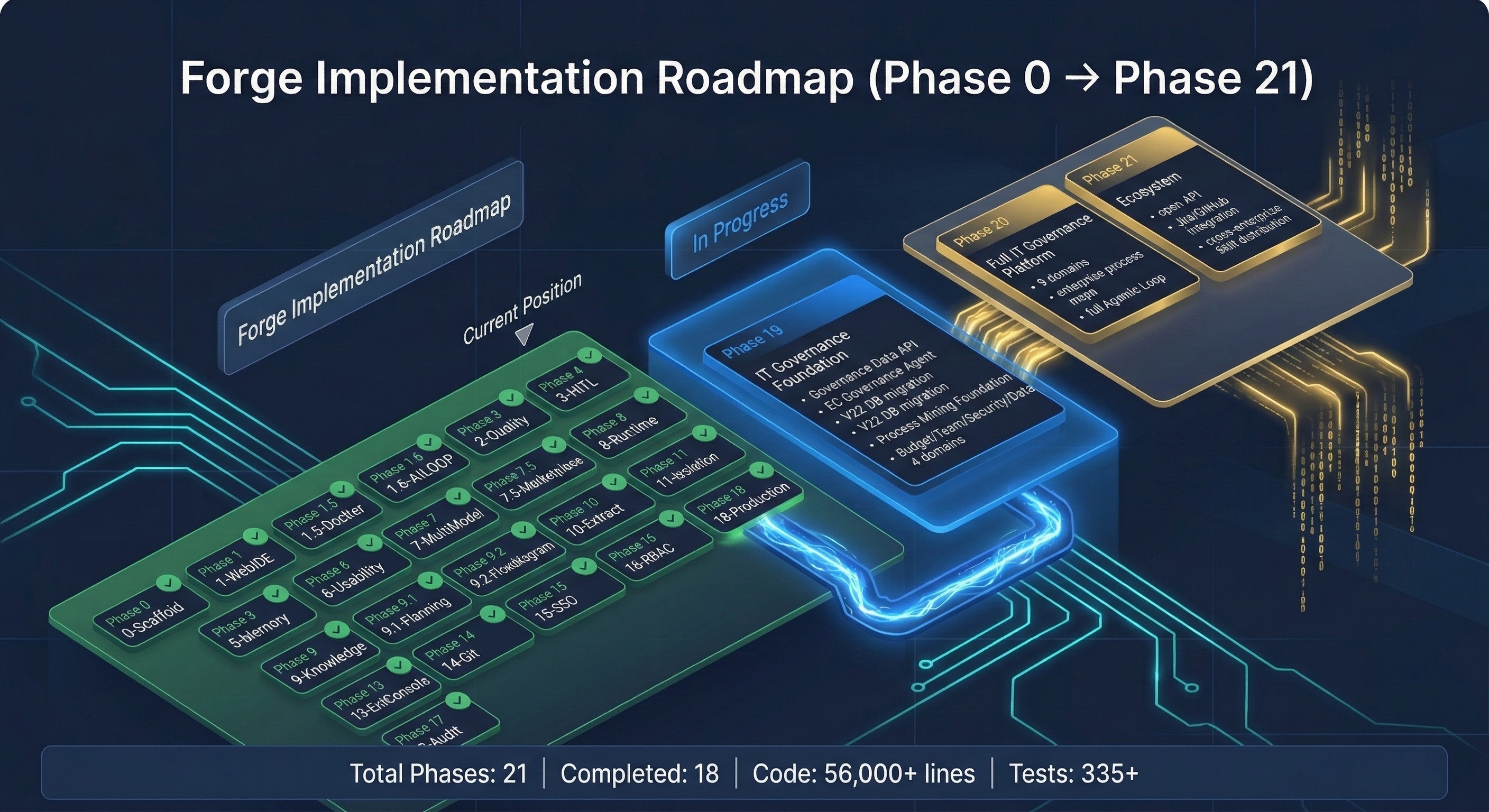
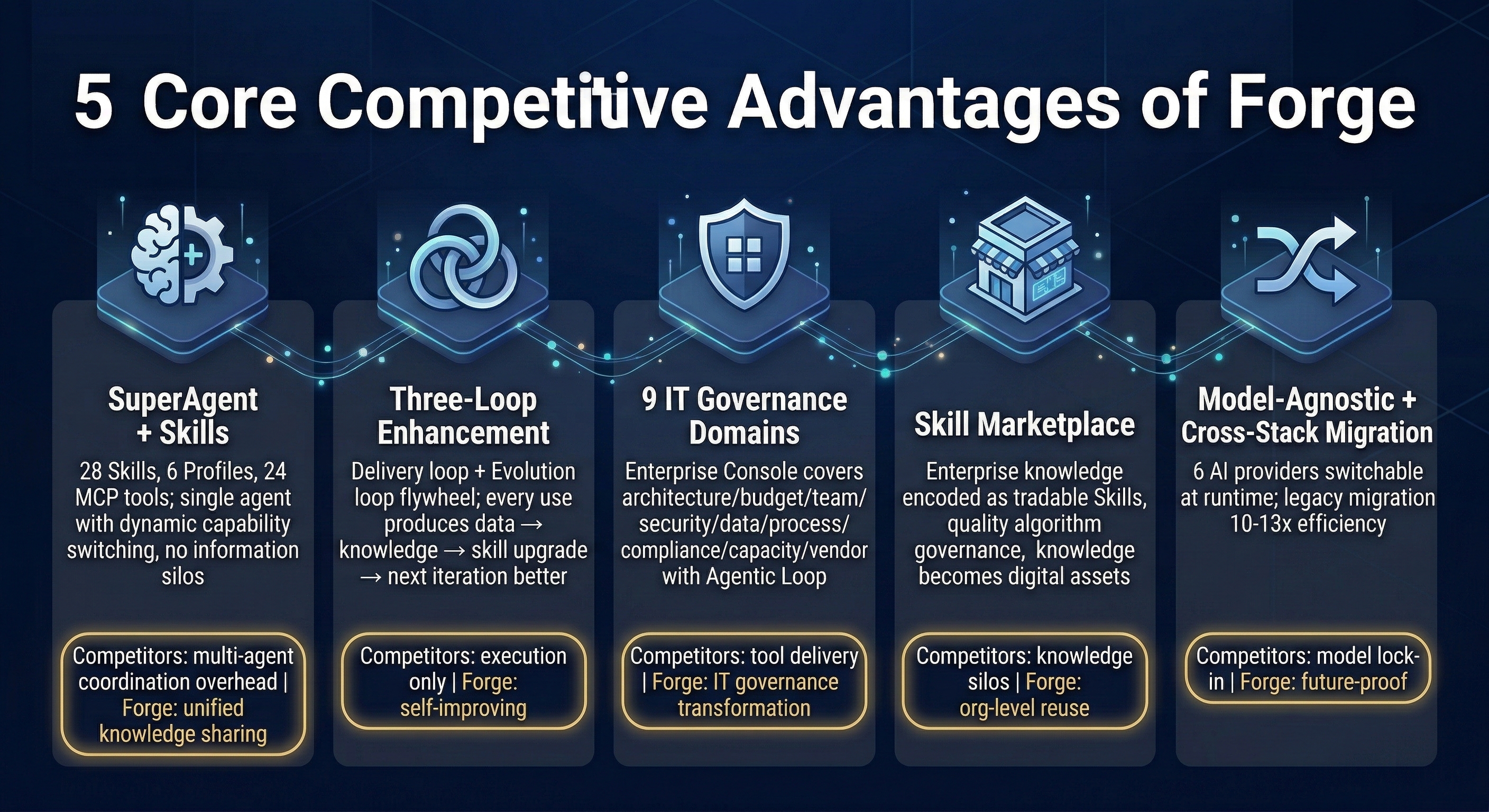
Competitive Advantages
Ecosystem Vision: Forge × Synapse AI
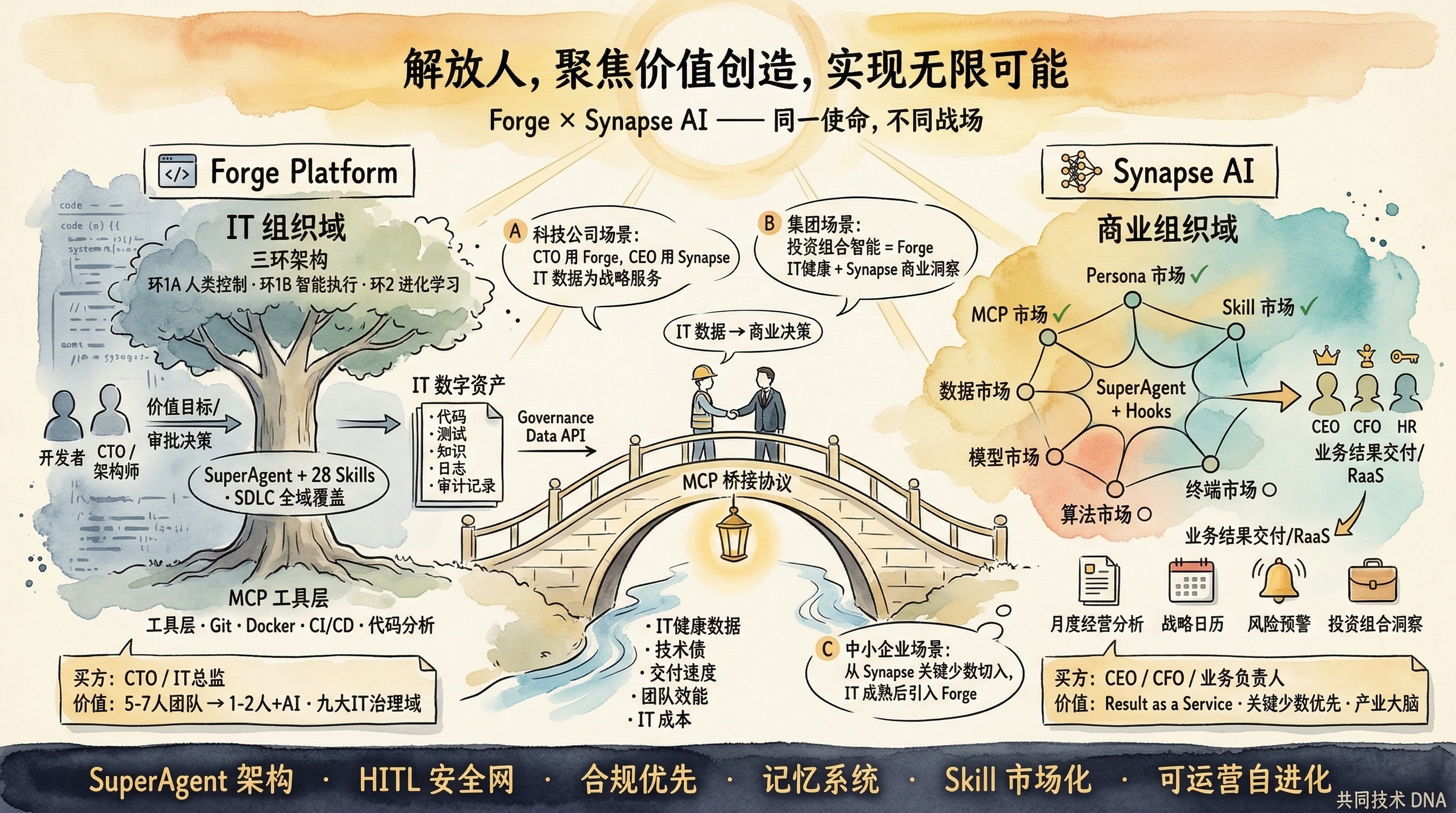
Same mission, different battlefields: Forge serves the IT organization domain (execution + governance), Synapse AI covers the business organization domain (RaaS · key minority priority · industry brain), connected via MCP bridging protocol for IT data → business decisions.
Development Guide
Run Unit Tests
# Backend tests
./gradlew :web-ide:backend:test :adapters:model-adapter:test

# Evaluation framework tests
./gradlew :agent-eval:test
Local Development Mode (without Docker)
# Start backend
cd web-ide/backend
./gradlew bootRun

# Start frontend (new terminal)
cd web-ide/frontend
npm run dev
# Access http://localhost:3000

# Start Enterprise Console (new terminal)
cd enterprise-console
npm run dev
# Access http://localhost:19001
Common Issues
| Issue | Solution |
|---|---|
| JDK version error | Must use JDK 21: export JAVA_HOME=/opt/homebrew/opt/openjdk@21 |
| Frontend type errors | Use npm run build not npm run dev (dev doesn't check types) |
| WebSocket CORS | forge.websocket.allowed-origins must be a comma-separated string |
| Enum serialization | All enums must add @JsonValue returning lowercase |
| Empty string vs null | Use isNullOrBlank() instead of ?: default |
| workspaceId propagation | REST API and WebSocket are two independent paths — both require workspaceId |
Documentation Index
| Document | Path | Description |
|---|---|---|
| Product Feature List | docs/product/feature-list.md |
Complete feature description (user-facing) |
| Design Baseline | docs/baselines/design-baseline-v1.md |
Validated UI/API/data model baseline |
| Planning Baseline | docs/baselines/planning-baseline-v1.5.md |
Design-driven planning document |
| Development Logbook | docs/planning/dev-logbook.md |
Complete session-by-session development records |
| Architecture Overview | docs/architecture/overview.md |
System architecture documentation |
| Trial Guide | docs/product/TRIAL-GUIDE.md |
Internal trial operation manual |
| Acceptance Tests | docs/acceptance-tests/ |
Phase-by-phase acceptance test reports |
| Bug List | docs/analysis/buglist.md |
Known issue tracking |
Contributing
Contributions are welcome! Here's how you can participate:
- Submit Issues: Report bugs, suggest features, or propose improvements
- Submit Pull Requests: Fix bugs, improve documentation, add new Skills
- Extend Skills: Add new Skills or Profiles in the
plugins/directory - Enrich Knowledge Base: Add documentation in the
knowledge-base/directory
Before submitting a PR, please ensure:
- All unit tests pass:
./gradlew :web-ide:backend:test - Frontend builds without errors:
cd web-ide/frontend && npm run build - Code follows existing style conventions (see
plugins/forge-foundation/skills/kotlin-conventions/)
Note: By submitting a contribution, you agree to license your contribution to The Forge Contributors as described in the LICENSE.
License
This project is licensed under the Forge Source Available License v1.0.
- ✅ Permitted: View source, personal learning, non-commercial use and modification, submit contributions
- ❌ Restricted: Commercial use (SaaS, internal business tooling, consulting services) requires written authorization
Commercial licensing inquiries: https://github.com/pan94u/forge/issues
Forge — Making AI truly participate in software delivery, not just assist with coding
Yorumlar (0)
Yorum birakmak icin giris yap.
Yorum birakSonuc bulunamadi