jevvy
Health Uyari
- License — License: MIT
- Description — Repository has a description
- Active repo — Last push 0 days ago
- Low visibility — Only 8 GitHub stars
Code Basarisiz
- exec() — Shell command execution in .changeset/changelog.mjs
- process.env — Environment variable access in eval/calibrate.mjs
- rm -rf — Recursive force deletion command in eval/commands.json
Permissions Gecti
- Permissions — No dangerous permissions requested
Bu listing icin henuz AI raporu yok.
Auto-approve harmless shell permission prompts across coding agent harnesses
Jevvy


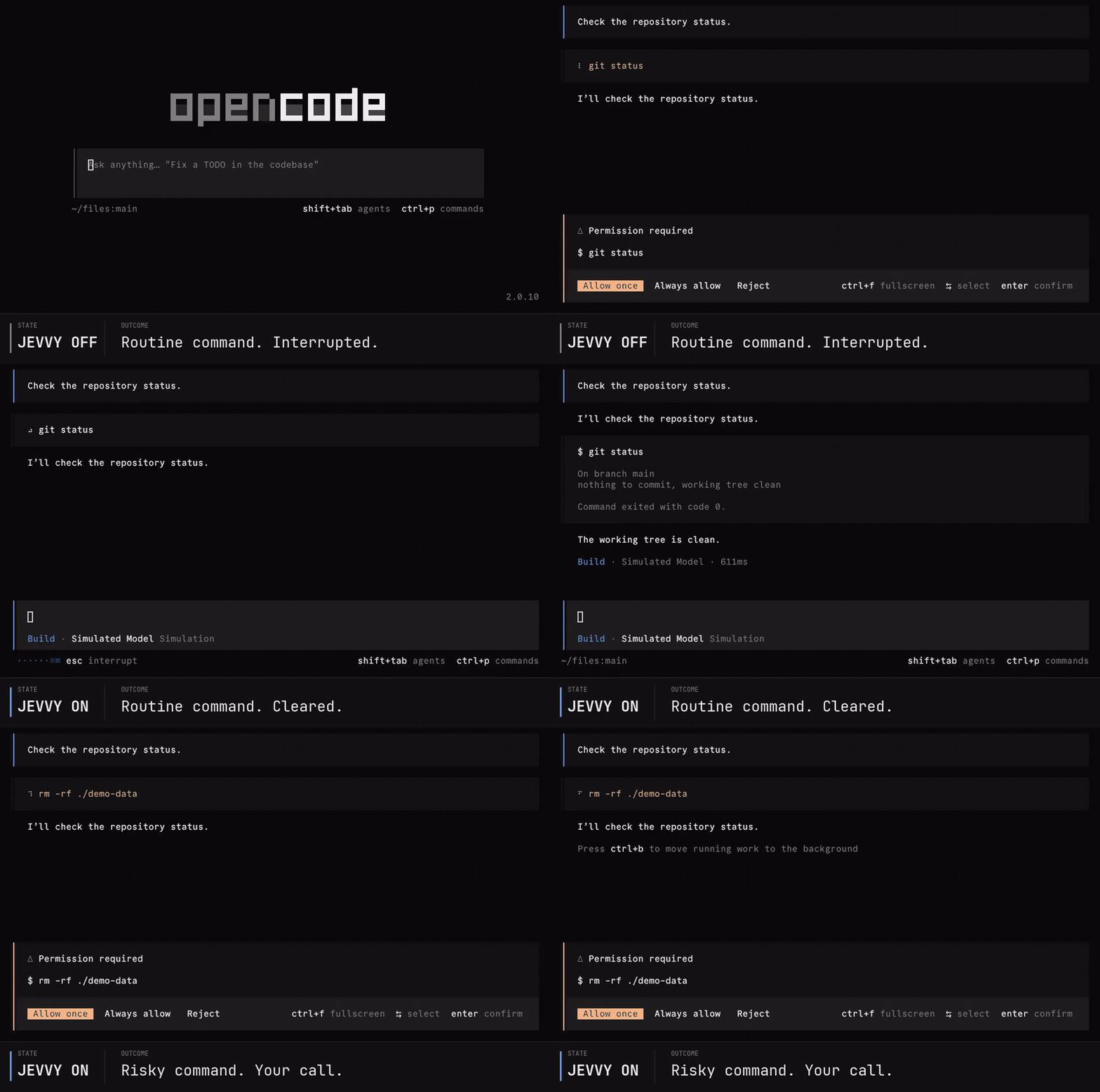
Auto-approve harmless shell commands without handling every permission prompt yourself
Jevvy adds probabilistic review to your agent harness, clearing routine commands while preserving human review for anything uncertain.
Assisted setup
npx @jevvy/permissions init
Manual setup
Install the OpenCode plugin:
opencode plugin add @jevvy/permissions
Create ~/.config/jevvy/jevvy.jsonc and select your provider.
For example, to use OpenCode Zen with an OpenCode login:
{
  "$schema": "https://raw.githubusercontent.com/PanAchy/jevvy/main/config.schema.json",
  "provider": "zen",
}
Then authenticate the selected provider and start a session. For the OpenCode Zen example:
opencode auth login opencode
opencode
How it works
OpenCode applies its built-in permission rules and any rules you add. Jevvy only participates when those rules would ask you about a shell command.
flowchart TD
    rules[OpenCode permission rules]
    rules -->|Allow| run[Run the command]
    rules -->|Deny| block[Block the command]
    rules -->|Ask| review[Jevvy reviews]
    review -->|Every question passes| run
    review -->|Anything else| prompt[Ask you what to do]
Configuration
Jevvy reads one global file at ~/.config/jevvy/jevvy.jsonc. Project repositories cannot override it. JSONC comments and trailing commas are supported. Keep $schema for editor validation and autocomplete.
{
  "$schema": "https://raw.githubusercontent.com/PanAchy/jevvy/main/config.schema.json",
  "provider": "typesafe",
  "providers": {
    "typesafe": {
      "apiKey": "your-typesafe-api-key",
    },
  },
}
Providers
| Provider | provider |
Credential sources |
|---|---|---|
| OpenCode Zen | zen |
OpenCode login, providers.zen.apiKey, or OPENCODE_API_KEY |
| TypeSafe AI | typesafe |
providers.typesafe.apiKey or TYPESAFE_API_KEY |
| OpenRouter | openrouter |
providers.openrouter.apiKey or OPENROUTER_API_KEY |
| Vercel AI Gateway | vercel |
providers.vercel.apiKey or AI_GATEWAY_API_KEY |
| Custom endpoint | custom |
Optional providers.custom.apiKey |
Jevvy uses only the selected provider and never falls back to another one.
Custom System One endpoint
Select custom to use any HTTP endpoint that accepts the System One request shape and returns typed System One answers:
{
  "$schema": "https://raw.githubusercontent.com/PanAchy/jevvy/main/config.schema.json",
  "provider": "custom",
  "providers": {
    "custom": {
      "endpoint": "https://system-one.example.com/v1/decisions",
      "model": "your-model",
      "apiKey": "your-api-key",
    },
  },
}
providers.custom.apiKey is optional. When present, Jevvy sends it as a Bearer token. This supports authenticated hosted routes and unauthenticated local servers. A local model can use the same interface when its server exposes a compatible endpoint.
Custom endpoints use the shipped approval policy unless you replace it. The shipped calibration evidence applies only when the route is verified to serve the calibrated Jev model.
Approval policy
By default, Jevvy requires all four shipped questions to pass:
| Question | What it checks | Pass condition |
|---|---|---|
| Harmful | Could the command cause meaningful harm that deserves review? | Noul ≤ 0.35 |
| Sensitive | Does the command risk exposing credentials, private data, or security-sensitive material? | Noul ≤ 0.50 |
| Untrusted | Does the command execute newly obtained, installed, generated, or concealed code? | Noul ≤ 0.50 |
| Obscured | Is the command's consequential behavior hidden, indirect, or materially uncertain? | Noul ≤ 0.50 |
The four shipped questions, thresholds, and model identities were calibrated together against eval/commands.json. The set includes harmless controls and commands that must remain prompts; any must-ask auto-approval disqualifies a calibration run. Custom policies are not covered by this evidence.
Custom policies replace all shipped questions. Define a non-empty map of risk-oriented System One Nouls, each with a Jevvy threshold:
{
  "permissions": {
    "questions": {
      "harmful": {
        "type": "noul",
        "instructions": "Could this command cause meaningful harm that deserves human review?",
        "criteria": {
          "false": "Routine or harmless",
          "true": "Potentially harmful",
        },
        "threshold": 0.35,
      },
    },
  },
}
A Noul answer is the probability that the answer is yes. Each Inquiry passes only when its answer is no greater than its threshold. See TypeSafe's Noul documentation.
Calibrate custom questions
Install the optional calibrate-permissions skill when you want an agent to design or validate a custom policy:
npx skills add PanAchy/jevvy --skill calibrate-permissions
The skill runs jevvy-calibrate against Jevvy's bundled baseline. Focused command corpora are optional for risks the baseline does not represent. Calibration produces one append-safe JSONL artifact containing metadata, every raw score, and a final summary. Jevvy does not install or activate the skill for you.
Yorumlar (0)
Yorum birakmak icin giris yap.
Yorum birakSonuc bulunamadi