SpaceO
Health Uyari
- License — License: MIT
- Description — Repository has a description
- Active repo — Last push 0 days ago
- Low visibility — Only 5 GitHub stars
Code Basarisiz
- spawnSync — Synchronous process spawning in Tests/ComputerUseEvidenceTests.mjs
- process.env — Environment variable access in Tests/ComputerUseEvidenceTests.mjs
Permissions Gecti
- Permissions — No dangerous permissions requested
Bu listing icin henuz AI raporu yok.
Give AI agents their own macOS displays. Keep your screen, cursor, and focus.

Give AI agents their own screen on your Mac.
Let agents work in real apps while you keep using your computer.
SpaceO runs agent apps on separate, headless displays.





Get started · How it works · FAQ · Setup guide · Releases · Reference
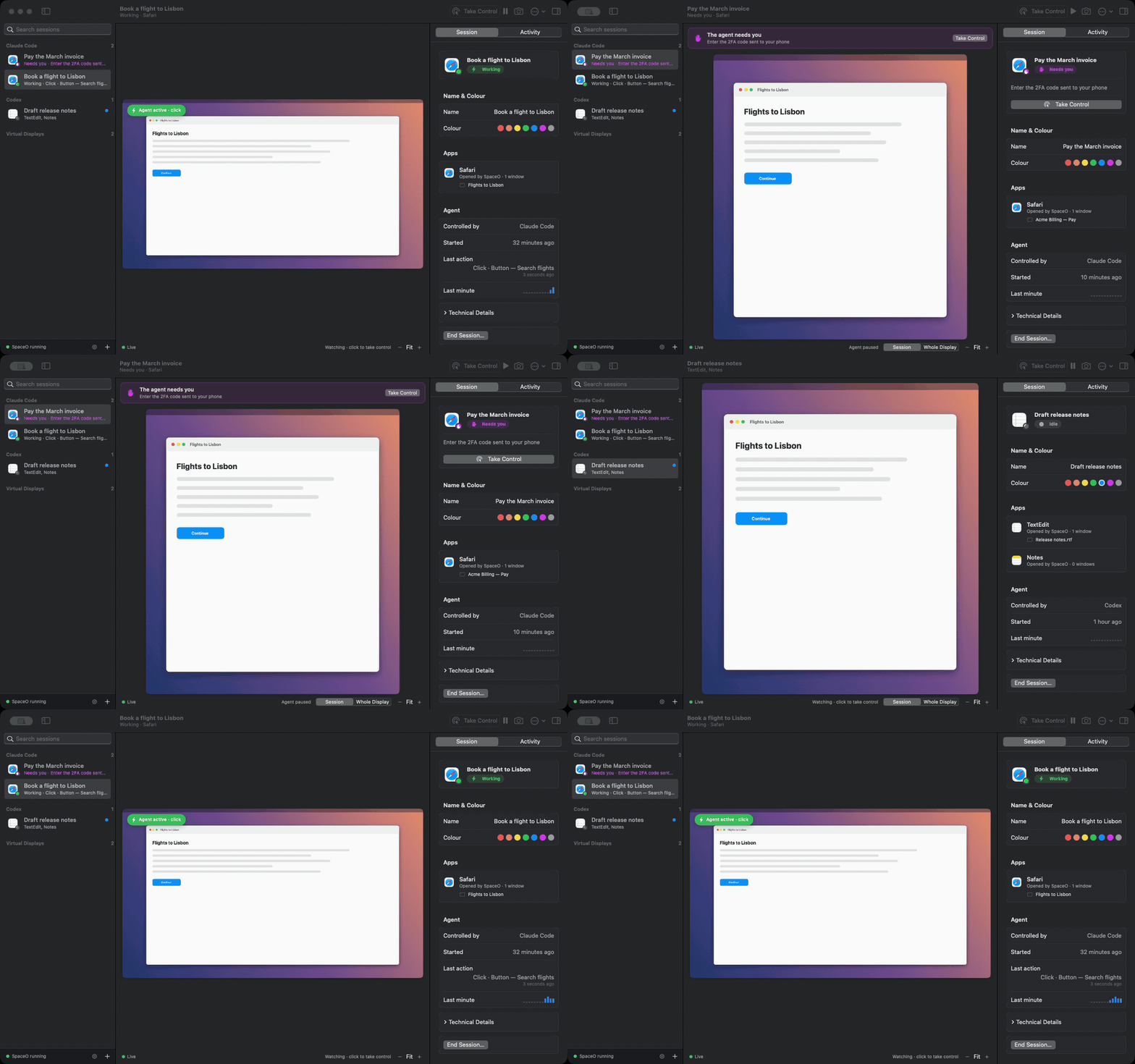
Recorded from the real SpaceO Viewer using synthetic preview sessions and sample screen content.
View the still screenshot.
[!NOTE]
Latest release · latest signed SpaceO release. Install it with
one command, which verifies the signed, notarized release for you. You can also
download the DMG from the Releases page.Supported scope: native apps and Chromium browsers. Managed Electron apps such as
Cursor and VS Code are refused before launch because they can take desktop focus.
These editors can still connect to SpaceO as MCP clients to drive supported apps.
A screen for every agent
| You keep working | Your agents keep working |
|---|---|
| Your physical display stays available | Apps render on headless virtual displays |
| Your pointer stays where you put it | Accessibility actions and targeted events operate apps |
| You decide when to intervene | Viewer shows sessions, activity, pause, and human handoff |
| Multiple agents can share one Mac | Sessions own apps, windows, and display tiles |
SpaceO is a native Swift app, a CLI, and an MCP server. Agents can read interface elements,
click controls, enter text, inspect screenshots, and check what actually happened. Sessions can
use dedicated displays or share a display in separate tiles.
What an agent can do
| Capability | MCP tools |
|---|---|
| Own a workspace | spaceo_session_create, spaceo_session_destroy, spaceo_session_list, spaceo_pool_status |
| Launch and place apps | spaceo_open_app, spaceo_open_url, spaceo_adopt_app, spaceo_place_window, spaceo_list_windows |
| See the interface | spaceo_read_screen, spaceo_find, spaceo_read_text, spaceo_screenshot, spaceo_wait_for |
| Act on it | spaceo_click, spaceo_type, spaceo_press_key, spaceo_scroll, spaceo_drag, spaceo_menu, spaceo_select_text |
| Batch and verify | spaceo_run_steps, spaceo_verify_isolation, spaceo_events |
| Hand off to you | spaceo_session_pause, spaceo_session_resume, per-session clipboard broker |
Actions prefer Accessibility elements over coordinates, and every receipt says whether the result
was confirmed, unconfirmed, or refused. The reference lists every
tool and CLI command.
How it works
flowchart LR
  You["You · keyboard + mouse"] --> Physical["Your physical display"]
  Physical --> Work["Your apps and work"]
  AgentA["Agent A"] --> SessionA["Session A · virtual display"]
  AgentB["Agent B"] --> SessionB["Session B · virtual display / tile"]
  SessionA --> AppA["Browser · research"]
  SessionB --> AppB["Editor · documents"]
  Viewer["SpaceO Viewer"] -. "observe · pause · take control" .-> SessionA
  Viewer -. "observe · pause · take control" .-> SessionB
  style Physical fill:#eaf5ef,stroke:#24845b,color:#163a29
  style SessionA fill:#edf0ff,stroke:#6172cb,color:#25345f
  style SessionB fill:#edf0ff,stroke:#6172cb,color:#25345f
An inactive Mission Control Space can stop an app from drawing. A virtual display keeps its
windows available to the compositor, capture, and Accessibility. SpaceO places agent windows
there and sends actions to the target without deliberately activating it or moving your pointer.
Apps can still activate themselves, and macOS private APIs can change. SpaceO reports observed
isolation failures and checks it cannot establish; an attempted action is not automatically
reported as a confirmed result.
[!IMPORTANT]
Attention isolation is not a security sandbox. Agent apps run as your macOS user, with that
user’s files, network, credentials, and app sessions. Use a separate login or VM for untrusted
workloads. Keep SIP enabled. See the security policy.
Get started
You need a Mac with Apple Silicon and macOS 14 or later. Run one command:
curl -fsSL https://raw.githubusercontent.com/ParthJadhav/SpaceO/main/install.sh | bash
The installer:
- downloads the latest signed release and checks its publisher signature, checksum, and
notarization before running anything from it; - installs
spaceoto~/.local/binand SpaceO Viewer to~/Applications, withoutsudo; - connects SpaceO to Claude Code, Codex, Cursor, and Claude Desktop if they are installed;
- walks you through the Accessibility and Screen Recording permissions and runs a short
self-test.
Restart your agent, then ask it something like "Open TextEdit in SpaceO, write a short note, and
show me a screenshot". It creates its own session and cleans it up when it finishes.
Run the command again to upgrade. Add | bash -s -- --uninstall to remove SpaceO, or --help
for options. To do each step yourself, follow INSTALL.md. Runtime support
depends on your macOS build; spaceo doctor checks your Mac without changing anything. A passing
self-test does not cover every input or isolation behavior. The setup guide
covers permissions, compatibility, and your first session.
Connect another agent later
spaceo setup --client claude-code # or codex, cursor, claude-desktop
For other MCP clients, use the absolute path to spaceo with the argument mcp
(client configurations).
Or build from source (needs Xcode with Swift 6.2 or later; CI selects Xcode 26.3)
git clone https://github.com/ParthJadhav/SpaceO.git
cd SpaceO
make install                 # installs ~/.local/bin/spaceo
~/.local/bin/spaceo setup    # permissions, self-test, and MCP configuration
Virtual-display creation uses runtime capability checks on macOS 14 and later, with bounded
lifecycle waits and creation limits. See display safety.
Or drive an app yourself from the CLI
spaceo daemon &
eval "$(spaceo session create --session try --export)"   # sets SPACEO_SESSION and SPACEO_LEASE
spaceo run TextEdit
spaceo ax                  # list indexed Accessibility elements
spaceo click --element 0
spaceo type "hello from another display"
spaceo screenshot -o /tmp/try.png
spaceo session destroy
spaceo daemon stop
For 1.0.1, use Viewer on a physical display while the controlled application runs on a SpaceO
virtual display. Hosting Viewer itself on a SpaceO virtual display is not qualified or supported:
that nested arrangement showed intermittent stream staleness during qualification. No runtime
fix for nested Viewer use is included in this privacy maintenance candidate.
Open the Viewer from a source build
SPACEO_CODESIGN_IDENTITY=- make viewer
open ".build/SpaceO Viewer.app"
This produces a local development build. Releases contain a Developer ID-signed, notarized
Viewer and CLI in a signed, stapled DMG. See installation and verification.
From request to result
sequenceDiagram
  participant Agent
  participant SpaceO
  participant App as App on agent display
  participant Human as You / Viewer
  Agent->>SpaceO: Create session
  SpaceO-->>Agent: Session + controller lease
  Agent->>SpaceO: Open app, read screen
  SpaceO->>App: Place window, inspect Accessibility
  SpaceO-->>Agent: Elements and observed state
  Agent->>SpaceO: Act on an element
  SpaceO->>App: Targeted action
  SpaceO-->>Agent: Confirmed / unconfirmed / failed
  opt Human assistance needed
    Human->>SpaceO: Pause agent and take control
    Human->>SpaceO: Return control
    SpaceO-->>Agent: Handoff context
  end
  Agent->>SpaceO: Destroy session
  SpaceO-->>Agent: Cleanup result and any blockers
Architecture
flowchart TB
  MCP["MCP clients"] --> Server["SpaceOMCP · tool schemas + stdio"]
  CLI["spaceo · CLI"] --> Daemon["Shared per-user daemon"]
  Server --> Daemon
  Viewer["SpaceO Viewer · SwiftUI / AppKit"] --> Daemon
  Daemon --> Kit["SpaceOKit · sessions, leases, placement, input, capture, recovery"]
  Viewer --> Kit
  Kit --> Public["Accessibility · ScreenCaptureKit · AppKit"]
  Kit --> Private["SpaceOPrivate · runtime-resolved private APIs"]
  Public --> Apps["macOS apps on virtual displays"]
  Private --> Apps
Private API resolution stays in one target. Higher layers enforce bounded requests, ownership,
capability checks, and explicit partial results. Controller leases coordinate clients running
as the same user; they do not create a separate security boundary.
Read the architecture, runtime API support, and
session recovery documents for the contracts and limitations.
FAQ
Why not just use another Space or a VM?
Apps on an inactive Mission Control Space can stop drawing, so they can't be captured or
reliably driven. A VM works but has no access to your installed apps, sign-ins, or files. SpaceO
keeps apps in your login on displays you don't see.
Will it steal my focus or move my mouse?
SpaceO never warps the pointer and does not deliberately activate agent apps. Apps can still
activate themselves. When that happens, SpaceO reports the breach instead of hiding it
(spaceo_verify_isolation).
Which apps work?
Native macOS apps and Chromium browsers (Chrome, Chromium, Edge, Brave, Vivaldi, Opera, Arc) are in scope.
Apps built on Electron, such as Cursor, VS Code, and Slack, are refused before launch in
1.0.0, because their renderers can take desktop focus.
Is it a sandbox?
No. Agent apps run as your user, with your files, network, and credentials. Use a separate login
or VM for untrusted work.
Why does it use private APIs?
macOS has no public API for creating virtual displays or delivering targeted background input.
SpaceO resolves these APIs at runtime, confines them to one target, and fails closed when a
capability is missing. See runtime API support.
How do I remove it?
Run spaceo daemon stop, then delete ~/.local/bin/spaceo and the Viewer app. Full steps are in
INSTALL.md.
Develop and contribute
make build
make test             # deterministic; no app launches or synthetic input
make verify-release   # optimized build, safe tests, MCP smoke checks
Live tests create displays and drive real apps. Read LIVE_TESTS.md and use
an eligible idle host. Skipped live tests are not release evidence.
See CONTRIBUTING.md for changes and review, AGENTS.md for repository
conventions, and CHANGELOG.md for what is implemented.
| Learn more | |
|---|---|
| Reference | CLI, MCP, Viewer controls, tiling, and capability status |
| Troubleshooting | Permissions, sessions, input, and recovery |
| Updates | Version checks and daemon upgrades |
| Support | Supported platforms and known limits |
| Security | Private vulnerability reporting and trust boundaries |
| Release policy | Signing, qualification, and publication approval |
Released under the MIT license. macOS and Apple frameworks remain subject to Apple’s
terms; SpaceO does not include Apple SDKs or private-framework binaries.
Yorumlar (0)
Yorum birakmak icin giris yap.
Yorum birakSonuc bulunamadi