lingo
Health Warn
- License — License: MIT
- Description — Repository has a description
- Active repo — Last push 0 days ago
- Low visibility — Only 6 GitHub stars
Code Warn
- process.env — Environment variable access in .github/workflows/release.yml
- fs module — File system access in .github/workflows/release.yml
- process.env — Environment variable access in apps/site/next.config.ts
Permissions Pass
- Permissions — No dangerous permissions requested
No AI report is available for this listing yet.
Make forms easier, LLM tools safer. Natural-language quantities, units, dates & ranges parsed into canonical values — zero dependencies, two-way.
lingo
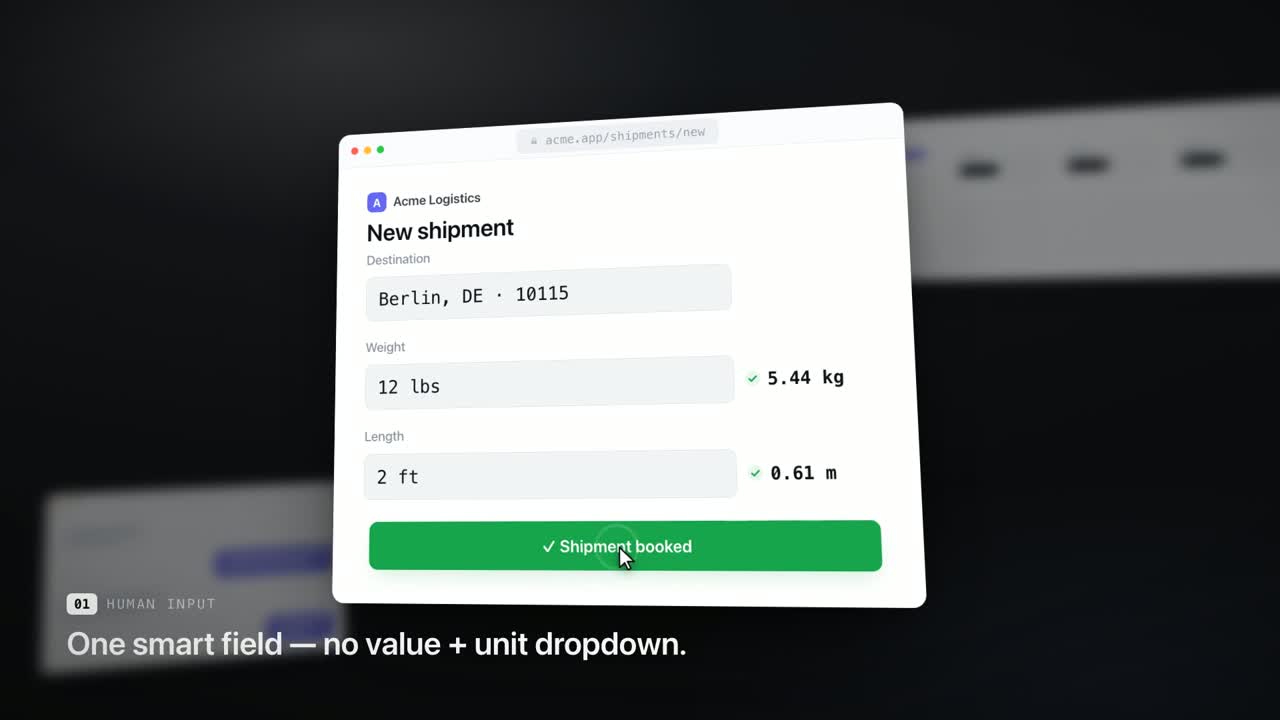
Make forms easier, LLM tools safer.
People type fast and loose: 180cm, 5ft 11, 1.5 cups, 90 min,next friday, 1,5 kg, typos included. Models emit fluent, over-formatted
strings: "5'11\"", "1½ cups", "twenty-five kg", "3pm EST","1,234 kg". Your database wants canonical values: one number in one unit,
one ISO date. The library is the layer in between: natural-language
quantities, units, dates, and ranges parsed into validated values, then
humanized back. Zero dependencies; English-first parsing with locale-aware
formatting (locale packs are on the roadmap, plan 013).
For the web. Use one text field instead of a value box plus a unit dropdown:
- Accepts how people actually type:
180cm,5ft 11,2 lb 3 oz,an hour and a half, typos with did-you-mean (5 meterz), and fuzzy words
(it's hot) where a field opts in. - Validation UX ships as data: fields are never yelled at mid-typing (
2 fis
incomplete, not invalid), and every issue carries a stable code, a human
message you can override, a span into the original input, and did-you-mean
suggestions. - No silent guesses: ambiguous input (
1,234: 1.234 or 1234?) returns a
deterministic best reading plus ranked alternatives and a warning;confirm
strictness turns each assumption into a one-click confirmation. - Two-way and tested: whatever
format()/humanize*()emits re-parses to the
same value.1.9999 mformats as6′7″, never5′12″. - Headless DOM controller,
<lingo-input>element, and React hook. No styles
shipped, no framework lock-in, and parsing is microsecond-scale, fast enough
to run on every keystroke.
For LLMs. Models are better at emitting "5'11\"" than 1.8034; the/ai fields make the string the reliable path:
- Standard Schema fields (
quantityField,dateField,lingoObject) drop
into AI SDK tools, OpenAI/Anthropic/Gemini strict modes, LangChain, and MCP
(lingoTool()). One field definition covers the provider wiring documented
in the recipes. - Tool-boundary defaults reject risky values: ambiguous numbers, ignored timezones,
and clock-drifting relative dates fail loudly with[CODE] ... Did you mean ...?
messages a model can self-correct from in one round trip. - Measured on a 160-fixture recorded canonicalization corpus (not an LLM
benchmark): naiveNumber()/new Date()coercion accepts 17.5% of it and
is silently wrong on 6.3%; lingo accepts 96.9% with zero silent-wrongs. - Deterministic and replayable: pass an explicit
nowand results are exactly
reproducible. The/aidate field requires it for relative dates, so a
queued or retried tool call never drifts across midnight. repairToolCallWith/canonicalizeValuesfix malformed payloads client-side,
with no extra model call.
One parser powers both sides. The same lingoObject can validate a model tool
call and a human form through Standard-Schema form resolvers (React Hook Form,
TanStack Form, ...).
This is the monorepo. The library README with install, API tour, and recipes lives
with the package: packages/lingo.
Layout
| Path | What it is |
|---|---|
packages/lingo |
@pascal-app/lingo, the published library (src, tests, bench, size/corpus/zero-deps gates) |
apps/site |
Docs site with live parser demos (Next.js, port 3000 or next free) |
plans/ |
Forward-looking specs, one numbered living markdown file per topic |
wiki/ |
As-built docs: architecture, decisions, conventions, credits, research |
AGENTS.md |
Canonical agent guide (hard rules, workflow, module map) |
CONTEXT.md |
Vocabulary glossary with canonical names and synonyms to avoid |
Quick start
bun install
bun run check     # typecheck + tests + build + size budgets + corpus gate + zero-deps gate
Develop (library + site together):
bun dev           # tsup --watch on the library + site dev (port 3000, auto-increments)
bun kill          # stop all lingo dev processes (ports 3000-3003 + this repo's watchers)
bun restart       # kill + clear .next*/.turbo caches + bun dev
The site consumes the library as a live workspace link, so watch rebuilds show
up in the running site. (cd apps/site && bun dev still works for site-only
work; bun run site:sync refreshes served data files like llms.txt.)
Contributing
See CONTRIBUTING.md. The short version: bun run check must
be green, zero runtime dependencies is non-negotiable, specs in plans/ are
living documents, and notable changes land in the CHANGELOG under [Unreleased].
License
MIT
Reviews (0)
Sign in to leave a review.
Leave a reviewNo results found