coding-ethos
Health Uyari
- License — License: AGPL-3.0
- Description — Repository has a description
- Active repo — Last push 0 days ago
- Low visibility — Only 5 GitHub stars
Code Gecti
- Code scan — Scanned 12 files during light audit, no dangerous patterns found
Permissions Gecti
- Permissions — No dangerous permissions requested
Bu listing icin henuz AI raporu yok.
Policy-as-code enforcement for AI agents: MCP server, CEL policies, git hooks, SARIF, and static analysis guardrails.
Coding Ethos








Policy-as-code enforcement for AI agents: MCP server, CEL policies, Git hooks,
SARIF, runtime sandboxing, and static-analysis guardrails.
coding-ethos turns engineering principles into runnable repository policy for
human contributors and AI coding agents.
The project currently holds an
OpenSSF Best Practices Silver badge
and tracks Gold readiness in
docs/OPENSSF_GOLD_CHECKLIST.md.
It keeps agent instructions, generated documentation, static-analysis config,
Git hooks, agent tool-use guards, MCP tools, CEL custom policies, generated
skills, and runtime axioms on one source contract. Human contributors and AI
agents see the same standards, run the same checks, and hit the same critical
safety gates before bad changes land.
Licensing
coding-ethos is dual-licensed to support both open-source and commercial
ecosystems.
Open Source License: The software is available under the AGPLv3. This is
ideal for open-source projects, academic use, and individuals.
Commercial License: If you wish to use coding-ethos in a proprietary or
closed-source product without being bound by the copyleft requirements of the
AGPLv3, we offer commercial licenses. Please contact [email protected] to discuss
commercial licensing options.
Use coding-ethos when you need:
- AI-agent guardrails for Codex, Claude Code, Gemini CLI, and other coding
agents. - A local MCP server that agents can call for policy checks, lint advice,
SARIF remediation, and ETHOS-grounded context. - Git hook enforcement that catches unsafe commands, protected path edits,
unmanaged tool use, and file-growth problems before commit time. - CEL policy-as-code that keeps repo-specific rules close to the ETHOS
principle they enforce. - SARIF and code-scanning output for CI, pull requests, IDEs, and trend
analysis. - Code intelligence that stores hook traces, SARIF, remediation outcomes,
Tree-sitter chunks, AST links, and sqlite-vec metadata in a repo-local
SQLite store for agent search.
30-Second Start
make install
make check
make install-hooks
For full Git plus AI-agent hook cutover:
make cutover-install
Start the local MCP server for configured agents:
bin/coding-ethos-run mcp
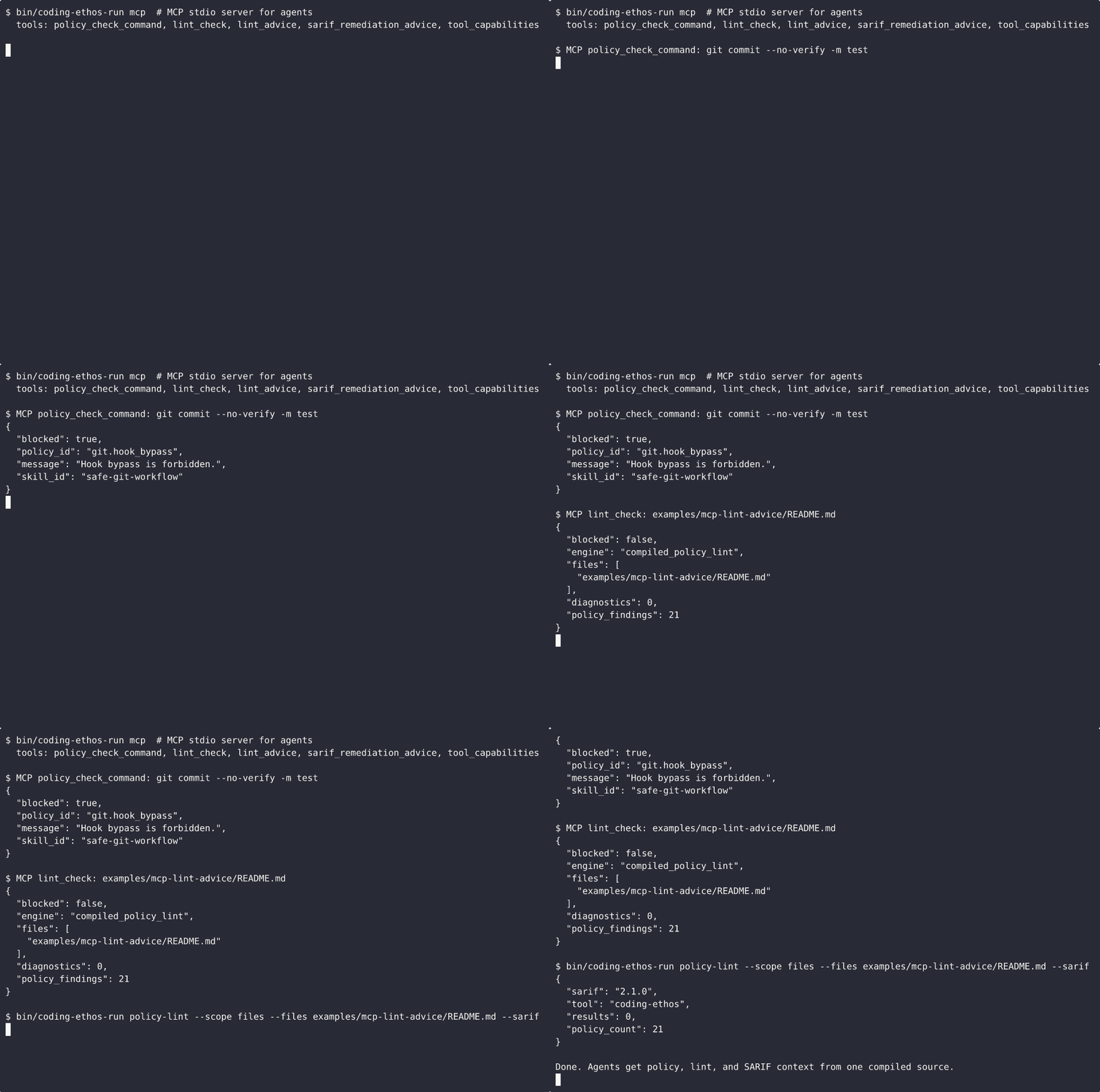
The project is built around defense in depth for AI-assisted coding:
- ETHOS as source:
coding_ethos.ymland repo overlays are the backbone:
principles own their skills, axioms, generated docs, and first-class policy
grounding. - Compiled enforcement: Go hook runtimes evaluate built-in policies and
typed CEL expression policies through the same decision model. - Managed tools: lint and type checks run through generated configs,
managed binaries, normalized diagnostics, and trace logging. - Runtime capabilities: managed tools declare network, Git, sandbox,
timeout, memory, CPU, and seccomp capabilities that CEL, MCP, traces, and
SARIF can all inspect. - Sandboxed capture: managed lint can run through the native sandbox
helper with Linux namespace isolation, read-only repository and.git
policy, disconnected network for offline tools, declared write paths, and
normalized denial evidence. - Agent steering: Claude, Codex, and Gemini receive generated hook settings,
MCP server configuration, skills, prompt addenda, and compact axiom advice. - Repair feedback: lint findings, blocked policy decisions, skill hints,
and MCP guidance all point agents back to the relevant ETHOS contract.
Why It Matters
AI coding work fails hardest when guidance and enforcement drift apart:
- a Markdown rule says one thing
- a linter checks another thing
- a Git hook allows a third thing through
- an agent sees the mismatch and treats the safety system as broken
coding-ethos closes that gap by compiling the repo's working agreement into
the places contributors actually work:
| Surface | What it gets |
|---|---|
| Agent context | AGENTS.md, CLAUDE.md, GEMINI.md, ETHOS.md, and deep principle docs |
| Tool config | Pyright, mypy, Ruff, Pylint, YAML, Bandit, SQLFluff, Tombi, and golangci-lint config |
| Git hooks | compiled Go policy preflight plus deterministic hook groups |
| Agent hooks | Claude, Codex, and Gemini tool-use guards |
| MCP | stdio policy, skill, lint, SARIF, and tool-capability queries from the compiled bundle |
| AI review | Gemini prompt packs grounded in ethos and repo config |
| CI/CD | SARIF output plus generated GitHub Actions and GitLab CI gates with actionlint, CodeQL, OSV-Scanner, zizmor, artifacts, package validation, and sandbox evidence |
| Audit data | .coding-ethos/hook-runs/, .coding-ethos/lint-runs/, and .coding-ethos/code-intel.db with policy, tool, SARIF, AST, remediation, and sandbox evidence |
Agents Used In This Repository
coding-ethos is developed with human review and AI-agent assistance. The
project explicitly targets and has been shaped by work with:
- Codex from OpenAI: coding, review, refactoring, documentation, and
repo-policy workflow validation. - Claude Code: coding, hook integration, generated skill surfaces, and
policy feedback loops. - Gemini CLI: review prompts, generated prompt packs, and independent
agent-hook compatibility checks.
Agent assistance does not change the quality bar. Generated or agent-authored
changes are expected to pass the same hooks, static analysis, tests, review
feedback, and ETHOS policy gates as human-authored changes.
The project heavily dogfoods its own guardrails: Codex, Claude, and Gemini are
run through the generated hooks, MCP configuration, skills, axioms, managed
toolchain, and policy feedback surfaces while developing coding-ethos itself.
Defense In Depth
Policy is intentionally layered. No single hook, file, or agent instruction is
trusted as the only line of defense.
coding_ethos.yml      repo_ethos.yml
       │                    │
       ├──── merged ethos ──┤
       │                    │
       ▼                    ▼
AGENTS.md / CLAUDE.md / GEMINI.md / ETHOS.md
.agents/ethos/ deep docs
.agent-context/ prompt addons
.agents/skills/ remediation playbooks
runtime axioms with MCP next steps
principle-owned CEL policies

config.yaml          repo_config.yaml
       │                    │
       ├── merged enforcement config
       │
       ├── generated tool configs
       ├── transitional CEL expression policies
       ├── Gemini prompt pack
       ├── Go policy bundle
       ├── Git hook runtime
       ├── agent hook runtime
       └── MCP server tools
The same inputs drive guidance and enforcement. Unknown linter findings still
flow through normally; findings tied to ETHOS principles can receive stronger,
policy-grounded advice instead of generic tool text. When a finding maps to a
generated skill, agent-facing output includes a compact skill_id hint and a
next action to load that remediation playbook.
Skills and axioms are part of the same defense-in-depth plan, not decorative
prompt text. Skills provide provider-portable remediation playbooks. Axioms are
short principle-local reminders that hooks surface when they are related to a
policy decision, always on lint calls, and statistically on other post-hook
events. Rendered axiom advice includes the MCP call an agent should use next,
so advice can escalate from compact guidance to policy_explain,skill_lookup, or skill_recommend without dumping full context into every
hook response.
CEL support extends that same model to repo-specific policy. First-class CEL
policies live with the ETHOS principle they enforce in coding_ethos.yml.
Config-level policy.expressions remains available for consumer overlays and
for transitional policy that has not yet been expressed as part of the ETHOS
contract. The compiler checks CEL up front, dispatches it through hook and lint
paths, and emits normal policy decisions with ETHOS grounding and skill hints.
Source-aware policy follows the documented
AST, CEL, and SARIF architecture. Go
collects normalized Tree-sitter facts, CEL owns configurable policy predicates,
and SARIF carries stable AST identity plus remediation metadata. The same facts
feed hook preflight, lint policy, SARIF, MCP, and code-intelligence storage.
New Python, Go, shell, JavaScript/TypeScript, YAML, JSON, TOML, or config
policies should extend that path before adding ad hoc text scanners or
policy-specific AST walkers.
Runtime capability policy uses the same path. Managed tools declare whether
they need network, Git, environment access, writable paths, sandbox profiles,
timeouts, memory, CPU, and seccomp profiles. Those facts are available to CEL
as tool_capabilities, exposed through MCP, retained in .coding-ethos
traces, and copied into SARIF run properties. The built-in managed-tool
contract blocks ordinary lint tools that forget to declare offline/no-Git
behavior or resource bounds.
Runtime sandboxing is the complementary data plane. The current Go runtime can
run managed lint capture through a repo-owned native helper with Linux
namespaces, Linux Landlock write policy for a read-only repository and .git,
disconnected network for offline tools, declared writable paths,
hard timeouts, cgroup resource requests, and seccomp profile metadata. Linux
cgroup limits are prepared before process start in a delegated hierarchy and
cleaned up after exit when the host delegates cgroup control. There is no
operator sandbox mode: Linux runs sandbox-profiled managed tools through the
native sandbox helper, and non-Linux platforms do not select Linux namespace
sandboxing. On Linux, namespace creation is a hard gate; if the host kernel or
policy blocks the native sandbox, managed sandboxed execution is blocked withruntime.sandbox_dependency or runtime.sandbox_denial diagnostics.
Non-Linux platforms report that Linux namespace enforcement is not available
and use the best available process execution evidence. See
docs/RUNTIME_SANDBOXING.md.
Code-intelligence storage is the memory layer for this evidence. The
repo-local SQLite store ingests hook traces, lint traces, SARIF, remediation
outcomes, hook usage analytics, Tree-sitter chunks, graph edges, and
AST-to-finding links. FTS5 provides exact search, while sqlite-vec stores
derived embedding rows for hybrid retrieval without a daemon or hosted vector
service. MCP tools expose search, code indexing, focused chunk lookup,
embedding candidates, and index status so agents can retrieve relevant context
before broad file reads or repeated failed repairs. See
docs/CODE_INTEL.md.
Repository trust surfaces are part of the product. The public repo now carries
CODEOWNERS, structured issue templates for policy rules, hook false positives,
and MCP tool requests, GitHub Discussion templates, Dependabot cooldowns for
all managed ecosystems, restricted Actions allow-lists, CodeQL, OSV-Scanner,
zizmor, Scorecard, fuzz smoke, release attestations, and SBOM generation. See
docs/TRUST_SIGNALS.md.
For larger platform directions such as deeper MCP context serving,
policy-language support, IDE integration, SARIF/CI components, red-team
testing, ETHOS inheritance, and agent remediation loops, see
docs/STRATEGIC_ROADMAP.md.
The documentation landing page is docs/index.md, and
promotion/security trust work is tracked in
docs/TRUST_SIGNALS.md.
Supply-chain trust controls, Scorecard publishing, GitHub artifact
attestations, SBOM generation, PyPI Trusted Publishing, and verification
commands are documented in
docs/SUPPLY_CHAIN_ATTESTATIONS.md.
CI publishes JUnit XML, Python coverage, and Go coverage artifacts for public
test evidence.
The security posture is summarized in docs/THREAT_MODEL.md,
and release readiness is documented in docs/RELEASE.md.
The verified demo transcript is docs/DEMO.md.
For positioning and adoption planning, see
docs/COMPARISON.md,
docs/INTEGRATIONS.md, and
examples/.
The CEL-first policy-language design is tracked in
docs/POLICY_LANGUAGE_STRATEGY.md.
CI/CD usage and SARIF upload examples are documented in
docs/CI_CD_SARIF.md.
Runnable and copyable examples start in examples/.
MCP Server
coding-ethos includes a local stdio MCP server backed by the same compiled
policy bundle and generated skill metadata used by Git hooks and agent hooks.
The design and expansion plan are documented in
docs/MCP_SERVER.md.
The server is exposed through the managed runtime:
bin/coding-ethos-run mcp
The first tools are intentionally narrow and auditable:
policy_check_command: check a proposed shell command before running it.policy_check_edit: check a proposed file edit before applying it.lint_check: run managed lint capture for Ruff, mypy, pyright, pylint,
ESLint, SQLFluff, and other captured tools; when no tool is supplied, run
compiled coding-ethos policy lint checks for current work.lint_advice: map a lint diagnostic to ETHOS policy, advice, and skill hints.sarif_remediation_advice: turn SARIF or retained trace evidence into
focused ETHOS-grounded repair guidance.sarif_risk_summary: summarize a SARIF run for policy, skill, file, tool,
severity, and next-action risk signals.sarif_trend_analysis: compare SARIF runs or retained traces for
introduced, fixed, persisting, reopened, and worsening findings.sarif_policy_feedback: report unmapped diagnostics, missing skills, weak
severity mappings, and noisy rules for policy authors.tool_capabilities: list managed tool capabilities, including network/Git
tags, sandbox profile, timeout, memory, CPU, seccomp profile metadata, and
declared read/write paths.policy_explain: return the compiled explanation for a policy ID.skill_lookup: return an ETHOS-derived skill playbook by skill ID.remediation_explain: expand an emittedagent_remediationitem into
policy, principle, skill, and retry guidance.code_intel_search: retrieve stored SARIF/remediation/code-chunk evidence
with FTS and sqlite-vec vector search.code_intel_index_status: report SQLite/sqlite-vec index freshness and
embedding coverage.code_similarity_check: preflight proposed code against indexed repository
symbols using normalized hashes and MinHash LSH.code_intel_repo_map: return a compact repository-wide AST map with ranked
files, symbols, and signatures for startup orientation.code_intel_index_code: refresh Tree-sitter chunks for Go, Python,
JavaScript/TypeScript, shell, YAML, JSON, and TOML paths.code_intel_code_chunks: fetch focused symbol/config chunks before broad
file reads.code_intel_code_context: expand a known chunk, symbol path, or file line
into nearest AST context, graph edges, and linked findings.code_intel_embedding_candidates: return compact traceable records for an
approved embedding producer.skill_recommend: recommend ETHOS-derived skills for the task at hand.
Hook, provider-native block responses, lint, SARIF, and trace outputs also
include an agent_remediation payload when a violation can be explained. Each
item carries a stable remediation ID, policy ID, ETHOS principle IDs, skill ID,
failed action or file location, concrete next steps, rerun commands when known,
and the next MCP call an agent should make. Agents can pass the full item toremediation_explain, or follow the embedded policy_explain orskill_lookup call directly. See Agent Remediation Payloads.
Tool definitions include coding_ethos metadata that tells clients whether a
tool is advisory, reads files, executes managed lint tools, and persists traces.
Agents should call lint_check instead of invoking linters directly so target
resolution, generated config integrity, managed tool versions, evidence maps,
skill hints, and trace logging stay on the enforced path.
Agents should call tool_capabilities before choosing a managed tool when
runtime behavior matters; it is the MCP view of the same capability facts CEL
uses for policy decisions.
The MCP server is advisory context, not a bypass. Hook enforcement remains on
the normal Git and agent-hook paths, and MCP responses come from the same
compiled policy inputs as those enforcement paths.
ETHOS Skills
Skills are generated remediation playbooks, not a separate hand-maintained
documentation layer. coding_ethos.yml defines each skill with its ETHOS
principles, trigger terms, short hint, focus, and remediation steps. make build renders those skills into the portable .agents/skills/ tree and the
native Claude, Codex, and Gemini skill locations.
The compiled policy bundle carries the same skill metadata. Runtime lint and
hook results attach a skill_id when a finding maps through an evidence map,
overlaps a skill's ETHOS principles, or matches a skill trigger term.
Agent-facing output stays compact: TOON and human output emit the skill ID,
short hint, and next action instead of dumping the full skill body into the
agent context.
Skill hints are also logged under .coding-ethos/lint-runs/. Those traces let
the project measure which remediation playbooks appear in real work and promote
recurring unmapped findings into stronger evidence maps or repo-specific
skills.
coding-ethos can also import retained lint and hook traces into a local
SQLite code-intelligence store for repeated-failure and remediation search:
bin/coding-ethos-run code-intel ingest-traces
bin/coding-ethos-run code-intel repeated-failures --policy-id python.unused_imports
bin/coding-ethos-run code-intel search --text 'unused import'
bin/coding-ethos-run code-intel anatomy-map --path pkg --format toon
ls pkg | bin/coding-ethos-run code-intel enrich-listing --command 'ls pkg'
bin/coding-ethos-run code-intel compact-context --path pkg/app.py
bin/coding-ethos-run code-intel proxy-file-read --session-id sess-1 --path pkg/app.py
bin/coding-ethos-run code-intel proxy-sessions --provider codex
bin/coding-ethos-run code-intel repeated-edits --path pkg/app.py
The store lives at .coding-ethos/code-intel.db; it is repo-local and derived
from retained traces, SARIF, AST chunks, proxy session events, remediation
records, and vector metadata. It is not a replacement for hooks or CEL policy
evaluation.
The directory anatomy map is inspired by Aider's repo map: agents get a compact
symbol preview before deciding which files to open, while coding-ethos keeps the
repo-local Go AST index as the source of truth. The proxy transform preserves
the original directory listing and appends a compact TOON anatomy block with
normal in-memory transform evidence. Successful Bash ls and tree
PostToolUse outputs are conservatively recognized through the shell parser,
refreshed against the repo-local AST index, and emitted as live proxy context
with a proxy.directory_anatomy event. ls listings stay directory-local;tree listings refresh recursive source files, and tree -L N caps the
anatomy map at the same displayed depth. enrich-listing remains the runnable
CLI bridge for applying the same append-only transform to captured listing
output; it does not persist a proxy event by itself.
At SessionStart, the hook runtime refreshes the repo-local AST index and
injects a compact coding_ethos_repo_map when source facts are available. The
same map is exposed through MCP as the code_intel_repo_map tool and thecoding-ethos://code-intel/repo-map resource, so agents can refresh or expand
startup orientation without broad directory listings or whole-file reads.
The proxy-file-read bridge records session-scoped file read cache evidence in
the same proxy ledger. The first unchanged read records a normal file_read
event with the file content hash. A later read of the same path in the same
session recomputes the file hash and, when it still matches, records acache_hit event and returns a short cached-read stub instead of resending the
file body. This is the reusable core for future transparent read interception.
Provider-native file read tools are the supported path for reading source.
Claude-style Bash file-tool emulation such as cat <path>,sed -n '1,20p' <path>, awk ... <path>, tee <path>, and echo/printf
write-redirection forms are blocked before execution so the provider preserves
structured file targets for policy evaluation. The code-intel proxy-file-read bridge
remains the explicit CLI path for session-scoped read-cache evidence and future
transparent read interception.
Agent Bash PostToolUse output also passes through the proxy transform path
before hook context is returned to the provider. Verbose shell, lint, compiler,
and test output is summarized with known diagnostic parsers where possible,
line-compressed, then capped by a hard token budget while preserving command
identity and the terminal failure tail. The token ledger uses a conservative
UTF-8 rune estimator, records every Bash PostToolUse action that includes a
session id, and stores the resolved budget source, payload measurements, token
usage, decision, and ordered transform records in .coding-ethos/code-intel.db.
Unknown model/context windows default to 2,000 output tokens; events that carry
model context metadata use bounded tiers of 4,000 (<=32k context), 8,000
(<=128k), 12,000 (<=256k), 24,000 (<=1M), or 32,000 (>1M), and an explicitproxy.output_compression.max_tokens repo setting wins. Whenever output is
removed, the runtime prepends a warning, writes the full original payload to acoding-ethos-tool-output-*.log evidence file in the system temp directory,
and surfaces that path in the visible marker. Stale matching temp evidence
files are pruned before new evidence is written. Repositories can tune this
behavior with proxy.output_compression in repo_config.yaml; token-budget
environment variables remain local runtime overrides for tests and diagnostics.
Parent install/check, parent lint, policy lint, policy-tool runs, and
pre-commit/pre-push refresh the store through the compiled runner. AST rows
store each source file's mtime and size, so repeated scans can skip unchanged
files before reading file contents. Source indexing follows Git's--exclude-standard ignore rules and records oversized, overlong, or
structurally dense sources as inactive metadata instead of parsing them into
expensive AST chunk sets. Refreshes also record staged/worktree diff hunk
fingerprints with the current Git HEAD, hunk coordinates, and nearest AST symbol
identity so repeated edits to the same code area can be learned without
persisting raw edited text.
Current built-in skills:
agent-operating-disciplineconditional-importslint-remediationmanaged-toolchainsafe-git-workflow
agent-operating-discipline adapts the useful behavioral pattern fromforrestchang/andrej-karpathy-skills
into coding-ethos' derived-skill model: explicit assumptions, simple designs,
surgical diffs, and verifiable success criteria. The upstream repo is a useful
inspiration source, but coding-ethos keeps the canonical text incoding_ethos.yml and regenerates provider-specific skill files from that
source.
Quick Start
Install dependencies and generated local artifacts:
make install
Run the standard verification gate:
make check
Install repo-local Git hooks:
make install-hooks
Install and verify the full Git plus agent hook cutover:
make cutover-install
Generate agent-facing files for this repo:
make generate
Generate files for another repo:
make generate REPO=/path/to/repo
PyPI Package Usage
The PyPI package installs the Python generator CLI plus the defaultcoding_ethos.yml, base config.yaml, and example overlays. That path is
useful for generating agent docs without cloning the source checkout:
uvx coding-ethos --repo .
The same CLI can be run through pipx:
pipx run coding-ethos --repo .
The PyPI package intentionally does not publish the compiled Go hook runtime or
managed binary toolchain. Full Git hook and agent-hook installation still uses
the source checkout/submodule path with make build andmake cutover-install; see Runtime Publication
for the release-asset strategy required before compiled runtimes are published
outside a source checkout.
In the source checkout, generated tool configs, generated GitHub/GitLab CI,
Gemini prompt packs, and provider skill surfaces are rendered only by
the compiled policy runtime exposed through bin/coding-ethos-policy andbin/coding-ethos-run policy.
Managed Runtime Architecture
The Go command binaries are intentionally thin. Product behavior lives in
focused internal packages, while go/cmd/* packages parse process entrypoint
arguments and delegate to those packages. This keeps hook execution, managed
capture, policy evaluation, code intelligence, MCP, and Git wrapping testable
without making Go code shell out to other coding-ethos Go binaries.
Current runtime ownership:
| Surface | Owning package |
|---|---|
| Hook groups and hook reports | go/internal/hookrunnercli |
| Git hook preflight and lifecycle hooks | go/internal/githookcli |
| Managed lint/test capture | go/internal/managedcapture plus go/diagnostics |
| Lint CLI orchestration | go/internal/lintcli |
| Policy bundle, config sync, and CI config sync | go/internal/policycli, go/internal/toolconfigs |
| Agent hook settings and checks | go/internal/agenthookscli, go/internal/agenthooks |
| MCP server and CLI | go/internal/mcp, go/internal/mcpcli |
| Code-intelligence ingestion/query | go/internal/codeintel, go/internal/codeintelcli |
| Git wrapper behavior | go/internal/policygitcli, go/internal/realgit, go/internal/gitwrap |
| Managed toolchain install and verification | go/internal/toolchaincli |
All managed tool output is expected to pass through the same evidence path:
catalog-backed execution, stream capture, parser normalization, diagnostics,
CEL policy promotion, trace retention, and SARIF formatting. Hook runner code
does not own parsing or formatting; it runs hook groups and reports normalized
results from the packages that own those concerns.
Common Workflows
| Goal | Command |
|---|---|
| Show resolved paths and config | make status |
| Check required local tools | make doctor |
| Refresh generated configs, managed tools, hook entrypoints, and parent runtime | make build |
| Run Python tests | make test |
| Run full local check | make check |
| Run all configured linters | make lint |
| Sync parent repo artifacts | make parent-install |
| Check parent repo artifact freshness | make parent-check |
| Sync and lint parent repo | make parent-lint |
| Run all configured formatters | make format |
| Apply managed autofixers | make fix |
| Format, then apply autofixers | make lint-fix |
| Smoke test the built wheel | make package-smoke |
| Dry-run release package checks | make release-dry-run |
| Validate hook runtime | make validate |
| Run Go tests | make go-test |
| Sync generated tool configs | make sync-tool-configs |
| Check generated tool config drift | make check-tool-configs |
| Sync Gemini prompt pack | make sync-gemini-prompts |
| Check Gemini prompt-pack drift | make check-gemini-prompts |
| Check generated agent skill drift | make check-agent-skills |
| Run staged-file hooks | make pre-commit |
| Run hooks over all files | make pre-commit-all |
| Run pre-push hooks | make pre-push |
| Generate agent docs | make generate |
| Preserve existing root agent docs while generating | make generate-merge |
| Use an external agent CLI for root-file merges | make generate-merge-llm |
Useful overrides:
make generate REPO=/path/to/repo PRIMARY=/path/to/coding_ethos.yml
make generate REPO=/path/to/repo REPO_ETHOS=/path/to/repo_ethos.yml
make sync-tool-configs \
  TOOL_CONFIG_REPO=/path/to/repo \
  REPO_CONFIG=/path/to/repo_config.yaml
make seed SEED_FROM=/path/to/ETHOS.md PRIMARY=/path/to/coding_ethos.yml
Parent Repo Workflow
For submodule consumers, prefer the Go runner as the stable interface and keep
Make as a thin alias:
coding-ethos/bin/coding-ethos-run parent-install
coding-ethos/bin/coding-ethos-run parent-check
coding-ethos/bin/coding-ethos-run parent-lint
The runner resolves the parent repo from Git when coding-ethos/ is installed
as a submodule. It accepts --repo, --repo-ethos, --repo-config, and--scope when the caller needs explicit paths. Parent command output is TOON:
install/check emit only status plus artifact-step rows, while parent lint emits
the normal coding-ethos TOON lint report. See TO_MY_PARENT.md for the parent
artifact contract.
Parent repos can opt into profile defaults in repo_config.yaml:
repo:
  kind: go-static-site
profiles:
  - generated-site-output
go-static-site enables Go-oriented checks and, when no Python sources are
present in the parent repo, disables Python pytest, docstring, and type-check
gates. Explicit repo_config.yaml settings override profile defaults.
Direct CLI Usage
The package exposes coding-ethos. During local development the Makefile runs
through uv run python main.py so repo-local sources are used.
Generate agent docs:
uv run coding-ethos --repo /path/to/repo --primary coding_ethos.yml
Seed a primary YAML file from Markdown:
uv run coding-ethos \
  --primary coding_ethos.yml \
  --seed-from-markdown /path/to/ETHOS.md
Sync generated tool configs:
make sync-tool-configs REPO=/path/to/repo
By default the same command writes the managed SARIF CI files and includes
them in .code-ethos/tool-config-hashes.json. The generated GitHub workflow is
reusable by default so a repo-level CI workflow can own concurrency, required
checks, package validation, and attestations without duplicate SARIF uploads.
Repos with a deliberate exception can setgenerated_config.ci.github_actions.enabled: false orgenerated_config.ci.gitlab.enabled: false in their merged enforcement config.
They are checked by make check-tool-configs; there is no separate CI sync
path.
Check generated tool config drift:
make check-tool-configs REPO=/path/to/repo
Trace and validate enforcement config:
bin/coding-ethos-run policy config-trace --json
Sync the Gemini hook prompt pack:
make sync-gemini-prompts REPO=/path/to/repo PRIMARY=coding_ethos.yml
Repository Model
| Source | Purpose | Derived output |
|---|---|---|
coding_ethos.yml |
shared ethos contract | root agent docs, deep principle docs, ETHOS skills, axioms, principle-owned CEL policies, and principle-derived tool config intent |
repo_ethos.yml |
repo-local context and overrides | repo-specific agent guidance and principle-derived tool config refinements |
config.yaml |
bundle-wide enforcement defaults | tool configs, hooks, prompt grounding |
repo_config.yaml / repo_config.yml |
consumer repo overrides | repo-specific enforcement |
pre-commit/prompts/ |
Gemini prompt templates | .code-ethos/gemini/prompt-pack.json |
pre-commit/ |
hook bundle | repo-local Git and agent hook runtime |
Generated Markdown files are derived artifacts. Change the YAML source or
renderer first, then regenerate and review the generated diff.
Generated Output
Agent-facing output:
repo/
├── AGENTS.md
├── CLAUDE.md
├── ETHOS.md
├── GEMINI.md
├── .agent-context/
│   └── prompt-addons/
│       ├── claude.md
│       ├── codex.md
│       └── gemini.md
├── .agents/
│   ├── ethos/
│   │   ├── README.md
│   │   ├── solid-is-law.md
│   │   └── ...
│   └── skills/
│       ├── conditional-imports/
│       │   └── SKILL.md
│       └── lint-remediation/
│           └── SKILL.md
├── .codex/
│   └── skills/
│       └── ...
├── .gemini/
│   └── extensions/
│       └── coding-ethos/
│           ├── gemini-extension.json
│           └── skills/
│               └── ...
└── .claude/
    ├── ethos/
    │   └── MEMORY.md
    └── skills/
        └── ...
Enforcement output:
repo/
├── pyrightconfig.json
├── mypy.ini
├── ruff.toml
├── .yamllint.yml
├── .bandit.yml
├── .sqlfluff
├── tombi.toml
├── .golangci.yml
└── .code-ethos/
    ├── cache/
    │   └── ... ignored runtime caches
    └── gemini/
        └── prompt-pack.json
Configuration
coding_ethos.yml
The primary ethos YAML is the shared source contract. It uses version: 2,
metadata, and an ordered list of principles. Each principle needs an id,order, title, directive, and at least one section or inline body.
The optional top-level skills list defines provider-portable skills grounded
in ETHOS principles. Generation emits the same skill body into the portable.agents/skills/ tree and the native Claude, Codex, and Gemini locations. The
compiled Go policy bundle also carries those skill definitions so linter
evidence can point at skill_id and runtime output can steer agents to the
right remediation playbook.
Each principle may also define local axioms. Axioms are short reminders owned
by the ETHOS principle they explain, not a separate enforcement-config list.
The compiler derives hook reminder advice from principles[].axioms, falling
back to the principle's quick_ref and directive when no explicit axioms are
present. That keeps advice, enforcement grounding, generated docs, and runtime
post-hook reminders attached to the same cohesive ETHOS entry.
Runtime hook advice surfaces those axioms in two stages: policy-related hook
results emit priority ETHOS reminders first, while unrelated post-hook output
gets one ambient reminder on lint calls and a sampled single reminder on other
calls. Rendered reminders include the MCP tool and arguments an agent should
call next, such as policy_explain for blocked policies or skill_recommend
for principle-level guidance.
Behavioral skills should follow the same source-of-truth rule as remediation
skills. For example, agent-operating-discipline incorporates ideas fromforrestchang/andrej-karpathy-skills
without copying static provider prompts into the repo; edits belong incoding_ethos.yml, then make build regenerates the checked-in surfaces.
Principles may declare typed tool_config intent for linter choices that are
part of the policy contract rather than raw operational defaults. The supported
schema is deliberately narrow: golangci_lint.linters.enable,golangci_lint.linters.disable, and Bandit enabled, exclude_dirs, andskips. Each item can carry a rationale; generated tool configs render that
provenance as comments so reviewers can see which principle owns a rule such as
enabling gosec or disabling misspell.
Accepted primary aliases when --primary is omitted:
coding_ethos.ymlcoding_ethos.yamlcode_ethos.ymlcode_ethos.yaml
repo_ethos.yml
The optional repo overlay adds local commands, paths, notes, per-agent notes,
principle overrides, and additional repo-specific principles.
Repo overlays may add the same typed tool_config entries onprinciples.overrides.<id> or principles.additional[]. These entries are
merged after the base ethos and before consumer repo_config.yaml overrides.
config.yaml and repo_config.yaml
coding_ethos.yml is the backbone of policy intent. config.yaml is the
bundle-wide enforcement artifact for generated tool settings, operational
defaults, and policy that has not yet been expressed cleanly with an ETHOS
principle. A consuming repo can refine the compiled enforcement artifact withrepo_config.yaml or repo_config.yml at the repo root, or by passing--repo-config.
Use tool_config on a principle when a linter setting expresses policy intent
with a stable rationale. Keep values in config.yaml when they are operational
defaults, installation details, line-length plumbing, formatter mechanics, or
transitional settings without a clear principle owner. Use repo_config.yaml
when a consumer repo needs the final local override; those overrides prune stale
principle provenance from generated config comments.
The merged config drives:
- generated Pyright, mypy, Ruff, Pylint, YAML, Bandit, SQLFluff, Tombi, and
golangci-lint config - generated GitHub Actions and GitLab CI SARIF gates, controlled by
generated_config.ci.*.enabled, timeout, trigger, artifact, test, and build
knobs - hook policy for Python, shell, text, commit-message, and Go checks
- Gemini AI review settings and prompt grounding
- shared style settings such as
style.python_versionandstyle.line_length
Code-intel also reads repo-root repo_config.yaml / repo_config.yml
directly for source indexing exclusions such as code_intel.exclude_paths.
Use that setting for repo-specific generated output that should not be indexed.
coding-ethos-policy config-trace validates known top-level enforcement
sections, compiles the merged bundle, validates it, and reports policy,
evidence-map, and dispatch counts. Use it when changing config.yaml or a
consumer repo_config.yaml so unknown sections do not silently drift.
License and copyright enforcement is repo-specific. Consumer repos do not
inherit this repo's license policy. To opt in, setrepo.license.spdx_identifier and, if desired, repo.license.copyright inrepo_config.yaml. The compiled policy downloads the SPDX license text,
verifies the repo LICENSE file without overwriting it, and requires matching
SPDX source headers.
Consumer repos that intentionally allow direct work on protected branches can
set repo.protected_branch_work.enabled: false in repo_config.yaml. That
repo-level switch disables branch-switch blocking and protected-branch
file-write blocking together while leaving history-rewrite prevention enabled.
The history-rewrite policy blocks amend commits, force pushes, branch-moving
resets, git checkout -B, and git branch -f; use a new commit instead of
rewriting review history.
CEL Expression Policies
First-class CEL policies should live under the relevant principle incoding_ethos.yml:
principles:
  - id: solid-is-law
    policy:
      expressions:
        - id: filesystem.line_limits
          scope: file
          severity: block
          when: >
            file_changes.exists(file, file.ext == ".py" && file.line_count > 1000)
          message: Large source files must not keep growing.
          advice: Split large files into focused modules before committing.
Consumer repos can also add small custom policies under policy.expressions inrepo_config.yaml. That path is an overlay and transitional extension point,
not the preferred home for shared ETHOS policy. These policies are CEL
expressions compiled into the policy bundle and evaluated by the same Go hook
runtime as Go-backed policies.
Use CEL for narrow predicates over normalized hook or lint data, for example
blocking a repo-specific command pattern:
policy:
  expressions:
    - id: custom.no_python_subprocess_git
      description: Block Python subprocess attempts to route around protected Git.
      scope: command
      severity: block
      principle_ids:
        - one-path-for-critical-operations
        - no-rationalized-shortcuts
      skill_id: safe-git-workflow
      when: >
        shell_commands.exists(cmd,
          cmd.name in ["python", "python3"] &&
          cmd.argv.exists(arg, arg.contains("subprocess")) &&
          cmd.argv.exists(arg, arg.contains("git"))
        )
      message: Git must use the approved repo workflow.
      advice: Run ordinary git commands without bypass flags or shell indirection;
        approved operations are routed by the hook automatically.
Current supported fields include:
command: raw command text for command-scope hook policies.argv: parsed command arguments when available.shell_commands: parser-normalized shell command facts frommvdan.cc/sh/v3/syntax, including command name, argv, leading assignments,
redirects, here-docs, line/column, background execution, dynamic expansion flags,
command/process substitution flags, shell-exec detection, Git detection,
lint-tool detection, and PATH override detection. Malformed shell text is
blocked before policy evaluation continues.files: repo-provided file targets for the current hook or lint event.file_changes: typed staged-file facts, including status, extension,
generated/test/protected flags, byte size, current line count, and original
line count when Git can provide it.diff: staged diff facts prepared by Go, including changed/staged file
lists, hunks, added lines, removed lines, line numbers, old/new line numbers,
and hunk headers.event: provider-native hook metadata such as provider, hook name, tool,
source, matcher, session ID, transcript path, tool-input/tool-response keys,
return code, and provider booleans for Claude, Codex, and Gemini.cwd: invocation working directory.scope: expression scope such ascommand,path,diagnostic, orfinding.metadata: non-sensitive event metadata.path,diagnostic,finding, andrepo: typed objects for the initial
path, diagnostic, finding, and repo policy slices.similarity_facts: MinHash LSH-based code similarity results for the current
file set, including source/match paths, symbol metadata, Jaccard similarity
score, and exact-normalized flag. Populated lazily from the code-intel store
only when the CEL expression referencessimilarity_facts. Runtime
thresholds and MinHash parameters come fromconfig.yaml'ssimilarity
section.
CEL is intentionally pure. Expressions cannot read files, run shell or Git,
inspect environment variables, access the network, or depend on wall-clock
time. Go prepares normalized facts; CEL decides over those facts.
Every expression policy must be ETHOS-grounded with principle_ids, and should
include a skill_id when a generated skill explains the remediation path. CEL
matches emit normal coding-ethos decisions, diagnostics, TOON/human output,
trace data, and skill hints.
Current boundary:
- CEL now covers most simple and medium-complexity policy predicates over
normalized facts, including Git, shell, file, diff, repo, path, diagnostic,
finding, and event inputs. - Multi-file and multi-finding semantics must use explicit collections such as
paths,files,file_changes,findings, anddiff; do not depend on
implicit first-file ordering. - Diff line facts are staged-diff facts. Policies that need unstaged editor
content should use hook file/content facts or a purpose-built Go evaluator. - Keep parsing, Git state modeling, managed toolchain behavior, path
normalization, file-content scanning, generated-config freshness, and other
security-sensitive fact collection in Go. CEL decides over prepared facts; it
does not inspect the host directly.
See docs/POLICY_LANGUAGE_STRATEGY.md for
the CEL-first decision record and the roadmap for a complete generic policy
engine.
Merge Behavior
--merge-existing preserves root agent files:
AGENTS.mdCLAUDE.mdGEMINI.md
ETHOS.md and supporting generated files are replaced with deterministic
output.
Inject merge is the default strategy:
uv run coding-ethos --repo /path/to/repo --merge-existing
It inserts managed import blocks and addendum blocks into existing root files.
Re-running is idempotent, and locally authored content outside managed blocks
is preserved.
LLM merge asks an installed codex, gemini, or claude CLI to mergeexisting.md and generated.md inside an isolated temporary workspace:
uv run coding-ethos \
  --repo /path/to/repo \
  --merge-existing \
  --merge-strategy llm \
  --merge-engine gemini \
  --merge-bin /path/to/gemini \
  --merge-timeout-seconds 300
The selected CLI must already be installed and authenticated. The merge process
must write merged.md; otherwise the command fails.
Hook Runtime
The bundled enforcement package lives under pre-commit/. It uses
repo-local Git hook entrypoints that resolve directly to the compiledbin/coding-ethos-run runner.
Git Hooks
Installed Git hook entrypoints are small executable scripts that callbin/coding-ethos-run git-hook <hook> orbin/coding-ethos-run lfs-hook <hook> with the original Git arguments. The
runner repairs missing checkout-local runtime artifacts with make build and
dispatches to the built hook binary.
Policy selection and validation remain inside the coding-ethos checkout.
Run Git hooks:
make pre-commit
make pre-commit-all
make pre-push
Hook output honors hooks.output_format (auto, human, json, or toon).auto selects TOON when known agent or LLM environment markers are present.
Successful groups are silent by default; failure output is intentionally narrow:
show the failing checks and actionable findings, not pass tables, internal group
names, or timings that do not help fix code.
When policy preflight has both record-only context and blocking decisions, the
agent-facing result reports the blockers first and omits non-blocking record
rows from the compact finding table.
Compiled lint preflights also write normalized JSON traces under.coding-ethos/lint-runs/. Fresh repos with no trace directory analyze as an
empty history, and trace filenames use portable scope names so captured tool
results work across platforms.
Captured linter runs follow a single event contract: store the original argv,
the rewritten argv, exit code, parser identity, parser outcome, redacted
stdout/stderr excerpt for tool/config failures, normalized diagnostics, and any
ETHOS mapping that was applied. A nonzero tool run with no parsed diagnostics is
itself a finding, not an empty result; the agent-facing output must explain
which tool failed, why it could not produce normal diagnostics, and what command
or configuration should be checked next.
Captured tool execution is controlled by coding-ethos, not by the target repo:
the target repo is treated as an untrusted file tree and trace destination.
Wrappers must not trust target-repo PATH, absolute binaries, uv run
settings, pyproject.toml, shell state, aliases, or local tool installs.
Captured stdout and stderr are drained concurrently so high-volume stderr from a
managed tool cannot deadlock a run while stdout remains open.
Python linters are run from the coding-ethos hook project with coding-ethos
versions and explicit coding-ethos generated config flags (ruff.toml,mypy.ini, pyrightconfig.json, .pylintrc, .yamllint.yml,.bandit.yml, .sqlfluff, and tombi.toml). Parent
repo config files with the same names must not be discovered accidentally.
For non-linter Python commands, hooks prefer the consumer repo environment:uv run --project <repo> python ... for uv projects, then<repo>/.venv/bin/python ... when only a virtualenv exists. The runtime also
adds <repo>/.venv/bin to PATH after coding-ethos-managed directories so
protected shims remain first.
Binary linters such as ShellCheck, actionlint, hadolint, dotenv-linter,
golangci-lint, kube-linter, ESLint, and tsc are installed intobuild/toolchain/ through the managed installer. ShellCheck, actionlint, and
hadolint use pinned GitHub release assets with SHA-256 digests; actionlint,
golangci-lint, and kube-linter are built into the managed Go bin directory with
the repo Go toolchain; ESLint and tsc are installed from checked-in npm
lockfiles and exposed through managed wrappers.
The source manifest lives at pre-commit/hooks/managed-toolchain.tsv, and the
installed toolchain writes build/toolchain/manifest.tsv. Hook execution treats
missing managed binaries as runtime artifact failures instead of falling back to
host tools.
ESLint is registered as the javascript hook group and as a managed capture
tool, but it is not part of the default pre-commit or pre-push group set until a
repo opts in and owns an explicit ESLint config boundary.tsc is also registered in the javascript hook group. It runs at the
TypeScript project boundary with --noEmit --pretty false --project <repo>/tsconfig.json, because TypeScript compiler diagnostics are
project-level facts rather than safe per-file checks.
kube-linter is registered as the kubernetes hook group and as a managed
capture tool. It first filters YAML candidates to documents that parse with
top-level Kubernetes apiVersion and kind fields, then runs those manifest
paths with lint --format json; the hook group is opt-in so generic YAML files
are not passed to kube-linter by extension alone.
Current managed lint and analyzer integrations:
| Tool | Ecosystem | Managed acquisition | Diagnostic parser |
|---|---|---|---|
| Ruff | Python | hook project | JSON and text |
| mypy | Python | hook project | JSON lines and text |
| Pyright | Python | hook project | JSON |
| Pylint | Python | hook project | JSON |
| Bandit | Python security | hook project | JSON |
| SQLFluff | SQL | hook project | JSON |
| Tombi | TOML | hook project | text |
| yamllint | YAML | hook project | parsable text |
| ShellCheck | shell | pinned GitHub release | JSON |
| actionlint | GitHub Actions | pinned Go install | JSON lines |
| hadolint | Dockerfile | pinned GitHub release | JSON and text |
| dotenv-linter | dotenv | pinned GitHub release | text |
| golangci-lint | Go | pinned Go install | JSON |
| ESLint | JavaScript and TypeScript | pinned npm lockfile | JSON |
| tsc | TypeScript | pinned npm lockfile | text |
| kube-linter | Kubernetes YAML | pinned Go install | JSON |
The repo Makefile exposes only unified managed tool groups for ordinary source
quality work: make lint runs the linters group, make format runs theformatters group, make fix runs the autofixers group, and make lint-fix
runs format followed by fix. These targets call coding-ethos-run policy-tool-group ...; they must not invoke individual linters or formatters
directly, because direct tool output bypasses normalized diagnostics, trace
storage, CEL evaluation, and SARIF generation.
Analyze captured lint history:
bin/coding-ethos-run policy-lint --analyze-log
bin/coding-ethos-run policy-lint --analyze-log --for-files lib/python/app.py
bin/coding-ethos-run policy-lint --replay .coding-ethos/lint-runs/<trace>.json
Emit SARIF for CI/code-scanning surfaces:
bin/coding-ethos-run policy-lint --sarif --scope files --files lib/python/app.py
bin/coding-ethos-run policy-lint --managed-capture-tool ruff --sarif -- check lib/python/app.py
bin/coding-ethos-run policy-lint --sarif --replay .coding-ethos/lint-runs/<trace>.json
SARIF is the superset evidence artifact. Everything coding-ethos can observe
about a managed run belongs in SARIF: parsed diagnostics, pathless tool-level
failures, parser state, exit status, stdout/stderr capture, sandbox evidence,
ETHOS rule metadata, remediation skill IDs, and deterministic fingerprints.
CEL receives the understood subset: normalized facts and diagnostics that are
stable enough for deterministic policy decisions. A finding can therefore be
SARIF-only when it is observed but not yet understood by CEL.
Code-scanning consumers still prefer repository-relative artifact URIs for
inline annotations. coding-ethos emits locatable findings with exact locations
when locations exist, and emits pathless/tool-level SARIF results plus run and
result properties when the evidence is aggregate or execution-level. Audit, MCP
remediation, and code-intelligence ingestion must not lose what the tool
actually emitted merely because a finding is not tied to one source line.
Managed capture derives native sandbox use from the platform and tool catalog.
Sandbox backend, profile, declared capabilities, and denials are retained in
lint traces and SARIF run properties so runtime enforcement has the same audit
trail as CEL and static-analysis findings. The checkout build runscoding-ethos-toolchain validate-sandbox-runtime; on Linux, that gate proves
that native namespace creation works before managed runtime artifacts are
advertised.
Agent-facing lint output includes an agent_remediation block in JSON and TOON
formats. SARIF result properties and retained .coding-ethos/lint-runs/
traces carry the same derived payload so CI findings, MCP remediation, and
local hook failures point agents at the same next action instead of duplicating
advice logic.
The analyzer highlights unmapped tool/code pairs separately from ETHOS-backed
findings so real lint traces can drive the next evidence-map additions.
Replay renders the saved normalized result without invoking the underlying
linter, which makes bad agent output reproducible from a trace file.
Captured traces include emitted skill hints so later analysis can show which
ETHOS remediation playbooks are being suggested in real work.
Output quality is part of the contract: blocked results must not render empty
finding tables, absolute local paths, internal timing/group noise, or generic
guidance without at least one actionable finding. Golden-output tests should
cover normal lint failures, clean runs, invalid config, malformed tool output,
and tool crashes for every managed linter.
Agent Hooks
Render or verify repo-local agent hook settings:
bin/coding-ethos-run agent-hooks print
bin/coding-ethos-run agent-hooks sync
bin/coding-ethos-run agent-hooks doctor
bin/coding-ethos-run agent-hooks verify
Agent hook generation is all-or-nothing. sync writes every supported
repo-local surface:
| Provider | Native file | Coverage |
|---|---|---|
| Claude | .claude/settings.local.json, .mcp.json |
full runtime hook set plus MCP stdio server |
| Codex | .codex/config.toml |
native supported hook events plus MCP stdio server |
| Gemini CLI | .gemini/settings.json |
native supported hook events plus MCP stdio server |
Codex runs one native command hook per supported event so current Codex
sessions enter the same policy runtime without depending on unstable tool
matcher names. Generated Codex config does not inline PATH= mutations,
installs explicit shell/edit matchers for tool hooks, and keeps lifecycle hooks
matcher-free. In nested checkouts, only the hook whose consumer root is the
nearest repo root enforces a Codex event, preventing duplicate parent/nested
reports.
The same sync path also installs the local coding-ethos MCP server for all
supported agents. Claude receives a project .mcp.json entry, Codex receives a
managed [mcp_servers.coding-ethos] block in .codex/config.toml, and Gemini
receives a mcpServers.coding-ethos entry in .gemini/settings.json. doctor
checks those entries along with hooks so MCP drift is not a separate hidden
setup step.
Generated ETHOS skills and native agent settings use the same managed-output
model. make build refreshes the checkout-local skill surfaces, hook settings,
and MCP settings and, when coding-ethos is installed inside a parent
repository, refreshes the parent repo's .agents/skills/, .claude/skills/,.codex/skills/, Gemini extension skill surfaces, and native agent hook/MCP
settings without rewriting parent root agent docs.
agent-hooks verify runs doctor first, then invokes the configured hook command
with provider-native Claude, Codex, and Gemini payloads. The probes cover:
- Claude transparent Git wrapper rewrite
- Codex blocks for raw Git, absolute Git paths, nested shell Git, and Python
subprocess Git when rewrite is unavailable - Gemini deny responses for raw shell Git and write-tool policy denial
- managed hook-binary tampering:
rm ...coding-ethos-git-hook && go build -o ...coding-ethos-git-hook
Hook logs under .coding-ethos/hook-runs/ include stdout, stderr, metadata,
and a sanitized event.json for agent-hook executions. Add--coding-ethos-debug to a hook-runner or Bash tool command to capture
structured debug events in debug.log and stderr for that run. The trace
records provider, event, tool, cwd, referenced files, command preview and hash,
policy IDs, status, and output shape without dumping raw provider input.
Each hook result records runtime duration, and debug traces emit a slow-hook
event when inspection exceeds the managed budget. CEL event facts also include
the active TodoWrite item when a provider supplies one, so policies can connect
shell activity to the agent's current task without reading provider memory.
Agent shell commands are accepted through one runner boundary. cerun -- ...
executes the target command under the managed runtime, cerun --check -- ...
performs a non-executing preflight, cerun git ... and cerun python ...
apply managed rewrites before execution, and cerun lint ... runs the managed
policy-lint path. Nested cerun/agent-shell invocations are rejected because
the first boundary is the enforcement point.
Claude Bash file-tool emulation is blocked. Commands such as cat README.md,sed -n '1,20p' README.md, awk '{print}' README.md, tee README.md, andecho text > README.md must use provider file tools instead, preserving
structured file targets for policy evaluation. Claude /permissions entries
should allow only the literal runner forms such as Bash(cerun -- *) andBash(cerun --check -- *); provider permission prompts do not weaken the
coding-ethos hook and runner checks.
Cutover
Use cutover commands when preparing a repo to install the active generated hook
surfaces:
bin/coding-ethos-run cutover install
bin/coding-ethos-run cutover verify
cutover install installs repo-local Git hook entrypoints, syncs every supported
agent hook surface, and runs readiness verification. cutover verify checks
Git hooks, agent hooks, required runtime ignores, and policy runtime
validation, then emits a concise TOON readiness report.
Tamper And Bypass Handling
Agent shell policy rejects hook-system reconnaissance and protected hook binary
tampering. Banned strings are rejected when they appear directly in a command
and when they appear in regular files referenced by the command.
Direct attempts to inspect, delete, rebuild, replace, chmod, or write managed
hook binaries under coding-ethos/bin/ are treated as tampering, not as
ordinary lint failures. Blocked tamper and Git-bypass responses start with a
uniform CODING-ETHOS EMPLOYMENT VIOLATION warning before the policy-specific
finding, including explicit language that the actor has done something wrong
and that continued circumvention attempts may result in termination.
Provider output uses the strongest native shape each agent supports:
| Provider | Block shape | Context/advice shape |
|---|---|---|
| Claude | hookSpecificOutput.permissionDecision = deny |
full hookSpecificOutput, including updatedInput |
| Codex | decision: "block" plus permissionDecision: "deny" for PreToolUse; compact reason text for exit-code-2 stderr |
compact native additionalContext for supported lifecycle/post-tool advice; compact systemMessage only where Codex exposes no additionalContext |
| Gemini | decision: "deny" plus systemMessage |
additionalContext on supported lifecycle hooks |
Agent-Hook Scope
The agent-hook path runs deterministic compiled evaluators only: Python policy
checks, structured-data syntax validation, merge-conflict detection,
private-key detection, PII scrubbing, repo-specific license headers, required
runtime ignore checks, shebang checks, large-file limits, line limits, and
shell best-practice checks.
Python policy checks use Tree-sitter for the import and functional-idiom
surfaces. Conditional-import enforcement blocks write-time introduction of
function-local imports, TYPE_CHECKING import branches, module __getattr__
import shims, __import__, and importlib.import_module; functional-idiom
guidance flags assigned lambdas and closure factories with functools,operator, and itertools remediation advice.
Gemini review checks remain in pre-commit/pre-push. Agent hooks never call
Gemini or another model from the tool-use path.
Continuation state is stored under the configured hook continuation directory.
Admin-Gated Work On This Repo
For work directly on coding-ethos, an admin may authorize a specific agent
session by placing an approved process PID in /etc/coding-ethos-admin.pids.
In that repo-local, admin-supervised case only, the Git wrapper accepts--admin-approved before the Git subcommand:
bin/coding-ethos-run policy-git --admin-approved commit -F /tmp/msg
The flag only changes git.staged_admin_files from block to record. It does
not disable other policy and is invalid outside this repository.
Agents must not use /usr/bin/git or any other raw Git path for this workflow.
Development
The CLI stays thin. Behavior belongs in focused modules:
| Path | Responsibility |
|---|---|
coding_ethos/loaders.py |
validate and merge ethos YAML |
coding_ethos/renderers.py |
render deterministic Markdown |
coding_ethos/merging.py |
managed-block injection and external merge orchestration |
go/internal/toolconfigs/ |
source-checkout generated repo-root tool config and CI sync/check |
go/internal/geminiprompts/ |
source-checkout Gemini prompt-pack sync/check |
go/internal/agentskills/ |
source-checkout provider skill-surface sync/check |
go/internal/hookrunnercli/ |
active hook runtime, hook groups, and hook reports |
go/internal/managedcapture/ |
managed linter/test execution capture |
go/diagnostics/ |
parser normalization for lint, formatter, type-check, and test output |
go/internal/codeintel/ |
repo-local trace, SARIF, AST, vector, and remediation storage |
go/internal/agentproxy/ |
provider-neutral agent event envelope and token-saving transform foundations |
go/cmd/ |
thin process entrypoints for compiled policy, hook, lint, MCP, code-intel, and wrapper tools |
When flags, output layout, merge behavior, overlay semantics, or enforcement
config behavior change, update this README, the relevant example YAML, and the
tests in the same change.
Verification
Canonical local verification:
make build
make check
make build is the explicit environment mutation target. It refreshes generated
configs, managed tools, hook entrypoints, provider settings, policy bundles,
and the parent hook runtime when this checkout is installed as a submodule.
Test and diagnostic targets do not run build implicitly; if the managed
runtime is missing, they fail fast and tell the operator to run make build
deliberately. Go tests follow the normal Go workflow through managed capture:make go-test runs go test, make go-e2e-test runs the e2e package withgo test, and make check uses those test targets without a separate
compile-and-run test path. Tests must not install tools, regenerate configs, refresh hooks,
sync parent artifacts, or otherwise mutate the operator environment as hidden
setup.
Broader verification for hook work:
make validate
make go-test
make go-tools-test
make go-tools-smoke
make pre-commit-all
After source changes:
| Change | Follow-up |
|---|---|
coding_ethos.yml, repo_ethos.yml, or renderers |
make generate |
| generated tool-config behavior | make sync-tool-configs |
| Gemini prompt templates or grounding | make sync-gemini-prompts |
| ETHOS skill source or renderer behavior | make build |
| hook runtime or cutover behavior | make cutover-verify |
See pre-commit/PRE-COMMIT.md and
pre-commit/hooks/HOOKS.md for hook internals.
Yorumlar (0)
Yorum birakmak icin giris yap.
Yorum birakSonuc bulunamadi