claude-agent-tools
Health Warn
- License — License: MIT
- Description — Repository has a description
- Active repo — Last push 0 days ago
- Low visibility — Only 6 GitHub stars
Code Fail
- fs module — File system access in .github/workflows/android.yml
- new Function() — Dynamic code execution via Function constructor in .github/workflows/ci.yml
- fs module — File system access in .github/workflows/ci.yml
- os.homedir — User home directory access in agent-viz/capture.js
- fs module — File system access in agent-viz/capture.js
- fs module — File system access in agent-viz/phone.sh
- child_process — Shell command execution capability in agent-viz/report.js
- os.homedir — User home directory access in agent-viz/report.js
- process.env — Environment variable access in agent-viz/report.js
- fs module — File system access in agent-viz/report.js
- child_process — Shell command execution capability in agent-viz/server.js
- exec() — Shell command execution in agent-viz/server.js
- fs.rmSync — Destructive file system operation in agent-viz/server.js
- os.homedir — User home directory access in agent-viz/server.js
- process.env — Environment variable access in agent-viz/server.js
- fs module — File system access in agent-viz/server.js
Permissions Pass
- Permissions — No dangerous permissions requested
No AI report is available for this listing yet.
Automatic model routing + live agent dashboard for Claude Code. Haiku for lookups, Sonnet for daily work, Opus to orchestrate - watch every agent, model and dollar in real time.
Claude Agent Tools
Automatic model routing and a live agent dashboard for Claude Code.
Haiku answers the lookups, Sonnet does the daily work, Opus plans the big jobs —
and you watch every agent, model and dollar in real time.
▶ Try the live demo · English · 简体中文







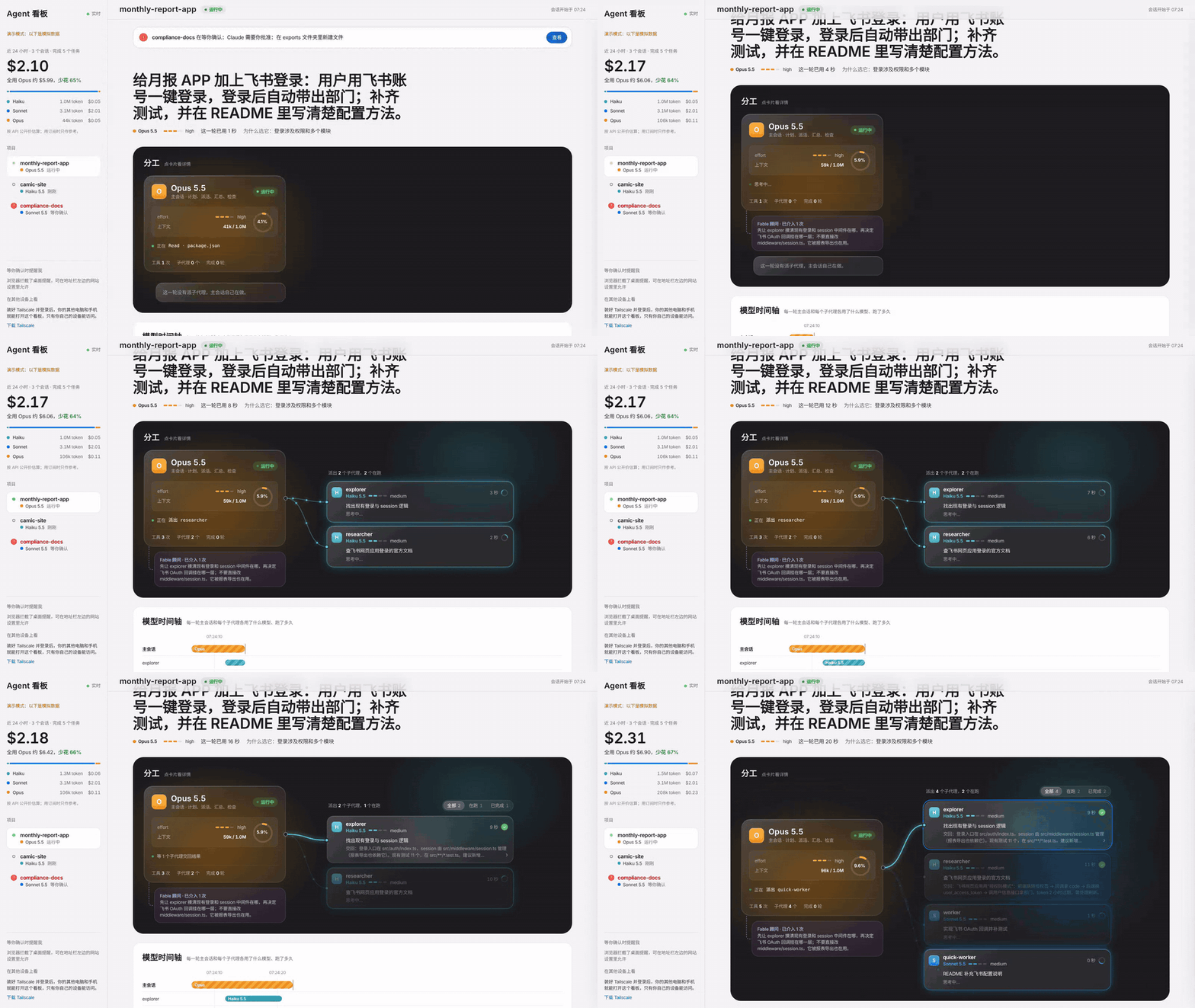
Demo data. Open the live demo · full-quality video
Why
Claude Code uses one model for everything unless you keep typing /model. That means paying Opus prices to ask "where is the login code?", or asking Sonnet to architect a migration. And when a session fans out into sub-agents, you can't see who is doing what.
This repo ships two small tools that fix both:
| What it does | |
|---|---|
| auto-router | A Claude Code plugin that picks the model and effort every turn, and for every sub-agent. Simple questions go to Haiku, everyday coding to Sonnet, architecture and multi-step jobs to Opus (which plans and delegates). A built-in report shows what it saves you versus running everything on Opus — measured on your own transcripts, not promised. |
| agent-viz | A local dashboard at http://localhost:4321: every project, the current task, a live tree of the main session and its sub-agents, which model each one runs, a model timeline, estimated cost and savings, and an alert when Claude is waiting for your approval. Works on your phone too. |
How it compares
| claude-agent-tools | claude-code-router | ccusage | /model by hand |
|
|---|---|---|---|---|
| What it is | Plugin + local dashboard | Proxy in front of Claude Code | Usage analyzer CLI | Built in |
| Picks the model | Every turn and every sub-agent, automatically | By scenario (background, thinking, long context…), to any provider | — | You, when you remember |
| Stays on Anthropic models, no proxy | ✓ | Routes through its proxy | ✓ | ✓ |
| Sees sub-agents live | ✓ | — | — | — |
| Shows cost | Live, plus a savings-vs-Opus report | — | ✓ detailed usage & cost reports | — |
Use it alongside ccusage if you like its reports; use claude-code-router if you want non-Anthropic models. This project is for people who want to stay on Claude and stop overpaying for easy turns.
Features
- Per-turn routing — keyword rules first, then a Haiku classifier for the rest. Tag a prompt with
#opus,#sonnet,#haikuor#fableto override once;/route opusto pin. - Multi-model teamwork — big tasks ("implement docs/spec.md") get Opus as the orchestrator,
explorersub-agents on Haiku to read code,workersub-agents on Sonnet to write it. - Plan → execute — in plan mode (Shift+Tab) Opus writes the plan; once you approve, Sonnet carries it out.
- Guard rails — Haiku hands over to Sonnet before editing a 4th file or running risky commands (
rm -rf,git push, migrations, deploys); 3 tool failures in a turn escalate one tier on the spot; downgrades need two confirmations. - Cache-aware — the prompt cache belongs to one model, so a switch makes the new model re-read the whole conversation at the cache-write price. While the current model's cache is warm, the router only downgrades when the turn will earn that back (it learns whether your cache lasts 5 minutes or 1 hour); the status line shows how long the cache has left.
- Test gate — when Haiku or Sonnet changed code, your tests run before the turn ends. If they fail, the turn steps up to Opus and keeps fixing — once per turn, never in a loop. Detects npm / pnpm / yarn / bun, pytest, cargo, go and
make test; skipped when the model already ran the tests itself. /routecard, on your phone too — model and why, cache time left, test gate, running sub-agents and session cost as one card in the terminal, the desktop app, and the Claude app via Remote Control.- Live agent tree — curved links with flowing particles while a sub-agent runs, a green pulse back when it reports, hover to trace a branch, click any card for its full brief, result and every tool step.
- Model timeline & cost — which model ran each turn and each sub-agent, token use per model, estimated cost and how much you saved.
- "Needs you" alerts — banner, desktop notification or sound when a session is blocked on your approval.
- Anywhere access — Tailscale (private, zero config) or your own domain via Cloudflare Tunnel + Access email login; add it to your phone's home screen and it opens as an app on the card view.
- Savings report —
node ~/.claude/viz/app/report.jsreads your local transcripts: spend per model, all-Opus baseline, routed vs. un-routed sessions;--mdfor a shareable write-up. - English and 中文 — router messages, dashboard (with an EN | 中文 switch) and installers follow your system language.
- Apple-style liquid-glass UI, light theme, mobile layout, reduced-motion support.
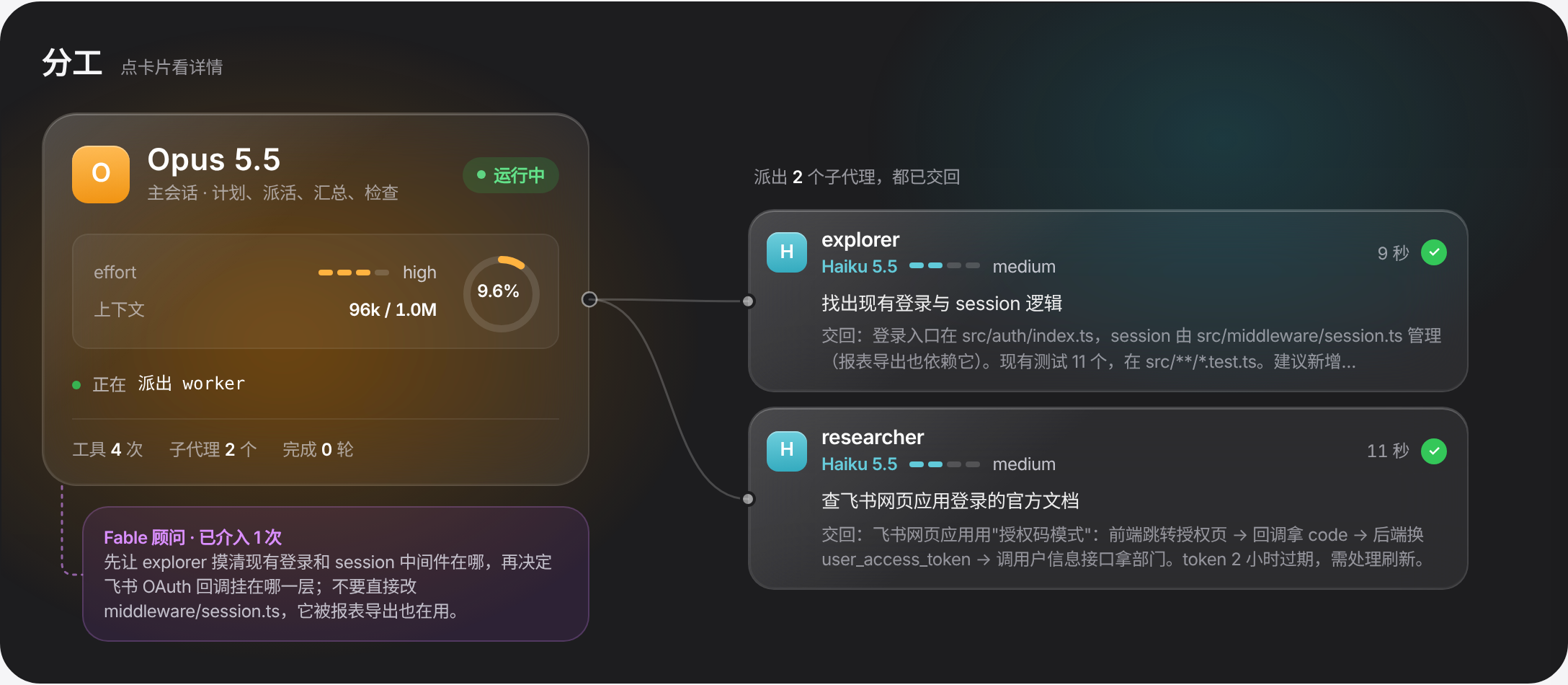 |
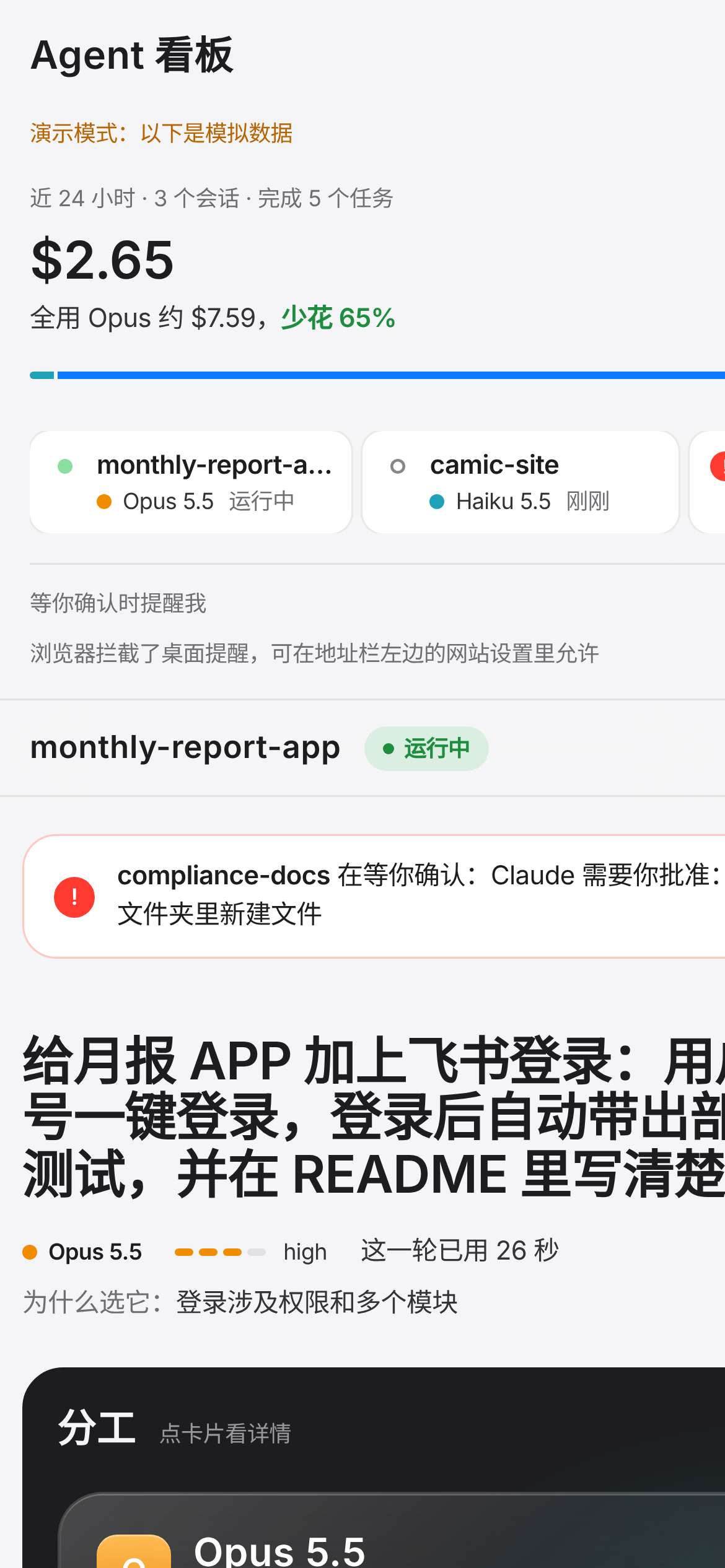 |
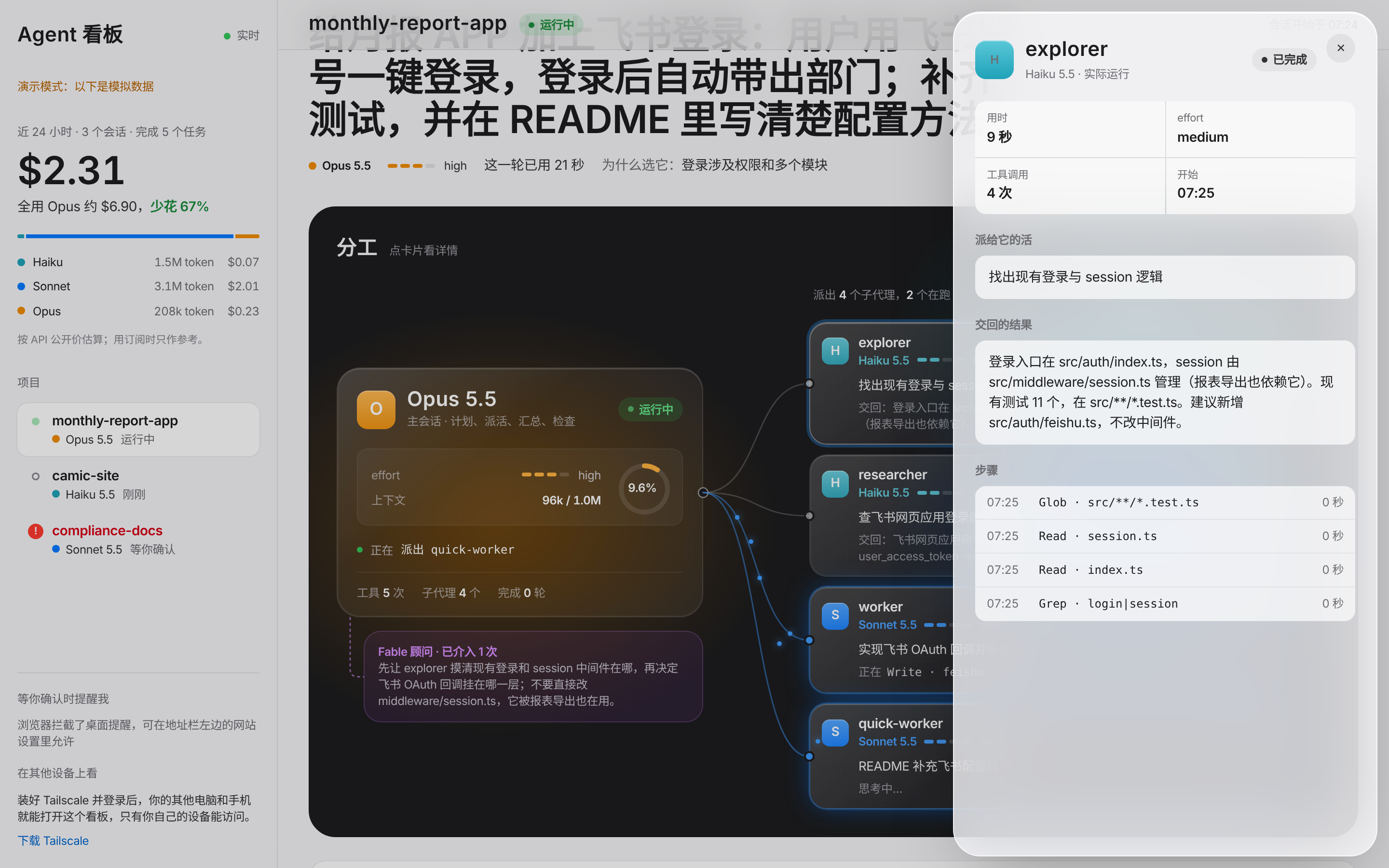 |
Install
Requirements: Claude Code 2.1.288 or newer, Node.js 18+, Git.
macOS / Linux
git clone https://github.com/paxon-yang/claude-agent-tools.git ~/claude-agent-tools && bash ~/claude-agent-tools/install.sh
Windows (beta)
In PowerShell:
irm https://raw.githubusercontent.com/paxon-yang/claude-agent-tools/main/install.ps1 | iex
It clones the repo to %USERPROFILE%\claude-agent-tools and runs the same installer through Git Bash (which Claude Code on Windows already needs). The dashboard starts hidden at login from your Startup folder.
Then restart Claude Code and open http://localhost:4321.
Update
bash ~/claude-agent-tools/update.sh
Or just tell Claude Code: "run bash ~/claude-agent-tools/update.sh". Your config.json changes are kept.
How routing works
flowchart LR
  P[Your prompt] --> M{#tag or /route pin?}
  M -- yes --> T[That model]
  M -- no --> R{Rules}
  R -- "plan mode / big multi-step task / architecture" --> O[Opus · orchestrates]
  R -- "question, lookup, tiny edit" --> H[Haiku]
  R -- unsure --> C[Haiku classifier] --> S[Sonnet / Haiku / Opus + effort]
  O -. delegates .-> E[explorer · Haiku]
  O -. delegates .-> W[worker · Sonnet]
  E & W -. report back .-> SUM[Sonnet summarizes]
Each turn's choice, and why, shows up in the Claude Code status line, in /route, and on the dashboard.
Everyday use
| You type | What happens |
|---|---|
/route |
A card: current model and why, cache time left, test gate, running sub-agents, session cost, recent decisions (also in the Claude app via Remote Control) |
/route rules |
The active rules |
/route sonnet · /route auto · /route off |
Pin a model · back to automatic · disable (the desktop card's tray menu has an "Auto model routing" switch for the same thing) |
#opus refactor the auth module |
Use Opus for this prompt only |
| Shift+Tab, then "go ahead" | Opus plans, Sonnet executes |
Desktop card (macOS / Windows)
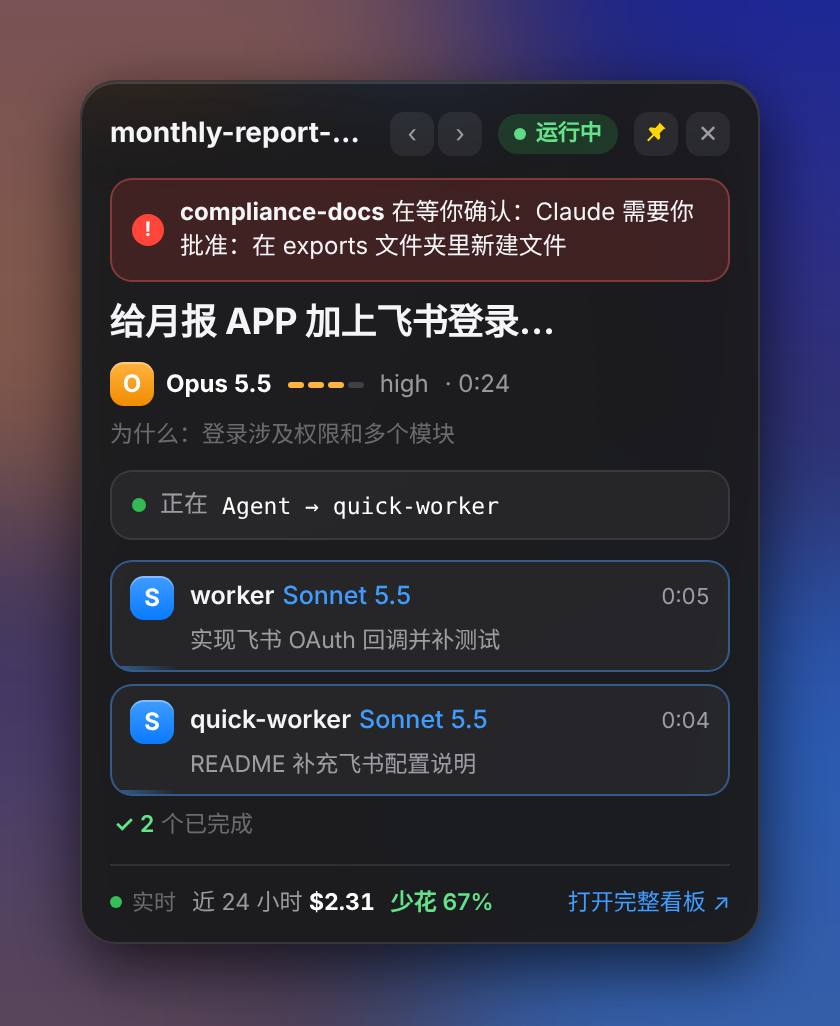
A small always-on-top window with only what matters right now: the current task, model and effort, the step it is on, sub-agents and background tasks that are still running, and a red banner when a session is waiting for your approval. Drag it anywhere; the pin keeps it on top; the menu-bar / tray icon hides or shows it.
bash ~/claude-agent-tools/agent-viz/widget/install.sh
It downloads Electron once (~100 MB) and opens at login. The same card works in any browser at http://localhost:4321/mini, which is handy on a phone.
Skins. Optional backgrounds in warm terracotta tones: Fox (animated: a small voxel fox typing at a desk; desktop and phone cards only), Clay, Contour, Terminal, Dunes, Aurora and Night sky. Each is a faint pattern under a scrim, so the text stays readable. Pick one from the dashboard sidebar (Skin) or the card's menu-bar / tray icon. The desktop card, the dashboard and the Android card (set to "Same as computer") all follow it.
How much did it save me?
node ~/.claude/viz/app/report.js            # last 7 days
node ~/.claude/viz/app/report.js --days 30 --md   # write claude-savings-YYYY-MM-DD.md to share
Claude Code · model routing savings
Last 7 days · 3 sessions · 7 model replies

  Model     Replies  Input  Cache read  Output  Est. cost  Share
  Haiku           3   190k        1.5M     80k      $0.10    <1%
  Sonnet          1   200k          2M    100k      $1.80    16%
  Opus            2   400k          3M    230k      $9.40    83%

  Estimated cost       $11.30
  All on Opus          $16.96
  Saved           33% ($5.66)
Sample output from the test fixtures. Estimates use public API prices; on a subscription it's an equivalent value, not your bill.
Configuration
Edit ~/.claude/auto-router/config.json and restart Claude Code. The most useful keys:
| Key | Default | Meaning |
|---|---|---|
defaultTier |
sonnet |
Used when nothing else decides |
bigTaskTier |
opus |
Orchestrator for multi-step tasks — set to sonnet to save more |
handbackTier |
sonnet |
Who summarizes sub-agent results |
subagents |
explorer→haiku, worker→sonnet … | Model per sub-agent type |
haikuGuard.maxFiles |
3 |
Files Haiku may edit before Sonnet takes over |
autoFable |
false |
Let the hardest tasks go to Fable automatically |
lang |
your system | en or zh for router messages |
cache.enabled |
true |
Weigh the prompt cache before downgrading |
cache.ttlSeconds |
"auto" |
Cache lifetime: "auto" learns it (starts at 1 hour), or 300 / 3600 |
cache.prices |
dashboard's | $ per million tokens per model; only the ratios matter |
qualityGate.enabled |
true |
Run tests before finishing when a cheaper model changed code |
qualityGate.command |
detected | Test command for every project, e.g. "npm run test:unit" |
qualityGate.trustTier |
opus |
Code changed by this model or above isn't checked |
qualityGate.timeoutSec |
180 |
Give up on a test run after this long |
Per project, .claude/auto-router.json in the project folder can set {"testCommand": "pytest -q tests/unit"} or turn the gate off with {"qualityGate": false}.
Dashboard settings live in ~/.claude/viz/app/config.json (port, prices used for estimates, remote access, lang). Set CAT_LANG=en or CAT_LANG=zh before installing to force the installer language.
Open the dashboard from other devices
- Tailscale (private): install Tailscale on the computer and your other devices with the same account. The dashboard listens on the Tailscale address automatically and shows the link in its sidebar.
- Your own domain (Cloudflare): create a Cloudflare Access application for the hostname (email one-time PIN), then run
bash ~/claude-agent-tools/agent-viz/cloudflare.sh board.example.com.
It creates a dedicatedagent-boardtunnel and never touches your other cloudflared config.
On your phone
- Drive Claude from your phone with Claude Code's own Remote Control:
/config→ Enable Remote Control for all sessions, plus Push when actions required for approval alerts. Approvals, questions and pushes are all handled there. - Type
/routein the Claude app to see what the router is doing: the same card as in the terminal. - Android home-screen card — a real widget for Android phones: task, model, sub-agents, cache, tests and cost on the home screen, live while a session is busy. Set up with one command and a QR scan:
bash ~/claude-agent-tools/agent-viz/phone.sh(guide). - Add the board to your home screen (Safari: Share → Add to Home Screen; Chrome: ⋮ → Add to Home screen) through your Tailscale or Cloudflare address. It opens full-screen on the card; Open full board and ‹ Card switch between the two.
Uninstall
bash ~/.claude/auto-router/uninstall.sh
bash ~/.claude/viz/app/uninstall.sh
Both make a backup before editing ~/.claude/settings.json or ~/.claude/CLAUDE.md.
FAQ
Does switching models lose context? No. The conversation is kept; the cost is that the new model re-reads it once at the cache-write price, while the current model would have read it from cache (1/20 of the input price on Opus and Sonnet). In a long conversation that usually outweighs a whole turn's savings, so while the cache is warm the router compares the two and stays put when switching wouldn't pay (/route shows the reason with the dollar estimate). With a cold cache, or a short conversation (under 100K tokens a move to Haiku costs about nothing extra), it switches freely. Haiku 5.5 bills requests with prompts over 100K tokens at 5x, so in a long conversation a move to Haiku rarely pays.
Will the test gate run my whole suite every turn? Only on turns where Haiku or Sonnet edited code (not docs), and not when the model already ran the tests after its last edit. Turn it off per project with .claude/auto-router.json or globally with qualityGate.enabled: false.
Does it send my data anywhere? No. Routing runs inside Claude Code; the dashboard reads local files and listens on localhost (plus your Tailscale address, or a tunnel you set up).
Is the cost exact? It's an estimate from public API prices. On a subscription, treat it as relative.
Roadmap
- Daily and weekly cost history on the dashboard
- Router feedback: tell it "wrong model" and it learns
- Native Linux autostart (systemd)
Issues and PRs are welcome — see CONTRIBUTING and the changelog.
License
Reviews (0)
Sign in to leave a review.
Leave a reviewNo results found