nlm-memory
Health Uyari
- License — License: Apache-2.0
- Description — Repository has a description
- Active repo — Last push 0 days ago
- Low visibility — Only 5 GitHub stars
Code Uyari
- process.env — Environment variable access in nlm/index.js
- network request — Outbound network request in nlm/index.js
Permissions Gecti
- Permissions — No dangerous permissions requested
Bu listing icin henuz AI raporu yok.
Local-first non-linear memory OS for AI operators. One index across Claude Code, Codex, Cursor, Windsurf, Hermes, OpenCode, Aider, pi, and more — with an editable timeline.






Install · Quick Start · Runtimes · How recall works · Signals · MCP · REST API · Digest · Config · Security · vs Alternatives
nlm-memory is a local-first memory layer for AI coding agents. It indexes every session from Claude Code, Codex, OpenCode, Cursor, Windsurf, Hermes, Aider, and pi into a single searchable store on your machine. Three properties no other memory layer ships together:
- Cross-runtime reach. One index, every adapter.
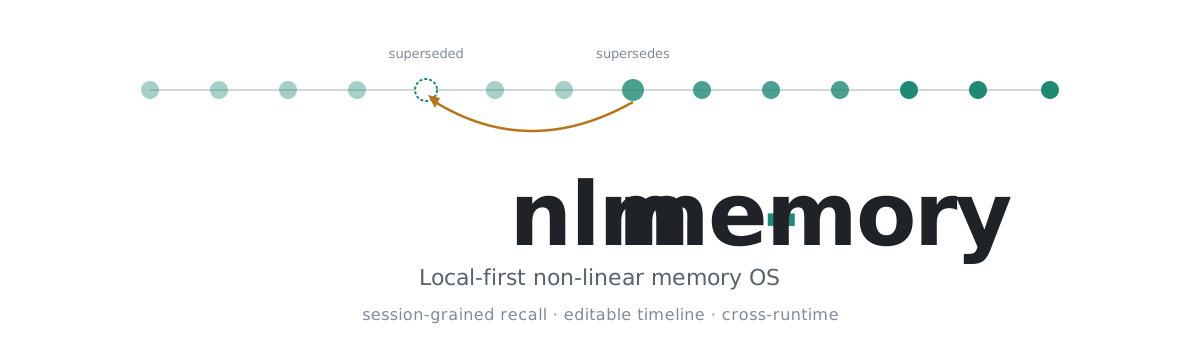
- Editable timeline. Sessions can be superseded by newer ones; entities can be retired. Patch history retroactively — no other tool lets you do this. See docs/supersedence.md.
- 97.2% R@5 baseline. On a 14-month corpus, keyword recall surfaces the right session in the top 5 on 97.2% of evaluator queries. No fine-tuning. The labels were generated by DeepSeek V4 — the retrieval algorithm is the same code path you'll run, but expect a lower number with a smaller local classifier. See docs/methodology-recall-baseline.md.
Everything stays on your machine by default. No telemetry, no account. The classifier defaults to local (Ollama); if you opt into a cloud classifier (DeepSeek, OpenAI, Anthropic, OpenRouter, or any OpenAI-compatible endpoint), session transcripts are sent to that provider — see Security for the exact data-flow.
Install
npm install -g nlm-memory
nlm setup
nlm setup is the interactive first-run wizard. It picks your classifier + model, wires the runtimes you actually use, generates an NLM_MCP_TOKEN, hardens permissions on ~/.nlm/, and installs the daemon supervisor for your platform. For headless environments (servers, CI, agents), use nlm start directly after initial setup — it boots the daemon without interactive prompts.
| Platform | Daemon | Notes |
|---|---|---|
| macOS | LaunchAgent at ~/Library/LaunchAgents/com.github.pbmagnet4.nlm-memory.plist |
Auto-starts on login |
| Linux | systemd user unit at ~/.config/systemd/user/nlm.service |
Headless servers: loginctl enable-linger $USER so the daemon survives logout |
| Windows | Manual nlm start for now |
Hook + MCP install paths are platform-aware; supervisor lands next release |
Stop or remove: nlm uninstall.
Quick Start
After nlm setup finishes, open http://localhost:3940/ui — the daemon is running. (If you changed NLM_PORT, substitute your port in all examples below.) A 30-second sanity check:
nlm recall "what was that pgvector decision"   # one-shot search from the shell
nlm digest                                      # yesterday's activity at a glance
nlm --version
Runtimes
One corpus across every adapter. MCP works against all nine. Automatic context injection via hooks ships on four (Claude Code, Codex CLI, Hermes Agent, pi.dev). Cursor, Windsurf, and OpenCode receive an optional static rules-file nudge (nlm connect <runtime> --with-rules) that instructs the agent to call recall_sessions on history-flavored prompts — those runtimes don't expose a pre-prompt hook today, so a rules nudge is the closest equivalent. Aider is ingest-only. nlm connect wires whichever surface the runtime supports:
| Runtime | Connect | Sessions read from | Hooks |
|---|---|---|---|
| Claude Code | nlm connect claude-code |
~/.claude/projects/**/*.jsonl |
6 hooks: UserPromptSubmit, SessionStart, SessionEnd, Stop, PreCompact, SubagentStart |
| Codex CLI | nlm connect codex |
~/.codex/sessions/ |
Marketplace plugin (UserPromptSubmit + Stop) |
| Hermes (WebUI) | nlm connect hermes |
~/.hermes/sessions/ |
MCP only (writes the MCP server block to ~/.hermes/config.yaml) |
| Hermes Agent (NousResearch CLI) | nlm connect hermes-agent |
~/.hermes/state.db |
6 hooks: pre_llm_call, post_llm_call, on_session_start/end/finalize/reset (Python plugin in ~/.hermes/plugins/nlm-memory/) |
| Cursor | nlm connect cursor [--with-rules] |
Cursor IDE chat DB | MCP + optional rules nudge (workspace .cursor/rules/nlm-recall.mdc) |
| Windsurf | nlm connect windsurf [--with-rules] |
Windsurf user dir | MCP + optional rules nudge (~/.codeium/windsurf/memories/global_rules.md) |
| OpenCode | nlm connect opencode [--with-rules] |
~/.local/share/opencode/ |
MCP + optional rules nudge (~/.config/opencode/AGENTS.md) |
| Aider | adapter active (ingest only) | AIDER_CHAT_HISTORY_FILE |
No native MCP, no hooks — sessions are read into the corpus but Aider cannot call recall back |
| pi.dev | nlm setup (auto) or nlm connect pi |
~/.pi/agent/sessions/**/*.jsonl |
1 hook: input (prepend via transform) |
nlm disconnect <runtime> reverses any of the above.
How recall works
Two delivery paths. They share the same index.
1. Hooks — automatic context injection
Hooks fire on user input and prepend a pointer block of likely-relevant prior sessions to the model's context. Four runtimes ship hooks today: Claude Code (six-hook lifecycle), Codex CLI (UserPromptSubmit + Stop via the marketplace plugin), Hermes Agent (six parallel hooks), and pi.dev (one input hook via nlm/). Cursor, Windsurf, and OpenCode don't expose a pre-prompt hook today, so the --with-rules install path drops a static rules snippet that asks the agent to call recall_sessions itself on history-flavored prompts (see docs/hooks.md for the snippet). Full lifecycle, modes, logging surface, and the daily liveness canary documented in docs/hooks.md.
Claude Code — six hooks written to ~/.claude/settings.json via nlm connect claude-code:
| Event | What NLM does | Mode |
|---|---|---|
| UserPromptSubmit | Score the prompt, silently prepend pointer block listing 0–3 most likely-relevant prior sessions | live by default |
| SessionStart | Cold-start agents (cron, background) hit this; same pointer-block delivery without a user prompt, plus a "Known failure modes for this repo" block when signals data exists (see Signals below) | live by default |
| SessionEnd | Delete the per-conversation memo on session close so state files don't accumulate | always on |
| Stop | Scan the model's response for citations of surfaced session IDs → updates useful_hit_rate and builds the reranker training substrate |
always on |
| PreCompact | Flush the per-conversation surfaced-IDs memo so post-compaction recalls aren't gated | always on |
| SubagentStart | Record parent→subagent links so threads stay coherent across dispatches | always on |
Hermes Agent — six hooks installed to ~/.hermes/plugins/nlm-memory/ via nlm connect hermes-agent. All calls are fire-and-forget except pre_llm_call, which returns a context string for injection:
| Hook | What NLM does | Blocks turn? |
|---|---|---|
| pre_llm_call | POST prompt to daemon → inject pointer block of relevant prior sessions into context | yes (returns context string) |
| post_llm_call | POST assistant response to daemon → citation scan, useful_hit_rate update |
no |
| on_session_start | Signal session open → daemon initialises per-session memo | no |
| on_session_end | Signal session close → daemon flushes memo | no |
| on_session_finalize | Signal transcript finalised → triggers async classifier run | no |
| on_session_reset | Signal session reset → daemon clears per-session state | no |
pi.dev — one input hook registered via nlm connect pi. Pi's extension API only exposes input, so transcript ingestion is handled separately by the passive adapter scanning ~/.pi/agent/sessions/:
| Hook | What NLM does | Blocks turn? |
|---|---|---|
| input | Score user message → if relevant sessions found, prepend pointer block to the prompt text via { action: "transform" } |
yes (returns transformed text) |
All three fail-open: any daemon error yields a clean exit and never blocks the model. Switch Claude Code hooks to shadow mode (log-only, no injection) with NLM_HOOK_MODE=shadow.
2. MCP — explicit tools any agent can call
Container-hosted agents (Hermes WebUI, Codex CLI, etc.) hit the Streamable-HTTP POST /mcp endpoint with Authorization: Bearer ${NLM_MCP_TOKEN}. Stdio MCP is also supported for Claude Code via ~/.mcp.json.
Agent self-improvement signals
NLM can ingest structured feedback events (nlm.signal) from any tool in your agent stack -- quality gates, eval runners, code reviewers, test harnesses -- and surface the aggregated failure patterns back to the agent at session start. Over time the agent learns which steps tend to fail for a given repo and model, without any external service.
Payload contract
{
  "v": 1,
  "kind": "gate" | "eval" | "review" | "test",  // required
  "outcome": "pass" | "fail" | "fix" | "exhausted",  // required
  "producer": "quality-gate",   // defaults to "unknown"
  "model": "qwen3-coder",       // defaults to "unknown"
  "repo": "/path/or/name",      // defaults to "unknown"
  "detail": { "step": "types", "files": ["a.ts"], "attempt": 2 },
  "session": "<session-id-if-known>",
  "ts": "2026-06-09T18:00:00.000Z"  // defaults to now
}
kind and outcome are the only required fields; invalid values are rejected with 400. install_scope is stamped server-side -- do not send it.
Transports
HTTP (any producer)
await fetch("http://localhost:3940/api/signal", {
  method: "POST",
  headers: { "content-type": "application/json" },
  body: JSON.stringify({
    kind: "gate", producer: "my-tool", outcome: "fail",
    model, repo, detail: { step: "types" }, ts: new Date().toISOString(),
  }),
});
Rides the standard /api/* loopback gate. When the daemon runs with NLM_UI_AUTH=cookie, send Authorization: Bearer $NLM_MCP_TOKEN.
Session-embedded (pi.dev)
Pi producers call pi.appendEntry("nlm.signal", payload) inside an extension. This writes:
{ "type": "custom", "customType": "nlm.signal", "data": { ...payload } }
to the session .jsonl. NLM's pi adapter recognises the nlm.signal customType and the scheduler drains it during normal ingest -- no HTTP call required.
Failure-mode recall
NLM aggregates signals into failure modes per (repo, model) pair. A mode surfaces when its fail-rate reaches 20% or higher over at least 10 events in a trailing 14-day window. At session start the Claude Code SessionStart hook injects a "Known failure modes for this repo" block into the agent prompt automatically (repo-scoped). Any harness can fetch the same data directly:
GET /api/signals/failure-modes?repo=<repo>&model=<model>
Inspection
nlm improve # prints failure modes + recommendations for the current repo
The UI Recall page also has a failure-modes panel. NLM surfaces findings and recommendations only -- it never acts on them.
Configuration and privacy
| Var | Default | What |
|---|---|---|
NLM_SIGNALS_ENABLED |
1 (on) |
Set to 0 to disable signal ingest entirely |
NLM_SIGNAL_RETENTION_DAYS |
90 |
Raw signals older than this are pruned |
Signals are local-only. They are stamped with a per-install ID from ~/.nlm/install-id and never leave the machine.
Reference producer
The pi quality-gate extension (in the pi-sandbox repo) is a ~10-line integration that emits nlm.signal per gate step and again on retry exhaustion. It is the canonical example of the session-embedded transport.
MCP Tools
| Tool | What it does |
|---|---|
recall_sessions |
Hybrid keyword+semantic search across the full session corpus. Returns label, started_at, snippet, match score, status, and superseded_by. Superseded sessions are included (down-ranked, badged) so a decision investigation sees overturned reasoning; prefer the superseded_by successor for current state. |
get_session |
Full body of one session by ID. Includes enriched supersedes / supersededBy links (id + label + summary) so chasing corrected facts doesn't need a second round-trip. |
recall_facts |
Search structured facts: decisions, open questions, project state. Filterable by entity and kind. |
get_fact_history |
Full version history of one fact — how a decision evolved over time. |
cite_session |
Mark a session as explicitly referenced. Drives the useful_hit_rate metric and the future learned reranker. |
When to call cite_session: Call it when a surfaced session actually changes what you say — you referenced it explicitly, it corrected a decision, or you called get_session to read the full body. Do not call it for sessions you scanned and discarded. The Stop hook auto-detects citation when a session ID appears verbatim in your response; cite_session covers the deliberate case where the session influenced your reasoning without being quoted directly. Both paths feed the same signal loop.
| mark_superseded | Retroactively retire a stale session and point it at the newer one that replaces it. The editable-timeline write path — see docs/supersedence.md. |
REST API
Daemon binds 127.0.0.1:3940 (override with NLM_PORT). Selected endpoints:
| Method | Path | Auth | Purpose |
|---|---|---|---|
| GET | /api/health |
Host-only | Liveness probe; returns {version, status, service} |
| GET | /api/recall |
Bearer/Origin | Hybrid recall — ?q=, ?mode=keyword|semantic|hybrid, ?limit=, ?include_superseded=true (default off; opt-in to surface overturned sessions down-ranked, badged with superseded_by). Each result carries status + superseded_by. |
| GET | /api/recall/stats |
Bearer/Origin | 7-day stats: total, hit_rate, useful_hit_rate, top queries |
| GET | /api/recall/recent |
Bearer/Origin | Last N recall events for live tail/telemetry |
| GET | /api/recall/cite-stats |
Bearer/Origin | Citation rate over ?days= |
| GET | /api/session/:id |
Bearer/Origin | Full session body + supersedence links |
| GET | /api/recall/facts |
Bearer/Origin | Structured fact search; includes hint field when empty |
| GET | /api/facts/history |
Bearer/Origin | Version chain for one fact |
| GET | /api/dataset |
Bearer/Origin | Full session list for the UI dataset view |
| GET | /api/live/recent-writes |
Bearer/Origin | Live tail of ingested sessions |
| GET | /api/data/backup |
Bearer/Origin | Streaming SQLite snapshot download |
| POST | /api/data/restore |
Bearer/Origin | Stage a snapshot for apply-on-restart |
| POST | /api/citation/explicit |
Bearer/Origin | Log an explicit session citation (the route backing the cite_session MCP tool; payload {id, conversation_id?, reason?}) |
| POST | /api/hook/pre-compact |
Bearer/Origin | Hook endpoint; flushes the surfaced-IDs memo |
| ALL | /mcp |
Bearer required | Streamable-HTTP MCP transport for container agents |
/api/* is gated by three layers: 127.0.0.1 Host check (defeats DNS rebinding), Origin check when the browser sends one (defeats cross-origin drive-by), Bearer fallback when Origin is absent (server-to-server clients).
Daily digest
Once-a-day summary of yesterday's activity:
nlm digest                  # print to stdout
nlm digest --telegram       # post to Telegram (TELEGRAM_BOT_TOKEN + TELEGRAM_CHAT_ID)
Reports 24h real-traffic (probes filtered), 7d hit_rate + useful_hit_rate, top 5 queries, and a WARN hook silent alert when Claude Code ran yesterday but no live hook fires were logged. That alert is the canary for post-install drift — node upgrades, settings.json hand-edits, and dist/ moves silently break the hook while Claude Code keeps working. Setup-time smoke tests can't catch this; only the daily correlation can.
Wire to cron for a morning push:
0 7 * * * nlm digest --telegram >> ~/.nlm/logs/digest.log 2>&1
When the daemon is unreachable, --telegram still fires — posts a "daemon unreachable" alert instead of failing silently.
What's inside the UI
Open http://localhost:3940/ui after the daemon starts.
| Page | What it shows |
|---|---|
| Live | Sessions being written in real time, recent reads, recent decisions |
| Pulse | System health — coherence, runtimes, stale entities, recent sessions |
| River | Full session timeline with density controls + superseded-lane visualization |
| Thread | Per-entity conversation history with runtime filters and ←/→ navigation |
| Search | Keyword, semantic, or hybrid recall with match snippets and field-origin tags |
| Recall | Adoption telemetry — useful_hit_rate, source breakdown, query log |
| Settings | Sources, providers, classifier, data backup/restore |
Pipeline
What happens when an AI runtime writes a session and you later recall it:
ingest:  runtime transcript (jsonl/sqlite)
   -> adapter parses runtime-specific format
   -> classifier (Ollama local by default; DeepSeek / OpenAI / Anthropic / OpenRouter / OpenAI-compatible if you opt in) extracts label + entities + decisions + open questions
   -> embedder (nomic-embed-text via Ollama) computes 768-dim vector
   -> SQLite canonical store + FTS5 keyword index + sqlite-vec ANN index

recall: prompt / query
   -> tokenize + match scoring (label x3, entity-exact x4, decision x2, summary x1, phrase-bonus +5)
   -> hybrid: BM25-style keyword + vector cosine, fused by score
   -> select-top-N gate (per-fire cap 3, per-conversation cap 10)
   -> pointer block prepended to model context (hooks) or returned as tool result (MCP)
Configuration
Environment variables
| Var | Default | What |
|---|---|---|
NLM_PORT |
3940 |
Daemon bind port (loopback only) |
NLM_DB_PATH |
~/.nlm/canonical.sqlite |
SQLite canonical store location |
NLM_HOOK_MODE |
live |
live injects pointer block; shadow logs without injecting |
NLM_HOOK_LOG |
~/.nlm/hook-log.jsonl |
Hook fire log; powers digest's liveness alert |
NLM_USEFUL_HIT_LOG |
~/.nlm/useful-hit-log.jsonl |
Citation/useful-hit ledger |
NLM_QUERY_LOG |
~/.nlm/query-log.jsonl |
Recall query telemetry |
NLM_CITATION_LOG |
~/.nlm/citation-log.jsonl |
Stop-hook citation events |
NLM_MISS_LOG |
~/.nlm/miss-log.jsonl |
Stop-hook miss events — sessions the agent explicitly fetched via get_session/cite_session that the hook never surfaced. Reviewed via nlm misses. |
NLM_MISS_LOG_ENABLED |
true |
Set to 0 to disable miss-log emission entirely. |
NLM_MCP_TOKEN |
auto-generated | 256-bit bearer for /api/* (non-browser) and /mcp |
NLM_MCP_CONFIG |
~/.mcp.json |
Path the connect/disconnect commands modify |
NLM_CLASSIFIER |
ollama |
ollama (local, default), deepseek, openai, anthropic, openrouter, or openai-compatible |
NLM_CLASSIFIER_MODEL |
qwen3:4b-instruct-2507-q4_K_M |
Model id for the chosen provider. See classifier bench for why this is the recommended local default. |
NLM_OLLAMA_URL |
http://localhost:11434 |
Override Ollama endpoint |
NLM_ADAPTERS |
all | Comma-separated allowlist of adapters to enable |
DEEPSEEK_API_KEY |
— | Required only when classifier=deepseek |
NLM_DISABLE_UPDATE_CHECK |
— | Set to 1 to disable the daily npm-registry update check |
NLM_RECALL_DECAY_HALF_LIFE_DAYS |
180 |
Half-life of the recency multiplier applied to recall scores. Older sessions score lower; defaults to 6 months. Set to 0 to disable recency weighting entirely. |
NLM_RECALL_DECAY_FLOOR |
0.25 |
Lower bound on the recency multiplier — even ancient sessions retain at least 25% of their raw score so a perfect-match old session can still surface. |
NLM_RECALL_REWRITE_DEFAULT |
true |
Default value for the MCP recall_sessions rewrite parameter. When true, the service runs an LLM rewrite on vague natural-language queries before search. The HTTP hook caller bypasses rewrite regardless (hot-path protection). |
NLM_RECALL_REWRITE_TIMEOUT_MS |
5000 |
Per-call timeout for the rewrite LLM. Separate from the classifier timeout. |
NLM_FACT_CORROBORATION_BOOST_CAP |
2.0 |
Maximum multiplicative boost applied to fact recall scores based on how many sessions corroborate the same (subject, predicate, value). Log-scale: 1 corroboration is 1.0×, 10 is 2.0× (capped). Set to 1.0 to disable the boost — the count is still returned on each hit. |
NLM_HOOK_INJECT_FACTS |
true |
Whether to attach high-confidence facts about top-hit entities to the pointer block injected by the hook. Set to 0 to disable globally. |
NLM_HOOK_FACT_LIMIT |
5 |
Maximum number of facts in the "Known facts" section of the pointer block. |
NLM_HOOK_FACT_MIN_CORROBORATION |
2 |
Minimum number of sessions that must have asserted a fact before it qualifies for hook injection. Set to 1 to include single-source facts. |
NLM_HOOK_FACT_MIN_CONFIDENCE |
0.7 |
Minimum classifier confidence for a fact to qualify for hook injection. |
TELEGRAM_BOT_TOKEN / TELEGRAM_CHAT_ID |
— | Required for nlm digest --telegram |
Changing the classifier from the UI
The CLI env-vars above are one path; the running UI is the other. Settings → Providers is a full CRUD list of LLM endpoints (Ollama, DeepSeek, OpenAI, Anthropic, OpenRouter, or any OpenAI-compatible endpoint such as LM Studio, llama.cpp, vLLM, text-generation-webui). Click Add provider, point it at your local server, hit Save & test. Then in Settings → Classifier, pick that provider and model. No env-var editing required, and the DeepSeek row can be disabled or deleted from the same screen.
Adapter source paths can be overridden individually: NLM_CLAUDE_PROJECTS_PATH, NLM_CODEX_CONFIG, NLM_CURSOR_DB_PATH, NLM_HERMES_SESSIONS_PATH, NLM_HERMES_AGENT_DB_PATH, NLM_WINDSURF_USER_DIR, OPENCODE_DB_PATH, PI_SESSIONS_PATH, AIDER_CHAT_HISTORY_FILE.
Config file
~/.nlm/.env — autoloaded by every CLI command. Mode 0600, owned by you, never readable by other users. The setup wizard writes the initial keys; you can edit it directly.
Ports
| Port | Process | Bind | Override |
|---|---|---|---|
3940 |
Daemon HTTP API + MCP | 127.0.0.1 only |
NLM_PORT |
11434 |
Ollama (embedding + local classifier) | localhost | NLM_OLLAMA_URL |
Security
NLM is local-first by design, but "local-first" is not "local-only" — read this section before picking a classifier.
Daemon hardening (always on):
- Binds to
127.0.0.1only — never0.0.0.0 - Enforces Host + Origin checks on
/api/*to defeat DNS rebinding and cross-origin drive-by - Generates a 256-bit
NLM_MCP_TOKENon first run, persists to~/.nlm/.env(mode0600); non-browser clients authenticate withAuthorization: Bearer ${NLM_MCP_TOKEN}compared withtimingSafeEqual - Recursively enforces
0700on~/.nlm/and0600on its contents on every start - Optional opt-in UI cookie auth (
NLM_UI_AUTH=cookie) with HMAC-derived cookie value and nonce-based bootstrap (token never appears in a URL)
Outbound network traffic — exhaustive list:
| Destination | When | What data leaves |
|---|---|---|
| Configured classifier endpoint | Every new session is classified | Up to ~30K chars of the session transcript (prompts, responses, code snippets — whatever is in the transcript). If the classifier is Ollama (default) the destination is localhost:11434 and nothing leaves the machine. If you opted into DeepSeek / OpenAI / Anthropic / OpenRouter / any OpenAI-compatible endpoint, the transcript is POSTed to that vendor. |
Ollama localhost:11434 |
Every new session | 768-dim embedding request (local) |
registry.npmjs.org |
Once per 24h | Anonymous GET /nlm-memory/latest for update notifications. Cached at ~/.nlm/update-check.json. Disable with NLM_DISABLE_UPDATE_CHECK=1. |
api.telegram.org |
Only when nlm digest --telegram is invoked |
Digest content |
| AI runtime transcript files | Continuous | Read-only filesystem reads |
No analytics SDK. No crash reporter. No vendor ping beyond the four rows above.
Honest caveats — known limitations:
- Cloud-classifier data egress. A "cloud" classifier (DeepSeek, OpenAI, Anthropic, OpenRouter) by definition sees your session content. Anything pasted into a transcript — API keys, client names, internal URLs — is sent to that vendor under their data-use terms. The setup wizard warns you before you pick one. The default is Ollama for this reason.
- Provider API keys are stored in plaintext in SQLite today (
providers.api_key, in~/.nlm/canonical.sqlite). The file is0600, in a0700directory, owned by your user — so any process running as your user can read it. OS-keychain migration is on the roadmap; until then, treat the SQLite file like a.envfile. - The classifier is fed untrusted indexed content. Sessions written by AI runtimes can contain prompt-injection attempts. The classifier output is structured (label, entities, decisions, open questions) and never executed, but if you wire NLM to an agent that acts on classifier output, model that as untrusted input.
- The hook fails open. Any error in the recall hook yields a clean exit so it can't block your model. This means a silently-broken hook is possible — the daily digest's
WARN hook silentcanary is the detection path.
Report vulnerabilities via SECURITY.md.
Remote access
The daemon binds to 127.0.0.1. If you want to reach the UI from another device — phone, second laptop — don't change the bind. Put a tunnel in front instead.
Tailscale (recommended for personal use). Run once on the daemon host:
tailscale serve --bg http://localhost:3940
Then visit https://<machine>.<tailnet>.ts.net/ui/ from any tailnet device. Tailscale Serve rewrites the upstream Host header to localhost:3940, so the loopback check passes without any nlm-memory config. WireGuard + your tailnet ACLs are the auth layer — for a single-user tailnet this is strictly stronger than NLM_UI_AUTH=cookie, so leave that off.
If you do enable NLM_UI_AUTH=cookie (defense in depth, or you've added untrusted devices to your tailnet), bootstrapping a cookie from a remote device needs one extra step. nlm ui only opens a browser on the daemon host; for the remote browser:
ssh <daemon-host> 'nlm ui --print'   # mints a nonce, prints the URL
# Paste the URL into the remote browser within ~60s (nonce TTL)
Do not expose the daemon directly to the public internet. The cookie is a shared-HMAC speed bump, not real public-internet auth. If you absolutely must, put it behind something with real authentication (Cloudflare Access, Tailscale Funnel with auth in front, etc.).
Upgrading from v0.4.x
npm update -g nlm-memory
Old installs have NLM_HOOK_MODE=shadow hardcoded in ~/.claude/settings.json — shadow mode is silent, so re-run nlm hook install to switch to live recall injection. Permissions and NLM_MCP_TOKEN self-heal on the next nlm start.
vs Alternatives
| nlm-memory | mem0 | Letta / MemGPT | Built-in (CLAUDE.md) |
|
|---|---|---|---|---|
| Unit of memory | Whole session + extracted markers | Atomic facts | Graph nodes + edges | Static file |
| Cross-runtime | 9 adapters, one corpus | Per-app SDK integration | Per-app SDK integration | Per-runtime config |
| Editable timeline | Sessions can be superseded, retired, aborted | Append-only fact log | Graph edits | Manual file edits |
| R@5 baseline | 97.2% on 14mo corpus | published varies | published varies | n/a |
| External deps | SQLite + Ollama (local) | Postgres or Qdrant | Postgres | none |
| Hosted offering | none — local only | yes | yes | n/a |
| Account required | none | yes (cloud tier) | yes | none |
| Telemetry | none | yes | yes | none |
| License | Apache 2.0 | Apache 2.0 | Apache 2.0 | — |
The defining property is the editable timeline. mem0 and Letta append; NLM lets you reach back and mark a session as superseded by a newer one, retire one as no-longer-relevant, or flag one as aborted-mid-flight. The next recall surfaces the corrected version, not the stale one. A claim from 6 months ago can be patched today.
Docs
- docs/supersedence.md — the editable timeline: statuses, what gets recorded when, how supersedence flows through recall
- docs/hooks.md — full hook lifecycle, modes, selection logic, pointer-block format, logging surface, daily liveness canary
- docs/methodology-recall-baseline.md — how R@5 = 97.2% is measured + how to run LongMemEval-S on your own machine
- SECURITY.md — threat model + responsible disclosure
Development
git clone https://github.com/pbmagnet4/nlm-memory
cd nlm-memory
npm install
npm run build          # compile dist/ — commit the result, it ships in the repo
npm run dev            # hot-reload daemon
npm run ui:dev         # hot-reload UI at localhost:5173 (proxies /api to :3940)
npm test               # 726 tests across 73 files
npm run typecheck
node dist/cli/nlm.js doctor    # pre-publish: verify DB invariants (exit 1 on violations)
Architecture: hexagonal. src/core/ knows about ports (interfaces), not adapters. src/cli/nlm.ts is the composition root — the only file that wires concrete implementations (SqliteSessionStore, OllamaClient, Hono, StdioServerTransport). Adapters in src/core/adapters/ are one-way: they parse runtime-specific session formats into NLM's canonical shape; nothing in the runtime sees NLM.
dist/ is built on install via the prepare script (runs automatically on npm install from git or registry) and packed into the published tarball via the files field. Not tracked in git.
License
Apache 2.0 — see LICENSE.
Yorumlar (0)
Yorum birakmak icin giris yap.
Yorum birakSonuc bulunamadi