pbuf-registry
Health Pass
- License — License: Apache-2.0
- Description — Repository has a description
- Active repo — Last push 0 days ago
- Community trust — 20 GitHub stars
Code Fail
- rm -rf — Recursive force deletion command in .github/workflows/release.yml
Permissions Pass
- Permissions — No dangerous permissions requested
No AI report is available for this listing yet.
Self-hosted Protobuf schema registry in Go — OIDC/RBAC, multi-source vendoring (pbuf, buf.build, Git), go_package patching, drift detection, Web UI & MCP server
Self-Hosted, Open-Source Protobuf Schema Registry (pbuf-registry)



pbuf-registry is an Apache-2.0, self-hosted Protocol Buffers schema registry written in Go—complete with OIDC / OAuth2 SSO, per-module RBAC, multi-source vendoring (pbuf-registry, buf.build, and Git), automatic option go_package rewriting, breaking-change & transitive drift detection, a dark-mode Vue 3 Web UI, and a built-in Model Context Protocol (pbuf mcp) server for AI coding agents.
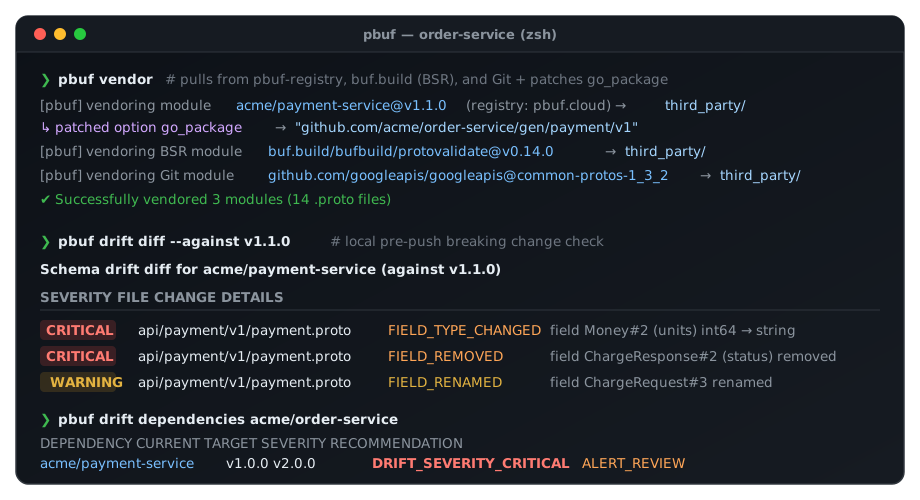
Table of Contents
- Why
pbuf-registry? (Comparison vs. Buf & Git) - The Ecosystem
- Key Features
- Automatic
option go_packageRewriting (gen_out) - Hybrid Multi-Source Vendoring (
pbuf-registry,buf.build, and Git) - Schema Drift & Breaking Change Detection (
pbuf drift diff) - Native MCP Server for AI Coding Agents (
pbuf mcp) - Per-Module RBAC & OIDC / OAuth2 SSO
- Web UI for Browsing & Incident Investigation
- Automatic
- Quick Start (2 Minutes)
- CLI Installation (
pbuf) - Configuration (
pbuf.yaml) - CLI Reference (
pbuf) - Deploying
pbuf-registry - Server CLI & Background Daemons
- Authentication & Access Control (RBAC & OIDC SSO)
- Server Configuration Reference
- CI/CD Integration
- API Reference
- Development & Contributing
Why pbuf-registry?
Once gRPC microservices split across repositories, teams typically face an uncomfortable choice: copy .proto files via brittle Git scripts, or pay per-seat SaaS pricing for private schemas, SSO, and RBAC.
pbuf-registry solves three real pain points out of the box:
- Self-Hosted, Zero-Seat-Tax Private Registry: Run a complete private registry (gRPC/REST server + background AST indexer + Vue 3 Web UI + PostgreSQL) in Docker Compose or Kubernetes under Apache-2.0—with OIDC SSO and granular per-module RBAC included for free.
- Automatic
option go_packageRewriting (gen_out): Eliminate conflicting upstreamoption go_packagedeclarations across Go repositories. Setgen_out: geninpbuf.yamlandpbuf vendorautomatically rewritesoption go_packagein downloaded.protofiles to match your localgo.modmodule path. - Gradual Migration via Multi-Source
pbuf.yaml: Pull internal schemas frompbuf-registry, upstream packages frombuf.build(BSR), and raw.protosubtrees from Git repositories in a single manifest.
| Capability | pbuf-registry + pbuf |
Buf Schema Registry (Free) | Buf BSR (Team / Enterprise) | Raw Git / git submodule / protodep |
|---|---|---|---|---|
| License & Self-Hosting | Apache-2.0 (Self-Hosted or Cloud) | SaaS only | Paid Enterprise self-hosted | DIY scripts |
| Private Schemas without Per-Seat Pricing | Yes (Unlimited users & bots) | Limited / public focus | Paid per-user seat tax | Yes |
| OIDC / OAuth2 SSO & Per-Module RBAC | Included | No | Paid / Enterprise tier | Relies on Git repo permissions |
Hybrid Vendoring (pbuf + buf.build + Git) |
Yes (All 3 in one pbuf.yaml) |
BSR only | BSR only | Git only |
Automatic option go_package Patching (gen_out) |
Built-in (go.mod-aware) |
Managed mode (compilation only) | Managed mode (compilation only) | Manual sed scripts |
| Transitive Dependency Drift & Breaking Alerts | Built-in (pbuf drift + UI) |
Breaking lint only | Breaking lint + graph | None |
Native MCP Server (pbuf mcp) for AI Agents |
Built-in (stdio) |
External | External | None |
The Ecosystem
All components live in this monorepo and are released together under unified semantic versions:
┌──────────────────────────────────────────────────────────────────────┐
│                                                                      │
│  ┌──────────────┐    push / pull    ┌───────────────────────────┐    │
│  │     pbuf     │ ◄───────────────► │       pbuf-registry       │    │
│  │  (CLI tool)  │                   │   gRPC :6777 / HTTP :8080 │    │
│  └──────┬───────┘                   │   Debug/Metrics :8082     │    │
│         │ vendor                    │   PostgreSQL backend      │    │
│         ▼                           └─────────────▲─────────────┘    │
│  ┌──────────────┐                                 │                  │
│  │  buf.build   │                   ┌─────────────┴─────────────┐    │
│  │  & Git repos │                   │     pbuf-registry-ui      │    │
│  └──────────────┘                   │   Web UI (Vue 3 + nginx)  │    │
│                                     └───────────────────────────┘    │
└──────────────────────────────────────────────────────────────────────┘
| Component | Description | Path | Artifact |
|---|---|---|---|
| pbuf-registry | Registry server & background daemons (gRPC, REST, RBAC, OIDC SSO, drift detection) | cmd/, internal/ |
ghcr.io/pbufio/registry |
| pbuf (CLI) | Command-line interface for initializing, pushing, vendoring (pbuf-registry, buf.build, Git), and administering the registry |
cmd/pbuf/, internal/cli/ |
GitHub Releases |
| pbuf-registry-ui | Developer-first Vue 3 Web UI for browsing modules, proto files, parsed AST metadata, and drift alerts | ui/ |
ghcr.io/pbufio/pbuf-registry-ui |
| Helm Chart | Kubernetes Helm chart for deploying the server, background workers, PostgreSQL, and Web UI | charts/pbuf-registry/ |
oci://ghcr.io/pbufio/charts/pbuf-registry |
Key Features
Automatic option go_package Rewriting (gen_out)
Anyone managing Go gRPC microservices across multiple repositories has hit conflicting option go_package declarations in upstream .proto files. When you set gen_out: gen on any dependency in pbuf.yaml, pbuf vendor reads your local go.mod module path and automatically rewrites option go_package in every downloaded .proto file:
 syntax = "proto3";
 package acme.payment.v1;
-option go_package = "github.com/acme/payment-service/api/payment/v1;paymentv1";
+option go_package = "github.com/acme/order-service/gen/payment/v1";
Multi-Source Vendoring (pbuf-registry, buf.build, and Git)
Consumer services can pull schemas from pbuf-registry, the Buf Schema Registry (buf.build), and Git repositories in a single pbuf.yaml:
version: v1
name: myorg/order-service
registry:
  addr: registry.example.com:6777
export:
  paths:
    - api
modules:
  # 1. From pbuf-registry — pinned, auditable, drift-tracked, go_package patched
  - name: myorg/payment-service
    tag: v2.1.0
    out: third_party
    gen_out: gen

  # 2. From Buf Schema Registry (buf.build) — public or private (via BUF_TOKEN / ~/.netrc)
  - name: buf.build/bufbuild/protovalidate
    tag: v0.14.0
    out: third_party

  # 3. From a Git repository — pinned to a tag or branch
  - repository: https://github.com/googleapis/googleapis
    path: google/api
    tag: common-protos-1_3_2
    out: third_party
Schema Drift & Breaking Change Detection
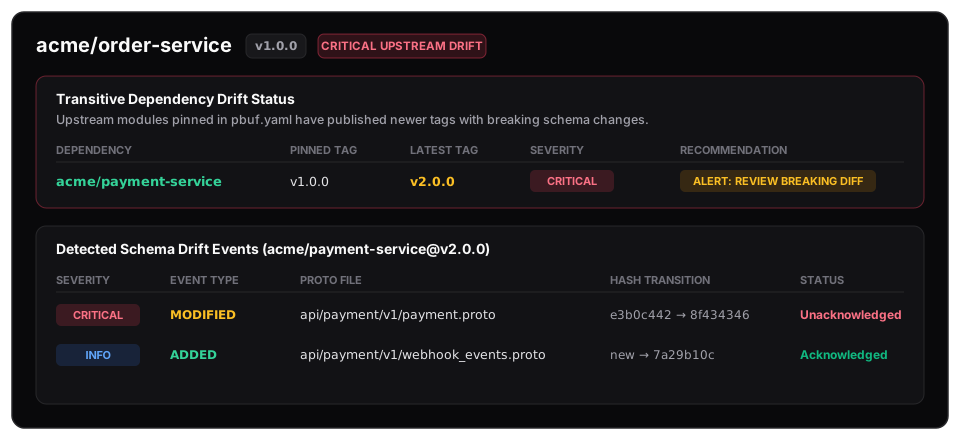
When a module version modifies, deletes, or incompatibly changes .proto files compared to prior tags or downstream dependencies, the background proto-parser indexes the AST and records drift events with severity levels (INFO, WARNING, CRITICAL) and upgrade recommendations. You can also run pbuf drift diff locally or in CI before pushing a tag:
# Compare local .proto edits against the latest published tag in the registry (exits non-zero on CRITICAL)
pbuf drift diff
pbuf drift diff --against v2.0.0 --format markdown

# List all unacknowledged drift events across the registry
pbuf drift list

# Drift events for a specific module, optionally filtered by tag
pbuf drift module payment-service --tag v2.1.0

# Evaluate transitive dependency drift status for a module
pbuf drift dependencies order-service --tag v1.4.0
Native MCP Server for AI Coding Agents (pbuf mcp)
pbuf includes a built-in Model Context Protocol (MCP) server (pbuf mcp) over stdio. Connect Claude Code, Cursor, Antigravity, or GitHub Copilot directly to your organization's live Protobuf registry so AI coding assistants can inspect module tags, pull .proto definitions, query parsed AST metadata (messages, fields, RPCs, enums), and check breaking drift statuses without hallucinating wire types.
Immutable Versioned Tags & Ephemeral Draft Tags
Every schema push gets a tag. Published tags are immutable: once pushed, the content at a tag never changes. Draft tags (--draft) can be overwritten during development and are automatically cleaned up after 7 days by the compaction daemon.
pbuf modules push v2.1.0               # Stable — permanent and immutable
pbuf modules push v2.1.0-rc1 --draft   # Draft — mutable, auto-expires after 7 days
Per-Module RBAC & OIDC / OAuth2 SSO
Engineers and CI pipelines can authenticate using:
- OIDC / OAuth2 SSO (
pbuf loginvia OAuth 2.0 Device Authorization Flow, or Web UI Authorization Code + PKCE Flow) - Scoped User & Bot Tokens (
pbuf_user_*/pbuf_bot_*) with explicitread,write, oradminpermissions per module or globally (*) - Static Admin Token (
SERVER_STATIC_TOKEN) for bootstrap and administrative automation
Web UI for Browsing & Incident Investigation
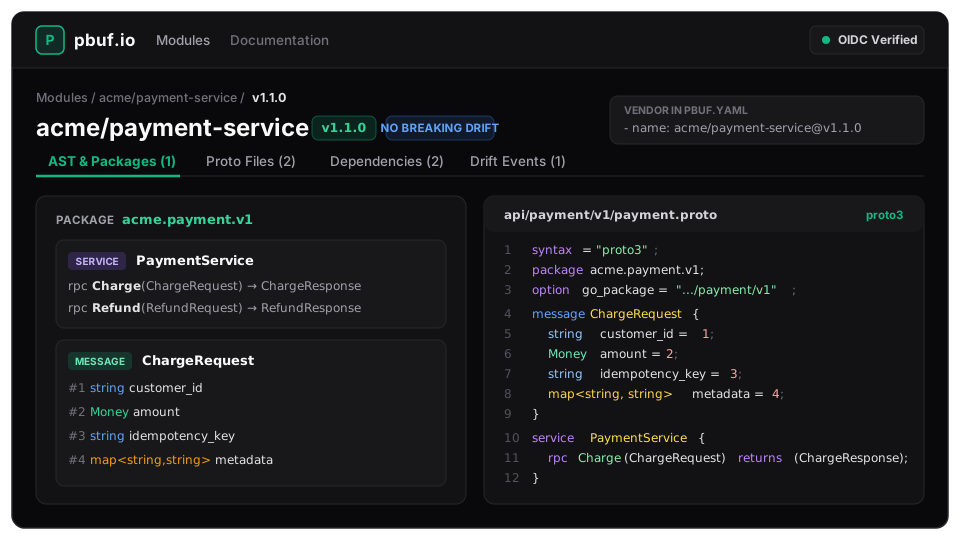
The dark-mode Vue 3 Web UI lets engineers browse registered modules, inspect .proto source files at any tag, explore parsed messages/services/enums/fields, and review dependency drift alerts — either in public read-only mode or authenticated via Bearer token or OIDC SSO.
Quick Start (2 Minutes)
Step 1 — Start the Registry Stack
git clone https://github.com/pbufio/pbuf-registry.git
cd pbuf-registry
make cert-gen                         # Generates TLS certificates in gen/certs/
export SERVER_STATIC_TOKEN=my-secret-token
make run-prod                         # Starts PostgreSQL, Registry, Daemons, and Web UI
- gRPC API:
localhost:6777 - REST API:
http://localhost:8080 - Web UI:
http://localhost:80
Step 2 — Install the pbuf CLI
curl -fsSL https://raw.githubusercontent.com/pbufio/pbuf-registry/main/scripts/install.sh | sh
Step 3 — Initialize, Authenticate & Push a Module
# Initialize pbuf.yaml for your module
pbuf init myorg/payment-service localhost:6777

# Save your registry token to ~/.netrc
pbuf auth "${SERVER_STATIC_TOKEN}"

# Register the module and push your .proto files as v1.0.0
pbuf modules register
pbuf modules push v1.0.0
Step 4 — Vendor Dependencies
# Pull all configured dependencies into third_party/
pbuf vendor
See examples/ for a complete end-to-end walkthrough with sample .proto files.
CLI Installation (pbuf)
Homebrew (macOS & Linux)
brew install pbufio/tap/pbuf
Linux & macOS (Install Script)
Install the latest release to /usr/local/bin:
curl -fsSL https://raw.githubusercontent.com/pbufio/pbuf-registry/main/scripts/install.sh | sh
Install a specific version or to a custom directory:
# Specific version
curl -fsSL https://raw.githubusercontent.com/pbufio/pbuf-registry/main/scripts/install.sh | sh -s -- -v v0.10.0

# Custom install directory (no sudo required)
INSTALL_DIR=$HOME/.local/bin curl -fsSL https://raw.githubusercontent.com/pbufio/pbuf-registry/main/scripts/install.sh | sh
Using Go (go install)
Requires Go 1.25+:
go install github.com/pbufio/pbuf-registry/cmd/pbuf@latest
Windows
Option 1: PowerShell
$release = Invoke-RestMethod "https://api.github.com/repos/pbufio/pbuf-registry/releases/latest"
$version = $release.tag_name
$plainVersion = $version.TrimStart('v')
$arch = if ([Environment]::Is64BitOperatingSystem) { "amd64" } else { "386" }
$url = "https://github.com/pbufio/pbuf-registry/releases/download/$version/pbuf_${plainVersion}_windows_${arch}.zip"
$output = "$env:TEMP\pbuf.zip"

Invoke-WebRequest -Uri $url -OutFile $output
Expand-Archive -Path $output -DestinationPath "$env:TEMP\pbuf" -Force
Move-Item -Path "$env:TEMP\pbuf\pbuf.exe" -Destination "$env:USERPROFILE\bin\pbuf.exe" -Force
Remove-Item -Path $output, "$env:TEMP\pbuf" -Recurse -Force
Option 2: Manual Binary Download
Download pre-built archives for Linux, macOS, and Windows (amd64 / arm64) from the GitHub Releases page.
Build from Source
make build-cli
# Binary is output to ./bin/pbuf
Configuration (pbuf.yaml)
pbuf reads pbuf.yaml from the current working directory.
Full pbuf.yaml Schema
version: v1
name: myorg/my-service

registry:
  addr: registry.example.com:6777   # Registry gRPC address (host or host:port; defaults to :443 or :80)
  insecure: false                   # Set to true only for plaintext HTTP/gRPC in local dev
  oidc:                             # Optional defaults for `pbuf login`
    issuer: https://idp.example.com
    client_id: pbuf-cli

export:
  paths:                            # Directories whose .proto files are exported on `pbuf modules push`
    - api
    - proto

modules:
  # 1. pbuf-registry dependency
  - name: myorg/common-protos
    path: common/v1                 # Optional: restrict vendoring to a subfolder or single .proto file
    tag: v1.2.0
    out: third_party                # Destination directory for downloaded .proto files
    gen_out: gen                    # Optional: rewrites `option go_package` in downloaded .proto files

  # 2. Buf Schema Registry (buf.build) dependency
  - name: buf.build/bufbuild/protovalidate
    path: buf/validate              # Optional: filter by path prefix
    tag: v0.14.0                    # Tag, commit ref, or `branch:` (defaults to "main" if omitted)
    out: third_party
    gen_out: gen                    # Optional: rewrites `option go_package`

  # 3. Git repository dependency
  - repository: https://github.com/googleapis/googleapis
    path: google/api                # Required for Git modules: subfolder or single .proto file in repo
    tag: common-protos-1_3_2        # Git tag (or use `branch: main`)
    out: third_party
    gen_out: gen                    # Optional: rewrites `option go_package`
Field Reference
| Field | Required | Description |
|---|---|---|
version |
Yes | Schema version (v1). |
name |
For register / push |
Canonical module name in pbuf-registry (e.g., myorg/payment-service). |
registry.addr |
For registry commands | Hostname or host:port of the pbuf-registry gRPC server (e.g., pbuf.cloud or localhost:6777). |
registry.insecure |
No | When true, connects over plaintext gRPC without TLS (false by default). |
registry.oidc.issuer |
No | Default OIDC issuer URL used by pbuf login when --issuer and PBUF_OIDC_ISSUER are not set. |
registry.oidc.client_id |
No | Default OIDC client ID used by pbuf login when --client-id and PBUF_OIDC_CLIENT_ID are not set. |
export.paths |
For push |
List of local directories to scan recursively for .proto files when pushing a module. |
modules |
For vendor |
List of dependencies to vendor when running pbuf vendor. |
1. Vendoring from pbuf-registry
Modules with a name (not starting with buf.build/) and no repository field are pulled from the configured registry.addr over gRPC:
modules:
  - name: pbufio/pbuf-registry
    tag: v0.9.0
    path: api/pbuf-registry/v1   # Optional: only vendor files under this prefix
    out: third_party
    gen_out: gen                 # Optional
2. Vendoring from Buf Schema Registry (buf.build)
Modules whose name starts with buf.build/<owner>/<module> are downloaded directly from the Buf Schema Registry reflection API (https://buf.build/buf.reflect.v1beta1.FileDescriptorSetService/GetFileDescriptorSet) and reconstructed into .proto files—without requiring a pbuf-registry server connection:
modules:
  - name: buf.build/googleapis/googleapis
    tag: main
    path: google/type
    out: third_party
Private BSR Modules Authentication:
- Set the
BUF_TOKENenvironment variable (export BUF_TOKEN=...), or - Add an entry for
buf.buildin~/.netrc:machine buf.build password <your-buf-token>
3. Vendoring from Git Repositories
Modules with a repository URL are cloned with a shallow single-branch fetch (depth: 1) at the specified tag or branch:
modules:
  - repository: https://github.com/protocolbuffers/protobuf
    path: examples/addressbook.proto
    tag: v24.4
    out: proto
Private Git Repositories Authentication:
Add credentials for your Git host in ~/.netrc:
machine github.com
login <github-username>
password <personal-access-token>
Automatic go_package Patching (gen_out)
When a dependency in modules specifies gen_out, pbuf vendor inspects your local go.mod module name and automatically sets or rewrites option go_package in every vendored .proto file for that dependency to:
<go.mod module name>/<gen_out>/<relative directory of .proto file>
For example, if your go.mod declares module github.com/myorg/order-service, out: third_party, and gen_out: gen, a vendored file at third_party/payment/v1/payment.proto will have its go_package patched to github.com/myorg/order-service/gen/payment/v1.
CLI Reference
Summary Table
| Command | Description |
|---|---|
pbuf init [name] [registry-url] |
Initialize pbuf.yaml interactively or via arguments |
pbuf auth <token> |
Save registry token to ~/.netrc (0600 permissions) |
pbuf login [--issuer <url>] [--client-id <id>] [--scope <scopes>] |
Authenticate via OAuth 2.0 / OIDC Device Authorization Flow |
pbuf vendor |
Vendor all dependencies (pbuf-registry, buf.build, Git) configured in pbuf.yaml |
pbuf modules register |
Register the module defined in pbuf.yaml |
pbuf modules push <tag> [--draft] |
Push .proto files from export.paths with a version tag |
pbuf modules list |
List all registered modules in the registry |
pbuf modules get [module_name] |
Get module details, tags, draft tags, packages, and dependencies |
pbuf modules update |
Update pbuf-registry dependencies in pbuf.yaml to their latest published tags |
pbuf modules delete-tag <tag> |
Delete a specific tag of the current module |
pbuf modules delete |
Delete the current module and all its tags |
pbuf metadata get [module_name] [tag] |
Retrieve parsed AST metadata (packages, messages, services, enums) for a module tag |
pbuf drift diff [module_name] [--against <tag>] [--format table|markdown|json] [--fail-on critical|warning|info|none] |
Compare local .proto files against a registry tag and fail on breaking changes |
pbuf drift list [--unacknowledged-only] |
List schema drift events across all modules |
pbuf drift module <module_name> [--tag <tag>] |
List schema drift events for a specific module |
pbuf drift dependencies <module_name> [--tag <tag>] |
Check dependency drift status and upgrade recommendations for a module |
pbuf drift acknowledge <event_id> --by <user> |
Acknowledge a schema drift event by ID |
pbuf mcp |
Start a Model Context Protocol (MCP) server over stdio for AI coding agents |
pbuf users create <name> [--type user|bot] |
Create a user or bot and output its one-time token |
pbuf users list [--page-size 50] [--page 0] |
List users and bots |
pbuf users get <id> |
Get user or bot details by ID |
pbuf users update <id> [--name <n>] [--active|--inactive] |
Update a user or bot's name or active status |
pbuf users delete <id> |
Delete a user or bot and revoke all permissions |
pbuf users regenerate-token <id> |
Rotate a user or bot's authentication token |
pbuf users grant-permission <user_id> <module> --permission read|write|admin |
Grant module-scoped or global (*) permission |
pbuf users revoke-permission <user_id> <module> |
Revoke permission for a module or * |
pbuf users list-permissions <user_id> |
List all permissions granted to a user or bot |
Project & Authentication Commands
pbuf init
Initializes a pbuf.yaml file in the current directory.
- Run without arguments to launch an interactive terminal prompt (asking for registry URL, module name, dependencies, and export paths).
- Run with positional arguments for non-interactive initialization:
# Interactive TUI prompt
pbuf init

# Non-interactive (defaults registry to pbuf.cloud when omitted)
pbuf init myorg/payment-service
pbuf init myorg/payment-service registry.example.com:6777
pbuf auth
Stores a static, user, or bot token in ~/.netrc (creating the file with 0600 permissions if it does not exist) for the host configured in pbuf.yaml (registry.addr, or localhost if pbuf.yaml is not present):
pbuf auth pbuf_bot_abc123...
pbuf login
Authenticates with an OIDC identity provider using the OAuth 2.0 Device Authorization Flow (RFC 8628) and saves the resulting ID token / access token to ~/.netrc.
# Using flags
pbuf login --issuer https://idp.example.com --client-id pbuf-cli --scope "openid profile email"

# Using environment variables
export PBUF_OIDC_ISSUER=https://idp.example.com
export PBUF_OIDC_CLIENT_ID=pbuf-cli
pbuf login

# Or using registry.oidc.issuer and registry.oidc.client_id from pbuf.yaml
pbuf login
pbuf vendor
Downloads all dependencies listed under modules: in pbuf.yaml (supporting pbuf-registry, buf.build BSR, and Git repositories) and applies go_package patching where gen_out is configured:
pbuf vendor
Module Commands (pbuf modules)
All pbuf modules commands use the name and registry settings from pbuf.yaml.
# Register the module in pbuf-registry
pbuf modules register

# Push .proto files from export.paths with an immutable tag
pbuf modules push v1.0.0

# Push a temporary draft tag (mutable, auto-deleted after 7 days)
pbuf modules push v1.1.0-rc1 --draft

# List all modules in the registry
pbuf modules list

# Get module metadata, tags, and dependencies (uses name from pbuf.yaml if omitted)
pbuf modules get
pbuf modules get myorg/payment-service

# Update all pbuf-registry dependencies in pbuf.yaml to their latest published tag
pbuf modules update

# Delete a specific tag of the current module
pbuf modules delete-tag v1.1.0-rc1

# Delete the current module and all of its tags
pbuf modules delete
Metadata Commands (pbuf metadata)
Retrieves parsed AST metadata (packages, messages, fields, nested types, enums, and gRPC services/methods) indexed by the background proto-parser:
# Uses module name from pbuf.yaml when omitted
pbuf metadata get
pbuf metadata get myorg/payment-service v1.0.0
Drift Detection Commands (pbuf drift)
Inspects local uncommitted breaking changes, file-level drift events, and cross-module dependency drift:
# Compare local .proto files in export.paths against the latest (or specified) registry tag
pbuf drift diff
pbuf drift diff --against v1.2.0 --format markdown --fail-on critical

# List unacknowledged drift events (default --unacknowledged-only=true)
pbuf drift list

# List all drift events (including acknowledged)
pbuf drift list --unacknowledged-only=false

# Get drift events for a specific module (optionally filtered by tag)
pbuf drift module myorg/payment-service
pbuf drift module myorg/payment-service --tag v2.0.0

# Print a tabular report of dependency drift status and recommendations
pbuf drift dependencies myorg/order-service
pbuf drift dependencies myorg/order-service --tag v1.4.0

# Acknowledge a drift event by ID
pbuf drift acknowledge <event-id> --by alice
AI Coding Assistants (pbuf mcp)
pbuf mcp runs a standard JSON-RPC 2.0 Model Context Protocol (MCP) server over stdio. It connects to the registry configured in pbuf.yaml (or via PBUF_REGISTRY_ADDR and PBUF_REGISTRY_INSECURE environment variables) using credentials from ~/.netrc.
Configure in Claude Code / Cursor / Antigravity (mcp.json)
{
  "mcpServers": {
    "pbuf-registry": {
      "command": "pbuf",
      "args": ["mcp"],
      "env": {
        "PBUF_REGISTRY_ADDR": "pbuf.cloud:6777"
      }
    }
  }
}
Available MCP Tools
| Tool Name | Description |
|---|---|
list_modules |
List registered protobuf modules with optional pagination (page_size, page_token). |
get_module |
Retrieve module details, published tags, draft tags, and packages (name). |
get_module_dependencies |
Get direct and transitive dependencies for a module tag (name, tag, resolve_transitive). |
get_module_metadata |
Retrieve parsed AST metadata (packages, messages, fields, enums, services, RPCs) for a module tag (name, tag). |
get_proto_files |
Pull raw .proto file contents for a module and tag (name, tag). |
list_drift_events |
List schema drift and breaking-change events across the registry (unacknowledged_only). |
get_module_drift_events |
List schema drift events for a specific module (module_name, tag_name). |
get_dependency_drift_status |
Evaluate dependency drift severities and upgrade recommendations for a module (module_name, tag_name). |
User, Bot & Permission Commands (pbuf users)
Requires admin privileges (Static Admin Token, a user with admin permission on *, or an OIDC user in adminGroups).
# Create a human user or CI bot (outputs one-time token: pbuf_user_* or pbuf_bot_*)
pbuf users create alice --type user
pbuf users create ci-deployer --type bot

# List users with pagination
pbuf users list --page-size 50 --page 0

# Get a user by UUID
pbuf users get <user-id>

# Update user name or active status
pbuf users update <user-id> --name "Alice Smith"
pbuf users update <user-id> --inactive
pbuf users update <user-id> --active

# Rotate a user or bot token (immediately invalidates the old token)
pbuf users regenerate-token <user-id>

# Grant and revoke permissions (read, write, admin) for a module or globally ("*")
pbuf users grant-permission <user-id> myorg/payment-service --permission write
pbuf users grant-permission <user-id> "*" --permission read
pbuf users list-permissions <user-id>
pbuf users revoke-permission <user-id> myorg/payment-service

# Delete a user or bot
pbuf users delete <user-id>
Deploying pbuf-registry
Docker Compose
Prerequisites: Docker and Docker Compose
git clone https://github.com/pbufio/pbuf-registry.git
cd pbuf-registry
make cert-gen
export SERVER_STATIC_TOKEN=your-strong-admin-token
make run-prod    # Starts PostgreSQL, Registry, Compaction, Proto-Parser, and Web UI
make stop-prod   # Stops the stack
Pin specific image versions via REGISTRY_VERSION and REGISTRY_UI_VERSION (both default to latest):
REGISTRY_VERSION=v0.9.0 REGISTRY_UI_VERSION=v0.9.0 SERVER_STATIC_TOKEN=your-token docker compose up -d
For local development with ACL seeding and auto-generated dev tokens:
make run         # Starts docker-compose.dev.yml and seeds sample ACL users/tokens
make stop        # Tears down dev environment
Helm (Kubernetes)
The Helm chart is published to GitHub Container Registry (OCI) and the GitHub Pages Helm Repository:
# Option 1: Install directly from GHCR OCI registry
helm install my-pbuf-registry oci://ghcr.io/pbufio/charts/pbuf-registry \
  --version 0.9.0 \
  --set postgresql.enabled=false \
  --set secrets.databaseDSN="postgres://user:pass@host:5432/pbuf_registry?sslmode=require" \
  --set secrets.staticToken="your-admin-token" \
  --set ui.enabled=true

# Option 2: Install via Helm repository
helm repo add pbuf https://pbufio.github.io/pbuf-registry
helm repo update
helm install my-pbuf-registry pbuf/pbuf-registry \
  --set secrets.staticToken="your-admin-token"
See charts/pbuf-registry/README.md for the full configuration values table, including External Secrets Operator (ESO), Ingress, Web UI, and OIDC SSO settings.
Web UI (pbuf-registry-ui)
The Web UI is included in docker-compose.yml and the Helm chart (ui.enabled=true), or can be run standalone via Docker:
docker run -d \
  -p 8080:80 \
  -e API_BASE_URL=http://your-registry:8080 \
  -e API_TOKEN=${SERVER_STATIC_TOKEN} \
  -e PUBLIC_ENABLED=true \
  --name pbuf-ui \
  ghcr.io/pbufio/pbuf-registry-ui:latest
See ui/README.md for full Web UI configuration, proxy architecture, and OIDC SSO setup.
Server CLI & Background Daemons
The pbuf-registry server binary (cmd/main.go) provides three subcommands:
| Command | Description | Default Schedule |
|---|---|---|
pbuf-registry |
Runs the main registry server (gRPC :6777, HTTP :8080, Debug :8082) and applies SQL migrations on startup |
Always running |
pbuf-registry compaction |
Runs the background compaction daemon that deletes expired draft tags (older than 7 days) and orphaned proto files | 0 * * * * (hourly) |
pbuf-registry proto-parsing |
Runs the background proto-parsing and drift detection daemons that index .proto AST metadata and detect breaking changes |
*/1 * * * * (every minute) |
Authentication & Access Control (RBAC & OIDC SSO)
Authentication Modes
Configure SERVER_GRPC_AUTH_ENABLED=true / SERVER_HTTP_AUTH_ENABLED=true and set SERVER_GRPC_AUTH_TYPE / SERVER_HTTP_AUTH_TYPE to one of:
static-token— Authenticates all requests againstSERVER_STATIC_TOKEN(full admin access).acl(ortoken) — Full role-based access control:SERVER_STATIC_TOKENgrants full superadmin access.- Scoped
pbuf_user_*andpbuf_bot_*tokens are looked up via SHA-256 prefix digest and verified against bcrypt hashes in PostgreSQL (pgcrypto).
oidc— Enables OIDC / OAuth2 JWT verification plus full fallback support forSERVER_STATIC_TOKENandpbuf_user_*/pbuf_bot_*tokens:- Discovers the provider's
jwks_urivia/.well-known/openid-configuration(or explicitJWKSURL) and verifies RS256/ES256 JWT signatures,iss,aud(clientId), andexp. - Automatically provisions a user record on first login when
autoProvision: true. - Grants global
adminpermission automatically if the user'sgroupsclaim intersectsadminGroups.
- Discovers the provider's
Permission Levels
| Level | Capabilities |
|---|---|
| Read | List modules, pull .proto files, view module metadata, view drift events |
| Write | Read + register new modules, push module tags |
| Admin | Write + delete modules, delete tags, manage users and permissions (when scoped to *) |
Permissions can be granted for a specific module name (e.g., myorg/payment-service) or globally (*). Unauthenticated users are allowed read-only access to public read endpoints (ListModules, GetModule, PullModule, GetModuleDependencies, GetMetadata, GetModuleDriftEvents, GetModuleDependencyDriftStatus).
Server Configuration Reference
Configuration is loaded from the embedded internal/config/config.yaml and overridden by environment variables (replacing . with _ in uppercase):
| Environment Variable | Config Key | Default | Description |
|---|---|---|---|
DATA_DATABASE_DSN |
data.database.dsn |
postgres://pbuf:pbuf@localhost:5432/pbuf_registry?sslmode=disable |
PostgreSQL connection string |
SERVER_STATIC_TOKEN |
— | (empty) | Static admin token for full registry access |
SERVER_HTTP_ADDR |
server.http.addr |
0.0.0.0:8080 |
HTTP/REST server listen address |
SERVER_HTTP_TIMEOUT |
server.http.timeout |
30s |
HTTP request timeout |
SERVER_HTTP_AUTH_ENABLED |
server.http.auth.enabled |
false |
Enable authentication on the HTTP server |
SERVER_HTTP_AUTH_TYPE |
server.http.auth.type |
"" |
Auth mode: static-token, acl, or oidc |
SERVER_HTTP_AUTH_OIDC_ISSUERURL |
server.http.auth.oidc.issuerUrl |
"" |
OIDC Issuer URL |
SERVER_HTTP_AUTH_OIDC_CLIENTID |
server.http.auth.oidc.clientId |
"" |
OIDC Client ID (audience) |
SERVER_HTTP_AUTH_OIDC_JWKSURL |
server.http.auth.oidc.jwksUrl |
"" |
Optional explicit JWKS URL override |
SERVER_HTTP_AUTH_OIDC_USERNAMECLAIM |
server.http.auth.oidc.usernameClaim |
email |
JWT claim used as the username |
SERVER_HTTP_AUTH_OIDC_GROUPSCLAIM |
server.http.auth.oidc.groupsClaim |
groups |
JWT claim containing group memberships |
SERVER_HTTP_AUTH_OIDC_ADMINGROUPS |
server.http.auth.oidc.adminGroups |
[] |
Comma-separated or list of OIDC groups granted global admin |
SERVER_HTTP_AUTH_OIDC_AUTOPROVISION |
server.http.auth.oidc.autoProvision |
true |
Auto-create user records on first OIDC login |
SERVER_GRPC_ADDR |
server.grpc.addr |
0.0.0.0:6777 |
gRPC server listen address |
SERVER_GRPC_TIMEOUT |
server.grpc.timeout |
30s |
gRPC request timeout |
SERVER_GRPC_TLS_ENABLED |
server.grpc.tls.enabled |
false |
Enable TLS on the gRPC server |
SERVER_GRPC_TLS_CERTFILE |
server.grpc.tls.certFile |
"" |
Path to gRPC TLS server certificate |
SERVER_GRPC_TLS_KEYFILE |
server.grpc.tls.keyFile |
"" |
Path to gRPC TLS private key |
SERVER_GRPC_AUTH_ENABLED |
server.grpc.auth.enabled |
false |
Enable authentication on the gRPC server |
SERVER_GRPC_AUTH_TYPE |
server.grpc.auth.type |
"" |
Auth mode: static-token, acl, or oidc |
SERVER_GRPC_AUTH_OIDC_ISSUERURL |
server.grpc.auth.oidc.issuerUrl |
"" |
OIDC Issuer URL for gRPC |
SERVER_GRPC_AUTH_OIDC_CLIENTID |
server.grpc.auth.oidc.clientId |
"" |
OIDC Client ID for gRPC |
SERVER_GRPC_AUTH_OIDC_JWKSURL |
server.grpc.auth.oidc.jwksUrl |
"" |
Optional explicit JWKS URL override for gRPC |
SERVER_GRPC_AUTH_OIDC_USERNAMECLAIM |
server.grpc.auth.oidc.usernameClaim |
email |
JWT claim used as the username |
SERVER_GRPC_AUTH_OIDC_GROUPSCLAIM |
server.grpc.auth.oidc.groupsClaim |
groups |
JWT claim containing group memberships |
SERVER_GRPC_AUTH_OIDC_ADMINGROUPS |
server.grpc.auth.oidc.adminGroups |
[] |
OIDC groups granted global admin |
SERVER_GRPC_AUTH_OIDC_AUTOPROVISION |
server.grpc.auth.oidc.autoProvision |
true |
Auto-create user records on first OIDC login |
SERVER_DEBUG_ADDR |
server.debug.addr |
0.0.0.0:8082 |
Debug & Prometheus /metrics listen address |
DAEMONS_COMPACTION_CRON |
daemons.compaction.cron |
0 * * * * |
Cron schedule for draft tag compaction |
DAEMONS_PROTOPARSING_CRON |
daemons.protoparsing.cron |
*/1 * * * * |
Cron schedule for proto parsing & drift detection |
CI/CD Integration
GitHub Actions
steps:
  - name: Checkout
    uses: actions/checkout@v4

  - name: Install pbuf CLI
    run: |
      curl -fsSL https://raw.githubusercontent.com/pbufio/pbuf-registry/main/scripts/install.sh | sh -s -- -v v0.9.0
      pbuf auth "${{ secrets.PBUF_TOKEN }}"

  - name: Vendor dependencies
    run: pbuf vendor

  - name: Push schema on release tag
    if: startsWith(github.ref, 'refs/tags/v')
    run: |
      pbuf modules register || true
      pbuf modules push "${{ github.ref_name }}"
GitLab CI
.pbuf_setup: &pbuf_setup
  before_script:
    - curl -fsSL https://raw.githubusercontent.com/pbufio/pbuf-registry/main/scripts/install.sh | sh -s -- -v v0.9.0
    - pbuf auth "${PBUF_TOKEN}"

vendor:
  <<: *pbuf_setup
  script:
    - pbuf vendor
API Reference
- gRPC (
:6777by default): Primary API for all registry, metadata, drift, and user management operations. Proto definitions:api/pbuf-registry/v1/ - REST (
:8080by default): HTTP/JSON transcoded API. OpenAPI/Swagger specification:gen/pbuf-registry/v1/registry.swagger.json - Debug & Metrics (
:8082by default): Health check and Prometheus metrics (/metrics).
Development & Contributing
Contributions are welcome! Please see CONTRIBUTING.md for guidelines.
Common make Targets
# Setup & Code Generation
make init                 # Install required Go protoc plugins, mockery, and golangci-lint
make api                  # Regenerate Go/gRPC/HTTP/Swagger code from api/pbuf-registry/v1/
make mocks                # Regenerate test mocks with mockery

# Build
make build                # Build registry server binary to bin/pbuf-registry
make build-cli            # Build pbuf CLI binary to bin/pbuf
make build-migrations     # Build database migrations binary to bin/pbuf-migrations
make build-ui             # Build Web UI production bundle in ui/dist

# Test & Lint
make test                 # Run all Go unit tests (server + CLI) with race detector
make test-ui              # Run Web UI unit tests (node --test)
make test-ui-e2e          # Run Web UI Playwright E2E tests
make lint                 # Run golangci-lint
make lint-charts          # Lint Kubernetes Helm chart in charts/pbuf-registry/
make test-e2e             # Run binary + PostgreSQL E2E test suite
make test-compose-e2e     # Run full Docker Compose + CLI + Playwright UI E2E suite
Reviews (0)
Sign in to leave a review.
Leave a reviewNo results found