Unleash_an_Agent_Watch_It_Burn
Health Warn
- License — License: MIT
- Description — Repository has a description
- Active repo — Last push 0 days ago
- Low visibility — Only 5 GitHub stars
Code Pass
- Code scan — Scanned 12 files during light audit, no dangerous patterns found
Permissions Pass
- Permissions — No dangerous permissions requested
No AI report is available for this listing yet.
Give an AI agent the keys to a real Kubernetes platform and watch it burn, then turn on the CNCF and agent-specific guardrails that stop it. The BurritoBot demo platform, run at KubeCon NA 2026, DevOpsDays Portland 2026 and AI Engineer World's Fair 2026.
Build a Platform, Unleash an Agent on it... and Watch it Burn! 🔥
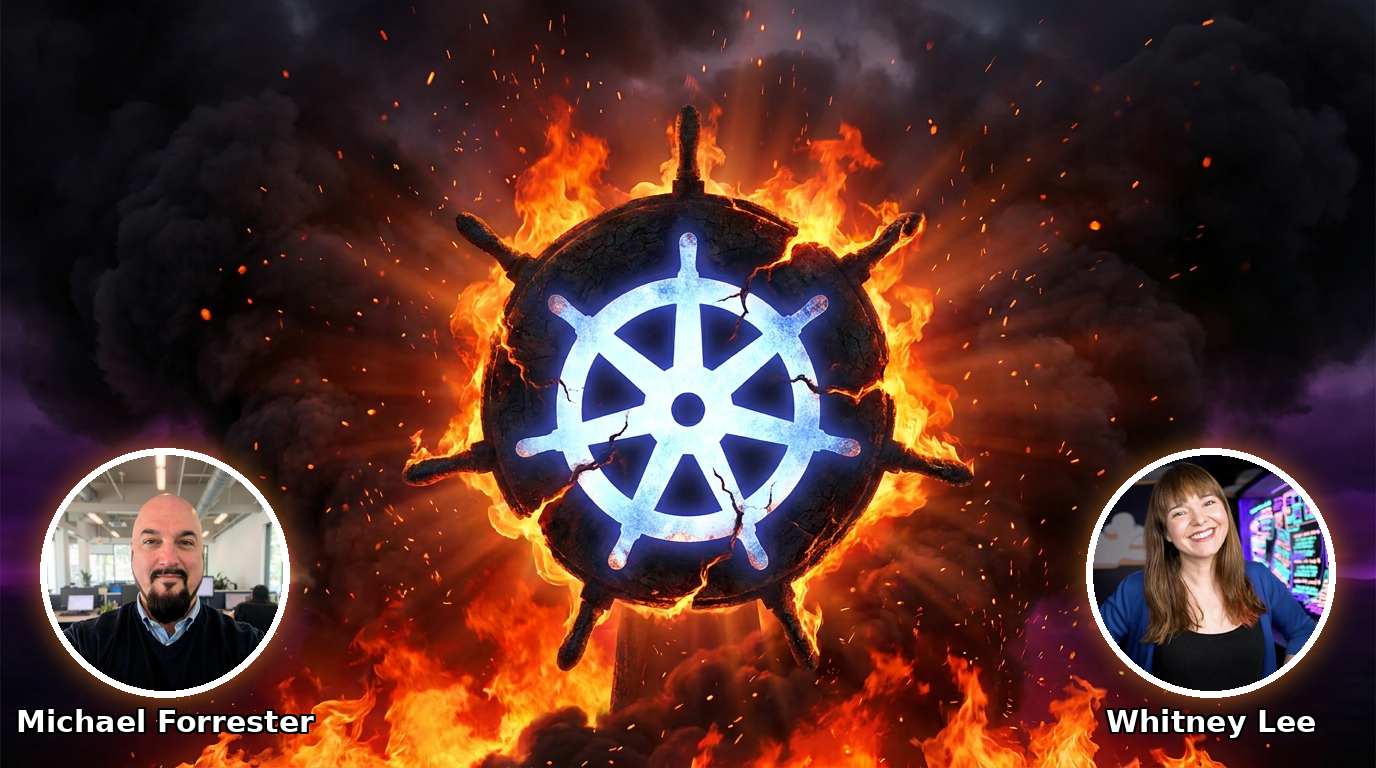
Give an AI agent the keys to a real Kubernetes platform, dare it to do damage, and watch which guardrails actually stop it, and which ones just watch it burn.





A hands-on workshop at DevOpsDays Portland 2026. Slot, venue and delivery live in conference-knowledge.
Presented by Michael Forrester (Accenture) with Whitney Lee.
TL;DR: one lesson in three moves. First the whole room attacks a shared cluster with no
guardrails and watches the agent do damage. Then everyone gets their own cluster and works eight
challenges, installing each guardrail themselves and re-running the attack to watch it die: the CNCF
controls most platform teams already run, then the guardrails specific to agents, the input, the output,
and the tools they can reach, because that is the part existing tooling cannot see.
At KubeCon NA 2026? The breakout BurritoBot Said Let's Dance, the Platform Said No (with Whitney
Lee) is a 30-minute cut of this workshop. Its run-of-show is
facilitation/kubecon-na-2026-run-of-show.md, and the room
uses the /kubecon page on the talk's clusters. The checklist for vetting an MCP server before an agent
gets it is docs/mcp-server-vetting-checklist.md.
What this is
You get a Kubernetes cluster that already runs a full internal developer platform: Argo CD for
GitOps, Kyverno for admission policy, Falco for runtime security, Prometheus and Grafana for
observability, plus secrets management, certificates, and a Backstage portal. You also get an AI
agent with access to that cluster.
The exercise is to make the agent do damage. Ask it to deploy a workload the policies forbid. Ask
it to give itself more permissions. Ask it to change infrastructure without going through Git. Ask
it to read a secret and hand the value back to you. Some of those attempts are stopped by the
platform. The rest get through, until you switch on guardrails meant for agents specifically.
What you learn
Most of what an agent will try against a real platform is already handled by tools many teams run
today, such as admission control, RBAC, and GitOps. Turn the right control on and the attack stops.
What those tools cannot see is the agent's input, its output, and the tools it is allowed to reach.
That is the part agents change, and it is where this workshop spends its time. You will also watch
an unguarded agent run up a real cloud bill, because wasted tokens are their own denial-of-service
problem, and you will see which guardrail stops the spend rather than paying for it after the fact.
How the session runs
The workshop runs two hours in three moves.
- The Community cluster. The whole room points at one shared cluster,
attackme.agenticburn.com,
which runs with no guardrails at all. Everyone attacks it together: talk the agent into leaking the
CEO's home address, and watch the room's own attempts show up by name in Datadog. - Provisioning. Each attendee claims their own cluster by email. It starts with the guardrails
uninstalled. - The eight challenges, on your own cluster. You run each attack, watch it work, then install the
control yourself and run the same attack again to watch it die. The first three are CNCF platform
controls (NetworkPolicy egress, a Kyverno registry allow-list, KubeArmor runtime enforcement). The
rest are the guardrails specific to agents: a budget cap, an output filter, an input filter, the tool
allow-list, and the agent's own RBAC.
You work in a browser. Each cluster gives you a chat window to your agent (BurritoBot, the burrito-ordering
app you are attacking), an in-browser terminal, and a Datadog login to watch what the agent did. No local
install is required.
What you take home
- This repository. It is the platform as code, so you can hand it to a coding agent and stand up
something close to production. - A governance map that lists each attack, the control that stops it, the layer it sits in, and
whether existing tooling already covers it. - A checklist you can run against your own platform to find the gaps.
- A walkthrough of how the session is run, as a reveal.js deck (
railway/walkthrough/, hosted at
walkthrough.agenticburn.com) — the run-of-show in delivery order, with facilitator detail in the notes.
The stack
Everything here is CNCF or open source. Each cluster is independent and take-home: its own in-cluster
Argo CD reconciles the whole platform from a single app-of-apps against the local cluster, with no hub
and no central control plane.
- GitOps: Argo CD
- Policy: Kyverno (incl. registry allowlist, PID limit, cosign image signing)
- Runtime security: Falco, Falcosidekick, and Falco Talon (detect and respond)
- Service mesh and identity: Istio ambient (mTLS, SPIFFE workload identity)
- Secrets and certificates: External Secrets Operator, cert-manager
- Observability: Datadog (primary, and the only log store), with Prometheus, Grafana, Tempo, OpenTelemetry as the fallback
- Developer portal: Backstage
- Agent: kagent (a CNCF project) on Amazon Bedrock
- AI guardrails: LLM Guard, agentgateway (MCP authorization)
Pinned versions are in VERSIONS.lock.
Repository layout
| Path | Contents |
|---|---|
gitops/ |
Argo CD app-of-apps: the whole platform as code |
gitops/ai-layer/ |
the agent and the AI guardrails (kagent, LLM Guard, MCP) |
gitops/ai-layer/guard-proxy/ |
submodule: guard-proxy-agenticburn, the platform-injected guard proxy |
images/llm-guard/ |
submodule: llm-guard-cpu-offline, LLM Guard packaged to scan offline |
policies/kyverno/ |
the admission policies |
security/, observability-idp/, backstage/ |
the platform foundation |
agent/, challenges/ |
guardrail sources and the attack content |
games/ |
the attendee challenges (Cluster-3 games; the S3 "exfil basketball" game is CUT, see games/eso-s3-exfil/CUT.md) |
infra/ |
cluster provisioning, bootstrap, and demo DNS (agenticburn.com) |
verify/ |
the verification scripts + the offline render-gate test suite |
facilitation/ |
run-of-show, governance map, self-assessment, the question tracker |
docs/ |
build spec, build plan, abstract, design decisions, and the stack walkthrough |
Two components live in their own repositories and are included as git submodules, so clone with
them:
git clone --recurse-submodules https://github.com/peopleforrester/Unleash_an_Agent_Watch_It_Burn.git
# or, in an existing clone:
git submodule update --init --recursive
Without them, kubectl kustomize gitops/ai-layer fails and the offline tests that import the guard
proxy cannot find it. Argo CD fetches submodules on its own, so a cluster needs nothing extra.
A third repository, peopleforrester/llm-guard-upstream-mirror (private), is a backup of the archived
protectai/llm-guard so builds survive if the upstream repository
is deleted. It is not a submodule and nothing here builds from it.
Safety
Everything here is synthetic. Planted secrets are obviously fake and carry a FAKE- prefix. No real
credential goes into a cluster, a trace, or a recording. The clusters are disposable on purpose.
Reviews (0)
Sign in to leave a review.
Leave a reviewNo results found