SignsofAI
Health Warn
- License — License: MIT
- Description — Repository has a description
- Active repo — Last push 0 days ago
- Low visibility — Only 6 GitHub stars
Code Fail
- fs.rmSync — Destructive file system operation in Docs/Blog/shorts/build-short.mjs
- process.env — Environment variable access in Docs/Blog/shorts/build-short.mjs
Permissions Pass
- Permissions — No dangerous permissions requested
No AI report is available for this listing yet.
A free, privacy-first tool that flags the tells of AI-generated writing, overused vocabulary, rhetorical crutches, robotic sentence rhythm and, for every finding, tells you how to fix it.
✍︎ Signs of AI Writing






Try the live demo → — English & Spanish, runs 100% in your browser. No signup, and nothing leaves your device.
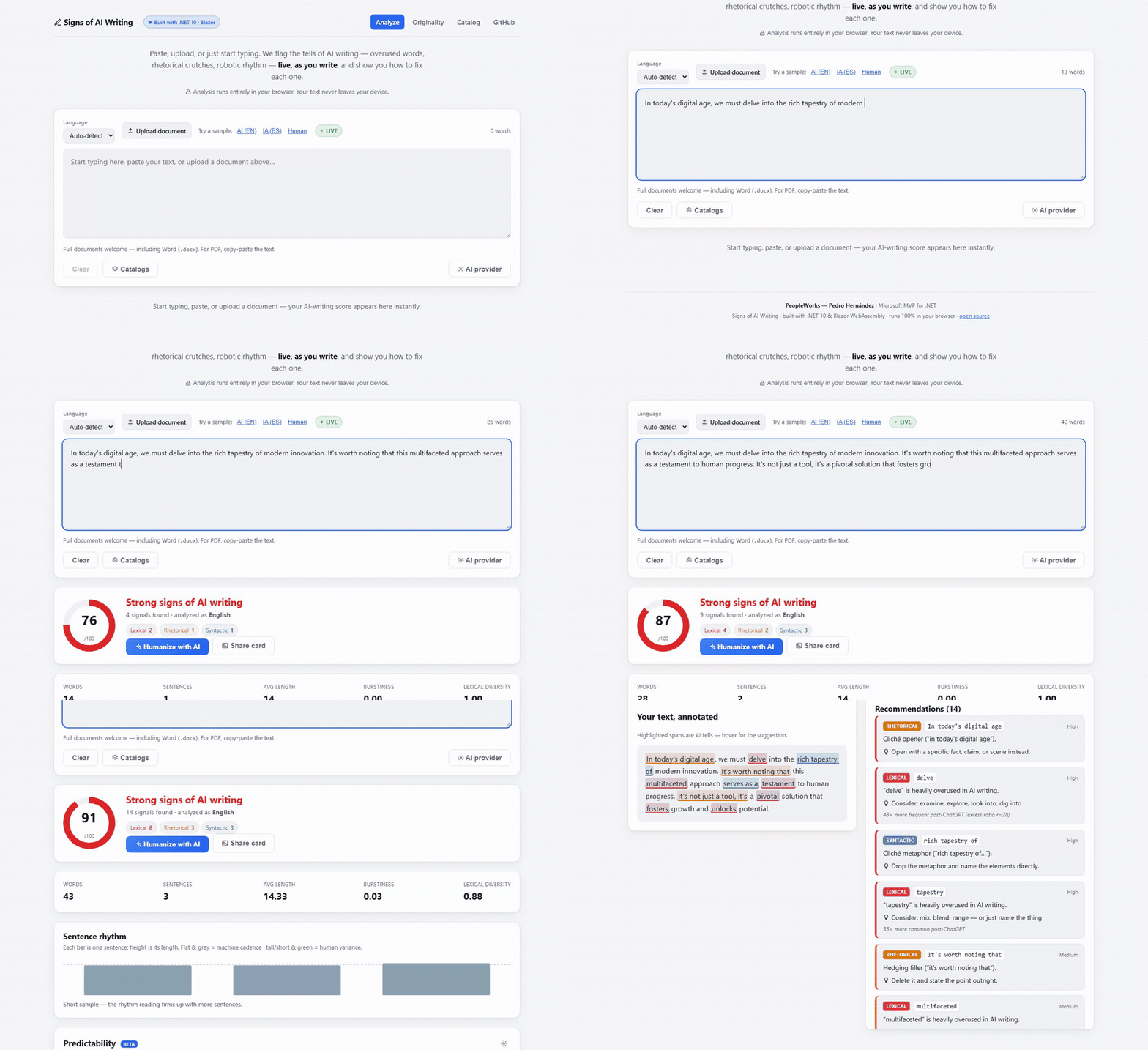
Real recording of the live demo — the score updates as you type, and every highlight comes with a suggested fix.
A free, privacy-first toolkit for academic and writing integrity. It does two things:
- De-AI-ify linter — flags the tells of AI-generated writing (overused vocabulary, rhetorical
crutches, robotic sentence rhythm) and, for every finding, tells you how to fix it. - Originality checker — "did they write it, or copy it?" Compares documents against each other
and surfaces the passages they share — verbatim copies, reworded paraphrases (even across
languages), and a whole-cohort overview — as evidence a human judges. Not a black-box verdict.
🔒 Almost everything runs 100% in your browser. Your documents never leave your device.
The only exception is the optional paraphrase check, which is strictly opt-in and clearly disclosed.
Built with .NET 10 and Blazor WebAssembly by Pedro Hernández (PeopleWorks), Microsoft MVP
for .NET — for the .NET and Microsoft developer community, por y para la comunidad educativa.
Repo: https://github.com/peopleworks/SignsofAI
Both English and Spanish are supported throughout (auto-detected or selectable). The Spanish
rule-pack is an original derivation of AI-writing markers for Spanish.
1. The AI-writing linter ("Analyze")
Unlike black-box detectors that only spit out a score, this is an explainable, actionable, educational
linter. Paste, upload (.docx / .txt / .md), or just start typing — the 0–100 score, highlights,
statistics, and per-finding fixes update as you write.
| Category | Examples |
|---|---|
| Lexical | delve, tapestry, multifaceted, nuanced, pivotal, underscore, showcase, testament… (weighted by post-ChatGPT excess frequency) |
| Rhetorical | Negative parallelisms ("it's not just X, it's Y"), cliché openers ("in today's digital age"), hedging ("it's worth noting that"), false ranges, rule-of-three |
| Syntactic | Copula avoidance ("serves as a…", "a testament to…"), inflated constructions ("plays a crucial role") |
| Statistical | Burstiness — sentence-length uniformity. Machine text hovers at 0.0–0.2; human prose 0.6–0.8 |
- Sentence-rhythm visualization — a per-sentence bar chart that makes burstiness visible.
- Per-finding recommendations — every flagged tell carries a concrete fix and the research behind it.
- Humanize (optional, BYOK) — connect an AI provider and rewrite the flagged text in one click.
Anthropic (claude-opus-4-8, works from the browser), OpenAI / DeepSeek, Azure OpenAI, or Ollama
(local, no key). Credentials live only in your browser and are sent directly to the provider. - Before/after diff and a shareable result card (a PNG summary that never includes your text).
- Custom catalogs (BYO rules) — paste banned words or import a rule-pack JSON; merges live.
- Catalog page — a searchable library of every AI-writing sign, in both languages, ranked with an
in-browser BM25 index.
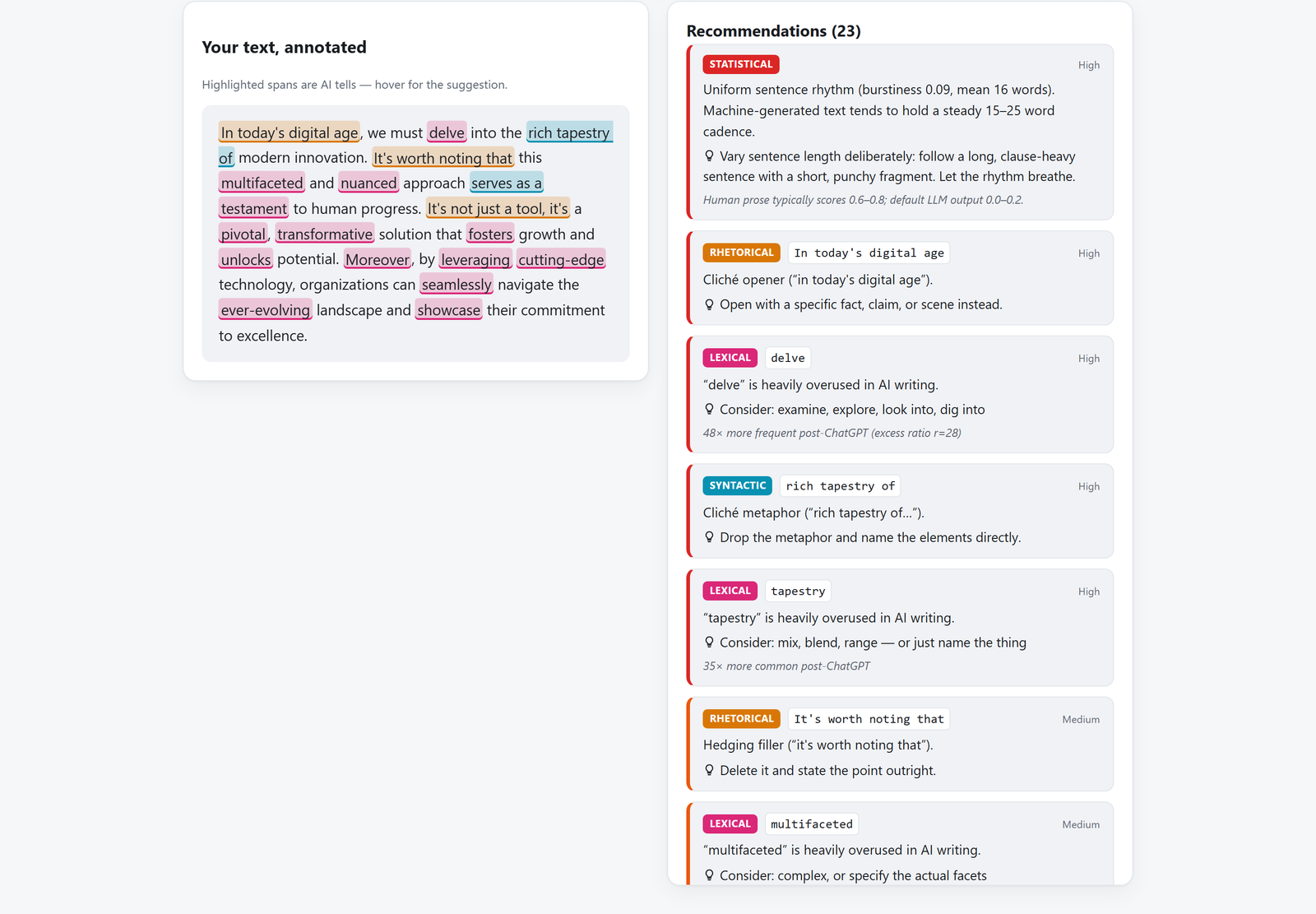
This is the difference: not "87% AI", but which words, why they were flagged, and what to write instead.
2. The Originality checker ("Originality")
"¿Lo escribió la IA, lo copiaste, o lo parafraseaste para esconderlo?" Drop in two or more documents —
a thesis and its sources, a batch of student submissions — and see exactly what they share. The guiding
principle is honest: we surface the evidence and highlight it; a human judges. We never accuse. This is
not a whole-internet index like Turnitin.
| Phase | What it catches | How | Where it runs |
|---|---|---|---|
| A — Literal copy | verbatim shared passages, resistant to changed capitalization/accents | accent/case-folded word k-shingles + greedy longest-match tiling, verified token-by-token | 🔒 in your browser |
| B — Paraphrase | reworded copies — same idea, different words — even across languages | sentence embeddings (Google EmbeddingGemma-300M, ONNX) + cosine similarity | 🌐 optional server (opt-in) |
| C — Cohort | who copied whom across a whole class, at a glance | batch upload + an N×N overlap heatmap; click a cell to inspect the pair | 🔒 in your browser |
| D — Web spot-check | whether a passage already exists online | extracts a document's most distinctive passages and hands you one-click exact-phrase searches (Google/Bing/DuckDuckGo) | 🔒 in your browser |
- Shared-passage evidence — matches are highlighted in both documents, side by side; the headline
overlap number equals exactly what you see highlighted (the evidence is the score). - Phase B is the one feature that leaves the device. It's opt-in, disclosed in the UI, and sends only
the sentences you choose to check to the PeopleWorks server. Everything else stays on your machine. - Phase D is deliberately honest: we can't index the whole web, so instead of pretending to, we surface
the passages worth checking and prepare the searches — nothing is sent anywhere until you click one.
An optional automatic web search can be enabled by the server operator (see Optional server below).
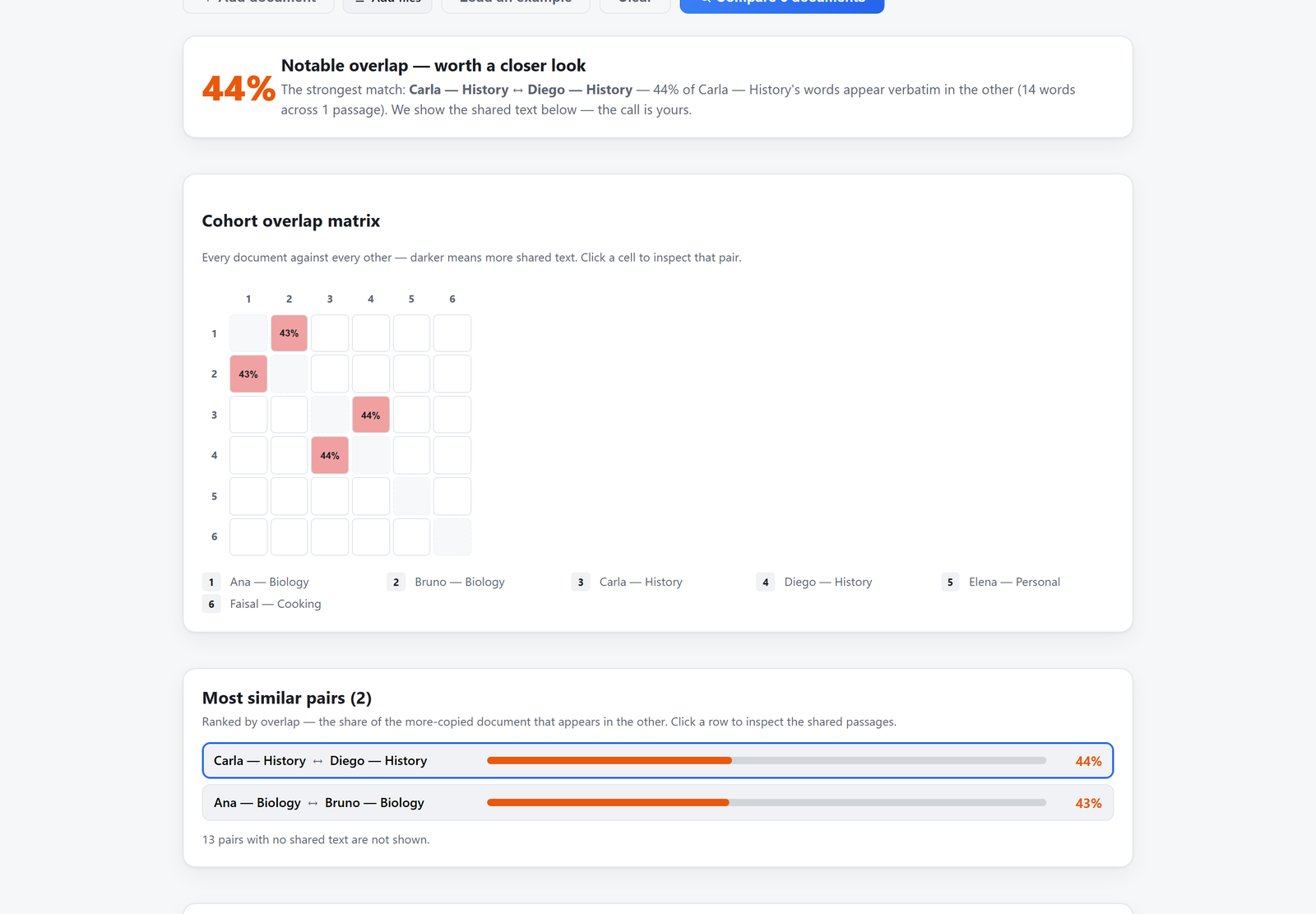
A whole class at a glance: every document against every other, then the shared passages themselves — evidence, not an accusation.
3. The predictability meter (optional server)
An honest reframing of perplexity. A small language model (Qwen2.5-0.5B or Microsoft Phi-4-mini, int8 ONNX)
measures how predictable / generic a text's phrasing is. This is not an AI-vs-human verdict — on a
labelled corpus the two overlap badly (memorized human text scores predictable too). We surface
predictability honestly as one signal among many, calibrated per language. Opt-in; runs on the PeopleWorks
server. The model lazily loads and idle-unloads to keep the server light.
4. Use it from other apps — MCP server
Everything above is also available to Claude Desktop and any MCP
client through SignsOfAI.Mcp, a Model Context Protocol server (built on the officialModelContextProtocol SDK, stdio transport). Because
the engine lives in SignsOfAI.Core — pure .NET, no browser — the server just exposes it as tools:
| Tool | What it does | Where it runs |
|---|---|---|
analyze_ai_writing |
score + verdict + findings (with fixes) + statistics | 🔒 on-device |
check_originality |
overlap % and shared passages across 2+ documents | 🔒 on-device |
search_catalog |
search the catalog of AI-writing signs (EN/ES) | 🔒 on-device |
extract_distinctive_phrases |
distinctive phrases + ready-made web-search links | 🔒 on-device |
measure_predictability |
perplexity via the optional server | 🌐 server (opt-in) |
check_paraphrase |
reworded/translated matches via EmbeddingGemma | 🌐 server (opt-in) |
The first four run entirely on the machine; the last two disclose that they send text to the server
(endpoint via the SIGNSOFAI_API_ENDPOINT environment variable).
It ships on NuGet as SignsOfAI.Mcp, so nothing needs
building. Point Claude Desktop at it:
// %APPDATA%\Claude\claude_desktop_config.json
{ "mcpServers": { "signs-of-ai": {
  "command": "dnx",
  "args": ["SignsOfAI.Mcp", "--yes"]
}}}
Or install it as a global tool once — dotnet tool install --global SignsOfAI.Mcp — and use"command": "signsofai-mcp". See src/SignsOfAI.Mcp/README.md for details.
VS Code: the package ships an MCP manifest, so its
NuGet page has an MCP Server tab with the config
already generated — copy it into .vscode/mcp.json and you're done.
5. Use it as an agent skill — /signs-of-ai
Prefer to work inside your editor? skill/signs-of-ai is a drop-in Claude Code / Codex / agent skill
that de-slops a draft — or judges whether text reads as AI-written — in English and Spanish. It's a
human-readable distillation of the same rules.en.json / rules.es.json taxonomy, so it edits by the
same rules the engine scores by. Install by pasting the repo link into your AI harness, or copy the
folder into ~/.claude/skills/, then:
/signs-of-ai            <your draft>          # edit mode: rewrite + change summary
/signs-of-ai is this AI slop?  <the text>     # detect mode: quoted verdict, no rewrite
The skill deliberately never fakes a numeric score — for a calibrated 0–100 verdict, burstiness,
originality, or perplexity it hands off to this engine (web app, CLI, or the MCP tools above). Seeskill/README.md.
Architecture
SignsOfAI.slnx
├─ src/
│  ├─ SignsOfAI.Core            # Pure C# engines (no UI/server deps)
│  │  ├─ Analyzers/             # Lexical, Pattern, Burstiness (IAnalyzer)
│  │  ├─ Originality/           # OriginalityChecker (shingles+tiling), ParaphraseFinder,
│  │  │                         #   DistinctivePhraseExtractor
│  │  ├─ Rules/Packs/           # rules.en.json, rules.es.json (embedded, community-extensible)
│  │  ├─ Text/                  # Tokenizer, sentence splitter, language detector, statistics
│  │  └─ AiWritingAnalyzer      # Public facade: Analyze(text, language)
│  ├─ SignsOfAI.Web             # Blazor WebAssembly front end (Analyze, Originality, Catalog)
│  ├─ SignsOfAI.Cli             # `dotnet tool` for CI pipelines
│  ├─ SignsOfAI.Mcp             # MCP server (stdio): the engine as tools for Claude Desktop / any client
│  └─ SignsOfAI.Perplexity.Api  # Optional ASP.NET Core server: predictability + embeddings
│     ├─ Engine/                #   OnnxPerplexityEngine, OnnxEmbeddingEngine (lazy-load + idle-unload)
│     └─ Config/                #   model profiles, calibration, embedding + web-search options
└─ tests/
   └─ SignsOfAI.Core.Tests      # xUnit (40+)
The Core engines are decoupled from the UI and server — the CLI, the Blazor app, and the API all reuse them.
Run it
dotnet run --project src/SignsOfAI.Web
# then open http://localhost:5019
Test
dotnet test
Command line & CI (dotnet tool)
The linter ships as a global tool so you can gate prose in CI:
dotnet tool install --global SignsOfAI.Cli

signsofai check README.md                 # pretty report
signsofai check article.docx --lang en    # Word documents too
signsofai check post.md --json            # machine-readable
signsofai check post.md --max-score 40    # exit 1 if it reads too much like AI → fails CI
signsofai check post.md --rules my-style.json   # your custom catalog
The analysis engine is also a library — dotnet add package SignsOfAI.Core:
var result = new SignsOfAI.Core.AiWritingAnalyzer().Analyze(text, "auto");
Console.WriteLine($"{result.OverallScore}/100 — {result.Verdict}");
Optional server (SignsOfAI.Perplexity.Api)
The client works fully on its own; this server only powers the opt-in features (the predictability meter
and the Phase B paraphrase check). It's ASP.NET Core (.NET 10) hosting ONNX models with lazy-load and
idle-unload so it stays light. Model files are not in git — they download on first use.
The client points at a hosted instance by default; to run your own, set the endpoint in the app's server
settings and configure CORS for your origin.
Enabling the optional automatic web search (Phase D)
By default Phase D is the on-device, one-click-search experience (no key, nothing sent until you click).
An operator can additionally enable an automatic web search — useful for presentations — by configuring
a search provider on the server (the key never touches the browser). It stays off unless configured:
// appsettings.json (or environment variables)
"WebSearch": {
  "Enabled": true,
  "Provider": "brave",              // Brave Search API (free tier); provider-abstracted
  "ApiKey": "",                     // prefer the BRAVE_API_KEY environment variable
  "MaxPhrasesPerDoc": 8,
  "MaxResultsPerPhrase": 5
}
When enabled, the server advertises the capability and the client offers an automatic "search the web"
action that reports pages containing a passage verbatim. If it's off, quota-exhausted, or errors, the UI
falls back to the manual one-click searches — it never breaks.
Extending the rules
Add entries to src/SignsOfAI.Core/Rules/Packs/rules.<lang>.json — lexical rules match single word
tokens, pattern rules are regexes for multi-word tells. Each sets a weight, severity, and suggestion.
Deploy
The Blazor client is a static bundle (hosts anywhere free). Included GitHub Actions:
- GitHub Pages (
deploy-pages.yml) — Settings → Pages → Source: "GitHub Actions". The workflow rewrites
the base href and writes an SPA404.htmlfallback. - Azure Static Web Apps (
azure-static-web-apps.yml) — add the deployment token as a repo secret.
The optional server is a normal ASP.NET Core app (dotnet publish the SignsOfAI.Perplexity.Api project).
Credits
Created by Pedro Hernández — PeopleWorks, Microsoft MVP for .NET. Detection markers are grounded in
linguistics research on AI stylometry — see Docs/GoogleResearch.md.
Reviews (0)
Sign in to leave a review.
Leave a reviewNo results found