engram-go
Health Uyari
- No license — Repository has no license file
- Description — Repository has a description
- Active repo — Last push 0 days ago
- Low visibility — Only 5 GitHub stars
Code Gecti
- Code scan — Scanned 6 files during light audit, no dangerous patterns found
Permissions Gecti
- Permissions — No dangerous permissions requested
This tool provides a persistent memory system for AI agents, enabling them to store and recall context across sessions. It uses a local PostgreSQL database with vector support to keep semantic search, decision logs, and notes entirely on your machine.
Security Assessment
The overall risk is rated as Low. The light code scan found no dangerous patterns, no hardcoded secrets, and no requests for dangerous permissions. According to its documentation, the tool operates 100% locally without making external network requests. It does not send your code context or notes to third-party APIs, relying instead on a local PostgreSQL database and a local Ollama instance for embeddings. There are no signs of unexpected shell command execution.
Quality Assessment
The project is actively maintained, with the most recent push occurring today. However, there are some trust and usability concerns. The repository has low visibility with only 5 GitHub stars, meaning it has not been broadly tested or reviewed by the open-source community. Additionally, the rule-based scan flagged a missing license file. While the README contains an MIT license badge, the actual absence of a formal license file in the repository is a legal risk for adoption and contribution.
Verdict
Use with caution — the underlying code is safe and local-only, but you should verify the MIT licensing status before adopting it in a professional environment.
Persistent memory for AI agents — 28 MCP tools, Go, PostgreSQL+pgvector, ~10MB container, 200ms cold start





Every time you close your AI coding session, it forgets everything. The JWT library you chose. The expiry bug you spent an afternoon on. The pattern you explicitly rejected. Gone. Next session, the agent starts from zero and you start explaining.
# Session start — before touching any code
memory_recall("session handoff recent decisions", project="myapp")

# After settling on a technical choice
memory_store(
    "Chose RS256 over HS256: the API gateway needs to verify tokens without
     holding the signing secret. HS256 would require distributing the key to
     every service. Do not change this without updating the gateway config.",
    memory_type="decision",
    project="myapp"
)
100% Local. No exceptions.
Your memories never leave your machine.
Most memory tools send your code context, architectural notes, and decision logs to a third-party API. Engram doesn't. Your PostgreSQL stores every memory. Your Ollama instance runs every embedding. Nothing leaves your infrastructure unless you push it yourself.
- No account to create
- No API key to manage
- No vendor terms governing your codebase notes
- No data leaving your network
make init && make up && make setup
# Done. Memory server at localhost:8788.
What makes this different
Finds what you mean, not just what you typed. BM25 keyword search and 768-dimensional semantic vectors run simultaneously. Searching "database lock timeout" finds your note about "WAL mode contention under load" — no shared words, close meaning. When Ollama is unavailable, search degrades gracefully to BM25+recency. Your results never disappear because an external service went down.
Weights by recency automatically. Exponential decay at 1% per hour. Yesterday's decision outranks one from six months ago. Nothing is deleted; old memories step back. Six-month-old memories are still there if nothing more recent matches.
Surfaces connected memories without being asked. A knowledge graph links decisions to the bugs they caused and the patterns they require. Recall one; get its neighborhood. Store a bug report, store the architectural pattern that caused it, connect them with a causes edge. Now any query about the pattern automatically surfaces the bug — you don't have to remember to ask for both.
Stores documents, not just notes. memory_store_document handles up to 500,000 characters. Engram chunks at sentence boundaries and embeds each chunk independently. A 20,000-word architecture document is searchable at the paragraph level — a query about authentication surfaces the auth section, not the whole document.
Quick Start
git clone https://github.com/petersimmons1972/engram-go.git && cd engram-go
make init     # generates POSTGRES_PASSWORD and ENGRAM_API_KEY in .env
make up       # starts postgres, ollama, and engram-go
make setup    # writes bearer token to ~/.claude/mcp_servers.json
The server starts on port 8788. Cold start: under 200ms. Memory at idle: 18 MB.
Docker users:
docker-compose.ymlnow setsENGRAM_SETUP_TOKEN_ALLOW_RFC1918=1automatically. If you run engram outside Docker and need/setup-tokenaccessible from RFC1918 addresses (e.g. a LAN host), add this variable to your environment. Without it,/setup-tokenonly accepts loopback (127.0.0.1 / ::1).
Run /mcp in Claude Code after setup to connect. All 30 core tools are available immediately. Five optional AI-enhanced tools (memory_ask, memory_reason, memory_explore, memory_query_document, memory_diagnose) activate when ANTHROPIC_API_KEY is set.
Architecture
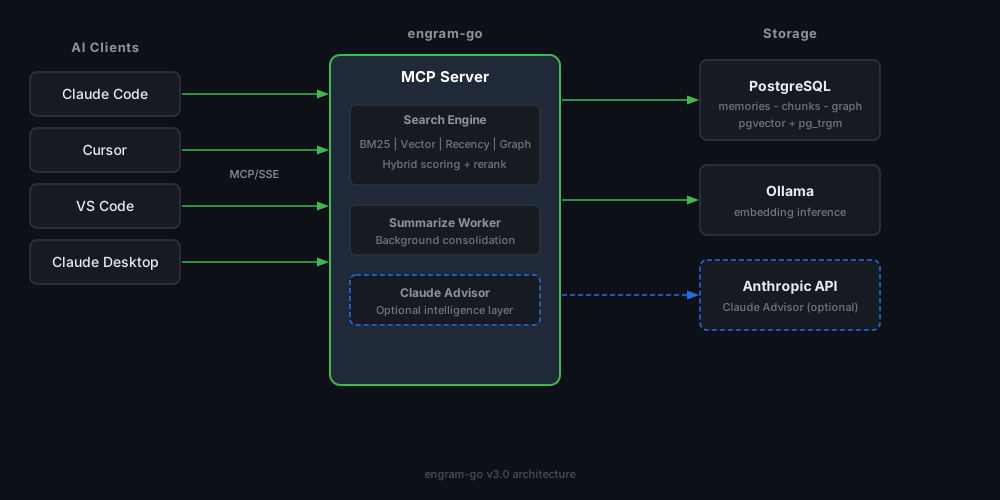
Your AI client speaks MCP over SSE. Engram exposes 35 tools — 30 run entirely locally (store, recall, connect, correct, episode management, cross-project federation, aggregate analysis, and more) plus 5 optional AI-enhanced tools that activate when ANTHROPIC_API_KEY is set. PostgreSQL with pgvector stores everything. Ollama (local) runs the embeddings.
New in v3
RAG Queries: memory_ask
Ask a natural-language question against your stored memories. Returns a synthesized answer with citations — not a list of chunks, a direct response.
memory_ask(
    question="What did we decide about authentication and why?",
    project="myapp"
)
# → "You chose RS256 JWT with 24h expiry stored in httpOnly cookies.
#    The decision was driven by the need to verify tokens in the API gateway
#    without distributing the signing secret. localStorage was explicitly
#    rejected due to XSS risk. (memories: auth-decision-001, security-pattern-003)"
Document Storage: memory_store_document
Store up to 500,000 characters — architecture documents, meeting transcripts, entire codebases. Engram chunks at sentence boundaries and makes every paragraph individually searchable.
memory_store_document(
    content=entire_architecture_document,  # up to 500k chars
    memory_type="architecture",
    project="myapp"
)
# Later: search surfaces the specific section, not the whole document
memory_query_document(doc_id=doc_id, query="authentication flow")
Aggregate Queries
Query the shape of your memory store without reading individual memories.
memory_aggregate(by="memory_type", project="myapp")
# → [{label: "decision", count: 47}, {label: "error", count: 12}, ...]

memory_aggregate(by="failure_class")
# → [{label: "vocabulary_mismatch", count: 8}, {label: "stale_ranking", count: 3}, ...]
Retrieval Miss Tracking
When memory_recall returns nothing useful, log the miss with a failure class. This feeds the retrieval quality benchmark and makes future recall better.
memory_feedback(
    event_id="<id from recall>",
    memory_ids=[],
    failure_class="vocabulary_mismatch"  # or: aggregation_failure, stale_ranking,
                                          #     missing_content, scope_mismatch
)
Documentation
| Why Engram? | The problem with AI agent memory and how Engram solves it |
| How It Works | Four-signal search, knowledge graph, context efficiency |
| Getting Started | Install and connect in 5 minutes |
| Connecting Your IDE | Claude Code, Cursor, VS Code, Windsurf, Claude Desktop |
| All 35 Tools | MCP tool reference with usage examples |
| Claude Advisor | AI-powered summarization, consolidation, re-ranking |
| Operations | Backup, security, data portability |
v3.0 vs v2 vs v1
v1 was Python. v2 rewrote in Go. v3.0 adds required authentication, auto-episode starts on every SSE connection, 35 tools, document storage, RAG queries, and aggregate analysis.
| v1 (Python) | v2 (Go) | v3.0 (Go) | |
|---|---|---|---|
| Container size | 200 MB | 10 MB | 10 MB |
| Cold start | ~3 seconds | ~200ms | ~200ms |
| Idle memory | 120 MB | 18 MB | 18 MB |
| Base image | python:3.12-slim | Chainguard static | Chainguard static |
| MCP transport | stdio | SSE | SSE |
| Authentication | optional | optional | required |
| Auto-episode | no | no | yes |
| Tool count | 19 | 19 | 35 (30 local + 5 AI-enhanced) |
| Max memory size | 50k chars | 50k chars | 500k chars |
| Document mode | no | no | yes — chunked at sentence boundaries |
| RAG queries | no | no | yes — memory_ask |
| Aggregate queries | no | no | yes — memory_aggregate |
| Cloud required | no | no | no |
MIT — see LICENSE
Yorumlar (0)
Yorum birakmak icin giris yap.
Yorum birakSonuc bulunamadi