jdbg
Health Uyari
- License — License: Apache-2.0
- Description — Repository has a description
- Active repo — Last push 0 days ago
- Low visibility — Only 6 GitHub stars
Code Gecti
- Code scan — Scanned 7 files during light audit, no dangerous patterns found
Permissions Gecti
- Permissions — No dangerous permissions requested
Bu listing icin henuz AI raporu yok.
Agent-friendly Java debugger CLI for coding agents and humans, wrapping JDK jdb with persistent sessions, structured output, and native MCP tools.
jdbg
Agent-friendly Java debugging from a Rust CLI.
Wraps the JDK jdb with prompt-aware control, persistent sessions,
an optional JDI sidecar backend, structured output, and native MCP tools for Claude Code,
Codex, OpenCode, Pi, and humans.




Debug Java without Bash glue
|
Built for agent workflows
|
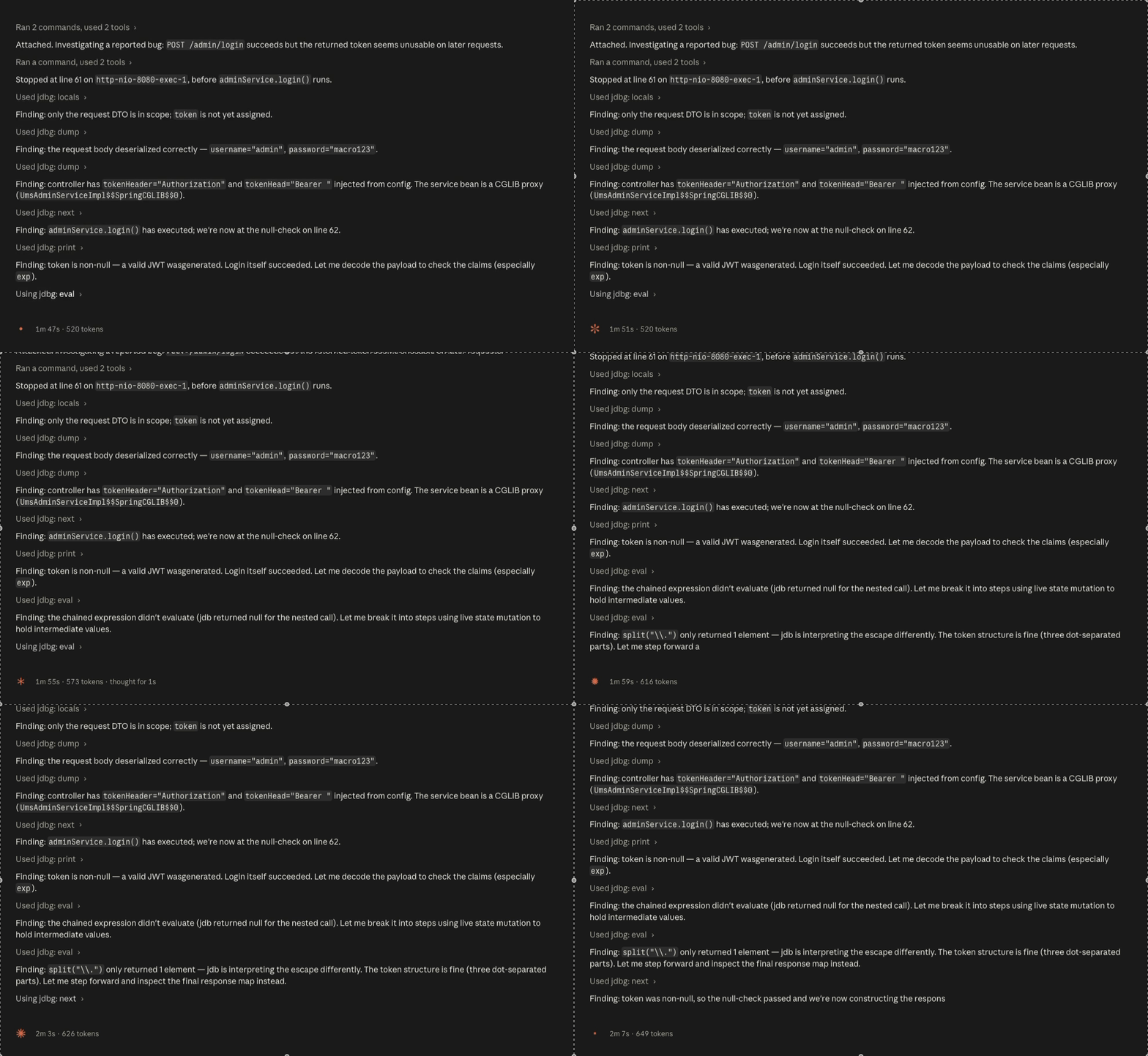
Demo
Quick Start
Install
The installer downloads the right release artifact for your OS and adds jdbg to your user-level PATH.
Open a new terminal afterwards so the command is visible.
Windows:
powershell -ExecutionPolicy Bypass -c "irm https://github.com/PieceOfFall/jdbg/releases/latest/download/java-agent-debugger-installer.ps1 | iex"
macOS / Linux:
curl --proto '=https' --tlsv1.2 -LsSf https://github.com/PieceOfFall/jdbg/releases/latest/download/java-agent-debugger-installer.sh | sh
# Install to ~/.cargo/bin/jdbg
cargo install --git https://github.com/PieceOfFall/jdbg.git

# Build from source
git clone https://github.com/PieceOfFall/jdbg.git
cd jdbg
# Source builds need JDK 17+ for the Gradle sidecar build.
cargo build --release
Register With Your Agent
jdbg setup
Use non-interactive setup when provisioning machines:
jdbg setup --target claude,codex,opencode,pi --yes
jdbg setup --backend jdi --target codex --yes
jdbg setup --target codex --print
jdbg setup --target opencode --print
jdbg setup --target pi --print
Debug Something
# Compile with debug info for locals and line breakpoints
javac -g Main.java

# Launch a debug session. The daemon starts automatically.
jdbg launch Main --classpath .

# Set a breakpoint and run
jdbg break-at Main 9
jdbg run

# Inspect the stopped program
jdbg locals
jdbg where
jdbg print myVar

# Move execution forward
jdbg step
jdbg cont

# Clean up
jdbg kill
jdbg daemon stop
In Claude Code, Codex, or OpenCode, ask the agent to debug the Java program.
It drives the same flow through mcp__jdbg__* tools. In Pi, the installed skill drives the jdbg CLI.
Why jdbg
| Capability | What it changes |
|---|---|
| Prompt-aware reader | Commands finish when jdb is actually ready, not after a guessed sleep. |
| Persistent daemon | Every CLI or MCP call can reuse live debug sessions instead of restarting state. |
| Native MCP surface | Claude Code, Codex, and OpenCode get typed tool calls instead of shell-wrapped debugging. |
| Thread-only breakpoints | suspend: "thread" stops the hit thread while heartbeat, ZK, Dubbo, and server threads keep running. |
| Runtime discovery | classes and methods help agents find CGLIB proxies, generated classes, and exact signatures. |
| Focused inspection | locals, where, inspect, watch, and thread-locks keep agent loops short. |
| JDI runtime actions | print, eval, set, and force-return let agents test hypotheses in a suspended frame when explicit side effects are intended. |
Agent Setup
jdbg setup installs only the target-specific configuration that belongs to jdbg.
Removal is surgical and preserves sibling servers, user settings, and unrelated skill directories.
Interactive setup also asks which backend the installed skills should prefer. Use --backend jdb|jdi
for non-interactive provisioning; the preference is written into the skill guidance, while jdb
remains the CLI/MCP runtime default when no backend is passed on session creation.
| Target | What gets configured | Installed skill |
|---|---|---|
| Claude Code | mcpServers.jdbg in ~/.claude.json, plus mcp__jdbg__* permission in ~/.claude/settings.json |
~/.claude/skills/jdbg/SKILL.md |
| Codex | [mcp_servers.jdbg] in ~/.codex/config.toml |
~/.codex/skills/jdbg/SKILL.md |
| OpenCode | mcp.jdbg in ~/.config/opencode/opencode.json |
~/.config/opencode/skills/jdbg/SKILL.md |
| Pi | No MCP config | ~/.pi/agent/skills/jdbg/SKILL.md |
jdbg setup --remove
jdbg setup --remove --target codex
jdbg update
jdbg update detects which agents already had jdbg configured, installs the latest release, then re-registers the same targets.
MCP Server
jdbg __mcp runs an rmcp-based stdio MCP server exposing the debugger as 37 native tools.
The MCP layer is a thin daemon client: it maps tool calls to the same command protocol used by the CLI, then renders the same results.
| Category | Tools |
|---|---|
| Sessions | launch, attach, status, list, kill |
| Breakpoints | break_at, break_in, catch, watch, unwatch, breakpoints, clear |
| Execution | run, cont, step, next, step_out, suspend, resume |
| Inspection | where, locals, print, dump, eval, inspect, threads, thread, frame, list_source, set, force_return, lock, threadlocks, raw |
| Discovery | classes, methods |
| Exception control | ignore |
Manual Claude-style MCP config for a development build:
{
  "mcpServers": {
    "jdbg": {
      "command": "target/debug/jdbg",
      "args": ["__mcp"]
    }
  }
}
Codex config:
[mcp_servers.jdbg]
command = "target/debug/jdbg"
args = ["__mcp"]
OpenCode config:
{
  "$schema": "https://opencode.ai/config.json",
  "mcp": {
    "jdbg": {
      "type": "local",
      "command": ["target/debug/jdbg", "__mcp"],
      "enabled": true
    }
  }
}
Command Surface
Core commands# Session lifecycle
jdbg launch <MainClass> [--backend jdb|jdi] [--classpath CP] [--sourcepath SP] [--name N] [-- app-args...]
jdbg attach [--backend jdb|jdi] [--host H] [--port P] [--sourcepath SP] [--name N]
jdbg status | list | kill [--session ID]
jdbg daemon start | stop | status
# Breakpoints and watchpoints
jdbg break-at <Class> <line> [-c <condition>] [-s thread|all]
jdbg break-in <Class> <method> [--event entry|exit|both] [--args types] [-c <condition>] [-s thread|all]
jdbg catch <Exception> [--mode caught|uncaught|all]
jdbg watch <Class.field> [--mode access|modification|all]
jdbg unwatch <Class.field> [--mode access|modification|all]
jdbg breakpoints | clear <spec>
jdbg ignore <Exception> [--mode caught|uncaught|all]
# Runtime discovery
jdbg classes [pattern]
jdbg methods <Class>
# Execution control
jdbg run | cont | step | next | step-out
# Inspection
jdbg where [--all] | locals | print <expr> | dump <obj> | eval <expr>
jdbg inspect <expr> [--max-elements N]
jdbg threads | thread <id> | frame <up|down> [n] | list-source [line]
jdbg suspend [thread-id] | resume [thread-id]
jdbg set <lvalue> <value>
jdbg force-return <value>
jdbg lock <expr> | thread-locks [thread-id]
jdbg raw <jdb command...>
# Setup and maintenance
jdbg setup [--remove] [--print] [--target claude,codex,opencode,pi|auto|all|none] [--backend jdb|jdi] [--yes]
jdbg update
Global flags:
| Flag | Purpose |
|---|---|
--session <id> |
Target a specific debug session. Defaults to the sole live session when unambiguous. |
--json |
Emit machine-readable JSON instead of human-readable text. |
--timeout <secs> |
Override per-command timeout. |
--jdb-path <path> |
Use an explicit jdb executable. |
Backend selection is made only when creating a session. The default jdb backend is the compatibility path
and supports the full command surface. The jdi backend can launch or attach through a local Java sidecar
for structured runtime data; it supports threads, line break-at, method break-in entry/exit events,
field watch/unwatch, run for launched sessions, cont, next, where, locals, thread, safe JSONinspect, expression print/eval/dump, set, and non-void force-return. Unsupported JDI commands fail
explicitly instead of falling back to jdb.
JDI method breakpoints accept --event entry|exit|both. Method exit stops include the rendered return value
when the target VM provides it. The jdb backend keeps method-entry behavior; --event exit and both fail
with an explicit unsupported-backend error.
On JDI sessions, inspect is intentionally safe and reads fields directly without invoking getters. JDIprint, eval, dump, set, and force-return are executable capabilities: method calls may run in the
target JVM and can have side effects. set assigns locals, fields, or array elements by evaluating the right
hand side as a Java expression. force-return evaluates its value expression and forces the current non-void
method to return it; void force-return is reported as unsupported. These executable JDI operations require a
suspended stop site; running, dead, or exited sessions fail explicitly.
The daemon can hold multiple JDI sessions at once. Each session serializes its own in-flight command, while
separate sessions continue independently so multiple agents can debug different Java projects concurrently.
The JDI sidecar message protocol is length-prefixed JSON over platform-local byte streams: two one-way
Named Pipes on Windows, or an AF_UNIX socketpair on Linux/macOS. The Unix socket is handed to the Java 8
sidecar as an inherited fd because Java 8 has no pathname UDS client API. gRPC, protobuf, and direct Rust
JDWP are not part of the roadmap.
Architecture
Two clients feed one daemon. The daemon owns live backend sessions and the in-memory session map.
flowchart LR
    CLI["CLI: jdbg <cmd>"]
    MCP["MCP: jdbg __mcp"]
    Daemon["Daemon: session manager"]
    JdbA["jdb child A"]
    Jdi["JDI sidecar"]
    JvmA["JVM A"]
    JvmB["JVM B"]

    CLI --> Daemon
    MCP --> Daemon
    Daemon --> JdbA --> JvmA
    Daemon -->|length-prefixed JSON| Jdi --> JvmB
The internal dependency direction stays simple:
bin -> cli / output -> client / daemon -> backend -> session / jdi -> jdb / jdkpath -> error / protocol / registry
See DESIGN.md for the full design reference.
Requirements
| Requirement | Notes |
|---|---|
| Debug target JDK | JDK 8-21+ with jdb on PATH or discoverable via JAVA_HOME. |
| Debug info | Compile Java with javac -g for locals and reliable line breakpoints. |
| Rust | Rust 1.85+ only when installing through cargo or building from source. |
| Source build JDK | JDK 17+ is required to run Gradle and build the JDI sidecar fat jar. Debug targets still support JDK 8+. |
For JDWP attach on JDK 8, start the target with address=5005 or address=localhost:5005.address=*:5005 is JDK 9+ syntax.
When building from source, cargo build runs the Gradle wrapper in sidecar/jdi, builds the fat jarjdbg-jdi-sidecar.jar, and copies it next to the jdbg binary. Set JDBG_GRADLE_JAVA_HOME when the build
JDK is different from the target/debuggee JDK. Override sidecar discovery with JDBG_JDI_SIDECAR_JAR or the
Java runtime with JDBG_JDI_JAVA. Set JDBG_SKIP_JDI_SIDECAR_BUILD only when a suitable sidecar jar is already
available through JDBG_JDI_SIDECAR_JAR or next to the jdbg binary.
classes works without a pattern, but that lists every loaded class; pass a pattern in real application
servers. watch --mode all creates separate access and modification watchpoints on both backends, sounwatch --mode modification removes only the write watchpoint and leaves access watchpoints active. JDI
structured inspect covers common list, deque, set, and map implementations without invoking getters.
Building And Testing
cargo build
cargo build --release
cargo test
cargo test -- --test-threads=1   # mirrors Windows CI when investigating JDI fixture contention
Tests cover parser fixtures from real jdb transcripts, reader behavior, protocol mapping, MCP tools, sessions, watchpoints, JDI fixture flows, JDI watchpoint flows, expression eval/set/force-return, MCP JDI smoke coverage, sidecar death handling, Java sidecar self-tests, and end-to-end flows where the environment has a JDK. CI runs the matrix on Windows, Linux, and macOS across JDK 8, 11, 17, and 21; Windows runs tests serially to avoid JDWP/JDI fixture process contention.
License
Licensed under the Apache License 2.0.
Yorumlar (0)
Yorum birakmak icin giris yap.
Yorum birakSonuc bulunamadi