explore-compile-replay
Health Warn
- License — License: Apache-2.0
- Description — Repository has a description
- Active repo — Last push 0 days ago
- Low visibility — Only 8 GitHub stars
Code Warn
- process.env — Environment variable access in packages/adapter-fixture/examples/anna-first-item.test.mjs
- process.env — Environment variable access in packages/adapter-fixture/examples/anna-new-item-ticked.test.mjs
- process.env — Environment variable access in packages/adapter-fixture/src/adapter.ts
Permissions Pass
- Permissions — No dangerous permissions requested
No AI report is available for this listing yet.
Explore once with an agent, compile to a standard test, replay in CI with no model. A pattern and an open contract for deterministic agent testing.

Explore-Compile-Replay
An agent explores your app once. What it did becomes a standard test that reruns in CI with no model.





Quick start · Documentation · Paper and specification · Contributing · Changelog
English · 简体中文 · 日本語 · Español · Português · Tiếng Việt · Türkçe



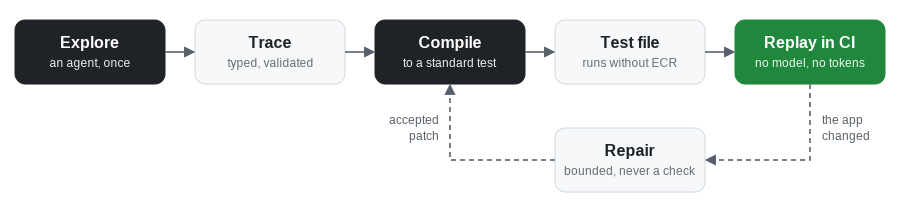
AI agents are good at finding what nobody thought to test. They are also slow, they cost money on every run, and they never take the same path twice, so they do not fit in CI. Explore-Compile-Replay (ECR) keeps the first part and removes the rest: the agent runs once, and its path is kept as a plain test file that anyone can read, review and run.
Early draft, opened on 24 November 2026, now measured on a real app. On LocalSend, 7 traces, one of them unstable, met 25 injected changes: no regression ended green, and a one-step repair was accepted for 25 of the 26 traces broken by a reworded text, every check unchanged. Changes that need two steps are refused, and fewer than half of the text and structure changes were repaired in full: results and limits.
Quick start
You need Node 22.18 or later and pnpm. Nothing is on npm yet: it runs from a clone.
git clone https://github.com/pierridotite/explore-compile-replay && cd explore-compile-replay
pnpm install
pnpm check     # types, tests and the conformance report

export ECR_PARAM_ITEM_TITLE="Buy bread" ECR_PARAM_PRIVATE_NOTE="Door code 4821"
pnpm ecr replay packages/adapter-fixture/examples/anna-first-item.trace.json \
  --adapter packages/adapter-fixture/src/index.ts
# pass  anna-first-item (node-test, 80 ms)
That replays a recorded trace against a to-do list in memory, the reference system. Every command: docs/command.md.
How it works
- Explore. An agent plays a persona and uses the system once. Each action and each check is recorded in a typed trace.
- Compile. The trace becomes a standard test file, a Maestro flow for a mobile app today. It runs without ECR.
- Replay. The file runs in CI. No model, no tokens, the same verdict every time.
When the app changes and a step breaks, your agent proposes a new action for that step, and a bounded repair accepts or refuses it. A repair can change how a step finds its target, never what the test checks. A bug the agent found is kept too: it compiles to a test that stays red until the bug is fixed.
A step of a trace, and what it compiles to{
"id": "s8",
"action": { "kind": "tapOn", "target": { "text": "Save" } },
"checkpoints": [
{ "id": "item-listed", "check": { "kind": "visible", "target": { "text": { "param": "ITEM_TITLE" } } } }
]
}
# Step s8
- tapOn:
    text: "Save"
# Oracle item-listed
- assertVisible:
    text: "${ITEM_TITLE}"
The tap is stored by the name of the button, not by its place on the screen. The text that was typed is stored by its name, never by its value. The whole example: the trace and the flow.
The four results of a replay| Result | Meaning |
|---|---|
pass |
Every check holds |
bug |
The replay stops on the bug the trace records, and on nothing else |
fixed |
The check that was recorded as a bug holds now. It becomes a guard |
FAIL |
Anything else: a step no longer finds its target, or a check that held no longer holds |
Paper and specification
ECR is meant to be a standard that anyone can implement, not one tool.
- Specification. The trace format, also published as a JSON Schema, the adapter contract and seven laws: determinism, fidelity, traceability, no model, state, safe repair, no secret. Drafts that can still change.
- Conformance kit. It checks an adapter law by law. An adapter that passes it conforms, whoever wrote it. How to write one: docs/adapter.md.
- Paper. The pattern, the contract and an evaluation on a real app, LocalSend: the PDF, 8 pages. Its protocol was public before the first measured run, and every number comes from a result file. The preprint is on Zenodo: 10.5281/zenodo.24565285.
- Citation. CITATION.cff, or "Cite this repository" on this page, and a badge for the projects that use ECR: citing ECR.
| Law | In short | |
|---|---|---|
| L1 | Determinism | The same trace compiles to the same bytes. The same file gives the same verdict |
| L2 | Fidelity | The file runs the actions and the checks of the trace, in the same order |
| L3 | Traceability | Each step of the trace maps to one distinct range of the file |
| L4 | No model | Compiling and replaying call no model |
| L5 | State | A saved state, once restored, is observed as identical, when the adapter can save one |
| L6 | Safe repair | A patch stays inside the failing step, and removes or weakens no check |
| L7 | No secret | Neither the trace nor the file contains a secret value |
Results on LocalSend
The evaluation of the paper ran on LocalSend v1.19.0, an open-source file-sharing app built from source, on Android emulators. An agent, claude-sonnet-5-5, explored it 20 times, and an AI assistant wrote the checks under a rule fixed in advance: 7 traces were kept, fewer than the 10 planned, with 62 checks. The protocol was public before the first measured run, and every number below comes from a result file.
| Result | |
|---|---|
| No model | Every replay ran with no model. The last replay of each trace ran with the network closed, and passed |
| Same result | On the unchanged app, 137 of 140 replays gave what the trace records: 6 traces 20 times of 20, one 17 times |
| The agent again | Run again, the agent reached the goal of a trace in 30 of 35 runs, and its own path replayed in full in 12 of 20 |
| Cost | A replay calls no model; an agent run costs a median of $0.20. With every repair counted, a kept trace costs less than running the agent again from the 8th run in price, but only from the 76th in time: a replay takes 52 to 101 s, an agent run 121.5 s |
| Regressions | None of the 5 changes of behaviour ended green. In all, 25 changes were injected, in five classes |
| Repair | An agent's one-step repair was accepted for 25 of the 26 traces broken by a reworded text, every check unchanged, and an AI assistant, not the author, judged all 25 right. A failed check is never repaired |
Five changes per class, each applied alone, then 3 replays of the 7 traces. Detected: a trace fails its 3 replays.
| Change | Detected | Repaired |
|---|---|---|
| D1, a text is reworded | 5 of 5 | 25 of 26 traces; 4 of the 5 changes for every trace |
| D2, an identifier is renamed | Does not apply: the 54 taps of the 7 traces all target a text | |
| D3, the target moves | 2 of 5: a target found by its text survives a move | 0 of 8 traces: 7 needed two steps changed, 1 stopped on a check |
| D4, a dialog comes first | 5 of 5, mostly as a failed check, which is never repaired | 0 of 34 traces, as expected: one step cannot add a step. In 90 of 102 attempts, the agent itself answered that one step was not enough |
| D5, the target comes 1, 5 or 15 s later | 0 of 5: 102 of 105 replays passed, but a 5 s delay failed one trace on a check in 2 replays of 3 | No repair asked |
| D6, a checked state is not reached | 5 of 5 | Every proposal refused, in 102 attempts: no false green |
What counts against ECR: one trace is not stable, and fails 3 replays of 20 on the check right after a Back, for a cause not established. A repair changes one step only, so only 4 of the 10 text and structure changes were repaired for every trace. Edited freely by an AI assistant, the same 68 broken traces needed 2 to 4 lines changed in the compiled flow, and all then passed 3 replays of 3 apart from the unstable trace: free edits reach what the bound refuses, with no guard on what they change. For 5 of the 25 accepted repairs, no check could see a missed tap, which is why each accepted repair is judged afterwards. The changes were written inside the project, by an AI assistant, and one app, one platform and one model say little about others.
Where it stands
- Works today: the
ecrcommand (validate,compile,replay,repair,conformance), a reference adapter, and a mobile adapter that compiles to Maestro flows. Measured on LocalSend, on Android emulators: replays with no model, and repairs thatecr repairchecked on the device. - Released: on 26 November 2026, version 0.1.0 (10.5281/zenodo.24565053) and the preprint of the paper (10.5281/zenodo.24565285), both on Zenodo.
- Not yet: iOS, a package on npm.
Part by part: docs/status.md.
Where it comes from
ECR generalizes mobile-agent-testers, which gives one phone to each AI tester on GitHub's runners and is the first project that writes ECR traces. The shape of the idea comes from Remotion, where a video is code: an AI writes it once, and every render gives the same video with no model. Here the agent explores once, and the replay is the render.
ECR does not claim to be first: the tools that came beforeSeveral tools already keep or replay what an agent did, each for its own system: Stagehand, Skyvern, workflow-use, Midscene, Arbigent, muscle-mem and autocompile. What this project adds is a name for the pattern and a written contract for it: one that works across systems, compiles to files that run without the tool, protects what the tests check, and can be verified by a conformance kit.
Build with ECR
ECR is a pattern, not a mobile tool: any system that an agent can use can be explored once and then replayed with no model. Below are ideas of projects to build on it. The first repositories that build one properly will be listed here, and anyone can propose a new idea. Each listed project is credited by name, with its author, here and in the release notes of the next version.
Built with ECR: mobile-agent-testers, by pierridotite, for mobile apps, the first project that writes ECR traces. Its agents explored LocalSend for the paper, and the 7 traces kept from them replay there with no model: results.
Ideas to build- Security tests of your own app. An agent looks for access flaws in a test copy of your app: an account that can see the data of another account, a paid screen that opens without paying. Each finding compiles to a test that stays red until the flaw is fixed, then keeps it from coming back. Only on systems that you own or are allowed to test.
- Web apps. A browser adapter: the agent explores a site, and the trace compiles to a Playwright test.
- Accessibility. The agent uses an app with a screen reader, or with the keyboard only. Each step it cannot get through, such as a button with no label or a focus trap, becomes a test.
- Command-line tools. The agent learns a tool from its help, and the trace compiles to a shell test that checks exit codes and outputs.
- APIs. The agent explores a REST API from its OpenAPI file, and the trace compiles to contract tests.
- Games. The agent plays a level with a fixed seed, and the trace compiles to a replay of the inputs that checks, after each change, that the level can still be finished.
- Getting started guides. The agent follows a README on a fresh machine, and the trace becomes a CI job that fails when the guide no longer matches the code.
- Business apps. The agent goes through a back-office flow of a CRM or an ERP in a sandbox, such as creating a record and getting it approved, and the trace compiles to the platform's own tests.
A repository is listed when:
- it is public, under an open-source license;
- its traces pass
ecr validate, and its adapter, if it brings one, passesecr conformance; - its compiled tests run in CI with no model, and a green run shows it;
- its README cites ECR, with the badge or the button;
- if it tests security, it tests only systems that its users own or are allowed to test, and it publishes no attack on the systems of others.
To be listed, open a Built with ECR issue with the link to your repository, one trace and the green run. Repositories are listed in the order they come in. To propose an idea that is not on the list, open an Idea to build with ECR issue.
Citing ECR
If your project uses ECR, show it: add this badge to your README. It links back here, and that is how the next team finds the pattern.

[](https://github.com/pierridotite/explore-compile-replay)
Or this button, which follows the light or dark theme of the page:

<a href="https://github.com/pierridotite/explore-compile-replay"><picture><source media="(prefers-color-scheme: dark)" srcset="https://raw.githubusercontent.com/pierridotite/explore-compile-replay/main/assets/tested-with-ecr-dark.svg"><img src="https://raw.githubusercontent.com/pierridotite/explore-compile-replay/main/assets/tested-with-ecr-light.svg" alt="Tested with Explore-Compile-Replay" width="320" height="54"></picture></a>
In a paper, a talk or a product page, cite the repository: the "Cite this repository" button on GitHub gives the reference, from CITATION.cff. Every version is archived on Zenodo with its own DOI, and 10.5281/zenodo.24565052 always points to the latest.
For the code itself, the Apache-2.0 license decides: a copy, a fork or a package of ECR's code, changed or not, must keep the LICENSE and NOTICE files. NOTICE names ECR and links to this repository.
Star history
Contributing
The contract is the thing to challenge right now: open an issue and say what would not fit your system. To write code, CONTRIBUTING.md lists two open pieces, a web adapter and an MCP server, and smaller tasks to start with.
Made by Pierre Raffalli · LinkedIn · GitHub · Discord · Apache-2.0 license
Reviews (0)
Sign in to leave a review.
Leave a reviewNo results found