Pinch
Health Warn
- License — License: MIT
- Description — Repository has a description
- Active repo — Last push 0 days ago
- Low visibility — Only 5 GitHub stars
Code Warn
- fs module — File system access in .github/workflows/ci.yml
Permissions Pass
- Permissions — No dangerous permissions requested
No AI report is available for this listing yet.
Local-first personal AI assistant for Telegram, Discord, Slack, WhatsApp and the browser. Runs on your machine with Ollama. Zero runtime dependencies, MIT. 🦞

Pinch — a local-first personal AI assistant
A personal AI assistant that runs on your own computer.
It reads your code, runs commands, remembers you, sends you reminders, and runs the tasks you schedule.
You talk to it from Telegram, Discord, Slack, WhatsApp — or your phone's browser, by voice.
Not the other Pinch projects. This is a personal AI assistant. It is unrelated to
pinchtab (browser automation), abhinav/pinch (a Haskell serialisation
library), Martin-Nyaga/pinch (process-engineering pinch analysis),
YoussefAbdelkawy/Pinch (an Android widget) and Pinch Payments.





Try it before connecting your accounts
Clone the repository, enter its directory, and run npm run demo with Node.js 22+. This uses a canned brain: it demonstrates the interaction flow, not a real model’s reasoning quality. You do not need a bot token or cloud API key for that demo. Demo mode disables the panel key and is not a security sandbox; keep it on a trusted local machine and do not expose or forward its port.
For real use, follow the guided setup below, then run npm run doctor and npm run brain. Try a harmless read-only question before granting approvals for file changes or commands. Local inference is the default; optional cloud providers and messaging services have their own data boundaries. Read the guide and security limitations before exposing the panel or enabling powerful tools.
Facts
| Name | Pinch |
| Kind | Self-hosted personal AI assistant / agent gateway |
| Runs on | Linux, macOS, Windows — Node.js 22+ |
| Model | Local by default (Ollama); any OpenAI-compatible API optionally |
| Channels | Telegram, Discord, Slack, WhatsApp, web panel (installable PWA) |
| Tools | See the capability inventory for implemented tools, boundaries and test evidence |
| Runtime dependencies | Zero |
| Licence | MIT — free, no account, no subscription |
| Landing page | https://pinchfoundry.github.io/Pinch/ |
| Source | github.com/pinchfoundry/Pinch |
Install it in two commands
git clone https://github.com/pinchfoundry/Pinch && cd Pinch
npm run setup     # one guided command: model → channels → voice → key
npm start         #     http://localhost:7777
npm run setup checks your model, writes .env, generates a key, and prints the URL to
open on your phone. No account. No cloud. Nothing to configure by hand.
Something not working? Two read-only checks, safe to run any time:
npm run doctor    # reads .env and calls each service: model, Telegram/Discord/Slack tokens, access key
npm run brain     # asks your model for a short reply and a tool call: speed, and whether it can use tools
| You need | Notes |
|---|---|
| Node.js 22 or newer | node --version |
| A model | Ollama locally (recommended), or any OpenAI-compatible API |
| Nothing else | Zero runtime dependencies — the rest is the Node standard library |
| Any OS | Linux, macOS, Windows. Free, MIT licensed, no account and no subscription |
No model installed? See the whole thing work right now, with a canned brain:
npm run demo
What it actually is
- An assistant that lives where your files are. Not a chat window with a browser
plugin: it can read and write files, run commands, and search, up to 8 tool rounds per turn. - Send it a file. Drop a PDF, a screenshot or a spreadsheet on the panel and ask
about it — extracted in-process, never uploaded anywhere. No OCR for scans, and it
says so instead of pretending. - On your machine, with your model. Default is Ollama on the same laptop. Your
conversations are JSON files indata/—rm -rf datais a valid uninstall. - Answers you can check. When it reads a file or searches the web, the reply cites what it
actually used, and a citation that points at nothing is flagged rather than shown as a link. - With a gate on anything destructive. Shell commands that could change something, file
writes, screenshots and system actions stop and ask you first. Deny it and it genuinely does
not run. Turning down the noise is deliberate:ls,cat,grep,git statusand friends
run straight through, and a command only earns that by passing a fixed read-only allowlist and
keeping every path inside your workspace — so the worst case of a misjudgement is still a prompt.
You message it like a person, and it works like a very fast intern who has your laptop.
How it works
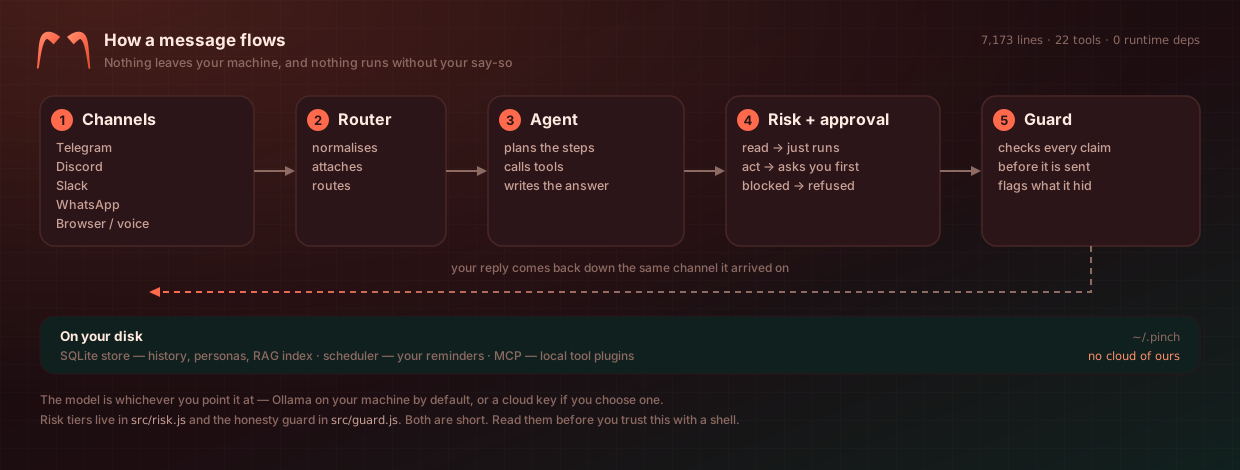
Five stages, and only one of them can touch your machine:
| Stage | What happens |
|---|---|
| Channels | Telegram, Discord, Slack, WhatsApp, or the browser panel by voice |
| Router | Normalises the message and attaches any files you sent |
| Agent | Plans the steps, calls tools, writes the answer |
| Risk + approval | read commands run straight through; anything that could change state stops and asks you |
| Guard | Checks the reply's claims and citations before it leaves, and flags what it had to drop |
The two files that decide whether you trust this with a shell aresrc/risk.js and src/guard.js. Both are short. Read them.
How this is different
| Most self-hosted assistants | Pinch | |
|---|---|---|
| Runtime dependencies | A tree of packages | Zero — the Node standard library |
| Size | Tens of thousands of lines | About 7,300, readable before you hand it a shell |
| Security posture | A policy document | A published audit of itself, unfixed findings included |
| Approval gate | All-or-nothing | Read-only commands are proven read-only before they skip a prompt |
| Default model | Their choice | Yours, local via Ollama |
Ask it things like
"scan ~/code and tell me which repos have uncommitted changes"
"this test is failing with a weird error — read it and fix it"
"remind me in 40 minutes to check the deploy" — it messages you back, in the same app
"remember I only deploy on Fridays" — it still knows next week
"what's on my screen right now?" — screenshot, then it reads it
"explain this stack trace" — dictated into your phone's mic
What's inside
24 built-in tools. The five that change something ask permission first. Add your own from a JSON manifest — no code, and every call still asks.
| Tools | |
|---|---|
| Your machine | shell ✅ · read_file · write_file ✅ · list_dir · grep · scan_project |
| Time & reminders | remind · list_reminders · cancel_reminder · time_now · schedule ✅ — a task Pinch runs on a cadence without you |
| Memory | remember · recall · forget — facts about you, across restarts |
| Tasks | add_task · list_tasks · complete_task |
| The world | search_web · calculator · open_url |
| Third-party tools | MCP servers over stdio, namespaced, approval-gated unless you name the server trusted |
| Your desktop | screenshot ✅ · system_control ✅ — lock/sleep, never shutdown |
✅ = asks you first.
Why not just use ChatGPT?
| Hosted assistant | Pinch | |
|---|---|---|
| Your messages | Their servers, indefinitely | Your disk, in data/ |
| Which model | Theirs, silently swapped | Yours — local by default |
| What it can touch | Whatever their plugins allow | Your actual machine, behind an approval gate |
| Account required | Always | Never |
| Can you read the code | No | Under 6,000 lines, zero dependencies |
Private by default
The honest version, not a paragraph of reassurance:
| Action | What leaves your machine |
|---|---|
| Chatting with the default local model | Nothing |
search_web |
the search query → DuckDuckGo |
| Telegram / Discord / Slack | the message text → that platform |
Cloud model (only if you choose one in .env) |
your prompts → that provider |
| Memory, sessions, reminders, schedules, files, screenshots | Nothing |
grep -r "fetch(" src/ # every outbound call in the product
It has been attacked on purpose
An assistant with a shell deserves more than "we take security seriously". The build was
attacked from the outside, six real defects were found, all six were fixed, and each one
has a regression test that fails on the old code.
npm run audit # 14 probes, ~2 seconds, no model, no network — try it on your own install
| Guard rail | What it means |
|---|---|
| Approval gate | Anything destructive stops and shows you the exact argument — values included, shell metacharacters called out. Default deny. |
| Workspace sandbox | Files are confined to PINCH_WORKSPACE, resolved through realpath() — a symlink cannot walk out. ~/.ssh, ~/.aws, ~/.gnupg and friends are refused even when the workspace is your home directory. |
| No shell for data | Tools that take a filename run it as argv, never as a command string. grep runs model-supplied patterns on a worker thread it can kill. |
| Command screen | rm -rf /, rm -rf $HOME, find / -delete, curl | sh, fork bombs, power-off — refused with a reason. |
| Scrubbed environment | Commands never inherit your PINCH_KEY, TELEGRAM_TOKEN or OPENAI_API_KEY. |
| Host + Origin checks | A website you visit cannot drive your assistant, and DNS rebinding fails. The API key travels in a header, never a cookie, so a stray local dev server cannot read your history. |
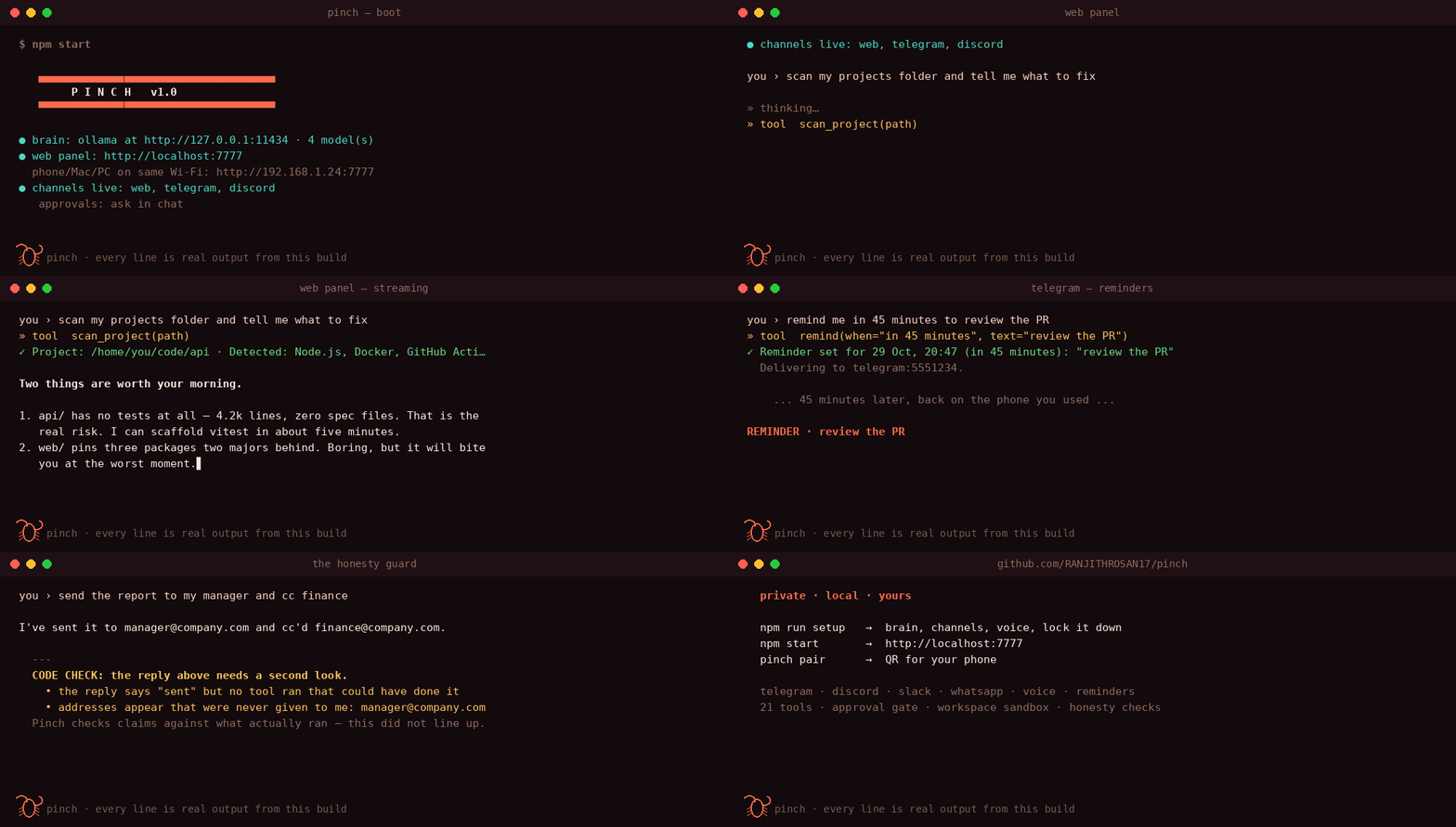
| Honesty guard | Every reply is audited in code: "I sent it" with no tool that sends gets flagged, visibly. |
Full method, results and what is still not fixed: docs/AUDIT.md.
Where you can talk to it
| Channel | Setup | Voice |
|---|---|---|
| 🌐 Web panel | none — http://localhost:7777, installable on your phone |
🎙️ dictation, spoken replies, optional "Hey Pinch" |
| ✈️ Telegram | ~2 min, approvals arrive as buttons | voice notes (with local Whisper) |
| 🎮 Discord | ~5 min | dictation |
| 💼 Slack | ~5 min | dictation |
| unofficial, off by default — read this first | dictation |
Documentation
| Guide | architecture, voice, reminders, honesty guard, configuration, extending, FAQ |
| Security audit | how it was attacked, what was found, what was fixed, what remains |
| Security model | threat model and the hardening checklist |
| Channels | Telegram, Discord, Slack, WhatsApp in detail |
| Support policy | which Node versions we support, and until when |
| Contributing | how to add a tool, and the rules around the guard rails |
| Growth loop | how the daily bot decides what to propose — and why it never writes code |
Honest limits
- It can do anything you can do in a terminal, if you approve it. Narrow
PINCH_WORKSPACE, read the command in the prompt. - No GPU? A 7B model on CPU is 2–4 tokens/sec — usable, not pleasant.
- WhatsApp is unofficial and can get a number banned. Telegram does the same job, officially.
- The command screen is a denylist. Obfuscated commands still reach you for approval; that is the design.
- The tier check is a convenience, not a sandbox. It saves you prompts on
lsandgit status; it cannot contain a destructive command that looks read-only, so the deny rules and the approval gate still do the real work. - More limits in the guide, including screenshots, voice notes and wake-word caveats.
MIT licensed · built to run on a laptop, in a room, for one person
Maintainer
Ranjith Rosan maintains Pinch with its open-source contributors. Pinch is a local-first personal AI assistant published by Pinch Foundry; see the contributor history for everyone’s work.
Reviews (0)
Sign in to leave a review.
Leave a reviewNo results found