neuromesh
Health Warn
- No license — Repository has no license file
- Description — Repository has a description
- Active repo — Last push 0 days ago
- Community trust — 71 GitHub stars
Code Pass
- Code scan — Scanned 12 files during light audit, no dangerous patterns found
Permissions Pass
- Permissions — No dangerous permissions requested
No AI report is available for this listing yet.
The Biomimetic Context Engine & Neural Runtime for AI Coding Assistants
NeuroMesh
Don’t delete the extra code. Fold it.
How does nature pack two metres of DNA into a nucleus without deleting a single letter?
Not by throwing genes away — by folding.
NeuroMesh does the same thing to your repository: a neural graph in RAM, reversible one-line folds, and an evidence packet instead of three thousand-line files dumped into Cursor or Claude.


Local-first MCP · Cursor · Codex · Antigravity · VS Code · Claude · Kilo · Trae
The pain
You ask a simple question in a large project. The editor copies two or three thousand-line files and ships them to the model.
What you pay for:
- Tokens you never needed — dollar cost on every turn
- Seconds of fake loading while the window fills with helpers you will not touch
- Lost in the middle — the model drowns in unrelated bodies and invents bugs
Today’s workarounds all leak in a different place:
| Approach | What goes wrong |
|---|---|
| Vector RAG | Chunks smash functions. The shape of the code disappears. |
| “Just attach the files” | The model sees everything and understands nothing. |
| A static code graph | Better map — then it still pastes full files into the prompt. |
NeuroMesh is the missing step: route first, then fold. The graph is for finding the path. The packet is what the model actually reads.
Don’t delete. Fold.
Nature does not delete DNA to fit a nucleus. It supercoils.
NeuroMesh treats the syntax tree like a genetic strand in RAM:
- Functions you need stay expressed (exons) — real body, real lines
- The rest collapse to a one-line reversible intron:
/* [neuromesh:fold:fold_unused_helper_1 | 12 lines folded | fn unused_helper()] */
The agent still sees the shape of the file — signatures, imports, neighbors — without paying for every private helper. When a folded body is required, neuromesh_expand_fold unsplices it from a registry in memory. Nothing was deleted. Nothing needs a second grep of the disk.
Structure stays. Tokens sleep. Wake a fold when you need it.
Inspired by living systems
| Nature | In the engine | For the agent |
|---|---|---|
| DNA supercoiling | Genetic skeletonizer | Fold unused bodies; keep the map of the file |
| Physarum (slime mold) | Steiner / shortest connecting tissue | Don’t flood the prompt with the whole neighborhood — grow the cheapest path between seeds |
| Synapses & STDP | Pheromone edges + record_feedback |
Paths you actually edited get stronger next time |
| Cell membrane | QualityGate | Tight by default; auth / payment tasks open the membrane |
| Mycelium | Hyphal prefetch | Warm the next hop before the second tool call |
| Neural mesh | Project graph in RAM | Files, functions, Imports, Calls — a nervous system, not a bag of strings |
The philosophy of the social pitch is right: a graph in RAM, a short path, the rest dormant. After seeds resolve, neighborhood Physarum grows tubes between them (under 20ms, skipped if the subgraph is huge). Fill still respects the token cap. record_feedback is how synapses change the next packet.
Play with the metaphors and the crates: docs/nature.md.
3D Neural Galaxy
neuromesh monitor is the live mesh: subsystems as a constellation, then the file graph, then the symbols inside a module.
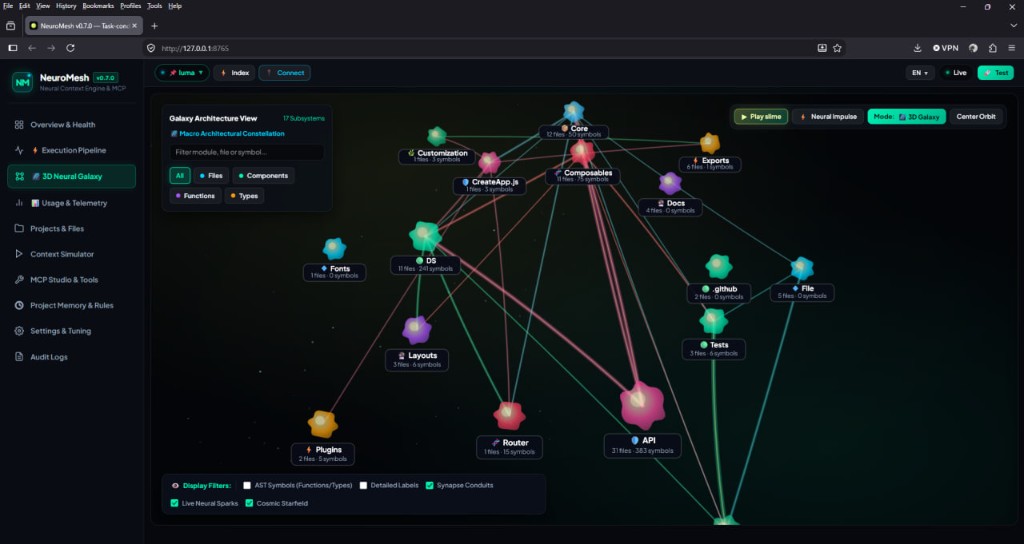
Constellation — crates and subsystems
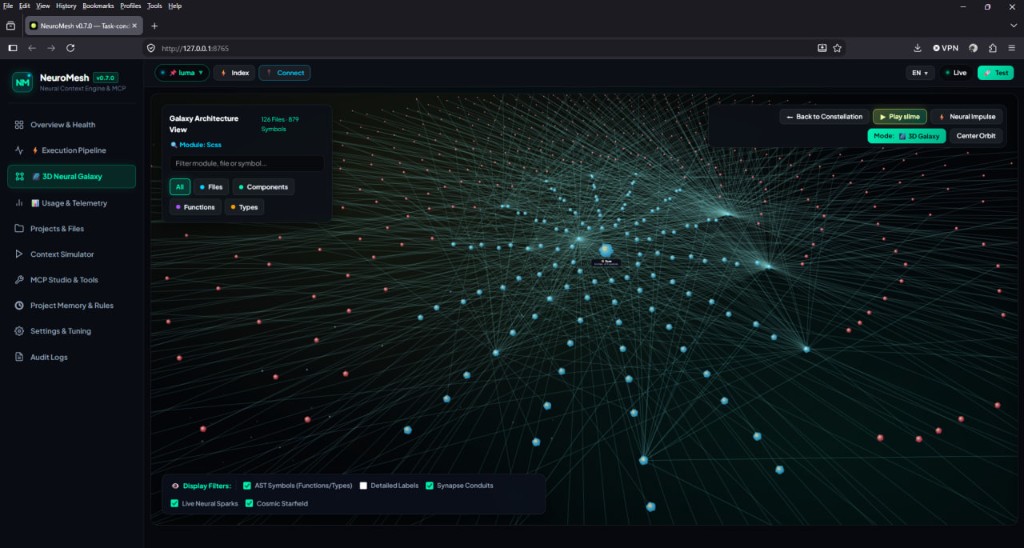
3D galaxy — files and synapses; Play slime grows Physarum tubes
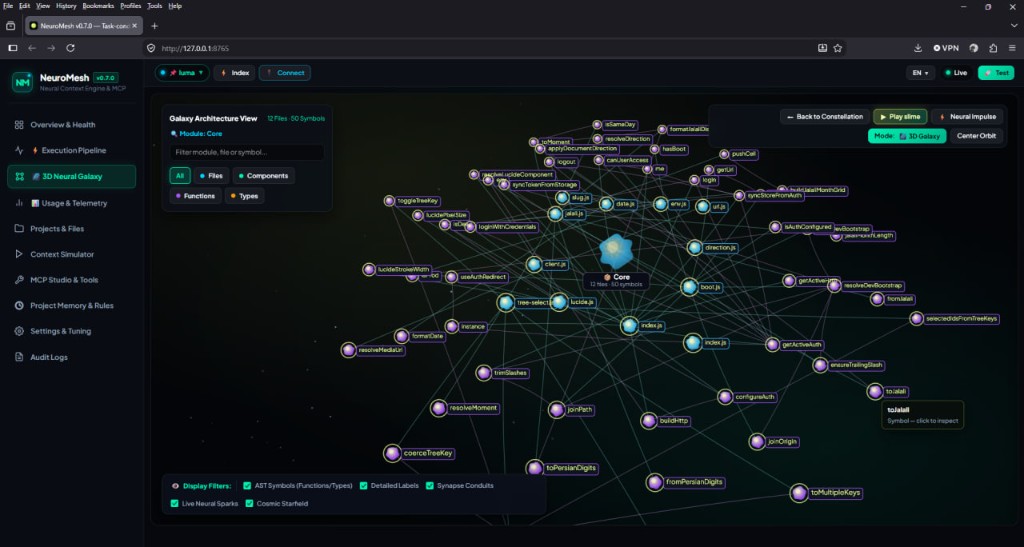
Module zoom — files and AST symbols in one crate
Default URL: http://127.0.0.1:8765. Port: neuromesh port.
How a turn actually goes
flowchart LR
  P[Prompt] --> I[Identifiers]
  I --> G[Graph in RAM]
  G --> S[Seed files]
  S --> T[Physarum tubes]
  T --> F[Fill + synapses]
  F --> X[Exon / intron splice]
  X --> E[Evidence packet]
  E --> W[expand_fold if needed]
- Read the task as written.
handle_tool_callsurvives; it is not lowercased into mush. - Resolve on the mesh. Edges exist when the target is unique. Ambiguous names stay sleepy — never a million fake links.
- Ship seeds, grow the tube, fill the rest. The files that own those symbols always go in. With two or more seeds, Physarum traces the cheapest connecting tissue on a neighborhood subgraph. Callees and synaptic neighbors fill a real budget (
balanced= 5k extra tokens). - Splice. Untargeted bodies become fold markers. Coverage tells you if a seed was missed — only then is Grep fair. Folds stay in the MCP session so the next tool can wake them.
Tell the agent (full install guide):
neuromesh_get_context(task_description)
  → neuromesh_expand_fold if a body is still folded
  → neuromesh_trace for callers
  → neuromesh_record_feedback after a good edit
Modes (the membrane)
| Mode | Extra tokens on top of seeds | Feel |
|---|---|---|
max_savings |
0 | Tiny, obvious edits |
balanced |
5,000 | Default |
max_quality |
16,000 | Refactors, auth, “don’t you dare miss it” |
Seeds are never truncated to fake a small packet.
Install
macOS / Linux
curl -fsSL https://raw.githubusercontent.com/pinoox/neuromesh/main/install.sh | bash
Windows
irm https://raw.githubusercontent.com/pinoox/neuromesh/main/install.ps1 | iex
# From source (needs rustup 1.80+; distro rustc 1.75 cannot parse this Cargo.lock)
git clone https://github.com/pinoox/neuromesh.git
cd neuromesh
cargo build --release --bin neuromesh

# Or Cargo
cargo install --git https://github.com/pinoox/neuromesh.git neuromesh-cli --bin neuromesh
neuromesh doctor
neuromesh connect    # write MCP configs for this repo (absolute binary, no PATH)
Update / uninstall
Same installer overwrites the binary. Re-run the curl / irm command above (or cargo install --force --git …). Then neuromesh -v and restart the IDE so MCP does not keep an old process.
Two copies are common: installer vs Cargo.
| How you installed | Binary |
|---|---|
install.sh |
~/.local/bin/neuromesh |
install.ps1 |
%LOCALAPPDATA%\Programs\neuromesh\neuromesh.exe (also copied to ~\.cargo\bin if that folder exists) |
cargo install |
~/.cargo/bin/neuromesh |
which neuromesh / where.exe neuromesh shows which one PATH hits first. Delete the extra file, or cargo uninstall neuromesh-cli if Cargo owns it. Drop the neuromesh block from .cursor/mcp.json (and friends) if you are leaving MCP.
Connect
Native MCP stdio — what Cursor, Claude, Codex, Antigravity, VS Code, Kilo Code, Trae, MiniMax, Windsurf, Cline, and Zed launch.
neuromesh connect           # merge NeuroMesh into project + installed-app configs
neuromesh connect --print   # copy-paste snippets only
That writes an absolute command (this binary) plus args: ["mcp", "<workspace>"] and NEUROMESH_WORKSPACE, so the agent does not need neuromesh on PATH.
Manual (PATH required): if neuromesh is on PATH, paste into Cursor MCP settings (.cursor/mcp.json). Always pass the workspace path as the second argument — args: ["mcp"] alone may index your home directory:
{
  "mcpServers": {
    "neuromesh": {
      "command": "neuromesh",
      "args": ["mcp", "/absolute/path/to/your/project"]
    }
  }
}
Details and other clients: docs/mcp.md#manual.
| Client | Config |
|---|---|
| Cursor | .cursor/mcp.json or ~/.cursor/mcp.json |
| VS Code / Copilot | .vscode/mcp.json (servers) |
| Codex | .codex/config.toml or ~/.codex/config.toml |
| Antigravity | .agents/mcp_config.json or ~/.gemini/config/mcp_config.json |
| Kilo Code | .kilo/kilo.jsonc (mcp + command array) |
| Trae | .trae/mcp.json or Trae/User/mcp.json |
| MiniMax Code | .minimax/mcp.json (same mcpServers shape) |
| Windsurf | ~/.codeium/windsurf/mcp_config.json |
| Claude Desktop | claude_desktop_config.json |
| Claude Code | .mcp.json or claude mcp add neuromesh -- neuromesh mcp |
| Cline / Roo | cline_mcp_settings.json / Roo MCP settings |
| Zed | context_servers in settings (neuromesh connect --print) |
It finds the git / Cargo / package.json root. It refuses $HOME and drive roots (that is how you accidentally index 11k junk files).
Optional but recommended: teach the agent to call NeuroMesh — full per-IDE tutorial in docs/agent-guide.md. Cursor shortcut: copy docs/agent-rule.mdc → .cursor/rules/neuromesh.mdc.
3D galaxy UI of the live graph: screenshots above · neuromesh monitor → http://127.0.0.1:8765 by default.
Monitor port
Default is 8765. Persist it for this repo, override one run, or use an env var:
neuromesh port                 # print effective port
neuromesh port 9000            # save to the managed project slot (see `neuromesh store`)
neuromesh monitor --port 9000  # this process only (`-p` works too)
Priority: --port / -p → NEUROMESH_PORT → project slot config.json → ~/.neuromesh/config.json → 8765.
neuromesh mcp has no TCP port. Cursor / Claude talk JSON-RPC over stdin/stdout (args: ["mcp"]). Do not put --port on that command.
HTTP / SSE MCP (GET /sse, POST /mcp) rides on the monitor process. Change that port the same way, then open http://127.0.0.1:<port>/sse.
VS Code / Cursor: Settings → neuromesh.port must match the running monitor. After neuromesh port 9000, restart neuromesh monitor and set the editor to 9000.
Index file cap
Default is auto: every production source, then tests, up to 50,000 files. The old silent 6,000-file stop is gone for large src/ trees.
neuromesh index --max-files auto     # persist auto (default)
neuromesh index --max-files 20000    # persist a hard limit
Priority: --max-files → NEUROMESH_MAX_FILES (auto / 0 = auto) → project slot config.json → auto. See cli.md.
Tools
| Tool | Role |
|---|---|
neuromesh_get_context |
Compact packet by default: skeletons, why, fold ids, coverage |
neuromesh_explain_packet |
On-demand diagnostics for a packet_id |
neuromesh_expand_fold |
Wake one intron by fold_id — no disk grep |
neuromesh_get_file_skeleton |
Fold one file; fold metadata has no original body |
neuromesh_search_symbols |
Ranked search |
neuromesh_get_dependencies |
Typed neighbors |
neuromesh_trace |
Call / import chains |
neuromesh_analyze_impact |
Blast radius |
neuromesh_get_architecture |
Languages, packages, entry points |
neuromesh_record_feedback |
Synaptic learning on the path you used |
neuromesh_get_project_memory |
Facts from manifests and docs |
neuromesh_get_stats |
Mesh size |
Each file in the packet has path, a short why, skeleton code, and fold descriptors without bodies. Details: docs/mcp.md.
Rust, TypeScript, Python, Go, Java, Kotlin, PHP, C#, Dart, Swift, and Ruby go through tree-sitter queries. JavaScript uses the TypeScript grammar. .svelte, .astro, .twig, .cshtml, .razor, .css, .scss, .less, and .svg are indexed. Framework overlays tag Android/Spring/Django/FastAPI/Next/Nuxt/Laravel/Pinoox/Symfony/WordPress/React/Vue/SvelteKit/Astro/Electron/Tauri/Vite/Prime/Rails/Flutter/Express/Nest/Angular/Gin/Echo/Axum/ASP.NET/SwiftUI/Remix/Ktor routes without a compiler. Vue has a scoped extractor. C/C++ use the generic regex parser. Ambiguous names are not “resolved” by hope.
What we actually measured
Not a universal “99.6%” — that number was never a warranty. Savings are per task, after folding. Re-run: neuromesh eval.
On this repo (release, 2026-08-28, 554,554 workspace tokens):
| Task | Mode | WS tok | Selected | Packet | vs WS | vs selected | Recall | Prec | Grep | ms |
|---|---|---|---|---|---|---|---|---|---|---|
handle_tool_call_intent |
balanced | 554554 | 63462 | 15900 | 97.1% | 74.9% | 1.00 | 0.75 | 0 | 33 |
physarum_usage |
balanced | 554554 | 18631 | 3945 | 99.3% | 78.8% | 1.00 | 0.50 | 0 | 17 |
Selected is the raw token count of the packet files before fold. Packet is after fold. Grep is 0 when every gold file is already in the packet. max_savings can miss gold files (0 extra tokens); that is visible in the same command, not hidden.
Recall ≥ 0.8 and precision ≥ 0.4 stay locked on this repo and the fixture projects (including mini-shop SCSS/dead-code/checkout). Packet activation < 200 ms in the debug gold test.
Index snapshot from that eval run: 323 files · 2,458 nodes · 5,594 edges · ~490 ms index (release).
Docs
| Living systems | DNA, Physarum, STDP — mapped to crates |
| Architecture | Pipeline and guarantees |
| MCP · CLI | Tools and commands |
| Quality | Gold, eval, numbers |
| Contributing | Come build a solver or a language |
| Changelog | 0.7.9 |
MIT · LICENSE
Reviews (0)
Sign in to leave a review.
Leave a reviewNo results found