symbolpeek-mcp
Health Uyari
- License — License: MIT
- Description — Repository has a description
- Active repo — Last push 0 days ago
- Low visibility — Only 9 GitHub stars
Code Basarisiz
- process.env — Environment variable access in scripts/benchmark-latency.mjs
- rm -rf — Recursive force deletion command in scripts/install.sh
- rm -rf — Recursive force deletion command in scripts/package-release.sh
Permissions Gecti
- Permissions — No dangerous permissions requested
Bu listing icin henuz AI raporu yok.
Ask for the symbol, not the file. Token-efficient MCP server giving AI coding agents symbol-level reads of TS/JS, Rust, Python, Java, Go, JSON, and Markdown
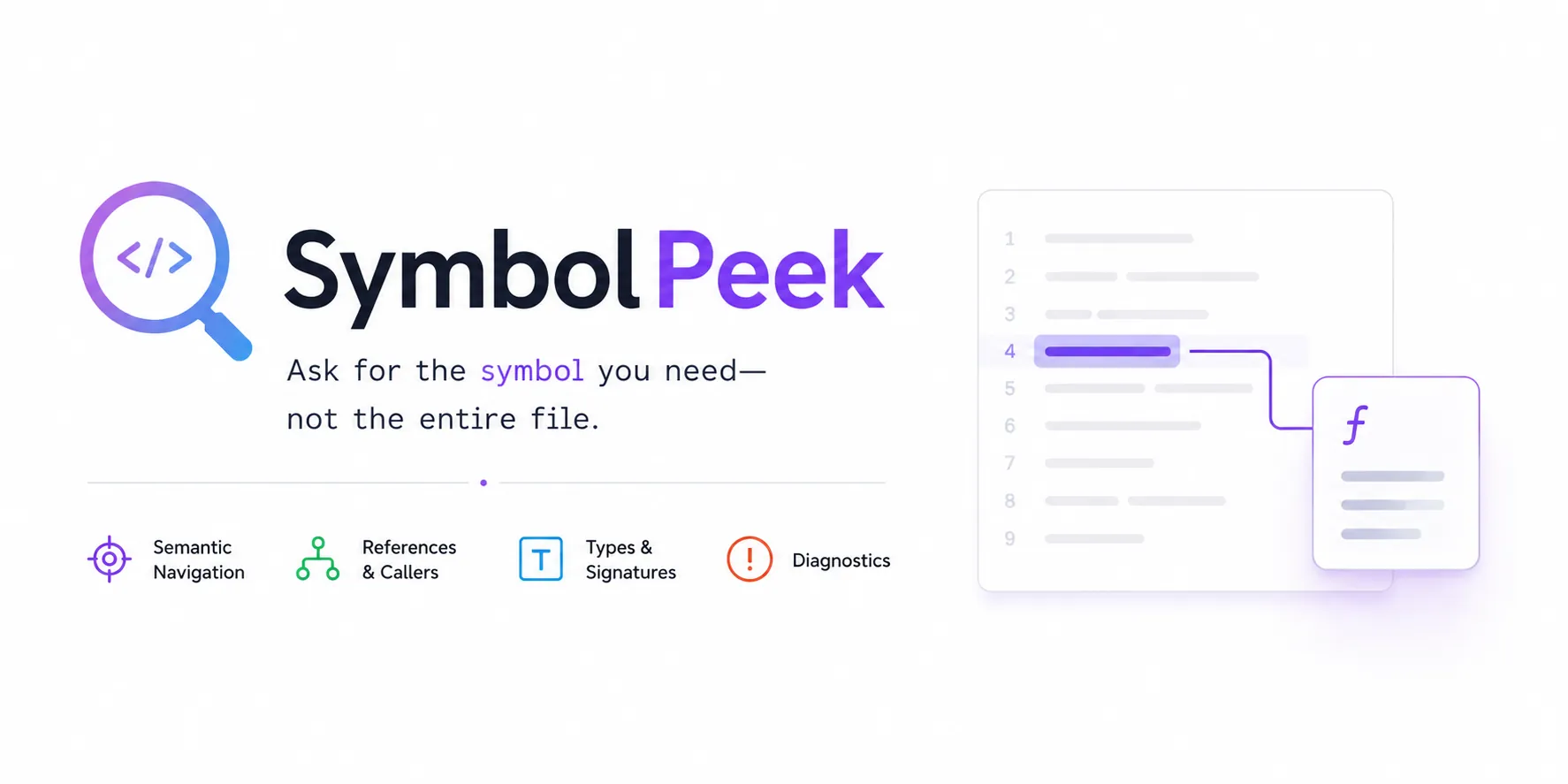
Semantic code intelligence for AI coding agents
Ask for the symbol you need—not the entire file.
.ts
.tsx
.js
.jsx
.rs
.py
.java
.go
.json
.md


Quick start · Language support · Tools · Troubleshooting · Tool reference
SymbolPeek is an MCP server that gives an AI coding agent a symbol-level view of
your codebase. Instead of reading a whole file to answer "what does this
function do" or "who calls it", the agent asks for one declaration and gets
exactly that.
TypeScript and JavaScript are analyzed with the official TypeScript Compiler
API. Rust, Python, Java, Go, JSON, and Markdown use embedded Tree-sitter for
syntax-level operations.
Quick start
Requirements
- An MCP client. Any stdio MCP client works; Codex and Claude
Code are documented below. - Node.js 20 or newer — required for
.ts,.tsx,.js, and.jsx
analysis. Rust, Python, Java, Go, JSON, and Markdown work without it.
No clone, Rust toolchain, or manual build is required.
macOS or Linux
curl -fsSL https://raw.githubusercontent.com/pioner92/symbolpeek-mcp/main/scripts/install.sh | sh
Windows PowerShell
irm https://raw.githubusercontent.com/pioner92/symbolpeek-mcp/main/scripts/install.ps1 | iex
The installer verifies the release checksum, installs the package, and then
prints the exact command to connect your client. It touches nothing outside
its own install directory — no client configuration is modified for you.
| Item | macOS / Linux | Windows |
|---|---|---|
| Package (binary + bundled TypeScript runtime) | ~/.local/share/symbolpeek |
%LOCALAPPDATA%\SymbolPeek |
symbolpeek and sym commands |
linked into ~/.local/bin |
added to the user PATH |
| Lifetime statistics (created on first use) | ~/.config/symbolpeek/stats.json (Linux)~/Library/Application Support/SymbolPeek/stats.json (macOS) |
%APPDATA%\SymbolPeek\stats.json |
That is the complete list. Connecting the MCP server and installing the
optional agent guidance are separate, explicit
steps. See Uninstall to remove everything.
To inspect the installer before running it:
curl -fsSL https://raw.githubusercontent.com/pioner92/symbolpeek-mcp/main/scripts/install.sh -o install-symbolpeek.sh
less install-symbolpeek.sh
sh install-symbolpeek.sh
Connect your client
The installer prints these commands with the correct absolute path already
filled in. Use the absolute path form — it works regardless of how your client
inherits PATH:
# Codex (macOS/Linux)
codex mcp add symbolpeek -- "$HOME/.local/share/symbolpeek/symbolpeek"

# Claude Code (macOS/Linux)
claude mcp add --transport stdio --scope user symbolpeek -- "$HOME/.local/share/symbolpeek/symbolpeek"
# Codex (Windows)
codex mcp add symbolpeek -- "$env:LOCALAPPDATA\SymbolPeek\symbolpeek.exe"

# Claude Code (Windows)
claude mcp add --transport stdio --scope user symbolpeek -- "$env:LOCALAPPDATA\SymbolPeek\symbolpeek.exe"
Restart the client, then verify: codex mcp list, or /mcp inside Claude Code.
Use --scope project with Claude Code to enable the server for one project only.
Optional: agent guidance
The tools work as soon as the server is connected. SymbolPeek also ships a
short skill that tells the agent to reach for
those tools before opening whole files — without it the model calls them less
often.
Install it only for the clients you actually use:
symbolpeek install-skills codex     # writes ~/.codex/skills/symbolpeek
symbolpeek install-skills claude    # writes ~/.claude/skills/symbolpeek
symbolpeek install-skills all       # both
CODEX_HOME and CLAUDE_CONFIG_DIR override those locations. Restart the
client afterwards so it discovers the skill.
Try it with a prompt like:
Use the symbolpeek MCP server. List the symbols in the absolute path
/project/src/dashboard.tsx, then read_symbol_context for Dashboard.
After that, find_references for useAuth and go_to_definition for one usage.
Configuration templates are checked in atconfig/codex-mcp.toml.example andconfig/claude-mcp.json.example.
What you get
A real request against this repository's own TypeScript worker
(src/language/typescript/worker.js, 1,791 lines / 65 KB):
read_symbol(path: ".../src/language/typescript/worker.js",
            symbol: "createProject.collectImports")
{
  "symbol": "createProject.collectImports",
  "kind": "function",
  "file": ".../src/language/typescript/worker.js",
  "lines": { "start": 713, "end": 751 },
  "source": "function collectImports(fileName, collected, visited) {\n  ...\n}",
  "supported": true,
  "analysis": { "backend": "ts-compiler-api", "analysis_level": "syntax", "complete": true }
}
The agent receives 2.0 KB instead of 65 KB — the 39 lines it asked for
rather than 1,791 lines it did not. Nested symbols are addressable by qualified
name, so the agent never has to read the enclosing function to reach the inner
one.
Language support
Every language-aware operation, exactly as reported by get_capabilities:
| Operation | .ts .tsx .js .jsx |
.rs |
.py .java .go |
.json |
.md |
|---|---|---|---|---|---|
read_symbol |
✅ | ✅ | ✅ | ✅ | ✅ |
list_symbols |
✅ | ✅ | ✅ | ✅ | ✅ |
search_symbols |
✅ | ✅ | ✅ | ✅ | ✅ |
get_document_outline |
✅ | ✅ | ✅ | ✅ | ✅ |
find_dependencies |
✅ | ✅¹ | ✅¹ | — | — |
read_symbol_context |
✅ | ✅¹ | ✅¹ | — | — |
find_implementations |
✅ | ✅² | — | — | — |
find_references |
✅ | — | — | — | — |
find_callers |
✅ | — | — | — | — |
find_callees |
✅ | — | — | — | — |
go_to_definition |
✅ | — | — | — | — |
get_type |
✅ | — | — | — | — |
get_diagnostics |
✅ | — | — | — | — |
get_call_hierarchy |
✅ | — | — | — | — |
rename_symbol (writes files) |
✅ | — | — | — | — |
check_safe_to_delete |
✅ | — | — | — | — |
| Backend | TypeScript Compiler API | Tree-sitter | Tree-sitter | Tree-sitter | Tree-sitter |
| Analysis level | semantic | syntax | syntax | syntax | syntax |
¹ Same-file only — conservative, no cross-file resolution.
² Explicit impl Type and impl Trait for Type blocks. Alias, re-export, and
blanket-impl resolution requires rust-analyzer and is not supported.
Unsupported operations fail with an explicit error rather than returning empty
results. get_capabilities returns this same matrix at runtime.
Tools
Navigation
| Tool | What it answers |
|---|---|
read_symbol |
"Show me the exact source for this symbol." |
list_symbols |
"What are the top-level symbols in this file?" |
search_symbols |
"Where is this symbol defined across the workspace?" |
go_to_definition |
"Where is the definition behind this usage?" |
read_symbol_context |
"Give me this symbol plus its minimal local context." |
Code intelligence
| Tool | What it answers |
|---|---|
find_references |
"Where is this symbol referenced across the project?" |
find_callers |
"Which functions or methods call this symbol?" |
find_callees |
"Which named targets does this symbol call, including unresolved ones?" |
find_dependencies |
"Which local symbols does this symbol depend on?" |
get_call_hierarchy |
"What callers and callees surround this symbol?" |
Type analysis
| Tool | What it answers |
|---|---|
get_type |
"What is the inferred type or signature at this location?" |
find_implementations |
"Which classes implement this interface or contract?" |
get_document_outline |
"What is the nested declaration structure of this file?" |
get_diagnostics |
"What TypeScript compiler diagnostics affect this file or symbol?" |
Refactoring
| Tool | What it answers |
|---|---|
rename_symbol |
"Rename this symbol project-wide." Writes files directly. |
check_safe_to_delete |
"Is this file referenced from anywhere else, or safe to delete?" |
Discovery and statistics
| Tool | What it answers |
|---|---|
get_statistics |
"How much source context has SymbolPeek avoided?" |
get_capabilities |
"Which operations does each language support?" |
Every request shape, option, and response format is documented in the
MCP tool reference.
Where it helps (and where it doesn't)
SymbolPeek does not replace reading files or text search. It replaces the most
expensive pattern an agent hits on a real codebase: find a symbol, find
everyone who touches it, and understand its type — across import aliases and
re-exports.
Where it genuinely saves an agent work and tokens
- One symbol out of a large file.
read_symbol/read_symbol_context
return a single declaration instead of a whole file. On large files this is
the bulk of the token saving. - Impact analysis without a grep loop.
find_referencesreturns resolved
locations, whilefind_callersalso identifies the enclosing functions in
one call. Both use the project's module resolution, including path aliases
(@app/...) and barrel re-exports, which text search follows unreliably. - Resolved types.
get_typereturns the instantiated signature (for
exampleuseAsync<FeedPermission, Error>), which text search cannot produce. - Scoped discovery.
search_symbolsfinds declarations by name and kind
(for example "hooks matchingconversation") without the noise of string
matches in comments and unrelated code.
Where an agent should still use ordinary tools
- Plain text, comments, small config files, or unsupported files —
grepis faster. - Understanding the full control flow inside one function — just read it.
- Very large monorepos — building a TypeScript program has real latency, so a
targetedgrepcan win for a single lookup. Rust, Python, Java, Go, and JSON
requests never start Node and stay fast regardless of project size.
What makes the results trustworthy
- Parsing, source ranges, type information, and cross-file navigation come from
the TypeScript compiler and its AST. Semantic labels such ashookandreact_componentare conventions applied on top of that syntax tree, based on
naming and JSX usage. - Cross-file results are only as complete as module resolution allows: with a
validtsconfig.jsonthey use its configured source set; without one they
cover the target file and recursively resolved static imports, exports, andrequire(...)calls. Compiler options come from the projecttsconfig.json. - Rust, Python, Java, Go, and JSON source ranges and nesting come from
Tree-sitter. Every result carries compactanalysis: { backend, analysis_level, complete }trust metadata, wherecomplete: falsemeans the parser recovered from a syntax error.
What gets indexed
TypeScript and JavaScript — function declarations, async functions,
generators, and arrow functions; exported and nested functions; React components
and hooks; classes and class methods; object methods; interfaces, type aliases,
enums and qualified enum members, variables, and constants.
Enum members are addressed by qualified name, for exampleScreens.PUBLISH_ACKNOWLEDGEMENT. Symbol names are indexed; assigned string
values remain literals and require text search.
Rust — functions, structs, unions, enums and variants, traits, impl blocks
and methods, modules, constants, statics, type declarations, and macros. Impl
methods use qualified names such as Client.send, and trait impl methods use<Client as Transport>.send.
JSON — object properties are indexed as RFC 6901 JSON Pointers, for example/checkout/errors/payment_failed. Array-valued properties remain single
addressable branches instead of expanding every element, which keeps large
locale and data files token-efficient. .jsonc and JSON5 are not supported.
Markdown — headings are the symbols, nested by level, and a symbol spans the
whole section rather than the heading line. read_symbol withQuick start.Connect your client returns that section alone; on this README
that is 839 bytes instead of 20 KB. Both # and underline (setext) headings are
indexed, # inside a fenced code block is not, and repeated headings such asOptions under several commands get @line:column selectors so each stays
addressable. Prose, lists, and code blocks are not indexed separately — this
finds sections, not full-text matches.
Using the tools
Absolute file paths are the canonical, most reliable input. Relative paths first
use an explicit SYMBOLPEEK_WORKSPACE_ROOT, then filesystem roots supplied by a
compatible MCP client; multi-root workspaces resolve only when exactly one root
contains the requested path.
Supported files are parsed from their current contents on every request — there
is no index to rebuild and no stale cache to invalidate.
Unsupported extensions return { "supported": false }. Missing files, parser
failures, and unknown symbols are returned as MCP invalid-parameter errors.
How agents discover the tools
Two mechanisms nudge a model toward targeted reads:
- Server instructions, always on. Every MCP initialization response includes
concise instructions to inspect outlines or search first, then retrieve only
the required symbol. This works with any MCP client that exposes server
instructions to its LLM — nothing to install. - The bundled skill, opt-in.
symbolpeekskill
is a stronger, always-loaded hint for Codex and Claude Code, with a trigger
description covering code exploration and large JSON locale/configuration
files. Install it withinstall-skillsif you want it.
No MCP server can force a client model to call a tool, but these mechanisms make
the intended workflow part of the model's default context. For another agent
that consumes neither, copy the short workflow from the bundled skill into that
client's global agent instructions.
Statistics
The CLI reports lifetime context-avoidance statistics:
symbolpeek stats
symbolpeek stats --reset
--reset clears lifetime totals only. Session counters belong to the running
MCP process and are available through get_statistics().
All numbers compare SymbolPeek with a counterfactual full-source baseline:
- requests — successful semantic calls;
- files avoided — distinct source files represented by each result, summed
across calls (onefind_callersrequest can count several files); - bytes / lines avoided — full contents of those files minus a compact
serialization of the semantic result; - estimated token savings — avoided bytes at a fixed ~4 bytes/token
heuristic; - average context reduction — size-weighted across all requests.
Treat these as directional context-reduction estimates, not exact model-token
counts or billing data.
Configuration
Prebuilt binaries detect their bundled TypeScript runtime automatically. These
variables are for advanced setups only:
| Variable | Purpose |
|---|---|
SYMBOLPEEK_WORKSPACE_ROOT |
Workspace root used to resolve relative source paths. |
SYMBOLPEEK_ALLOW_CWD_FALLBACK |
Allow relative paths to fall back to the process working directory (default true). |
SYMBOLPEEK_TYPESCRIPT_ROOT |
Directory containing the TypeScript runtime. |
SYMBOLPEEK_NODE |
Explicit Node.js executable for the parser worker. |
SYMBOLPEEK_STATS_PATH |
Override the lifetime statistics JSON path. |
For a global MCP installation, do not set SYMBOLPEEK_WORKSPACE_ROOT to a
fixed project — use absolute paths, or let the client provide filesystem roots.
Set SYMBOLPEEK_ALLOW_CWD_FALLBACK=false if relative paths must never resolve
against the server's working directory.
Troubleshooting
The client shows no SymbolPeek tools.
Confirm registration with codex mcp list or /mcp in Claude Code, and restart
the client — MCP servers are discovered at startup. If registration itself
failed, re-run the mcp add command using the absolute binary path.
TypeScript/JavaScript calls fail, other languages work.
Node.js 20+ is missing or not visible to the server process. Check withnode --version; if Node is installed but not on the client's PATH, setSYMBOLPEEK_NODE to the absolute Node executable.
symbolpeek: command not found after installing on macOS/Linux.~/.local/bin is not on your PATH:
export PATH="$HOME/.local/bin:$PATH" # add to your shell profile
The absolute path ~/.local/share/symbolpeek/symbolpeek always works.
Windows: the command is not recognized.
The installer updates the user PATH; open a new terminal so the change is
picked up. If irm ... | iex is blocked, runSet-ExecutionPolicy -Scope Process RemoteSigned first, or download the archive
manually.
macOS blocks the binary.
Release binaries are currently unsigned. If a browser-added quarantine flag
blocks a manually downloaded package, clear it:
xattr -dr com.apple.quarantine <package-directory>
A relative path resolves to the wrong project.
Use absolute paths, or set SYMBOLPEEK_WORKSPACE_ROOT for a deliberately
project-scoped launch. SYMBOLPEEK_ALLOW_CWD_FALLBACK=false disables working
directory fallback entirely.
An operation returns an unsupported-operation error.
Check the language support matrix — semantic operations are
TypeScript/JavaScript only.
Still stuck? Open an issue
with your OS, client, SymbolPeek version (symbolpeek --version), and the failing
call.
Uninstall
# macOS / Linux
rm -rf ~/.local/share/symbolpeek ~/.local/bin/symbolpeek ~/.local/bin/sym
rm -rf ~/.config/symbolpeek "$HOME/Library/Application Support/SymbolPeek"
# Windows
Remove-Item -Recurse -Force "$env:LOCALAPPDATA\SymbolPeek", "$env:APPDATA\SymbolPeek"
Then remove the server from your client: codex mcp remove symbolpeek orclaude mcp remove symbolpeek. On Windows, also drop the SymbolPeek entry from
your user PATH.
If you installed the optional agent guidance, remove it too:
rm -rf ~/.codex/skills/symbolpeek ~/.claude/skills/symbolpeek
Direct downloads
Prefer to install manually? Every package contains symbolpeek, the sym
alias, and the locked TypeScript runtime.
| Platform | Release package |
|---|---|
| Linux x86-64 | Download |
| Linux ARM64 | Download |
| macOS Apple Silicon | Download |
| macOS Intel | Download |
| Windows x86-64 | Download |
Every package has a matching .sha256 asset. All versions and release notes are
on the GitHub Releases page.
A manually extracted archive behaves exactly like an installer-placed one: run
the binary directly, register it with your client, and optionally runinstall-skills.
SymbolPeek communicates over stdio when used as an MCP server. It normally does
not print a terminal interface; an MCP client starts it and exchanges JSON-RPC
messages through stdin/stdout.
Documentation
| Document | Contents |
|---|---|
| MCP_TOOLS.md | Every tool's request shape, options, and response format |
| ARCHITECTURE.md | Internal design, provider boundary, request lifecycle |
| CONTRIBUTING.md | Reporting bugs, source builds, tests, releases |
| CHANGELOG.md | Release history |
| SECURITY.md | Reporting a vulnerability |
Roadmap
The current foundation is intentionally focused. Natural next capabilities
include:
- deep type expansion beyond
get_typehover signatures (fully resolved nested
and generic types); - JSX component trees and prop-flow analysis;
- project indexing and incremental parsing;
- additional language providers (Kotlin, Swift, C++).
License
MIT © Alex Shumihin
Yorumlar (0)
Yorum birakmak icin giris yap.
Yorum birakSonuc bulunamadi