batang
Health Pass
- License — License: NOASSERTION
- Description — Repository has a description
- Active repo — Last push 0 days ago
- Community trust — 16 GitHub stars
Code Warn
- network request — Outbound network request in client/src/batang/_transport.py
- network request — Outbound network request in client/src/batang/client.py
- network request — Outbound network request in client/src/batang/grants.py
Permissions Pass
- Permissions — No dangerous permissions requested
No AI report is available for this listing yet.
One hub for battery research: 3,400 standardized cells, DFN/SPMe/Neural P2D simulation and no-code AI modeling on one schema, used interactively with Batangi, a research assistant, or by hand.
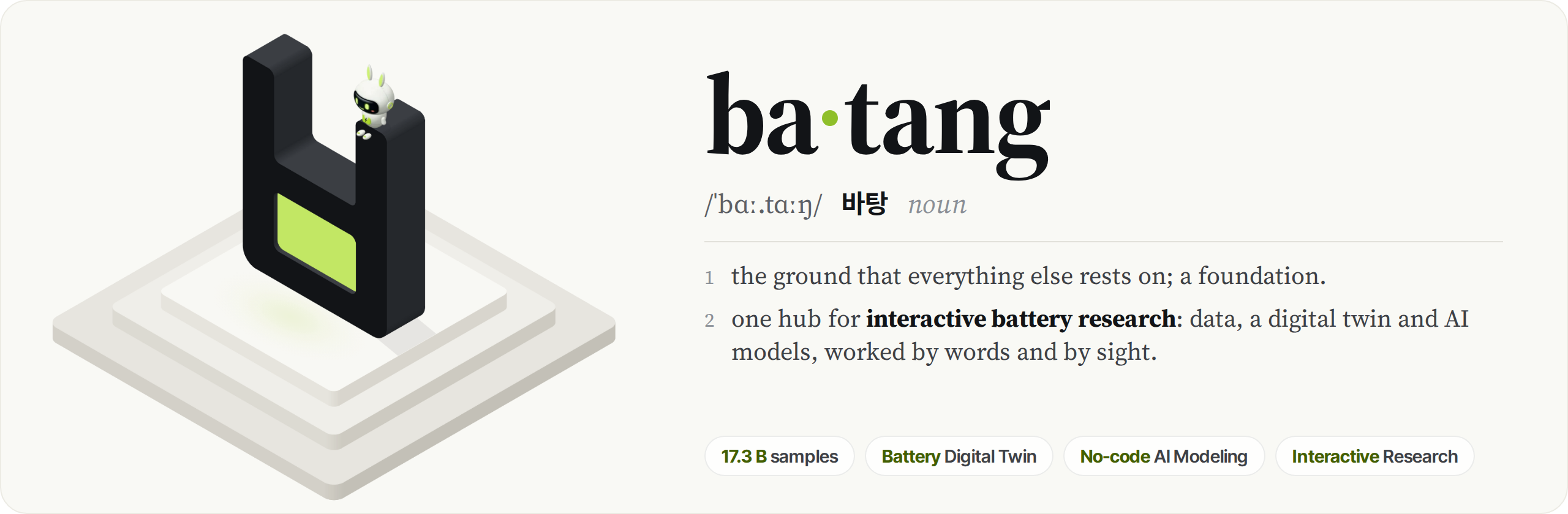




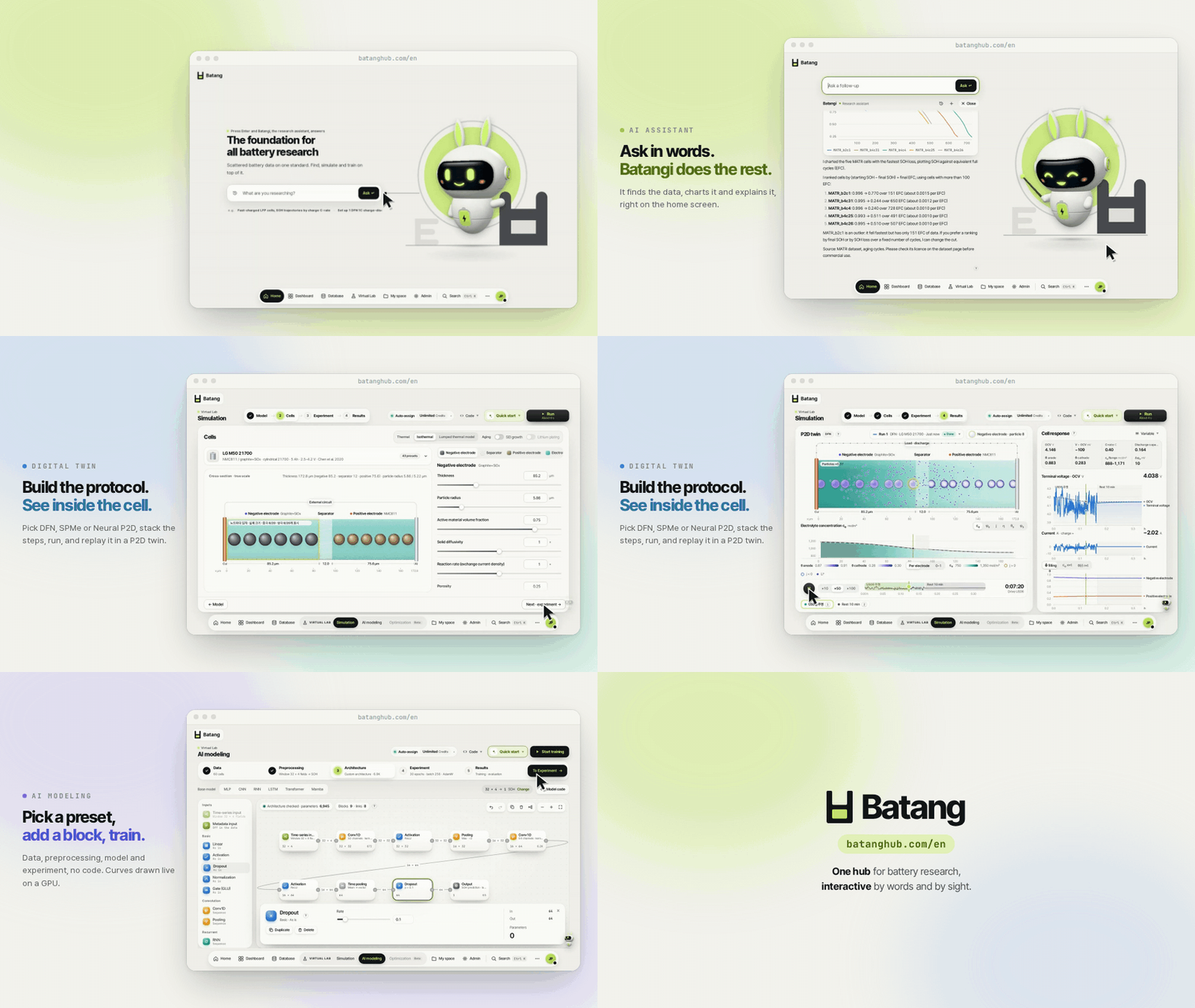
Batang (바탕, foundation) is one hub for the whole battery research pipeline, made to be used
interactively. Load and standardize data, explore and analyze it, simulate cells and train AI models, all in one
place on one schema. Every step can be done by words, with Batangi the research assistant, or by sight, with a
digital twin, sliders and blocks.
[!NOTE]
Sign up at batanghub.com with any Google account and start right away. Virtual Lab
credits come with the sign-up and are topped up every month.
💬 One hub × interactive
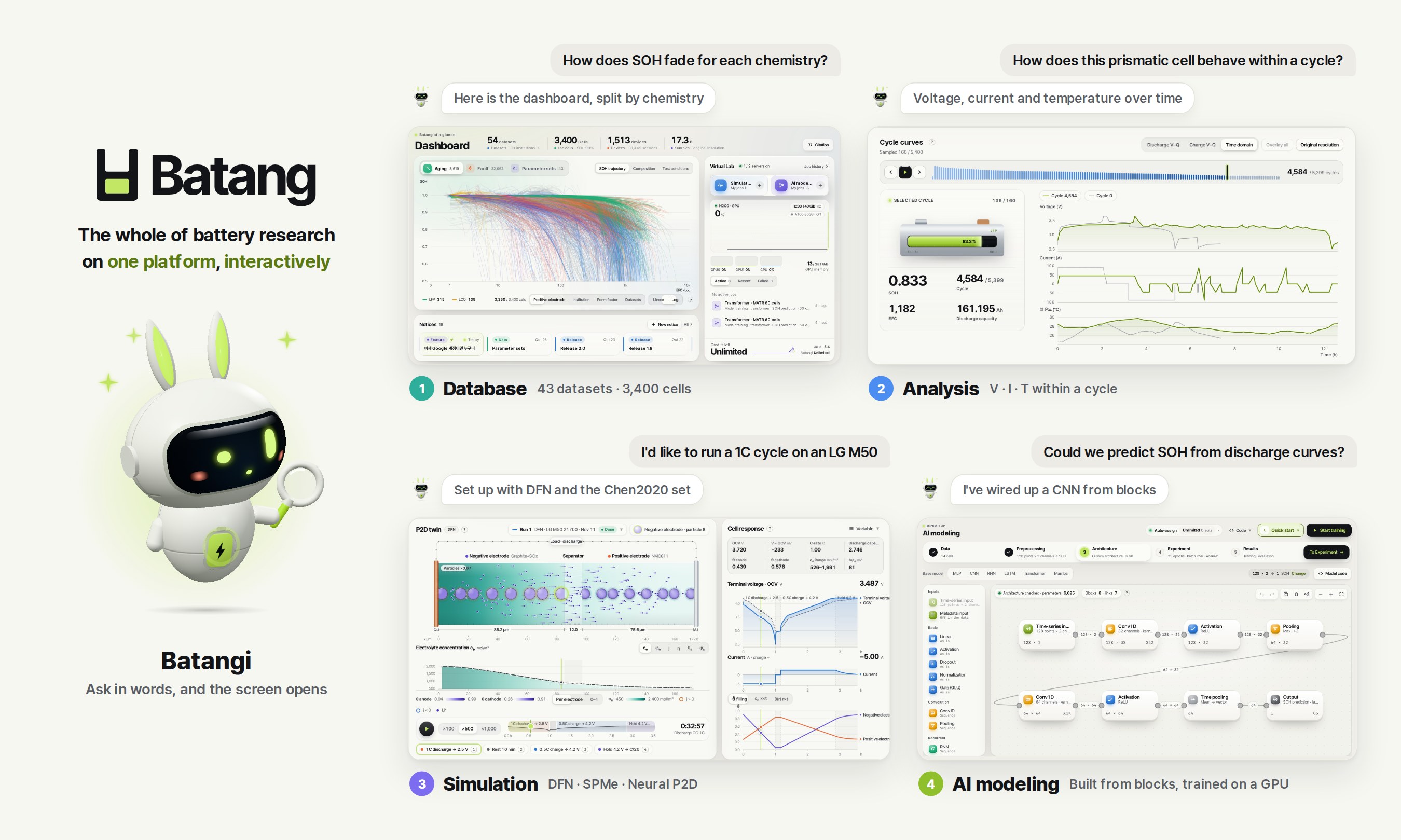
One hub. Battery research is usually scattered: a dataset cleaned with one script, preprocessing and training in
others, plots in a notebook, a simulator with its own setup. In Batang the whole loop runs in one place, on one schema
and one set of compute servers, so what one step produces is what the next one reads.
Interactive. Every step is something you can talk to and something you can see. Ask Batangi and it finds the
data, charts it, explains it and sets up the run you describe. Or watch the electrode in a P2D twin while you move
the sliders, and wire models from blocks and watch them learn.
✨ Features
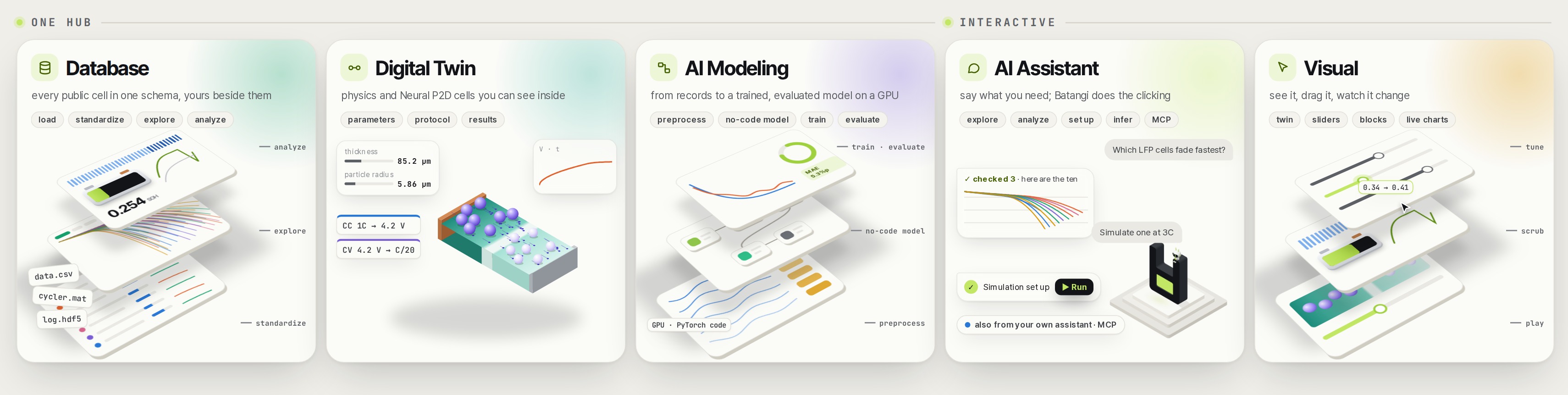
| 🗄️ Database | 43 public ageing datasets and 11 pack, vehicle and fault datasets, converted cell by cell into one schema. Explore, filter and compare them, and add your own cycler files beside them. |
| 🔋 Digital twin | Simulate cells with PyBaMM (SPM, SPMe, DFN) and Neural P2D, a GPU surrogate of DFN, on 43 parameter sets, and replay particles, electrolyte and lithium in a P2D twin. |
| 🧠 AI modeling | Preprocess records, build a network from blocks, train it on a GPU while watching it learn, and evaluate it on new data. The choices become PyTorch code to take home. |
| 💬 AI assistant | Batangi finds data, draws charts in the chat and opens the right screen, set up for you. Your own assistant, such as Claude, reaches the same data over MCP. |
| 🎛️ Visual interaction | The twin, parameter sliders, no-code blocks and live training curves: every step is shown, not only computed. |
📦 Data
Release 2.0 holds 3,400 cells (Li-ion, Na-ion, Zn-ion) with 10.0 M cycles and 17.0 G samples, and 1,513
devices with 336 M samples, at each source's own time resolution. Every record was converted and checked one by
one: one column naming rule, one cycle definition, one SOH definition, nothing deleted, and the source's licence kept
with the data.
- DATASETS.md: every dataset with its source, licence and the article to cite
- DATA_FORMAT.md: the schema, column by column
- client/: the Python package for approved downloads
Batang does not redistribute raw data. The original measurements come from each source, under its terms.
📜 Citation
If you use Batang, please cite it and the original datasets you use (DATASETS.md,docs/references.bib).
@misc{park2026batang,
  author = {Park, Jimin},
  title  = {{Batang}: An Open Hub for Battery Data, Simulation and {AI} Modeling},
  year   = {2026},
  url    = {https://batanghub.com},
  note   = {Release 2.0}
}
⚖️ License
- Data keeps the licence of its original source, listed per dataset in DATASETS.md with whether
commercial use is allowed. Batang does not relicense any dataset. Where a source states no licence, use it for
research with citation and ask its authors before anything more. - This documentation: CC BY 4.0. The Python package in
client/: MIT.
🙏 Acknowledgements
I thank Prof. Jung-Il Choi and the Multi-Physics Modeling & Computation Lab (MPMC),
Yonsei University, for supporting this project. Batang exists only because the groups listed in
DATASETS.md published their measurements openly.

Reviews (0)
Sign in to leave a review.
Leave a reviewNo results found