cairn
Health Gecti
- License — License: Apache-2.0
- Description — Repository has a description
- Active repo — Last push 0 days ago
- Community trust — 29 GitHub stars
Code Uyari
- process.env — Environment variable access in scripts/_shared.ts
- process.env — Environment variable access in scripts/benchmark.ts
Permissions Gecti
- Permissions — No dangerous permissions requested
Bu listing icin henuz AI raporu yok.
Cairn — an AI that walks your system and leaves a trail of tests: UI, API, unit, docs.
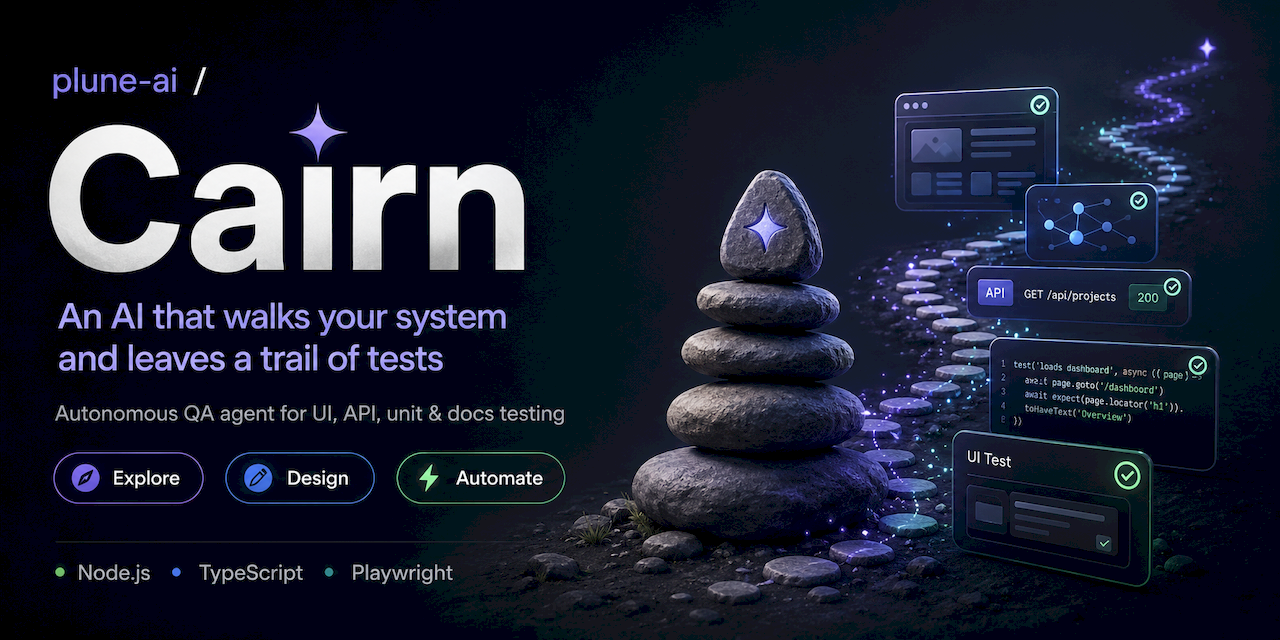
Cairn
Cairn — an AI that walks your system and leaves a trail of tests: UI, API, unit, docs.



▶ Demo: docs/demo/cairn.cast — play with asciinema play docs/demo/cairn.cast
Autonomous QA agent (Node.js / TypeScript) that logs into a web app with a saved session, explores
pages (ARIA snapshot + screenshot), designs methodology-based UI test cases (ISO/IEC/IEEE 29119-4),
generates runnable @playwright/test code, self-validates, self-repairs, and self-improves via
Langfuse. A portable CLI + library for embedding into other TypeScript projects.
Cairn is the generation layer — it produces tests across surfaces (UI + API shipped; unit / docs
planned), each arriving by demand. A separate Plune layer owns record / management / eval.
Renamed Lex-Bot → Cairn. The old
lex-botcommand and@plune-ai/lex-botpackage still work
(the CLI prints a one-line deprecation notice) — prefercairn/@plune-ai/cairn. LegacyLEX_/LEXBOT_env vars still work too; preferCAIRN_.
What it does
Point it at a URL (behind login, with a saved Playwright storageState) and it will observe (ARIA
- screenshot + interactive elements), ground (verify every locator, explore tabs/views, probe safe
state transitions — so it tests what is actually there, not hallucinations), design 29119-4 cases
(EP / BVA / decision-table / state-transition / error-guessing), generate & validate POM-style@playwright/testspecs with self-repair (keep-best: a repair never makes the suite worse), and
judge & learn (deterministic scorers + an LLM judge + a holistic Pilot verdict, traced to Langfuse).
It writes two kinds of case: ATC (Automatable — code is generated) and MTC (Manual — full
submits, security/XSS, visual/UX, irreversible actions — left for a human).
Two decoupled modes
design— explore + write cases as Markdown (ATC-*/MTC-*) with recorded selectors. No code.automate— generate@playwright/testcode from approvedATC-*cases (skipsMTC-*).explore— the full pipeline at once (cases → code → validation → repair → Pilot verdict).
Full walkthrough: Getting started.
Install
npm install -g @plune-ai/cairn      # global CLI → run `cairn …`
# …or local / library:  npm install @plune-ai/cairn   → run via `npx cairn …`

cairn install-browsers              # one-time: the Chromium Cairn drives (its OWN Playwright revision)
Requires Node.js 20+. Copy .env.example → .env and add your keys. Browsers are a separate
download — run cairn install-browsers once, or pass --channel chrome to drive your installed
Chrome with zero download (also the simplest path for OAuth and for projects that already ship
Playwright). cairn doctor diagnoses the setup. See Authenticated targets and
Configuration.
Quickstart
Installed locally (without
-g)? Prefix everycairn …below withnpx.
# 1. Capture a login session once (a browser opens — log in, then press Enter)
cairn session capture --url https://app.example.com/login --name myapp

# 2. Design test cases (no code) — review the .md files it writes
cairn design --url https://app.example.com/page --session myapp --checklist plan.md

# 3. Automate the approved (ATC) cases → @playwright/test code, and run them
cairn automate --run runs/<id> --validate --session myapp

# …or do everything at once:
cairn explore --url https://app.example.com/page --session myapp --checklist plan.md
--checklist steers what the bot tests (and is scored as coverage) — copyexamples/plan.md as a starting point. Add --fresh to ignore prior runs of a URL,--style <pack> to restyle cases (Prompts & styles), or --critique to
prune weak cases and top up technique gaps. (Git Bash: quote --run 'runs/<id>' or use the bare id.)
Add --screencast (to explore, or automate --validate) to record a .webm per scenario during
validation into runs/<id>/screencasts/, with a screencasts.json sidecar mapping each scenario's step
chapters (step → timecode). It's a review-gate affordance — watch what the agent did before approving a
case. Off by default; the recorded .webm paths are linked from the run summary and the TUI result screen.
Interactive TUI
Run cairn with no arguments in a terminal for a guided UI (launcher → form → live dashboard →
result summary → past-run browser). Ink/React are optional deps — see docs/tui.md.
Commands
| Command | Purpose |
|---|---|
cairn session capture --url <loginUrl> --name <s> |
Capture a login session → .auth/ (cairn login is a shorthand; session ls / rm) |
cairn observe --url <u> [--session <s>] |
ARIA snapshot + interactive elements + screenshot |
cairn design --url <u> --session <s> [--checklist <f>] [--style <s>] [--fresh] [--critique] |
Test cases only (ATC/MTC .md + selectors), no code |
cairn automate --run <dir> [--validate --session <s>] [--screencast] |
@playwright/test from ATC-* cases |
cairn promote --run <dir> --cases <ids> [--session <s>] |
Promote manual MTC case(s) to ATC (.md only; then automate) |
cairn explore --url <u> --session <s> [--checklist <f>] [--fresh] [--critique] [--screencast] |
Full pipeline (cases → code → validate → repair → Pilot) |
cairn api --spec <path|url> [--base-url <u>] [--negative] [--scenarios] [--adversarial [styles]] |
Generate (and, with --base-url, run + assert status/contract) happy-path, negative-schema, multi-endpoint-scenario, and adversarial (normal/curious/psycho/hacker) cases from an OpenAPI 3.x spec |
cairn experiment --dataset <d> --candidate name=file |
Compare prompt versions on a dataset |
lex-bot <command>still runs every command above (deprecated alias — prints a notice, then runscairn).
Library API
import { runDesign, runAutomate, runExploration, loadConfig } from "@plune-ai/cairn";

const config = loadConfig(process.env);
const result = await runDesign({ url, config, sessionName: "myapp", checklistText });
// result.testCases, result.testCaseFiles, result.scores
Documentation
- Getting started — step-by-step onboarding (session → design → review → promote → automate → validate).
- Authenticated targets · Configuration & role routing · Prompts & styles · Interactive TUI · MCP server
- Metrics · Cost benchmark · Langfuse
- Architecture overview — the plain async pipeline, locator grounding, self-improvement.
- Architecture Decision Records — why it's built this way (0001–0013).
Development
npm run build        # tsc
npm test             # vitest (unit + integration; LLM/browser are mocked in unit)
npm run test:coverage
npm run lint
License
Apache-2.0 (relicensed from GPL-3.0 in 0.3.0 — see docs/adr/0012). Methodology prompts ported from AZANIR/qa-skills (see docs/adr/0008).
Yorumlar (0)
Yorum birakmak icin giris yap.
Yorum birakSonuc bulunamadi