basehalf
Health Gecti
- License — License: Apache-2.0
- Description — Repository has a description
- Active repo — Last push 0 days ago
- Community trust — 10 GitHub stars
Code Gecti
- Code scan — Scanned 12 files during light audit, no dangerous patterns found
Permissions Gecti
- Permissions — No dangerous permissions requested
Bu listing icin henuz AI raporu yok.
BaseHalf desktop version!
Half AI. Half human. Half machine. Half flesh.
Building for agents and humans to do their best work.
BaseHalf is an open-source, local-first desktop workspace for AI-assisted
knowledge work. It sits on top of a real folder, gives you a canvas, block
editor, file graph, and agent-readable .bh/ context, so your own AI agent can
work from the same materials you see.





Status: pre-alpha, dogfood-ready. The CLI, local protocol, and Electron Mac
app are usable today and still changing quickly.
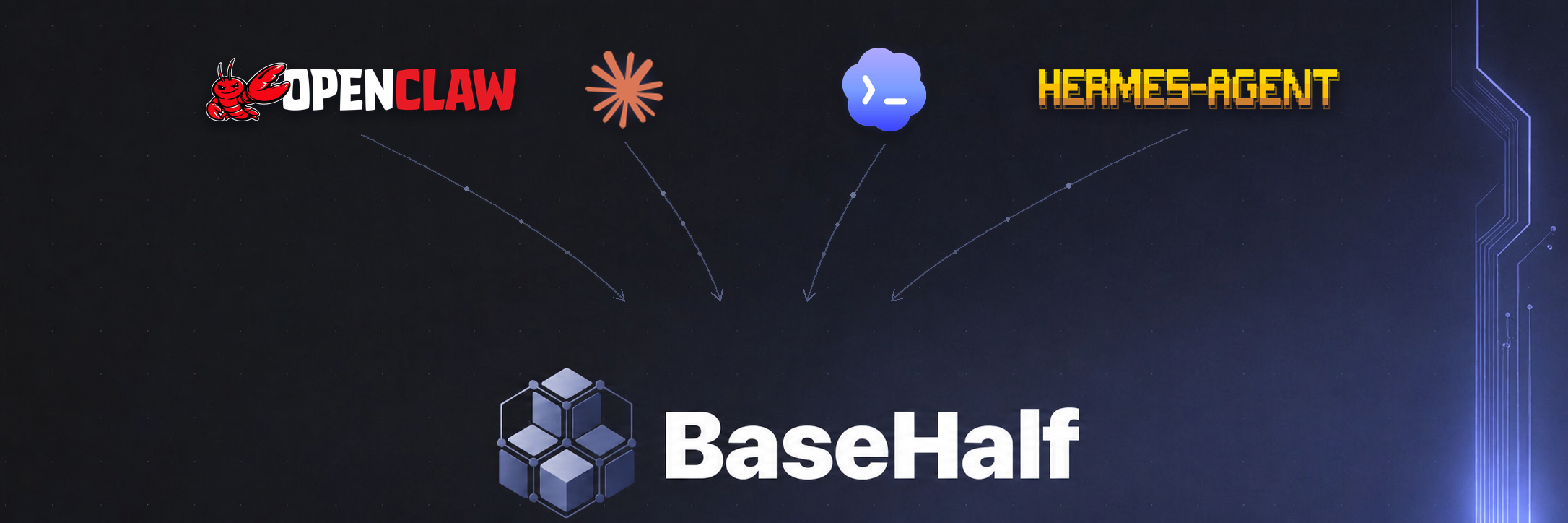
Bring your own agent: Codex, Claude Code, OpenClaw,
Hermes Agent, or any other agent that can read and write local files.
BaseHalf is being built in public. Star the repo, open a discussion, or join the
community if you're exploring local-first, AI-native workspaces.
Why BaseHalf
BaseHalf gives a local project a shared working surface for people and agents.
It turns a real folder into a visual workspace with files, notes, references,
prompts, and focus signals that stay close to the materials they describe.
Your files stay in a real folder. BaseHalf adds a .bh/ layer beside them for
canvas positions, prompts, references, and the current focus signal.
Humans work through the desktop app. Agents read the same local protocol and
decide what context to load.
The result is a local workspace your existing agent can understand: a canvas for
you, plain files for the agent, and a small protocol that helps both sides stay
oriented.
What It Is
- A desktop workspace: Electron, Mac first, with a file tree, canvas,
previews, and a block editor over local files. - A local folder model: your files stay where they are;
.bh/stores
BaseHalf metadata that can travel with the folder. - An agent-readable protocol:
.bh/focus.md,.bh/badges/<file>.json, and.bh/index/inbound.jsonpublish the graph through plain local files. - A bring-your-own-agent tool: you choose the agent. Codex, Claude Code,
OpenClaw, Hermes Agent, or any file-reading agent can participate. - A standalone local app: also useful as a knowledge workspace on its own.
How It Works
flowchart LR
  human["Human"] --> app["BaseHalf Desktop"]
  app --> files["Local workspace folder"]
  app --> bh[".bh protocol layer"]

  agent["Your AI agent"] --> files
  agent --> bh

  bh --> focus[".bh/focus.md"]
  bh --> badges[".bh/badges/*.json"]
  bh --> inbound[".bh/index/inbound.json"]
A badge is a file plus a small backpack of metadata: prompt, references, and
canvas position. Badges are materialized
automatically when you open a workspace.
The protocol is deliberately simple:
.bh/focus.mdsays what you are focusing on this turn..bh/badges/<file>.jsondescribes each file's agent-facing prompt,
references, and canvas metadata..bh/index/inbound.jsonis a derived reverse-reference index.
BaseHalf publishes structure; the agent chooses what to read.
What Works Today
BaseHalf is pre-alpha and the core loop is usable:
- Register a real folder as a workspace.
- See files and folders as badges on a canvas.
- Drag badges, persist positions, and scope into folder sub-canvases.
- Add references between badges.
- Preview and edit Markdown via BlockNote, with guardrails for lossy
round-trips. - Preview images, audio, video, PDFs, and plain code/text files.
- Focus a folder as a group and publish the current focus for agents.
- Keep
.bh/metadata reconciled as files are added, renamed, or removed.
Core modules currently ship for:
workspace- register, switch, rename, repath, and inspect workspaces.badge- read/write prompts, references, kind, and canvas metadata.inbound- query and rebuild reverse references.focus- publish the agent focus signal.search- full-text content search across the workspace.watcher- reconcile external filesystem changes.
Quickstart
Requirements: Node >= 20.19 and pnpm 9.
pnpm install
pnpm -r build
pnpm -r test
Link the CLI globally:
cd packages/cli
npm link
Create or register a workspace:
bh init
bh workspace add ~/Desktop/my-notes --name notes --setup
bh workspace list --json
bh workspace use notes
bh workspace current --json
Work with the protocol:
bh badge list --json
bh badge set chapter-03.md --prompt "explain supply and demand simply"
bh badge addRef chapter-03.md textbook.pdf --note "source chapter"
bh inbound get textbook.pdf --json
bh focus set --files chapter-03.md,textbook.pdf
bh search "supply and demand" --json
Create a demo workspace:
bh workspace demo ~/BaseHalf-Demo
Run the desktop app:
pnpm --filter @basehalf/desktop dev
Repo Layout
packages/
  core/             kernel + first-party modules
    src/
      index.ts        createCore() - the one door
      kernel/         registry, context, fs abstraction, command types
      modules/
        workspace/    workspace registry + local file access
        badges/       file/folder badges + references + canvas metadata
        inbound/      derived reverse-reference index
        focus/        .bh/focus.md publication
        search/       full-text content search over workspace files
        watcher/      chokidar reconciliation for local filesystem changes
  cli/              bh - thin shell over @basehalf/core
  desktop/          Electron + React shell over core via IPC
docs/             decisions, dependency policy, trademark policy
Architecture Principles
- One door. All operations go through
@basehalf/core'srun(command, args). CLI, MCP, and desktop UI stay thin. - Module isolation. Modules live under
packages/core/src/modules/<name>/
and compose throughctx.run. - Use the context filesystem. Core modules use
ctx.fs, so tests can swap
in a mock implementation. - Markdown is content truth. User files remain the source;
.bh/is
metadata and derived cache. - Publish simple local context. BaseHalf writes a small protocol to disk so
agents can navigate the workspace from the same folder. - Composable primitives. BaseHalf exposes small operations for workspaces,
badges, references, focus, search, and filesystem reconciliation.
Designed For
- Agent-assisted reading and writing: keep source files, notes, prompts, and
references connected in one local workspace. - Research maps: arrange files on a canvas, connect supporting materials,
and focus a folder of supporting materials for later work. - Project memory: keep the current focus, file-level prompts, and reference
graph beside the project itself. - Local-first collaboration with agents: let Codex, Claude Code, OpenClaw,
Hermes Agent, or another file-reading agent use the same folder structure you
are using.
Community
Community links are intentionally lightweight while BaseHalf is early:
- GitHub Discussions - questions, ideas, and build-in-public
updates. - Twitter / X - short public progress notes.
- Discord - async community chat.
- QQ Users - Chinese user community.
- QQ Developers - Chinese developer community.
If you are trying BaseHalf with Codex, Claude Code, OpenClaw, Hermes Agent, or
another local-file agent, we would love to hear what you build.
Contributing
BaseHalf is early and deliberately narrow. Please open an issue or discussion
before sending a non-trivial PR so we can align on scope first.
- Read CONTRIBUTING.md for build/test commands and architecture
invariants. - Open a PR; CI runs the project checks.
- Sign the CLA when prompted. Contributions must use
permissively-licensed dependencies.
Bug reports, ideas, and discussion are always welcome.
By participating you agree to our Code of Conduct.
License
Apache-2.0. Contributions require a signed CLA.
The "BaseHalf" name and logo are trademarks of Pointa Labs, Inc. See the
trademark policy.
Yorumlar (0)
Yorum birakmak icin giris yap.
Yorum birakSonuc bulunamadi