thinking-toolkit
Health Uyari
- License — License: MIT
- Description — Repository has a description
- Active repo — Last push 0 days ago
- Low visibility — Only 8 GitHub stars
Code Basarisiz
- rm -rf — Recursive force deletion command in install.sh
Permissions Gecti
- Permissions — No dangerous permissions requested
Bu listing icin henuz AI raporu yok.
30 thinking models as one portable agent skill — Claude Code, Codex CLI, OpenClaw, and any SKILL.md runtime
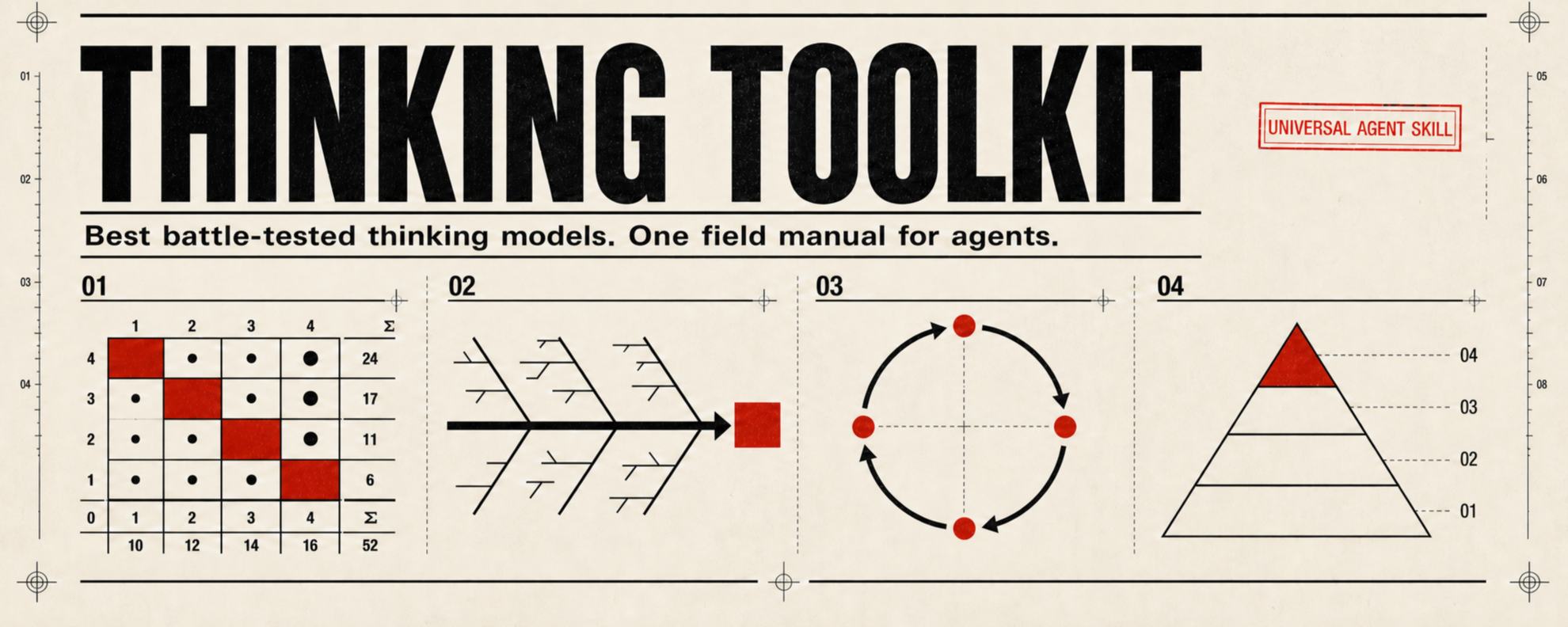
🧠 Thinking Toolkit
30 battle-tested thinking models, packaged as one portable skill for any AI agent.
Thinking Toolkit teaches an agent how to think about thinking: given a messy
real-world request — a decision to make, a problem to diagnose, a system to
understand, a message to deliver — it selects the smallest useful set of
structured thinking models, applies them faithfully step by step, and returns a
concrete artifact: a weighted matrix, a causal map, a premortem table, a
backward plan, a draft message.
It is plain Markdown with zero runtime dependencies. If your agent can read
files, it can use this skill.
Why
Left to itself, an LLM agent reasons in prose that sounds convincing and skips
steps. Meanwhile engineering, strategy, intelligence analysis, and
organizational learning have spent decades turning the situations agents face
daily — comparing options, finding root causes, estimating without data,
stress-testing plans — into named, tested procedures. This skill turns those
procedures into instructions an agent can execute, with the pitfalls
practitioners documented along the way.
Three commitments shape the design:
- Selection. Knowing what a decision matrix is costs nothing; the
expensive mistake is reaching for one at the wrong moment. The catalog
encodes selection cues, contrast rules ("Five Whys for one causal chain,
Ishikawa for breadth, Connection Circles for feedback"), and anti-patterns
for every model. - Procedure. Each model ships as a full operational card: inputs,
numbered steps, guiding questions, output format, a worked example, and
documented pitfalls. The agent follows the card instead of improvising
around a label. - Honesty. The core contract separates observed facts from assumptions,
marks unknowns instead of inventing evidence, runs sensitivity checks on
consequential results, and ends every artifact with an action and a review
trigger.
How It Works
When a model is named explicitly, the agent loads that card and follows it.
When the request is open, it identifies the job (decide, diagnose, estimate,
map, resolve, communicate), routes through the catalog's selection cues and
contrast rules, and picks one primary model with at most two complements. It
then frames the situation — stakes, reversibility, evidence — applies the
card's procedure at quick, standard, or deep depth, tests the result for
hidden assumptions and sensitivity, and closes with an artifact, an action,
and a review trigger.
The skill uses progressive disclosure to stay context-efficient: the agent
first reads only SKILL.md (~180 lines), consults the routing catalog when
selection is unclear, and loads only the model cards it actually needs.
Thirty models cost nothing until one is used.
The Catalog
Decision making — 12 models
| Model | Use when |
|---|---|
| Six Thinking Hats | A choice needs balanced perspectives instead of debate |
| Eisenhower Matrix | Tasks differ by urgency and importance |
| Second-Order Thinking | Immediate benefits may hide later effects |
| Decision Matrix | Several options must be compared across weighted criteria |
| Impact-Effort Matrix | A backlog needs rough portfolio prioritization |
| Ladder of Inference | A conclusion may have outrun its evidence |
| Hard Choice Model | The right amount of decision effort is unclear |
| OODA Loop | Conditions change while action is underway |
| Cynefin Framework | The response must fit the situation's causal nature |
| Confidence → Speed vs. Quality | Product work must trade speed against polish |
| Pareto Analysis | A few contributors may drive most of a measured effect |
| Backcasting | A distant goal needs a path from the endpoint to today |
Problem solving — 11 models
| Model | Use when |
|---|---|
| Ishikawa Diagram | A defined effect has many possible causes |
| Five Whys | One incident needs its causal chain traced to a process fix |
| Abstraction Laddering | The problem statement may be too narrow or vague |
| Conflict Resolution Diagram | Opposing demands appear mutually exclusive |
| Zwicky Box | A solution can be assembled from independent dimensions |
| Productive Thinking Model | A defined problem needs a complete creative process |
| Inversion | Failure modes reveal the path to success |
| Red Teaming | A confident plan needs an independent adversarial challenge |
| Issue Trees | A large problem needs non-overlapping decomposition |
| First Principles | Conventions and analogies constrain solution quality |
| Fermi Estimation | A quantity must be estimated without direct data |
Systems thinking — 5 models
| Model | Use when |
|---|---|
| Iceberg Model | Repeated events point to deeper structures and beliefs |
| Connection Circles | Variables and feedback relationships need mapping |
| Concept Map | Concepts and their semantic relationships need clarity |
| Balancing Feedback Loop | A system resists change or seeks a target |
| Reinforcing Feedback Loop | Growth or decline feeds further growth or decline |
Communication — 2 models
| Model | Use when |
|---|---|
| Situation-Behavior-Impact | Feedback must be specific and non-judgmental |
| Minto Pyramid | A busy audience needs the conclusion first |
Beyond single models, the catalog ships combination recipes — proven
sequences such as Consequential choice (Hard Choice Model → Decision Matrix →
Red Teaming) or Root-cause investigation (Pareto → Iceberg → Ishikawa → Five
Whys → OODA) — plus guardrails against the classic failure of stacking models
to appear thorough.
Installation
The skill follows the Agent Skills
convention (SKILL.md + resource files), supported by Claude Code, OpenAI
Codex CLI, OpenClaw, and other SKILL.md runtimes. Installation is copying a
folder.
Quick install
git clone --depth 1 https://github.com/ponomr/thinking-toolkit.git && thinking-toolkit/install.sh
That installs into every agent detected on the machine, printing each path and
refusing to overwrite an existing install unless you confirm.
Options:
- Pick a host:
./install.sh claude,codex,openclaw, or a custom path. --symlinklinks the skill instead of copying it, so a latergit pullin
this repo updates every install at once.--forceoverwrites an existing install without asking.
Manual install
| Agent | Personal skills directory | Project-scoped |
|---|---|---|
| Claude Code | ~/.claude/skills/thinking-toolkit/ |
.claude/skills/thinking-toolkit/ |
| OpenAI Codex CLI | ~/.codex/skills/thinking-toolkit/ |
.codex/skills/thinking-toolkit/ |
| OpenClaw | ~/.openclaw/skills/thinking-toolkit/ |
.openclaw/skills/thinking-toolkit/ |
| Anything else | Wherever your runtime discovers SKILL.md |
— |
Copy SKILL.md, references/, and (optionally) agents/ into the directory.
Nothing else is required at runtime — no API keys, no network access, no code
execution.
For self-hosted gateways and custom harnesses: inject SKILL.md into the
system context and make references/ readable; the skill assumes nothing
beyond file reading.
Usage
Ask for a model by name:
"Run a premortem on this launch plan."
"Compare these three vendors with a weighted matrix."
"Backcast from where we want the newsletter to be in three years."
Or just describe the situation and let the routing work:
"Support tickets keep growing and I don't know where to start."
→ Pareto Analysis to find the vital few, then Five Whys on the top category.
"We keep arguing about whether to rewrite the billing service."
→ Six Thinking Hats to structure the debate, Decision Matrix if options
stabilize, Red Teaming before committing.
The agent states which model it chose and why, applies the card's procedure,
and returns the artifact with its assumptions and a review trigger.
Repository Layout
thinking-toolkit/
├── SKILL.md                  # entry point: contract, routing, workflow
├── references/
│   ├── catalog.md            # index, aliases, selection cues, recipes
│   └── <model>.md            # 30 operational cards, one per model
├── agents/openai.yaml        # optional host discovery metadata
├── scripts/validate_skill.py # deterministic structure validation
├── tests/                    # validator regression tests
└── install.sh                # copy payload into agent skill dirs
Development
python3 scripts/validate_skill.py .        # structure + content invariants
python3 -m unittest discover -s tests -v   # validator regression tests
The validator enforces the invariants that make the skill reliable: every card
carries all ten operational sections, every link resolves internally, the skill
payload contains no external URLs (it must work fully offline), and the catalog
matches the card set exactly.
Design Principles
- Provider-neutral by construction. No tool calls, no browsing, no code
execution, no memory assumptions. Any capable LLM with file access qualifies. - The smallest useful model set. One model by default, three at most, and
explicit permission to use none: a communication model is chosen only after
the underlying analysis is adequate. - User agency preserved. Model outputs support a decision that stays with
the user. The skill never manufactures certainty the evidence does not
contain. - Depth matched to stakes. Quick pass for reversible low-stakes calls; deep
pass — with sensitivity checks and disconfirming evidence — for consequential
or irreversible ones. - Deterministic quality gates. A stdlib-only validator keeps all 30 cards
structurally complete and the routing tables in sync with the card set.
Acknowledgments
The models collected here were created by their original authors, including
Edward de Bono (Six Thinking Hats), Chris Argyris (Ladder of Inference), John
Boyd (OODA Loop), Dave Snowden (Cynefin), Kaoru Ishikawa (fishbone diagram),
Taiichi Ohno and Sakichi Toyoda (Five Whys), Eliyahu Goldratt (Evaporating
Cloud), Fritz Zwicky (morphological analysis), Tim Hurson (Productive
Thinking), Barbara Minto (Pyramid Principle), Joseph Novak (concept mapping),
Enrico Fermi (order-of-magnitude estimation), Vilfredo Pareto and Joseph Juran
(80/20 analysis), John B. Robinson (backcasting), Ruth Chang (hard choices),
the Center for Creative Leadership (SBI), and the systems-thinking tradition of
Jay Forrester and Donella Meadows. All card text is original prose written for
this project.
License
MIT — see LICENSE.
Yorumlar (0)
Yorum birakmak icin giris yap.
Yorum birakSonuc bulunamadi