ApeironCode
Health Uyari
- License — License: MIT
- Description — Repository has a description
- Active repo — Last push 0 days ago
- Low visibility — Only 5 GitHub stars
Code Gecti
- Code scan — Scanned 12 files during light audit, no dangerous patterns found
Permissions Gecti
- Permissions — No dangerous permissions requested
Bu listing icin henuz AI raporu yok.
Open-source, local-first AI coding agent for developers who want control. Use any model, inspect every action, review diffs, run commands safely, and keep your code under your rules.
ApeironCode
Open-source, local-first AI coding agent for developers who want control.
Use any model. See every action. Keep your code under your rules.


Early alpha, CLI-only public release. The VS Code extension is not part of this public alpha.
APIs and commands may change, but writes and commands remain approval-gated.
Install
The package and one-line installer are not published yet. Install the current
alpha from source:
git clone https://github.com/poolanithinreddy/ApeironCode.git
cd ApeironCode
npm ci
npm run build
npm link
Verify the installation:
apeironcode --help
apeironcode setup --provider mock
apeironcode doctor
Mock mode is deterministic and needs no API key. For real work, configure
Ollama or a cloud provider.
See It Work
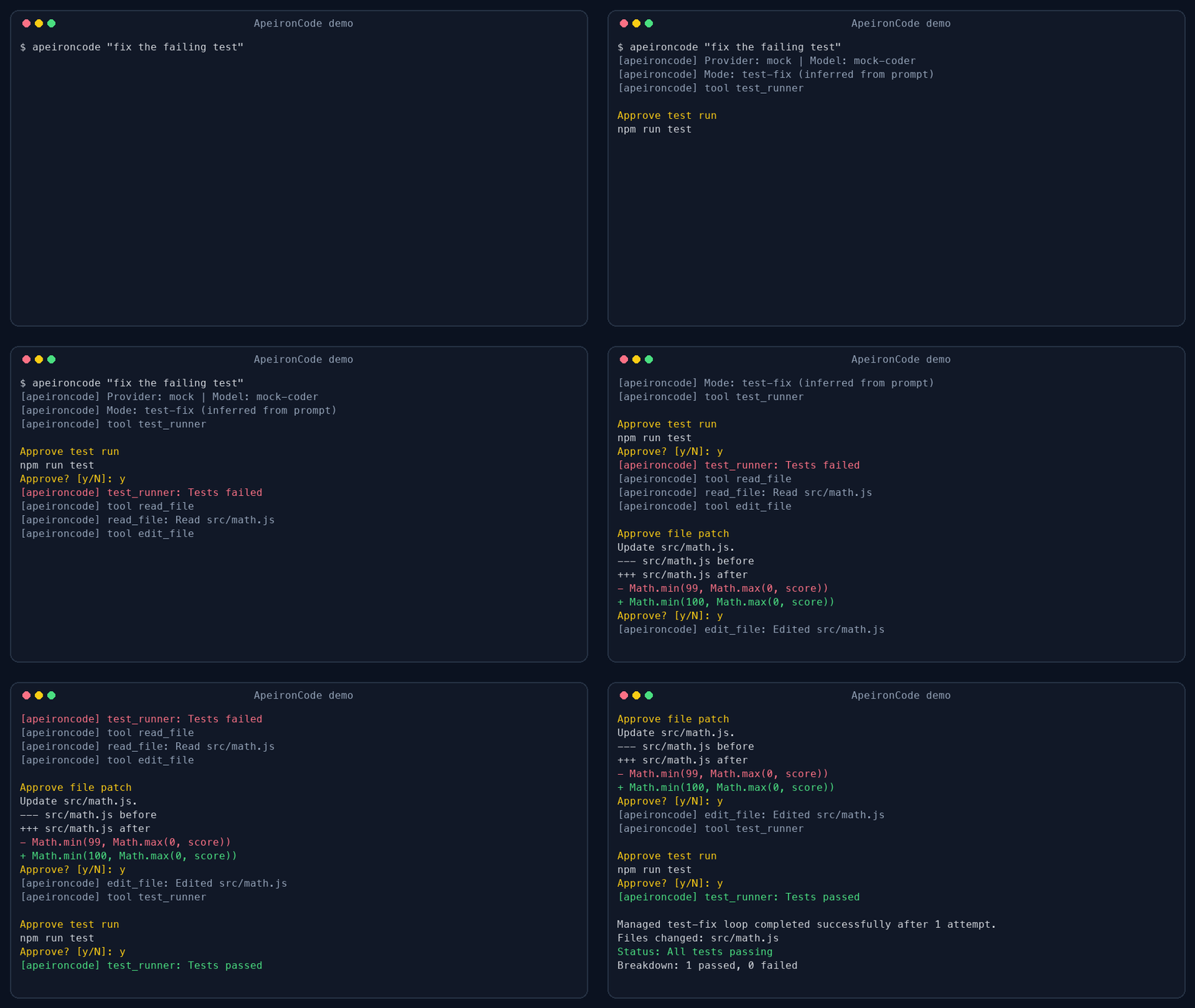
The demo above is a real no-key mock-provider run againstexamples/fix-failing-test/before.
It reads the failing source, previews the exact patch, waits for approval,
reruns the test with approval, and reports the passing result. Reproduction
steps are documented in docs/demo-recording.md.
Why ApeironCode?
Most coding agents are closed, provider-locked, or hard to inspect.
ApeironCode is built around a different idea:
- Use local, free cloud, or premium models.
- See what files the agent reads.
- Approve risky commands before they run.
- Review every diff before accepting changes.
- Create checkpoints and roll back when needed.
- Extend workflows with agents, skills, commands, hooks, and plugins.
Quickstart
cd your-project
apeironcode setup --local
apeironcode "explain this repository"
apeironcode "fix the failing tests"
Or try the offline mock provider:
apeironcode setup --provider mock
apeironcode "show project tree"
Simple filesystem and command requests are handled deterministically through
the same ToolRegistry used by model-driven work. File writes and shell
commands still require approval.
Examples
| Use case | What it demonstrates |
|---|---|
| Fix a failing test | Inspect, patch, approve, and rerun tests |
| Review a pull request | Diff-focused findings with file references |
| GitHub Action PR review | Dry-run automation with explicit permissions |
GitHub Action
The action is intentionally dry-run by default:
name: ApeironCode review
on:
  pull_request:

permissions:
  contents: read
  pull-requests: write

jobs:
  review:
    runs-on: ubuntu-latest
    steps:
      - uses: actions/checkout@v4
      - uses: poolanithinreddy/[email protected]
        with:
          mode: pr-review
          dry_run: true
See the complete action example.
Features
- Terminal-native interactive chat built with Commander.js, Ink, and React.
- One-shot execution for direct prompts from the shell.
apeironcode doctordiagnostics andapeironcode provider testsmoke checks.- Optional Project Brain:
apeironcode brain planpreviews a user-approved.apeironcode/workspace memory for long app builds, with large-app orchestration, PLAN/TASKS diff-merge, a persistent sync-preview store, token-efficient context planning, and agent routing. All writes require explicit--yes— no silent creation. Runtime brain intelligence adds deterministic intent classification (<1ms) that selects relevant brain context per prompt, surfaced via thebrain.runtime/brain.explainCLI. (A VS Code companion exists in development but is not part of this CLI alpha.) - First-run setup with
apeironcode setup, no-key mock-provider trial mode,/setup, and setup status/reset commands. - TUI product-home flow with command echo, compact dashboard sections,
/commands beginner, natural aliases such as/show memory, and temp-HOME smoke helpers vianpm run demo:tui. - Provider readiness UX with
apeironcode provider list,apeironcode provider setup,apeironcode provider fallback,apeironcode provider doctor,apeironcode model list, andapeironcode model recommend. - Local-first Ollama UX with
apeironcode ollama status,apeironcode ollama models,apeironcode ollama recommend, and pull hints. - Multi-provider architecture with Ollama, OpenAI-compatible, OpenRouter, OpenAI, Groq, DeepSeek, Gemini, and Anthropic support.
- Deterministic
mockprovider for local development, testing, and CI. - Evented agent runtime with transcript recording, task-state tracking, approval lifecycle events, and session compaction.
- Workflow-aware agent runtime with explicit feature, debug, explain, review, refactor, commit, and test-fix flows.
- LSP-aware code intelligence with readiness detection, process-local long-lived sessions, per-file cache invalidation, live-or-fallback
symbols,diagnostics,definition, andreferences, plus prompt-context diagnostics summaries that never block when servers are missing. - Routed provider system with role-aware model selection, provider fallback chains, model capability catalog, and usage cost estimation.
- Safe tool execution for file reads, file metadata, file listing, glob, grep, edits, structured patches, writes, shell commands, background commands, git inspection, git commit, and build/lint/test runs.
- Live web tools:
web_fetch,web_search, andweb_researchwithNetwork(...)permission checks, query sanitization, and private-host blocking by default. - Searchable history across saved sessions, task plans, edit history, project/global memory, and session-learning summaries.
- Structured session learning persisted with decisions, failed attempts, follow-up tasks, and memory load reasons.
- Experimental MCP runtime with configured endpoint discovery, server testing, tool listing, and stdio tool execution.
- Relevance-ranked project context with manifest scanning, indexed file summaries, repo-brain context packing, memory-graph facts, planning mode, and execution summaries.
- Native provider tool calling with malformed tool-input recovery prompts.
- Repo intelligence commands with
apeironcode repo,apeironcode repo map, andapeironcode repo symbols <query>. - Effective mode inference for plain chat prompts, with matching mode labels in the CLI preamble, execution summary, session metadata, and TUI status bar.
- Defensive display formatting so provider diagnostics, approval prompts, slash output, and error panels never degrade into
[object Object]. - Unified diff previews before edits and writes.
- Approval prompts for writes, commands, tests, commits, sensitive file reads, and external paths, with approval events recorded into transcripts.
- Local user config, project config, project memory, ignore rules, permissions, session persistence, session search, and transcript paths.
- Slash commands for
/help,/commands,/doctor,/model,/provider,/config,/clear,/compact,/cost,/history,/search,/fix,/debug,/feature,/review,/refactor,/commit,/pr,/test,/lint,/build,/tools,/repo,/context,/status,/permissions,/plugins,/sessions,/resume,/memory,/mcp,/web, and/exit. - Multi-agent sessions with process-local tracking of agent work: session lifecycle states (queued, running, paused, completed, failed, stopped), file change tracking, command/test execution logs, and file locks.
- Advisory file locks preventing concurrent modifications to files by different agent sessions within the same process. Locked for
edit_file,write_file,patch_file, andrevert_patch. - Session export to Markdown, JSON, and HTML formats with automatic secret redaction. Local-only storage in
.apeironcode-agent/shares/with file:// URLs. - Session display and management:
apeironcode session list,session start,session show,session stop,session locks, andsession attach(summary view, live attach not yet supported). - Plugin and MCP foundation with manifest loading from
.apeironcode-agent/pluginsand config-controlled enable/disable rules. - Memory Graph 2.0 with
.apeironcode-agent/memory/graph.json, dedupe, secret redaction, related search, review, prune, learn, "why" output, prompt retrieval, and session/task/file/skill updates after agent runs. - Reviewable memory suggestion queue with approve/reject commands before applying proposed durable graph facts.
- Local skills system with
.apeironcode-agent/skills/<name>/skill.jsonandskill.md, starter skills, validation, scoped CLI/TUI execution, run-plan previews, hooks, memory recording, and slash commands. - Skill browser and templates with
apeironcode skills,apeironcode skill browser,apeironcode skill templates, and/skills. - Safe connector foundation starting with GitHub: env-only token use, repo detection, issue/PR reads, local PR review reports, approval-gated comments, and approval-gated issue/PR creation.
- Specialist agent/team registry with planner/coder/tester/reviewer/security/docs/release roles, sequential team plans, real sequential team execution, scoped tools, strict subagent policies, temp-copy and clean-repo git-worktree isolation, rename-aware three-way merge review, conflict reports, merge-resolution state, workspace-ignore hygiene, approval-gated apply, git-apply-oriented patch export/validation, local team artifacts, live TUI review cockpit surfaces, and event logs.
- Lifecycle hooks wired into sessions, planning, tools, edits, commands, commits, memory suggestions, and skill runs, with disabled-by-default shell execution and explicit approval requirement.
- Token-efficient repo brain modules for file summaries, dependency edges, context packing, prompt-context injection, and budget reporting.
- Typed code quality workflow recipes for feature implementation, test fixes, debugging, review, refactor, tests, dependency upgrades, security/performance audits, docs, and release prep, with dry-run, report storage, and runtime execution through the agent loop.
- Honest sandbox status detection with
apeironcode sandbox status; OS-level sandboxed command execution is not implemented. - Mock-only local eval commands with
apeironcode eval list,apeironcode eval run smoke, andapeironcode eval report.
Provider Matrix
| Provider | Status | Notes |
|---|---|---|
| Ollama | Ready | Local-first default with http://localhost:11434 |
| OpenAI-compatible | Ready | Works with custom base URLs and API keys |
| OpenRouter | Ready | Uses OpenRouter headers and API key env var |
| OpenAI | Ready | OpenAI-compatible implementation with OpenAI defaults |
| Groq | Ready | OpenAI-compatible implementation with Groq defaults |
| DeepSeek | Ready | OpenAI-compatible implementation with DeepSeek defaults |
| Gemini | Ready | Uses Google Generative Language API |
| Anthropic | Ready | Uses Anthropic Messages API |
ApeironCode uses a bring-your-own-key model for cloud providers. API keys are read from environment variables and are not printed in setup output. It does not support unofficial ChatGPT Plus or GitHub Copilot login reuse.
Safety Model
- Read-only operations are low risk by default.
- File edits and writes always show a diff before approval.
- Shell commands, tests, and commits always require approval unless you explicitly pass
--dangerously-skip-approvals. - Web access is ask-first by default because outbound requests must match an explicit
Network(...)allow rule or be approved interactively. web_fetchonly supportshttp:andhttps:URLs and blockslocalhostand private IP ranges unlessweb.allowPrivateHosts=trueis set for trusted local testing.web_searchandweb_researchredact obvious secret-like query fragments before building outbound requests.- Sensitive files such as
.env, SSH keys, and secret stores require explicit approval. - Commands like
sudo,curl | sh,wget | sh, and system path permission changes are blocked. - High-risk commands such as
rm -rf, destructive git resets, andnpm publishrequire extra confirmation.
Slash Commands
/help [command]shows the available commands or detailed help for one command./commands [command]is an alias for/helpwith the same examples./doctorruns environment and provider diagnostics./model [name|list [role]|recommend [role]]lists, recommends, or changes the default model./provider [name|list|setup [provider]|fallback [role]|doctor|test]lists, diagnoses, configures, or changes the default provider./ollama [status|models|recommend]checks local Ollama readiness and model recommendations./configshows the active config summary./clearclears the in-memory conversation./compactsummarizes and compresses the current conversation state./costshows token or estimated usage information./historyshows saved session, usage, and edit-history summaries./search <query>searches saved sessions, task plans, edits, and memory./fix <request>runs the focused bug-fix workflow./debug <request>runs the debugging workflow./feature <request>runs the feature implementation workflow./review [scope]reviews the current diff by default, or a named scope such ascurrent difforsrc/auth.ts./refactor <request>runs the refactor workflow./commitgenerates a commit message and runsgit commit -m ...with approval./prgenerates a PR description from the current diff./lintruns the detected lint command with approval./buildruns the detected build command with approval./toolslists the active tool registry./lsp symbols|diagnostics|definition|references|sessions|restart|stop|cacheshows live, cached, or fallback LSP state in the running TUI process./repo | /repo map | /repo symbols <query>shows architecture, repo-map, and symbol intelligence./context [query]prints the current project summary and relevant files for a task./statusprints current session metadata and tracked file activity./permissions list|add|remove|resetmanages permission rules without leaving the TUI./plugins [name]lists plugin manifests and MCP endpoints, or prints one manifest in full./sessionslists saved sessions./resume [id]resumes a previous session./memory show|add|edit|clear|search|whymanages project memory and memory introspection./team plan|run|workspaces|runs|show|review|artifacts|artifact|merge-plan|conflicts|apply|discardplans and runs sequential subagent teams, including temp-copy, git-worktree, artifact review, and merge-review flows./workflow list|show|run|reportlists typed recipes, previews stages, runs workflows, and shows reports./mcp list|tools <server>|test <server>inspects configured MCP servers./web fetch <url> | /web search <query> | /web research <query>performs live web access under the same approval model as other tools./testruns the detected test command with approval./exitexits the interactive app.
Workflow command help now includes inline examples such as /fix failing tests, /debug paste the stack trace, /feature add a dark mode toggle, and /refactor src/auth.ts.
Documentation
- Architecture
- Context Engine
- LSP and Code Intelligence
- Multi-Agent Sessions
- Agents
- Team Workflows
- Git Worktrees
- Merge Review
- Merge Resolution
- Workspace Ignore Hygiene
- Rename-Aware Merge
- Review Cockpit
- Team Artifacts
- Safe Parallel Lanes
- Workflow Recipes
- Session Export & Sharing
- Providers
- Skills
- Connectors
- GitHub Connector
- Hooks
- Security Model
- Security Limits
- Comparison
- Demo Script
- Isolated Team Demo
- Workflow Demo
- Safety
- Troubleshooting
Mode Inference
When you stay in plain chat mode, ApeironCode can infer a more specific effective mode from the prompt.
Explain this reporesolves toexplainReview current diffresolves toreviewFix failing testsresolves totest-fix
The effective mode is shown consistently in one-shot CLI runs, execution summaries, session metadata, and the TUI status bar. If you pass an explicit CLI mode such as --mode chat, that explicit mode is kept for the run.
Code Intelligence
apeironcode lsp status
apeironcode lsp symbols src/agent/loop.ts
apeironcode lsp diagnostics src/agent/loop.ts
apeironcode lsp definition src/agent/loop.ts 10 0
apeironcode lsp references src/agent/loop.ts 10 0
apeironcode doctor
ApeironCode has a narrow, process-local LSP session manager rather than a full editor-style workspace integration.
ApeironCode now keeps process-local long-lived LSP sessions while the current agent or TUI process is running. Those sessions back symbols, diagnostics, definition, and references, reuse open documents, cache file-scoped results, and invalidate cached entries after file edits. They are still not IDE-grade workspace state and they do not persist across separate CLI invocations.
Stable today:
apeironcode lsp statusreports whether supported local language-server binaries are installed.apeironcode doctorincludes LSP readiness, active session state, and cache stats in the environment report.apeironcode lsp symbols <file>and/lsp symbols <file>use long-livedtextDocument/documentSymbolsessions when available, can reportsource: cached LSP, and fall back to the indexed symbol path otherwise.apeironcode lsp diagnostics <file>and/lsp diagnostics <file>use long-lived sessions when available and reportsource: live LSP,source: cached LSP, orsource: fallback analysisexplicitly.apeironcode lsp definition <file> <line> <character>andapeironcode lsp references <file> <line> <character>use long-lived position-based lookups when available and fall back cleanly when LSP is unavailable./lsp sessions,/lsp restart,/lsp stop,/lsp cache, and/lsp cache clearmanage the current process-local LSP runtime.- agent prompt context and final execution summaries now include capped diagnostics for the top 1 to 2 relevant files in
debug,fix,test-fix,review, andrefactormode.
Experimental today:
- live diagnostics still depend on whether the server actually publishes
textDocument/publishDiagnosticsfor the opened or changed file during the request window. - definition and reference lookups are still position-based.
- long-lived LSP sessions are process-local only; a fresh
apeironcode ...CLI invocation starts with an empty session list and empty cache. - no workspace-wide diagnostics, rename, code actions, semantic tokens, or IDE extension features are implemented.
Fallback behavior is explicit by design:
- missing servers do not break the agent or the CLI.
- fallback mode uses repository indexing, regex-based symbol hints, grep-style search, and the repo map.
- all LSP traffic is local-only between ApeironCode and the language-server process on the same machine.
Install hints:
# TypeScript / JavaScript
npm install -g typescript-language-server typescript

# Python
npm install -g pyright

# Go
go install golang.org/x/tools/gopls@latest

# Rust
rustup component add rust-analyzer
Web Research
apeironcode web fetch https://example.com/spec
apeironcode web search "parser design patterns"
apeironcode web research "streaming JSON-RPC client retries"
- Web access is enabled in the tool registry, but outbound requests are still ask-first unless a matching
Network(...)allow rule exists. web_searchandweb_researchcurrently supportduckduckgoonly.web_fetchsupports direct URL fetches, but blocksfile://,localhost, and private IPs by default.- For trusted local tests only, set
web.allowPrivateHosts=truein config and add a narrowNetwork(...)allow rule.
Example project config:
{
	"web": {
		"enabled": true,
		"searchProvider": "duckduckgo",
		"maxFetchChars": 6000,
		"maxSearchResults": 5,
		"allowPrivateHosts": false,
		"userAgent": "ApeironCode-Agent/0.1"
	},
	"permissions": [
		"Allow(Network(https://duckduckgo.com/*))"
	]
}
Diagnostics
apeironcode doctor
apeironcode doctor --provider
apeironcode provider test
apeironcode lsp status
The doctor command checks runtime prerequisites, config validity, provider selection, model selection, workspace permissions, interactive TTY support, provider readiness, and LSP server availability.
Provider readiness output now includes the selected model capability profile, and the system prompt adds model-aware guidance for smaller-context or prompt-tool providers.
Provider smoke and doctor output now also pass through the same safe display formatter used by slash commands and error panels, so unexpected structured values are rendered as readable JSON rather than [object Object].
For LSP specifically:
apeironcode lsp statusis the real readiness command todayapeironcode lsp symbols <file>can reportsource: live LSP,source: cached LSP, orsource: fallback indexapeironcode lsp diagnostics <file>can reportsource: live LSP,source: cached LSP, orsource: fallback analysisapeironcode lsp definition <file> <line> <character>andapeironcode lsp references <file> <line> <character>can reportsource: live LSP,source: cached LSP, orsource: fallback unavailableapeironcode doctornow includesLSP sessionsandLSP cachechecksapeironcode lsp sessionsandapeironcode lsp cachereflect only the current process state- missing language servers never crash these commands; they return an honest fallback reason instead
Testing and Acceptance
npm run typecheck
npm run lint
npm run build
npm test
npm run test:e2e
npm run check:file-size
npm pack --dry-run
Default tests are offline and deterministic. They use scripted native streaming chunks, mocked connector responses, temp workspaces, and redacted logs/exports, so no provider or connector API keys are required.
Useful release-readiness commands:
apeironcode eval list
apeironcode eval run smoke
apeironcode connector list
apeironcode connector env linear
apeironcode session export <id> --format markdown
apeironcode debug config
Eval results include estimated token-efficiency metrics such as context tokens, tool schema tokens, tool result tokens, compression ratio, and success per 1k tokens. See docs/release-checklist.md before publishing.
Permissions
apeironcode permissions list
apeironcode permissions add "Bash(npm test)"
apeironcode permissions add "FileEdit(src/**)"
apeironcode permissions add "Allow(Network(https://duckduckgo.com/*))"
apeironcode permissions add "Deny(Network(http://127.0.0.1:*))"
apeironcode permissions remove "Bash(npm test)"
Permission rules are enforced during approval decisions for matching file, command, tool, and network operations.
Rule resolution is simple:
Deny(...)wins overAllow(...).Allow(...)skips the approval prompt for matching operations.- No matching rule falls back to ask-first behavior.
See docs/permissions.md and docs/web-research.md for complete examples.
Configuration
User config path:
~/.apeironcode-agent/config.json
Project config path:
.apeironcode-agent/config.json
Project memory path:
.apeironcode-agent/memory.md
Ignore file path:
.apeironcodeignore
Plugin manifest directory:
.apeironcode-agent/plugins/*.json
Plugin config settings:
plugins.directoriesadds extra manifest search paths.plugins.disableddisables named manifests without deleting them.
MCP config settings:
mcp.serversconfigures named MCP endpoints from.apeironcode-agent/config.json.- Project config entries override plugin-defined MCP endpoints with the same name.
Web config settings:
web.enabledenables the built-in web tools.web.searchProvidercurrently supportsduckduckgoonly.web.allowPrivateHostsisfalseby default and should remain off outside trusted local testing.web.maxFetchChars,web.maxSearchResults, andweb.userAgenttune request behavior.
Supported environment variables:
OPENAI_API_KEYOPENROUTER_API_KEYGROQ_API_KEYDEEPSEEK_API_KEYGEMINI_API_KEYANTHROPIC_API_KEY
Development
npm run dev
npm run build
npm run typecheck
npm run test
npm run lint
npm run format
npm run bench:agent
Docs
- Coding tasks now use a structured file-plan loop: the model proposes files
and commands as JSON, then the runtime validates paths/content, shows a
preview, asks approval, and executes changes through the ToolRegistry. docs/providers.mdcovers provider readiness, setup, and model recommendation UX.docs/live-provider-smoke.mdcovers smoke-test semantics.docs/web-research.mdcovers live web tools, search-provider setup, and safety boundaries.docs/permissions.mdcoversAllow(...)andDeny(...)rules, includingNetwork(...).docs/memory.mdcovers project memory, global memory, and session learning.docs/history.mdcovershistory,search, and stored edit/task/session data.docs/mcp.mdcovers the experimental MCP runtime and current limitations.
Demo
A short CLI walkthrough will be added after the first public alpha. In the
meantime, run npm run smoke:dogfood to see scripted, offline coverage of the
build / modify / error-fix flows.
Roadmap
- Next: richer history and memory dashboards inside the TUI.
- Next: additional web search providers and richer result extraction.
- Next: broader MCP transport support beyond the current experimental stdio runtime.
- Later: a polished VS Code companion (in development, not part of this CLI alpha).
Known limitations
- Early alpha; this is a CLI-only public release.
- The VS Code extension is not included in the public alpha.
- The standalone marketing website is developed in a separate project.
- Large full-stack / multi-service app generation is experimental and
produced as phased plans, not one shot. - Browser/visual validation is heuristic/static (DOM + CSS over the entry
HTML and its linked assets), not full headless-browser rendering. - Provider/model switching UX is still improving.
- The real TTY interaction harness is still limited.
- No full autonomy is claimed — file writes and shell commands are
approval-gated.
Attribution
ApeironCode Agent is an independent clean-room implementation. It does not use leaked or proprietary Claude Code source code.
This project is independently maintained and is not affiliated with, endorsed by, or maintained by Anthropic or the Claude Code team.
Contributing
Issues and pull requests are welcome. Please run npm run typecheck, npm run test, npm run lint, and npm run build before opening a PR.
Real Agent Guarantees
ApeironCode separates reasoning from execution: the model plans, the runtime
executes. Concretely:
- Tool execution contract. Every tool call is normalized and validated
against that tool's own required fields before execution. Undefined/missing
arguments never reach a tool, an invalid call is never retried identically,
and a failure for one tool never reports another tool's error message. - Deterministic actions. Obvious filesystem/command requests (create file
or folder, list files, project tree, run a command, combined "inspect + create"
requests) run directly through the ToolRegistry with valid, deterministic
arguments — no provider call. - File plan execution. App build/modification asks the model for a strict
JSON file plan (one corrective retry on bad JSON, then a clean failure),
which the runtime validates, previews, gets approved, and writes. - Command approval. Plan commands are previewed and require approval; a
failing command can feed a follow-up fix plan. - Pending instructions. A bare "do the following changes in the web app"
waits for details (no tools, no provider); the next concrete instruction is
merged and run against the existing files. - Feature acceptance (no fake success). For app builds/modifications the
runtime extracts the requested features (e.g. todo: add input, list, toggle,
delete, localStorage, premium UI), evaluates them against the written files,
and asks the model for a correction plan (max 2) when features are missing.
It will not claim "ready" when acceptance failed, the build hasn't run, or a
command failed. - Build/run/fix. "run the application" resolves a deterministic command
(cd <dir> && npm run dev|start, oropen index.html); "run the application
and fix any errors" runsnpm run buildfirst and, on failure, asks for a
fix plan and rebuilds (max 2). No emptyrun_commandis ever issued. - todo_write is restricted. It is not exposed to the model during app
build/run/fix; only in explicit planning/task-management contexts. A
malformedtodo_writenever derails or fails the task. - Pasted-error debugging. Paste a runtime/build error (e.g.
Cannot read properties of undefined (reading 'x')) and the runtime classifies it,
searches the workspace for the symbol, reads the matched/likely files
itself, gets a JSON fix plan, patches after approval, and validates withnpm run build. No modelread_file/run_command/command_output;
pasted errors are never saved to memory. - Quiet by default. Normal output is the answer plus a short Files/Commands/
Tests footer. The full execution summary is debug-only (--verboseorAPEIRONCODE_DEBUG=1).command_outputis not exposed unless a background
command session is active.
Low-credit dogfooding
All flows are exercised offline with a fake provider and temp workspaces — no
API credits needed: npm run smoke:real-coding, npm run smoke:error-fix,npm run smoke:dogfood, npm run smoke:tui-dogfood, the Phase 18A master
smoke npm run smoke:master-dogfood, and the Phase 18B terminal-UX smokenpm run smoke:terminal-ux. Deterministic actions use no provider;
error fixing uses one file-plan call; app repair uses at most 1–2 correction
calls. Visual/layout repair prompts also run a deterministic, offline
browser smoke (DOM/CSS heuristics over the actual entry HTML + its linked
CSS/JS) and report Browser smoke: passed/failed honestly — ApeironCode does
not claim a premium UI passed when the rendered page can overflow, links a
missing asset, or the edited CSS is not the file the entry actually loads.
Package/framework apps report the smoke as a documented limitation (needs a
build + headless browser) instead of faking a pass.
- Memory hygiene. Failed tool/provider/runtime errors are never saved as
memory; only successful, useful project facts are. - Compact terminal UX. Normal mode is calm and Claude Code-like: a one-line
status header (ApeironCode · provider/model · workspace · status), single
compact tool lines (✓ Write styles.css +42/-12 · /revert e7), clean
approval cards that list the actual files (no nested boxes, no misleadingFiles affected: none), and short summaries. Raw diffs, tool args, and the
full execution summary are debug-only — setAPEIRONCODE_DEBUG=1(or--verbose) to see them.
Current limitations: very large multi-service builds are produced as phased
plans rather than one shot; small local models may still omit required JSON
fields (handled with one retry then a clean error).
License
MIT. See LICENSE.
Yorumlar (0)
Yorum birakmak icin giris yap.
Yorum birakSonuc bulunamadi