claude-continuity
Health Gecti
- License — License: MIT
- Description — Repository has a description
- Active repo — Last push 0 days ago
- Community trust — 27 GitHub stars
Code Gecti
- Code scan — Scanned 12 files during light audit, no dangerous patterns found
Permissions Gecti
- Permissions — No dangerous permissions requested
Bu listing icin henuz AI raporu yok.
Zero-touch session rotation and supervision for Claude Code
cc-continuity
Zero-touch session rotation and supervision for Claude Code.
Why it exists. Long sessions die when the context window fills up, and local LLMs make it worse: their window is fixed and small, and the built-in compaction (/compact, auto-compact) is a lossy one-shot summary. With a small model it silently drops decisions, rejected approaches and the exact stopping point, and every compaction then summarizes a summary, so the drift compounds. cc-continuity exists to give long work room to breathe inside the window: at a safe threshold it rotates the session with a structured, validated handoff instead of a lossy summary.
The goal is to let an agent drive a planned project end-to-end, from 0 to done, with a human involved only when the agent is truly blocked. This repository is the proof of concept: it was developed with cc-continuity itself, and the full development history is in this git log.
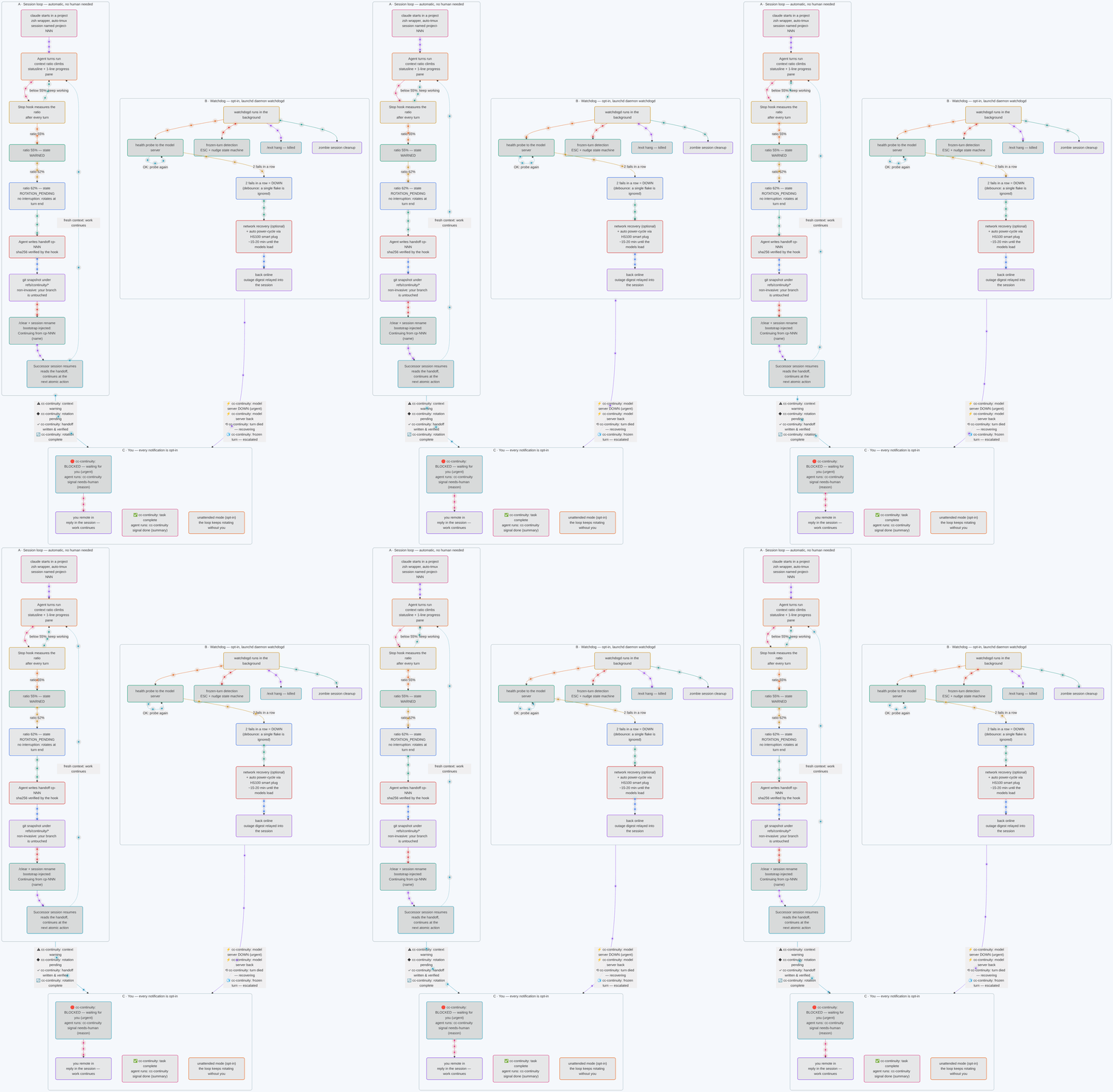
cc-continuity watches the context ratio and, when it crosses a threshold, rotates the session with no user action:
- the agent finishes the current step,
- cc-continuity makes it write a validated handoff,
- the git tree is snapshotted non-invasively (
refs/continuity/*refs:
no commits, no tags, no branches touched), - the context is cleared and the session renamed,
- a continuation prompt is injected and the successor session starts
withContinuing from cp-<NNN> (<slug>-<NNN+1>).
An optional watchdog daemon keeps long unattended runs recoverable
when the model server (for example a local vLLM box) dies or freezes, and
optional ntfy pushes let you watch from your phone.
What's new
The five most recent updates, newest first. Each line links to its
commit, so you can see what changed lately without digging through the
log:
- 2026-11-06 — Handoffs export the session transcript as a readable
HTML page (search, theme toggle) plus raw JSONL, and the successor
session echoes a clickableTranscript:link in its navigator panel
(issue #8). - 2026-11-05 — Notification pushes got richer: project, host, model
and context ratio plus the session's objective, next step and what the
agent last said, with secrets scrubbed on the way out
(issue #7). - 2026-11-05 — The first output of a rotated session is now a
Done/Next navigator panel rendered from the handoff, so you always see
where the work picked up
(issue #6). - 2026-11-03 — Rotation resume guarantee: the rotator retries until
the successor genuinely resumes (ack-driven keystrokes) instead of
giving up after two blind attempts
(commit). - 2026-11-03 — Session index stability: a restart after a stalled
rotation reuses the orphaned successor and its number instead of
minting a new session index
(commit).
How it works
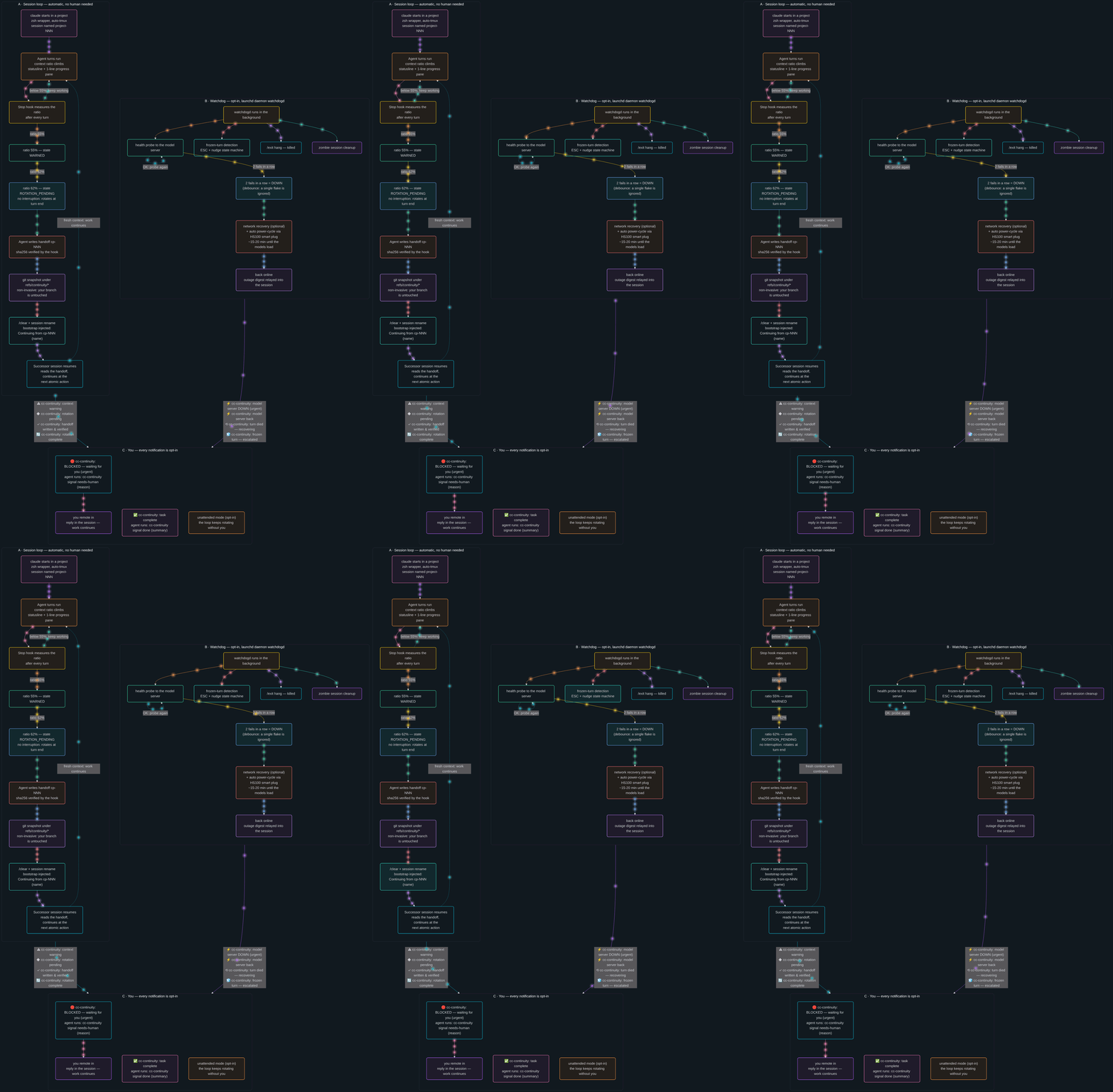
The whole flow in one picture: the automatic session loop, the optional
watchdog, and the opt-in notifications:
Demo
A full recorded run: install → five chained sessions → four context
rotations → a completed task, captured end to end. It is a long,
video-style GIF, so it is offered as a download rather than embedded
in the page:
- demo-high-res.gif — 896x1920, 20 fps (~20 MB)
- demo-low-res.gif — 700x1500, 12 fps (~12 MB)
The demo itself is recorded bytools/demo_gif.sh (it needs a local-model
endpoint in ANTHROPIC_* env); the cut list and the pipeline that
turned the recording into the GIFs are intools/demo_segments.txt andtools/gif_from_video.sh.
Requirements
- macOS, or Windows 10/11 with WSL (see Windows (via WSL))
- Python ≥ 3.11 (standard library only at runtime)
- tmux and curl on PATH; zsh on macOS (bash is fine on WSL)
- Claude Code ≥ 2.1.209
To verify your setup: cc-continuity doctor checks the Claude Code
version, and the WSL e2e script
(tools/e2e_wsl.sh) exercises the rotation/hook
path end to end.
Windows (via WSL)
cc-continuity runs inside a Windows Subsystem for Linux distro: the
Linux side is unchanged — same rotation, same watchdog, same ntfy
pushes — and only the daemon hosting differs. Where macOS uses
launchd, the distro uses a detached tmux session (default) or systemd
user units (WSL 2 with systemd enabled), plus one optional Windows
logon task so the daemons come back when the WSL VM restarts.
- WSL 2 recommended; WSL 1 works too (minus the systemd option).
- Ubuntu 24.04 recommended; Ubuntu 22.04 works with
python3.11
from deadsnakes. - Native Windows is out of scope — the distro is the runtime.
Full guide (requirements, install, watchdog, autostart,
troubleshooting): docs/WINDOWS.md. An end-to-end
test for the WSL install lives in tools/e2e_wsl.sh.
Quick start
From Git:
git clone https://github.com/pqant/claude-continuity
cd claude-continuity
python3 -m cc_continuity.cli install --window 262144
exec zsh                 # reload the shell (claude() wrapper)
cc-continuity doctor     # everything should be green
From PyPI:
pip install cc-continuity
cc-continuity install
exec zsh
cc-continuity doctor
On Windows (WSL) the same steps run inside the distro (bash as the
login shell); the full WSL guide is docs/WINDOWS.md.
The installer touches (all as identifiable managed blocks, all reversible
via cc-continuity uninstall): hooks + status line in~/.claude/settings.json, a managed block in ~/.claude/CLAUDE.md, theclaude() wrapper in ~/.zshrc, six /continuity-* skills, thecc-continuity launcher on PATH, and the app copy in~/.claude-continuity/app/. A timestamped backup ofsettings.json is written before any merge.
Daily use
cd ~/anything
claude                 # auto-tmux, session named <project>-001
Watch the status line: the context ratio climbs (default thresholds
55% warn → 62% rotate → 72% hard ceiling). Rotation is zero-touch
(quick-start list above). After a crash, sleep, or reboot: just runclaude in the project and say "continue".
In-session commands: /continuity-status, /continuity-checkpoint,/continuity-rotate, /continuity-off / /continuity-on,/continuity-history. Full CLI reference: docs/USAGE.md.
Configuration
Global: ~/.claude-continuity/config.json, start fromconfig.example.json (all keys, placeholder values). Per-project
override: .claude/continuity.json (e.g. {"enabled": false} to opt one
project out). CC_CONTINUITY=0 disables everything for one launch.
Notifications (ntfy, opt-in)
cc-continuity can push lifecycle events to any ntfy-compatible server, so
you can watch long unattended runs from your phone:
cc-continuity configure --ntfy https://ntfy.sh/your-topic   # or at install: --ntfy <url>
cc-continuity configure --ntfy off
cc-continuity doctor sends a test message to verify the endpoint.
| Event | Title | Meaning |
|---|---|---|
| start | ▶ session started |
a session registered itself (first hook or resume claim) |
| warn | ⚠ context warning |
ratio crossed the warning threshold |
| pending | ◆ rotation pending |
ratio crossed the hard threshold; rotates at turn end |
| verified | ✓ handoff written & verified |
checkpoint finalized, sha256 verified |
| complete | 🔄 rotation complete |
the successor session is running |
| resumed | ↻ resumed |
successor consumed the checkpoint |
| blocked | 🛑 BLOCKED, waiting for you |
agent hit a needs-human point (urgent) |
| done | ✅ task complete |
agent finished the task you gave it |
| error | ✗ … failed |
a lifecycle step failed (urgent) |
| end | ■ session ended |
SessionEnd (rotation, /clear, or close) |
Privacy: a push is a title + a body of at most 200 characters
containing only the project slug, session number, context ratio, a short
reason/summary you control, and the hostname. No file contents, no
prompts, no secrets; recorded text is secret-redacted on the way out.
Messages only ever go to the endpoint YOU configure, and only whennotify_enabled is on.
Unattended mode (opt-in)
⚠️ Loud warning:
launch --unattended(orconfig.json: "unattended": truefor a whole project) spawns the
session withclaude --dangerously-skip-permissions: the agent edits
files and runs commands without per-action approval. Use it only
on machines/projects you trust with that. Theneeds-humanmechanism
(below) is a signal the agent sends, not a permission boundary: it
enforces and blocks nothing. The default mode is unchanged; nothing
skips permissions unless you opt in.
claude --unattended            # via the zsh wrapper (one launch)
cc-continuity launch --unattended
cc-continuity configure --unattended    # project setting (whole chain)
Because a rotation is a /clear inside the same process, one flag (or
one project setting) carries the entire rotation chain: every successor
session stays unattended.
When it blocks on you
The agent signals you when it cannot safely continue (a
destructive/irreversible operation, an ambiguous requirement, the same
fix failing three times):
cc-continuity signal needs-human "<short reason>"
That pushes an urgent notification and marks the status line⛔ BLOCKED (machine-side truth, visible on any later attach). Remote
in to the pane, reply in the session; the block clears on your next
prompt. On completion the agent runs:
cc-continuity signal done "<one-line summary>"
Watchdog (opt-in)
A daemon that keeps long runs recoverable (launchd on macOS; a tmux
session or systemd user unit on WSL): a health probe for
your model server (2-fail debounce), per-session liveness classification,
a bounded nudge state machine (the session is told WHY its turn stopped),
an exit-hang killer, frozen-turn escalation, and optional auto
power-cycle of the box + a log digest relayed into the active session.
Off by default; the health URL is yours to supply. Details:docs/WATCHDOG.md.
Security
Read SECURITY.md before installing. It states the trust model: what
code runs with your rights, what the installer merges and how it
uninstalls, and what data ever leaves the machine.
Limitations
See LIMITATIONS.md (an honest list).
Development
python3 -m pytest -q # unit + contract tests
Tests redirect all state through CC_CONTINUITY_HOME (a temp dir) and
use throwaway git repos; they never touch the real~/.claude-continuity or ~/.claude. Architecture:docs/ARCHITECTURE.md.
License
MIT, see LICENSE.
Yorumlar (0)
Yorum birakmak icin giris yap.
Yorum birakSonuc bulunamadi