wallfacer
Health Warn
- License — License: MIT
- Description — Repository has a description
- Active repo — Last push 0 days ago
- Low visibility — Only 5 GitHub stars
Code Pass
- Code scan — Scanned 3 files during light audit, no dangerous patterns found
Permissions Pass
- Permissions — No dangerous permissions requested
No AI report is available for this listing yet.
A terminal session manager for Claude Code, and more
██╗    ██╗█████╗  ██╗     ██╗     ███████╗█████╗   ██████╗███████╗██████╗
██║    ██║██╔══██╗██║     ██║     ██╔════╝██╔══██╗██╔════╝██╔════╝██╔══██╗
██║ █╗ ██║███████║██║     ██║     █████╗  ███████║██║     █████╗  ██████╔╝
██║███╗██║██╔══██║██║     ██║     ██╔══╝  ██╔══██║██║     ██╔══╝  ██╔══██╗
╚███╔███╔╝██║  ██║███████╗███████╗██║     ██║  ██║╚██████╗███████╗██║  ██║
 ╚══╝╚══╝ ╚═╝  ╚═╝╚══════╝╚══════╝╚═╝     ╚═╝  ╚═╝ ╚═════╝╚══════╝╚═╝  ╚═╝
wallfacer
A terminal session manager for Claude Code,
Cursor CLI and Kiro CLI —
see every AI coding session you've ever started, then
name, tag, group, search, resume, or delete them, from a full-screen browser or straight
from the command line.


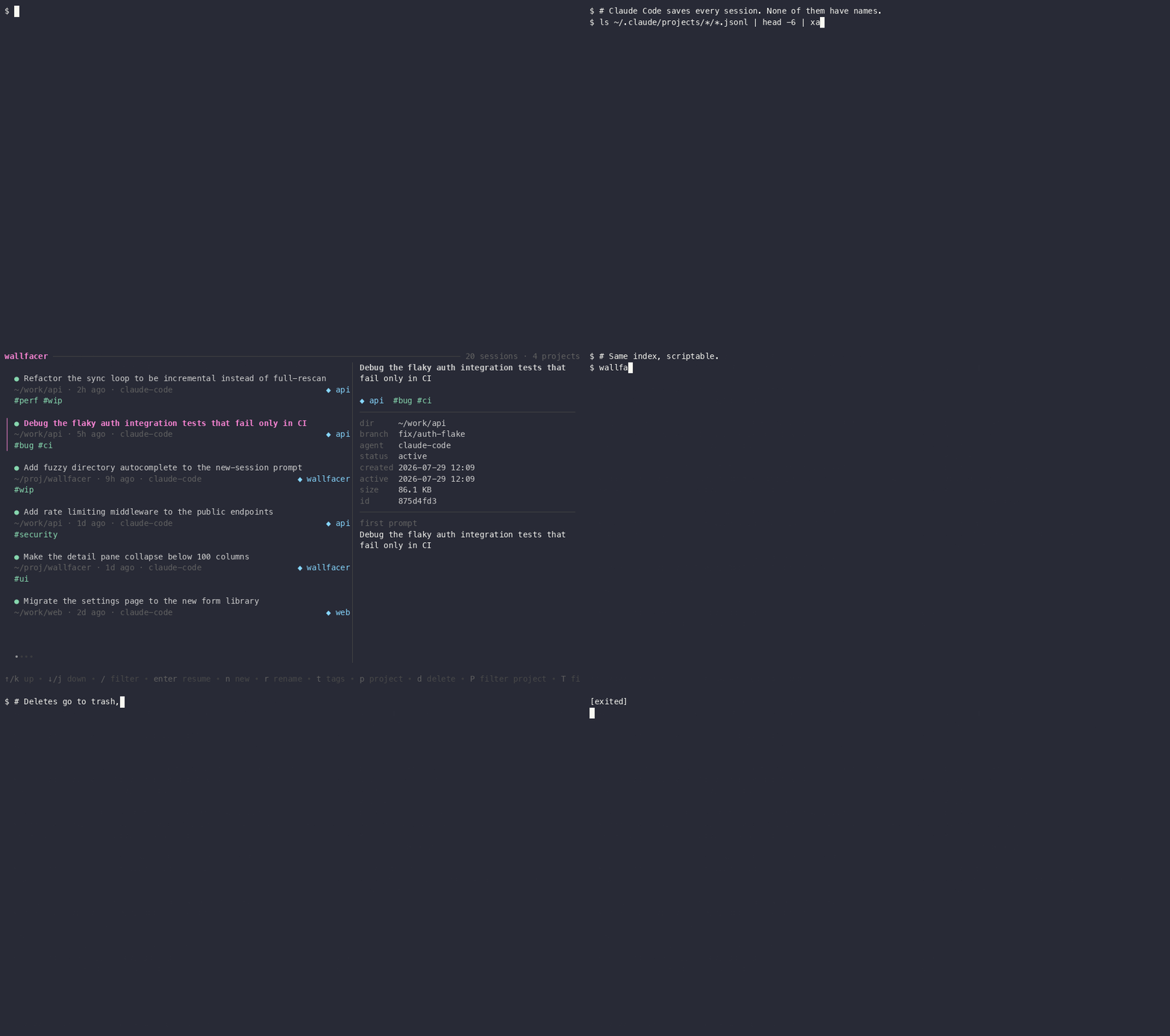
Why
Claude Code stores every conversation as an untitled JSONL file under ~/.claude/projects/,
keyed by whatever directory you were in. Kiro CLI does much the same in a single flat~/.kiro/sessions/cli/ folder, and Cursor CLI buries each chat in a hash-named directory
under ~/.cursor/chats/. After a few weeks you have dozens of transcripts, across three
agents, that you can't tell apart and no way to find the one you need.
wallfacer indexes them all — read-only, it never touches the agents' files — and keeps
your titles, tags, and projects in its own local SQLite database.
Features
- One view of everything — every session, from every directory and every agent, sorted by recency
- Organize — rename sessions, tag them, group them into projects
- Search — across titles, first prompts, directories, projects, and tags
- Launch & resume — start new sessions or jump back into old ones, from anywhere
- Multi-agent — Claude Code, Cursor CLI and Kiro CLI side by side; pick the agent when you
start a session, filter by it afterwards - Safe deletes —
rmmoves to trash; only--purgeis permanent - TUI and CLI — a full-screen browser for humans, subcommands +
--jsonfor scripts - Extensible — agents are pluggable adapters; Codex and opencode are on the roadmap
Install
go install github.com/pradipta/wallfacer@latest
Requires Go 1.22+. Pure Go, no CGO — macOS and Linux. Pre-built binaries are on the
releases page; building from source is
covered in the development guide.
Two ways to use it
wallfacer is one binary with two front ends, and which one you get depends on whether you
pass a subcommand:
| You type | You get |
|---|---|
wallfacer |
The TUI — a full-screen, interactive session browser. Start here. |
wallfacer <command> |
The CLI — one-shot subcommands for scripts and muscle memory. |
They are not separate tools and there is nothing to switch between: both read and write the
same SQLite index, so a session you tag in the browser is immediately findable bywallfacer list --tag, and vice versa. Anything the TUI can do, a subcommand can do too.
(If stdout isn't a terminal — wallfacer | less, or inside a script — the bare command
prints help instead of opening the browser.)
Quick start
Open the browser and work from there:
wallfacer
Or drive it from the shell:
wallfacer new ~/work/api --title "Fix flaky auth tests"
wallfacer resume "fix flaky auth tests"    # by title or ID prefix
wallfacer search auth
wallfacer list --project api --json        # for scripts
The TUI — wallfacer
Bare wallfacer opens a full-screen session browser: a list on the left, and a detail
pane on the right showing everything wallfacer show prints for whatever is highlighted.
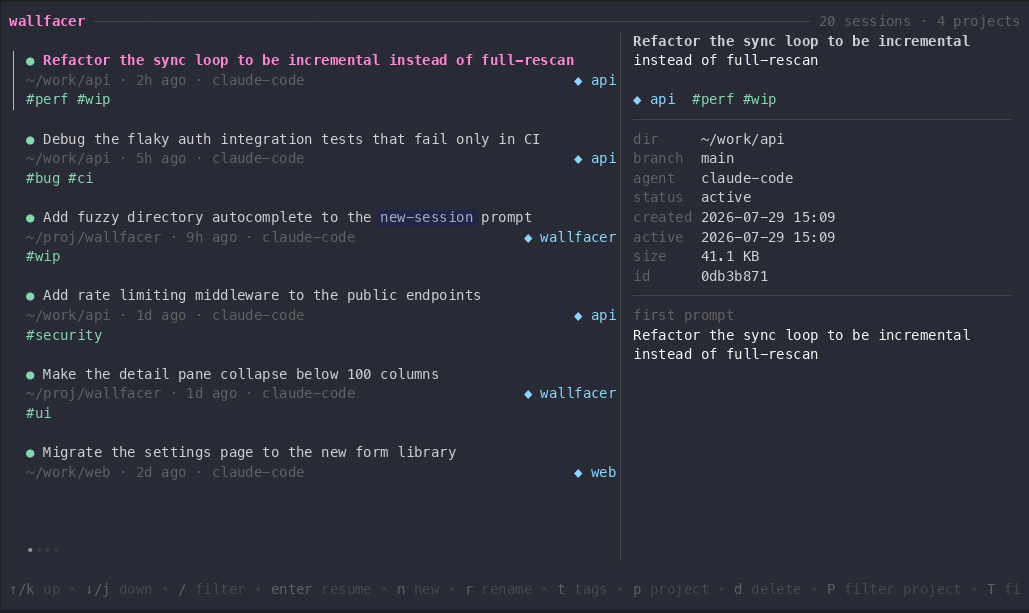
Every row shows its project, tags, directory, age and agent — the same metadatawallfacer list prints. Below ~100 columns the detail pane steps aside and the list
takes the full width.
| Key | Action |
|---|---|
↑/↓ j/k |
move |
/ |
fuzzy filter across titles, projects, dirs and tags |
P / T / A |
cycle the project / tag / agent filter (wraps back to unfiltered) |
x |
clear the project, tag and agent filters |
tab |
show or hide the detail pane |
enter |
resume — the terminal is handed to the agent; the browser returns when you exit |
n |
new session (asks for the agent, then directory, title, project, tags) |
r / t / p |
rename / edit tags / set project |
d |
delete → trash, with confirmation |
? / q |
help / quit |
The agent step comes first and is a one-line picker: ←/→ or a digit to choose, enter to
go on, esc to back out. Claude Code is preselected, and the step is skipped entirely if only
one adapter is registered.
The CLI — wallfacer <command>
Every subcommand is one-shot: it runs, prints, and exits. Same index as the browser.
| Command | What it does |
|---|---|
wallfacer |
(no subcommand) Open the interactive browser |
wallfacer new [dir] [--agent A] [--title T] [--project P] [--tag t] |
Start a new session in a directory |
wallfacer resume <ref> |
Reopen a session in its original directory |
wallfacer list [--project P] [--tag T] [--agent A] [--json] |
List sessions, newest first |
wallfacer search <query> |
Search titles, prompts, dirs, projects, tags |
wallfacer show <ref> |
Full details of one session |
wallfacer rename <ref> <title> |
Rename a session |
wallfacer tag add|rm <ref> <tag>… |
Add or remove tags |
wallfacer project set|clear <ref> |
Group sessions into a project |
wallfacer rm <ref> [--purge] [-f] |
Trash a session (--purge deletes permanently) |
wallfacer sync |
Rescan disk (runs automatically before every command) |
<ref> is an ID prefix (resume 5f2) or an exact title (resume "smoke test") — ambiguous
references list the candidates instead of guessing. Sessions started outside wallfacer are
picked up automatically; there's no import step.
How it works
wallfacer scans ~/.claude/projects/, ~/.cursor/chats/ and ~/.kiro/sessions/cli/, reading
just the head of each session file for its working directory, timestamps, and first prompt (the
automatic title). Every agent's listing carries the agent type, so wallfacer list shows anAGENT column and --agent narrows to one. Your metadata lives in SQLite at~/.local/share/wallfacer/ — delete it and you lose only the overlay, never a conversation.
Sync is incremental, so it stays fast with hundreds of sessions.
rm moves a session to wallfacer's trash. For agents that spread one session over several
files — Kiro CLI writes a transcript plus a metadata sidecar, prompt history and a scratch
directory, and Cursor CLI splits a chat between its own directory and a transcript filed under
the project — the whole set travels together, so a deleted session doesn't linger in the
agent's own session picker.
Other agents plug in through a small adapter interface — see
docs/adding-an-agent.md.
Roadmap
- Adapters for Claude Code, Cursor CLI and
Kiro CLI - Adapters for more agents: Codex,
opencode - A preferred-agent setting, so the picker's default is yours to choose
- Full-text search across session content (SQLite FTS5)
-
wallfacer restore(un-trash from the CLI) - Export a session transcript to Markdown
- Stats (sessions per project/week, disk usage)
- Desktop app — sessions in a sidebar, embedded terminal, multiple tabs
(Wails + xterm.js on top of the same Go internals)
Contributing
See the development guide for building, testing, and releasing.
Contributions welcome — especially new agent adapters.
License
The name is borrowed from the Wallfacers of Liu Cixin's The Dark Forest — people entrusted
with plans too sprawling for anyone else to follow.
Reviews (0)
Sign in to leave a review.
Leave a reviewNo results found