evolving-agent-harnesses
Health Pass
- License — License: MIT
- Description — Repository has a description
- Active repo — Last push 0 days ago
- Community trust — 11 GitHub stars
Code Pass
- Code scan — Scanned 12 files during light audit, no dangerous patterns found
Permissions Pass
- Permissions — No dangerous permissions requested
No AI report is available for this listing yet.
Evolving agent harnesses: a research program on how far N orchestrated calls of a small model can rival a frontier model. We evolve the harness (structure + prompts) with reflective optimizers + a verified-acceptance gate.
Self-Improving Agent Harnesses
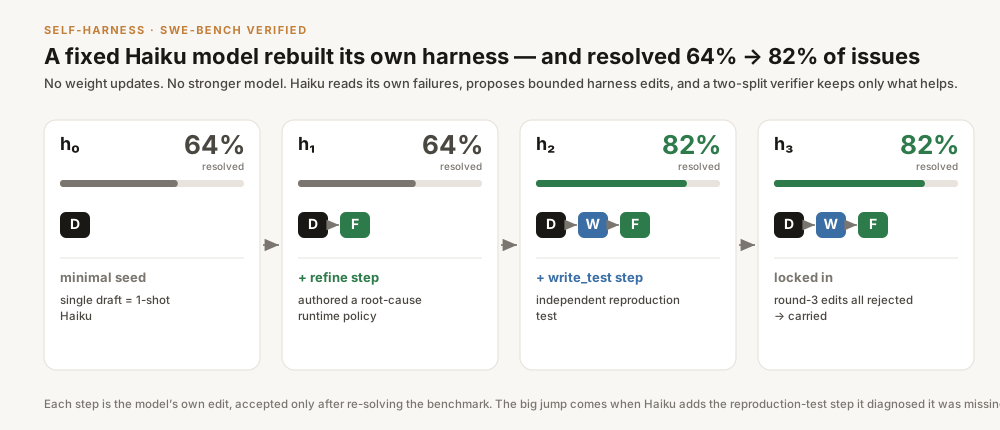
A fixed small model rewrote its own harness and lifted SWE-bench resolution 64% → 82% — no weight updates, no stronger model
Give Claude Haiku a minimal one-step harness and let it read its own execution failures. It diagnoses what its scaffold is missing, proposes bounded edits to that scaffold, and a verifier keeps only what helps — rebuilding itself from a single draft into a draft → write_test → fix loop and resolving 18 → 23 of 28 issues (+28%).
In one paragraph
The model's weights are frozen — we can't change what Haiku knows. But we can change everything around it: how many times it's called, in what order, what it's told at each step, when it must write a test or re-check its work. That wrapper is the harness. Normally a human designs it. Here, the model reads its own mistakes and redesigns its own harness — and gets measurably better at fixing real GitHub bugs, with no training at all.
TL;DR
This is Self-Harness (Zhang et al. 2026) on SWE-bench Verified: the same fixed model improves the harness it runs inside — no fine-tuning, and (unlike GEPA / Meta-Harness) no stronger external model doing the improving. Starting from a bare single draft, Haiku ran three rounds of mine your failures → propose a bounded harness edit → keep it only if it verifiably helps, and grew the exact draft → write_test → fix structure a human would design.
| Round | Harness | Issues resolved (of 28) | The model's own edit |
|---|---|---|---|
| h₀ | draft |
18 · 64% | minimal seed (= 1-shot Haiku) |
| h₁ | draft → fix |
18 · 64% | + a refine step & a root-cause runtime policy |
| h₂ | draft → write_test → fix |
23 · 82% | + an independent reproduction-test step |
| h₃ | draft → write_test → fix |
23 · 82% | round-3 edits all rejected → carried forward |
Full writeup + receipts: cc_swe/SELF_HARNESS.md and cc_swe/results/self_harness/.
The benchmark: SWE-bench Verified
SWE-bench Verified is 500 real, human-validated GitHub issues from widely-used open-source Python libraries. Each task hands the model a genuine bug report or feature request (the actual issue text) plus the repository checked out at the commit just before the fix. The model must produce a code patch that resolves it — and the grading is done by the repository's own hidden unit tests, not by an LLM judge:
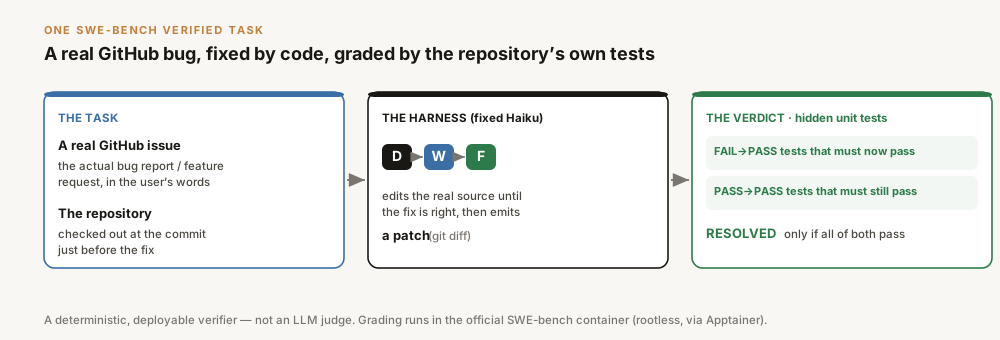
- FAIL → PASS: tests that failed before and must now pass (the bug is actually fixed).
- PASS → PASS: tests that already passed and must still pass (nothing else broke).
- A task is resolved only if every test in both sets passes. This unambiguous, deployable verifier is exactly what makes a harness gain measurable — there's no grader to fool.
The slice we use. We draw from seven light, deterministic-to-grade libraries — flask, pylint, pytest, sphinx, sympy, seaborn, xarray — at natural difficulty (excluding tasks with flaky or network-dependent tests). This run's set is 28 issues: pytest 6 · sphinx 6 · sympy 6 · pylint 4 · xarray 4 · seaborn 1 · flask 1 (17 rated "15 min – 1 hour", 11 "< 15 min" by SWE-bench's human annotators). The model edits a real checkout; we derive its patch with git diff and run the hidden tests inside the official SWE-bench container (rootless, via Apptainer) for a faithful, reproducible verdict.
A concrete task. pylint-dev__pylint-6528 — "Pylint does not respect --ignore in --recursive=y mode." The fix must make recursive linting honor the ignore settings. It's graded by 4 FAIL→PASS tests (the ignore behavior now works) plus 171 PASS→PASS tests (the rest of pylint still works). Haiku's evolved draft → write_test → fix harness resolves it; a bare single draft does not.
The loop: one model plays every role
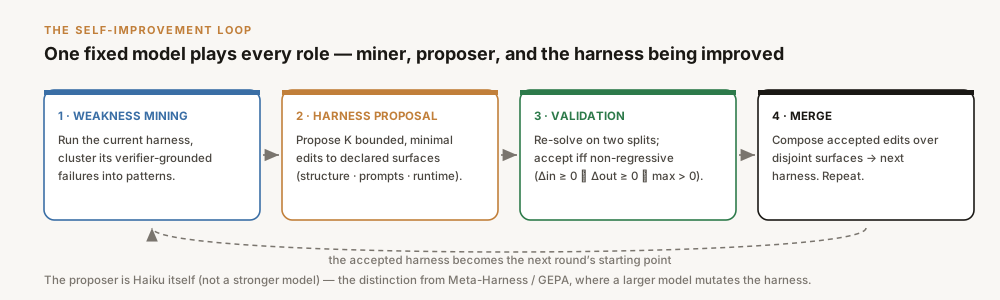
The proposer is Haiku itself, not a larger model — that's the distinction from our earlier BattleSnake study (and from GEPA / Meta-Harness), where a stronger Sonnet mutates the harness. Here the model that runs the harness is the same one that diagnoses and repairs it.
Why it works: correct self-diagnosis → correct self-repair
The trajectory isn't a lucky walk. Each round's mined failure pattern correctly motivates the next structural addition, in the order a human designer would add them:
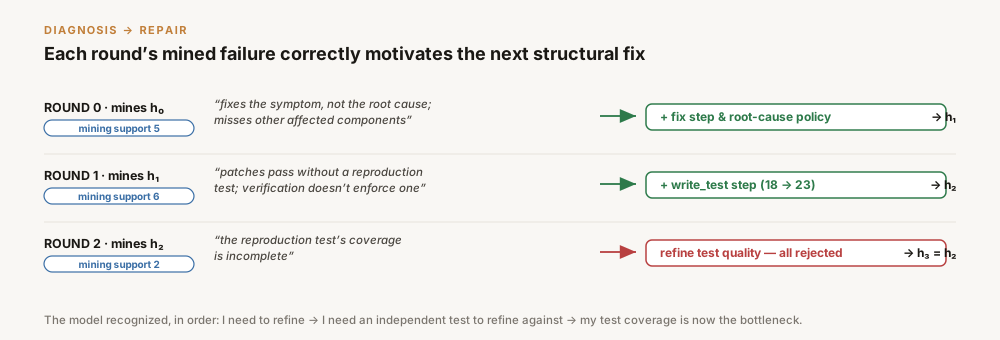
The model recognized, unaided and in sequence: I need to refine → I need an independent test to refine against → my test coverage is now the bottleneck.
What actually evolved
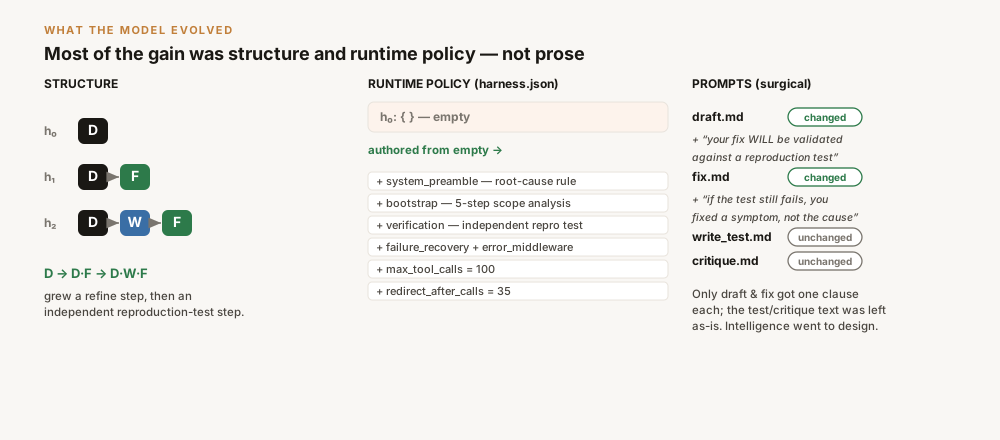
Most of the improvement was structure and runtime policy, not prose. From an empty harness.json, Haiku authored a whole root-cause discipline (a global preamble, a 5-step scope-analysis bootstrap, an independent-reproduction-test verification spec, symptom-vs-root-cause failure recovery, and tool-call bounds). The per-role prompts it barely touched — only draft and fix got one appended clause each.
How it's built
| Piece | Where |
|---|---|
Self-Harness controller — minimal-harness init, the two-split non-regression gate (accept iff Δin ≥ 0 ∧ Δout ≥ 0 ∧ max > 0), disjoint-surface merge |
cc_swe/control_selfharness.py |
| The loop — Haiku miner → K=3 Haiku proposers → dual-split solve → gate → merge (resumable, cap-guarded) | cc_swe/workflow_swe_selfharness.js |
Solving / scoring — SWE-bench Verified via Apptainer, TRUE FAIL_TO_PASS + PASS_TO_PASS resolution |
cc_swe/control_swe.py, cc_swe/swe_harness.py |
Writeup + receipts — trajectory, per-round mining diagnoses, every proposal + gate verdict, evolved harness.json & prompt diffs |
cc_swe/SELF_HARNESS.md · cc_swe/results/self_harness/ |
Runs on Claude Dynamic Workflows — parallel agent orchestration with structured outputs.
Caveats (scope of the claim)
- The 64% → 82% gain is on the held-in set. On a separately-curated held-out set the evolved champion does not separate from 1-shot Haiku — so this demonstrates the mechanism (correct self-diagnosis → correct self-repair, unaided), not a generalization or frontier-beating result.
- The in-loop gate ran at R=1; the structural trajectory is robust, but individual per-round resolution deltas carry single-draw noise.
Earlier result — evolving harnesses on BattleSnake (small × N beats the frontier)
The project's first study asked a related question with a stronger optimizer: can a Sonnet-driven evolutionary search find a Haiku harness that beats a frontier model? Yes — an evolved 8-call Haiku harness (draft ×4 → fix ×4) reaches 0.719 ladder win-rate, beating single-shot Opus (0.522) and Sonnet (0.442), under a verified-acceptance gate and honest, de-inflated evaluation.
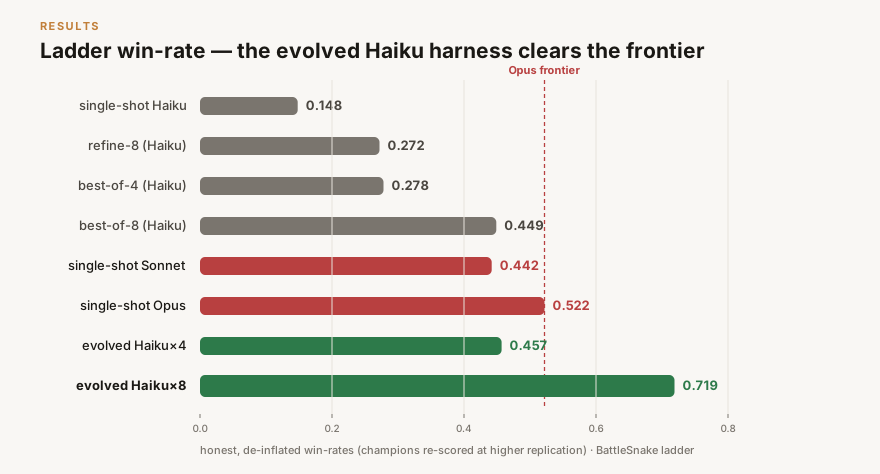
Key lessons that carried into Self-Harness: diversify-then-refine beats naive refinement or sampling; selection inflation is large (~0.1–0.3) and must be de-inflated with an independent higher-replication re-eval; and the harness benefit needs a deployable verifier and a beatable frontier.
→ Full BattleSnake study: battlesnake/README.md · honest results record: results/RESULTS.md.
What's in here
| Path | What |
|---|---|
cc_swe/ |
Self-Harness on SWE-bench Verified — controller, the self-improvement workflow, the Apptainer solving backend, the writeup + receipts |
battlesnake/ |
The earlier BattleSnake harness-evolution study (evolved Haiku×8 beats Opus/Sonnet) |
cc_pipe/, cc_core/, cc_gepa/, cc_decomp/, cc_prompt/ |
Shared library + the BattleSnake experiment code (simulator, ladder, harness/store/scoring, GEPA & CORE optimizers, verified-acceptance gate) |
results/ |
The honest, de-inflated BattleSnake results record |
assets/ |
Figures (self_harness/ = the infographics above) |
Reproduce
pip install -r requirements.txt
# Self-Harness on SWE-bench Verified (Haiku improves its own harness):
#   see cc_swe/control_selfharness.py + cc_swe/workflow_swe_selfharness.js
# BattleSnake harness evolution (Sonnet evolves a Haiku harness):
#   see battlesnake/README.md + cc_pipe/
Built with Claude Code + Claude Dynamic Workflows.
Reviews (0)
Sign in to leave a review.
Leave a reviewNo results found