preciso-graphrag
Health Uyari
- License — License: Apache-2.0
- Description — Repository has a description
- Active repo — Last push 0 days ago
- Low visibility — Only 5 GitHub stars
Code Gecti
- Code scan — Scanned 12 files during light audit, no dangerous patterns found
Permissions Gecti
- Permissions — No dangerous permissions requested
Bu listing icin henuz AI raporu yok.
Agent-first GraphRAG workflow that turns local documents into reusable knowledge graphs. Drop files in, let skills extract entities and relationships, then query a persistent graph artifact locally—no cloud or pipeline setup required also the graph can be exported to neo4j and qdrant for deployment
Preciso
Precise knowledge graphs from your documents.
Named after Bruno Fernandes. Every pass lands exactly where it needs to.







Most RAG tools retrieve documents.
Preciso builds a knowledge graph — so your agent can reason across connections, not just find similar text.
Documents → Agent picks skill → Extraction JSON → MCP ingest → Local graph
Drop source files into to_be_extracted/. An agent reads them, extracts entities and relationships using domain-specific skills, and persists a queryable knowledge graph locally in GRAPH_IS_HERE/. No cloud required. No pipeline to configure.
Why GraphRAG Over Regular RAG?
Regular RAG:
"What are Apple's risk factors?"
→ returns the Risk Factors section text
Preciso:
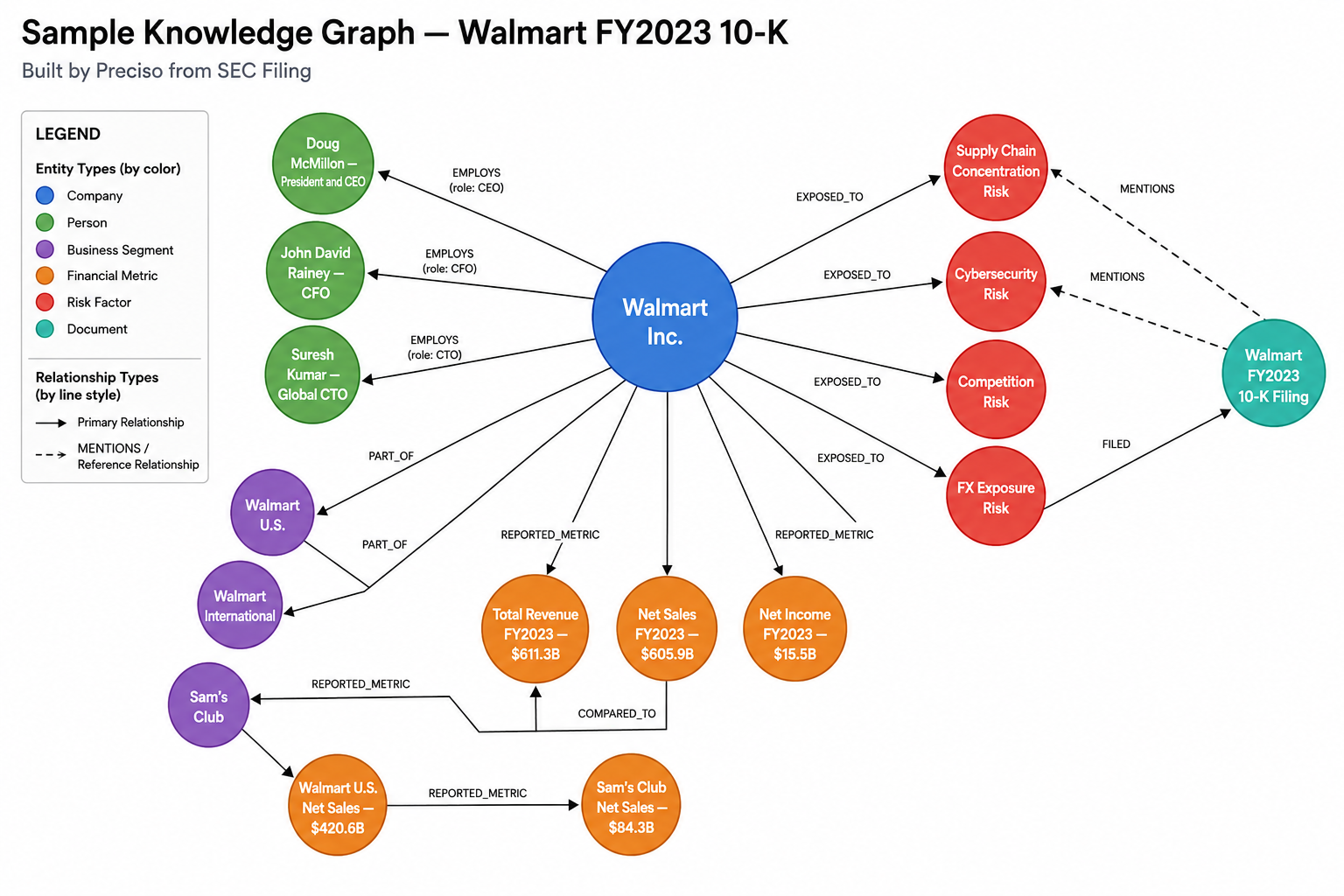
"What are Apple's risk factors and which executives are responsible for managing them?"
→ traverses RISK_FACTOR → EXPOSED_TO → COMPANY → EMPLOYS → PERSON
→ returns a connected answer with evidence
The graph makes multi-hop reasoning possible.
Benchmark Results
Tested on 23 financial QA questions from Walmart FY2022 + FY2023 10-K filings, scored on four dimensions:
| Metric | Score |
|---|---|
| Context Relevancy | 0.983 |
| Faithfulness | 1.000 |
| Answer Correctness | 0.960 |
| Precision | 0.910 |
| Preciso Score | 95 / 100 |
- Hallucinations: 0 / 23
- Failed questions: 0 / 23
| System | Score |
|---|---|
| Preciso | 95.4% |
| GPT-4 + long context (79k tokens) | ~79% |
| GPT-4 + standard RAG | ~19% |
See docs/eval-guide.md for full methodology and multi-hop breakdowns.
Quickstart (3 Minutes)
1. Clone and install
git clone https://github.com/Preciso-GR/preciso-graphrag
cd preciso-graphrag
python3 -m venv .venv
source .venv/bin/activate
pip install -r requirements.txt
Requires Python 3.11+, a local virtualenv at
.venv, and the agent opened from the repo root.
2. Drop files into to_be_extracted/
Best inputs: .md, .txt, README files, wiki exports, notes.
For PDFs: convert to
.mdfirst, or use Claude Code / Codex which can read PDFs natively.
3. Run this prompt in your agent
Open Codex, Claude Code, Copilot, or OpenCode from the repo root.
Quick version:
Process the files in to_be_extracted/ using Preciso.
Call get_server_status().
If overall is ready, proceed.
If overall is degraded, explain what is degraded, what still works,
and ask whether to proceed or fix first.
Read the files in to_be_extracted/.
Choose the most appropriate extraction skill from the skills folder for each file.
Extract entities, relationships, and chunks into extractions/{source_name}_extracted.json.
Validate that every source_id maps to a real chunk_id and that all relationships
reference defined entities.
If the extraction looks clean, call ingest_from_file for each generated extraction file.
If you find duplicate entities, orphaned relationships, or conflicts,
use the reconciliation skill before ingestion.
Confirm the graph artifacts written to GRAPH_IS_HERE/ and summarize what was ingested.
How It Works
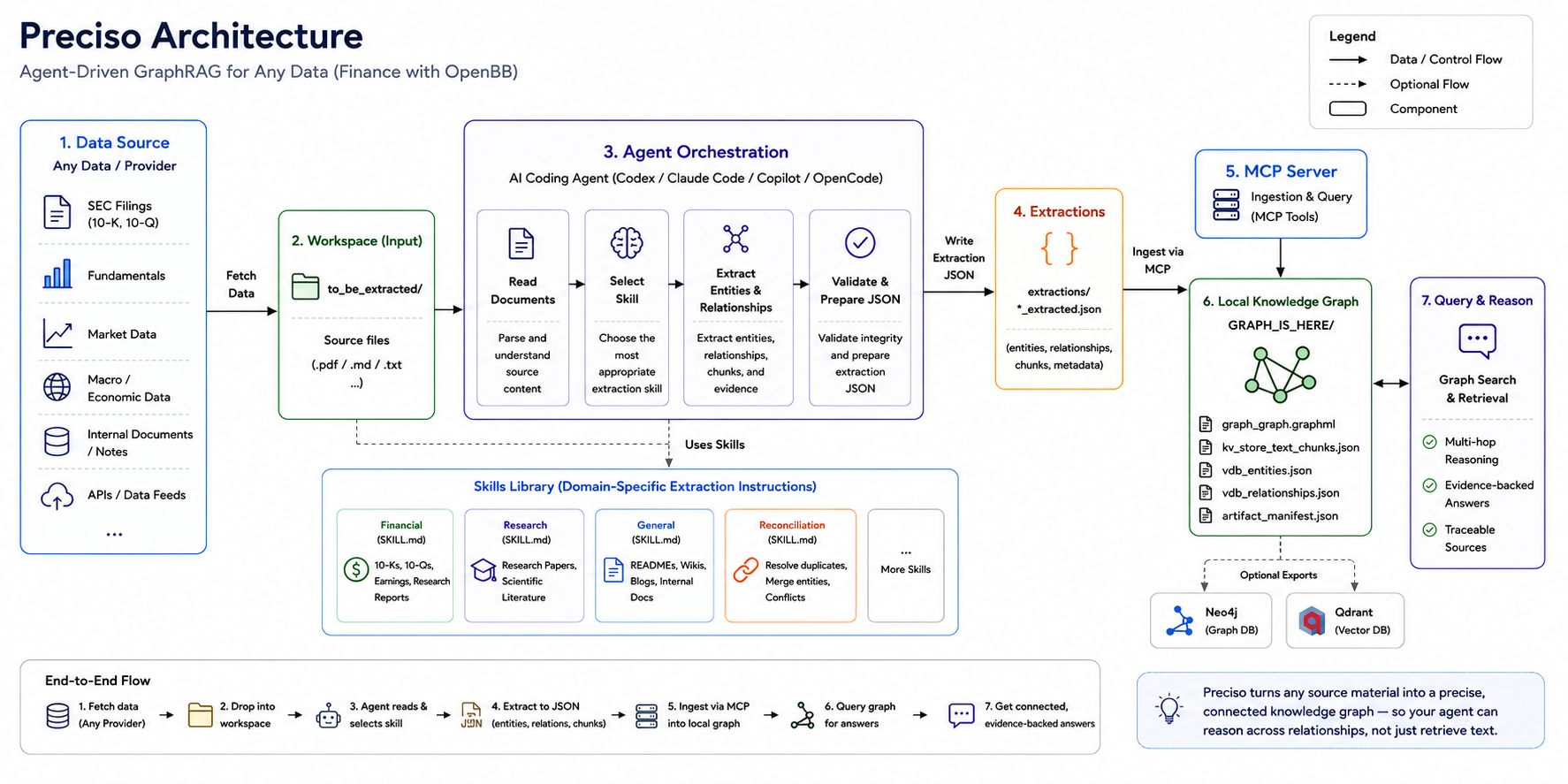
Six steps, always in this order:
| Step | Who | What happens |
|---|---|---|
| 1 | You | Drop source files into to_be_extracted/ |
| 2 | Agent | Reads the files |
| 3 | Agent | Selects the right skill from skills/ |
| 4 | Agent | Writes extractions/{source_name}_extracted.json |
| 5 | Agent | Calls the MCP ingestion tool |
| 6 | Preciso | Persists graph in GRAPH_IS_HERE/ — queryable immediately |
Folder Contract
to_be_extracted/    ← drop your source files here (.md, .txt)
skills/             ← agent reads these to know how to extract
extractions/        ← agent writes extraction JSON here
GRAPH_IS_HERE/      ← graph artifacts live here (source of truth)
docs/               ← guides and architecture reference
evals/              ← benchmark test cases and results
Skill Selection
| Skill | Path | Use When |
|---|---|---|
| Financial | skills/Financial-Graph-Extraction/SKILL.md |
10-Ks, 10-Qs, earnings calls, analyst reports |
| Research | skills/Research-paper-graph-extraction-skill/SKILL.md |
Research papers, scientific literature, academic corpora |
| General | skills/General-graph-extraction-skill/SKILL.md |
Codebases, READMEs, wikis, internal docs |
| Reconciliation | skills/Reconciliation-Subagent-Skill/SKILL.md |
Cleanup of existing extraction JSON only |
| Eval | skills/Eval-Skill/SKILL.md |
Evaluating a built graph — not for extraction |
MCP Tools
| Tool | Description |
|---|---|
get_server_status |
Runtime health check — call before anything |
ingest_from_file |
Ingest a completed extraction JSON file |
reingest_from_file |
Retry ingestion without re-extracting |
ingest_graph_tool |
Ingest an inline extraction payload |
ingest_with_reconciliation_tool |
Ingest after reconciliation subagents finish |
query_graph_tool |
Query the persisted graph |
export_graph_to_neo4j |
Optional: push graph structure to Neo4j |
export_vectors_to_qdrant |
Optional: push vector artifacts to Qdrant |
Runtime Status
Always call get_server_status() first. It reports embedding mode, graph health, and LLM config before any work starts.
{
  "overall": "ready",
  "warnings": [],
  "embedding": {
    "mode": "local",
    "provider": "ollama",
    "model": "mxbai-embed-large",
    "dimension": 768,
    "status": "active"
  },
  "graph": {
    "storage": "networkx",
    "entities": 142,
    "relationships": 281,
    "documents_ingested": 1,
    "chunks": 96
  },
  "llm": {
    "configured": true,
    "status": "active"
  }
}
{
  "overall": "degraded",
  "warnings": [
    "Fallback embeddings active — graph creation works, vector search quality reduced.",
    "LLM summarization not configured — extraction works, summary generation skipped."
  ],
  "embedding": { "mode": "fallback", "status": "degraded" },
  "llm": { "configured": false, "status": "inactive" }
}
If overall is degraded, the agent explains what still works and asks before proceeding. It never silently continues.
What You Can Query After Ingestion
"What are Apple's top 5 disclosed risk factors?"
"Which executives are connected to the supply chain risks?"
"What metrics declined year over year?"
"How does the Services segment relate to overall revenue?"
The graph connects entities across document sections so your agent gets reasoned answers, not retrieved chunks.
Graph Artifacts
After ingestion the graph persists in GRAPH_IS_HERE/ and is reusable across sessions:
GRAPH_IS_HERE/
├── graph_graph.graphml              ← most portable artifact
├── kv_store_text_chunks.json
├── kv_store_entity_chunks.json
├── kv_store_relation_chunks.json
├── vdb_entities.json
├── vdb_relationships.json
├── vdb_chunks.json
└── artifact_manifest.json
The most portable artifact is graph_graph.graphml. Copy the whole folder to move the graph to another machine.
Downstream Exports (Optional)


GRAPH_IS_HERE/ is always the source of truth. Neo4j and Qdrant are optional downstream copies — not storage backends.
Local graph (master) → optional → Neo4j copy
Local graph (master) → optional → Qdrant copy
Think of it like a Google Doc you export to PDF. The Doc is the real thing. The PDF is a snapshot for sharing. If you re-ingest locally, the local graph updates. Downstream copies do not auto-update — you re-export when ready.
Neo4j export config{
"uri": "bolt://localhost:7687",
"username": "neo4j",
"password": "your-password",
"database": "neo4j",
"workspace": "default",
"clear_existing": false
}
Required env vars: GRAPHRAG_NEO4J_URI, GRAPHRAG_NEO4J_USERNAME, GRAPHRAG_NEO4J_PASSWORD
{
  "url": "http://localhost:6333",
  "api_key": null,
  "collection_prefix": "preciso",
  "workspace": "default",
  "clear_existing": false
}
Required env vars: GRAPHRAG_QDRANT_URL, optionally GRAPHRAG_QDRANT_API_KEY
See docs/getting-started.md for full export setup including .env configuration.
MCP Setup
.mcp.json uses a repo-local launcher that finds the right Python automatically:
{
  "mcpServers": {
    "graphrag-mcp": {
      "type": "stdio",
      "command": "/bin/sh",
      "args": ["scripts/mcp_launcher.sh"],
      "cwd": ".",
      "tools": ["*"]
    }
  }
}
Manual Fallback
For users who want to drive ingestion and querying directly without an agent:
# Ingest an extraction file
python3 test/ingest_manual.py extractions/your_file_extracted.json

# Query the graph
python3 test/query_manual.py "What is Tim Cook's role?" mix

# Run reconciliation demo
python3 test/reconcile_manual.py
Docs
| Guide | What it covers |
|---|---|
| docs/getting-started.md | Full setup including embeddings and exports |
| docs/skills-guide.md | How to use and write extraction skills |
| docs/eval-guide.md | How to run evaluation and read results |
| docs/architecture.md | How the system works internally |
| docs/faq.md | Common problems and fixes |
Current Limitations
- Best input format is
.mdor.txt— PDF handling depends on external conversion or a native PDF-capable agent - Retrieval quality depends on embedding configuration
- Neo4j and Qdrant exports require those services running externally
- Single-user local workflow — no built-in multi-user or shared graph support yet
License
Licensed under the Apache License, Version 2.0. See LICENSE for full terms.
The extraction pipeline, skills system, MCP tooling, reconciliation layer, and evaluation framework are original work licensed under Apache 2.0.
Yorumlar (0)
Yorum birakmak icin giris yap.
Yorum birakSonuc bulunamadi