penguin-harness
Health Uyari
- License — License: Apache-2.0
- Description — Repository has a description
- Active repo — Last push 0 days ago
- Low visibility — Only 7 GitHub stars
Code Basarisiz
- rm -rf — Recursive force deletion command in .github/workflows/release.yml
- rm -rf — Recursive force deletion command in install.sh
- process.env — Environment variable access in packages/cli/src/commands/config.ts
- process.env — Environment variable access in packages/cli/src/commands/serve.ts
- network request — Outbound network request in packages/cli/src/commands/serve.ts
Permissions Gecti
- Permissions — No dangerous permissions requested
Bu listing icin henuz AI raporu yok.
Efficient Self-Improving Harness for Everyone

PenguinHarness
Efficient Self-Improving Harness for Everyone
Open-source, local-first infrastructure that builds AI agents for you — from automatic agent construction to recursive self-improvement.




English | 简体中文 · Website · Docs · Blog
Why PenguinHarness
- Simplest Is the Best — a deliberately minimal toolset over clean low-level interfaces: fewer tool calls, fewer tokens, complex tasks done efficiently.
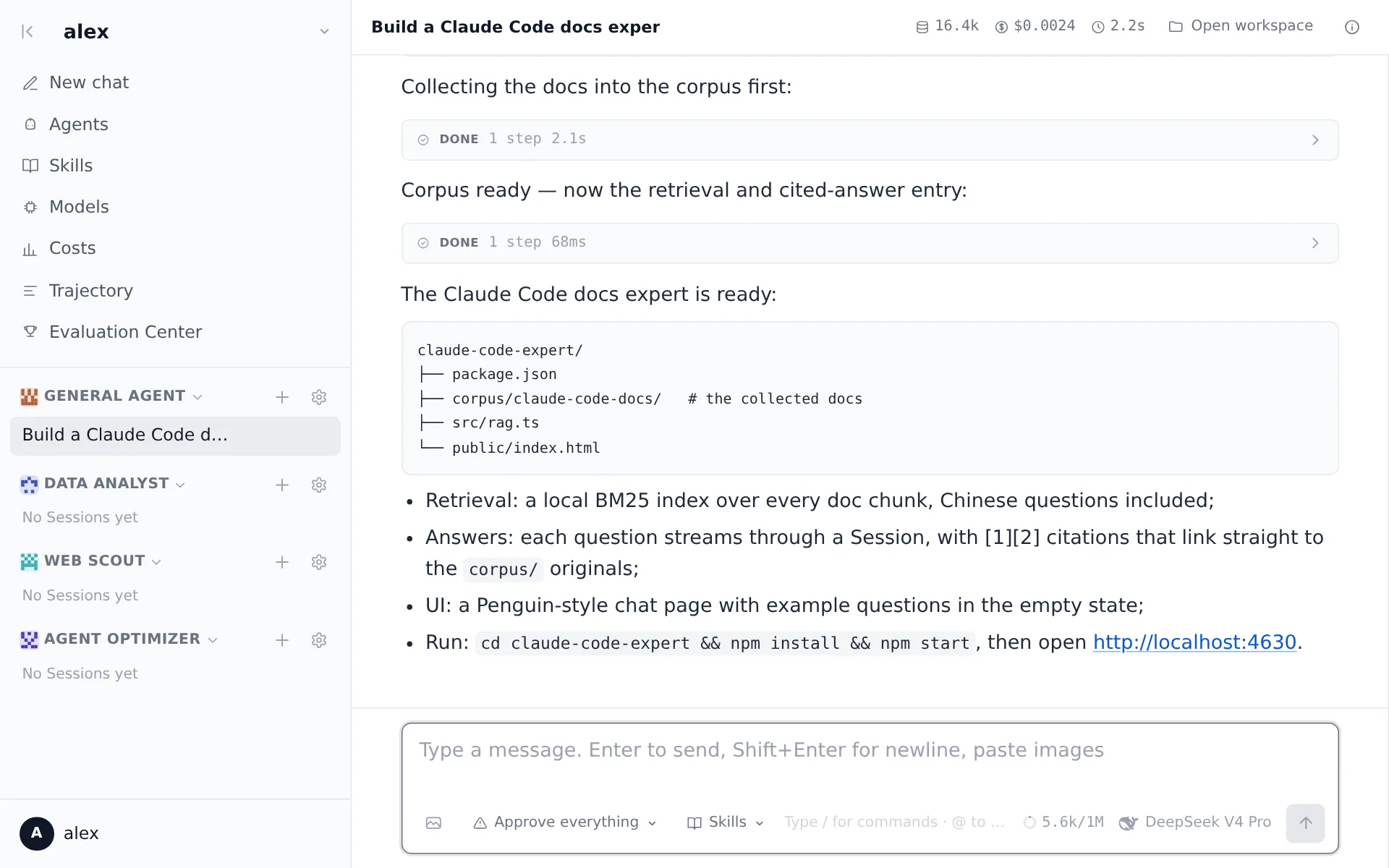
- Harness for Building Agents — with the PenguinHarness SDK, an Agent builds complete Agent applications for you, autonomously, from scratch.
- Harness for Recursive Self-Improvement — with PenguinHarness Skills, an Agent evaluates and optimizes itself: benchmark, find the lost points, ship version N+1, snapshot before every round.
- Local-first and lightweight — 100% open source, runs on a single CPU, your data never leaves the machine. 1000+ online and local models reachable through one gateway.
- Everything observable — every request, tool call and approval decision lands in an append-only Trace; any Session can be resumed from it.
Quickstart
Install with one command (Linux / macOS, x64 / arm64, bundled Node runtime):
curl -fsSL https://github.com/Prism-Shadow/penguin-harness/releases/latest/download/install.sh | sh
Or via npm (requires Node >= 24; the command it installs is penguin):
npm install -g @prismshadow/penguin-cli
Then launch the Web App — or stay in the terminal:
penguin web        # start the service and open http://127.0.0.1:7364 (first login: admin / admin123)
penguin server     # same service, headless

# configure a model once (or use the in-app Models page)
penguin config model add --model-id deepseek-v4-pro --api-key sk-... --set-default

penguin run -m "Create hello.txt containing Hello, Penguin"   # one-shot task
penguin chat       # interactive REPL (/compact, /exit, Ctrl-C to interrupt)
Using the SDK directly:
import { createAgent, isCompleteModelMessage, userText } from "@prismshadow/penguin-core";

const agent = await createAgent({ agentId: "default_agent" });
const session = await agent.createSession({ workspaceDir: process.cwd() });

for await (const output of session.run([userText("Create hello.txt containing hi")], {
  approve: async () => "allow", // per-tool-call approval
})) {
  if (isCompleteModelMessage(output) && output.payload.type === "text") {
    console.log(output.payload.text);
  }
}
What's inside
A pnpm monorepo (TypeScript, Node >= 24). One install ships four layers that share a single data directory (~/.penguin/data) and a single message protocol (OmniMessage):
| Package | Name | Role |
|---|---|---|
packages/core |
@prismshadow/penguin-core |
SDK & engine: ReAct loop, OmniMessage protocol, LLM/Environment interface contracts, Agent State, Trace |
packages/cli |
@prismshadow/penguin-cli |
The penguin command: REPL, one-shot runs, model & vault config, service launcher |
packages/server |
@prismshadow/penguin-server |
Web backend: HTTP API + SSE streaming, multi-user auth, Project authorization, usage stats |
packages/web |
@prismshadow/penguin-web |
Web App: multi-session chat, Agent/skill/model management, Trace observability, evaluation center |
packages/skills |
@prismshadow/penguin-skills |
Built-in skill library (agent creation, benchmarking, evaluation, optimization, …) |
packages/landing |
— | Product landing page (this repo's website) |
packages/docs |
— | Documentation site (bilingual, deployed under /docs/) |
Responsibilities split by source of truth: the SDK owns protocol and execution (message parsing, the agent loop, tools), the Server owns the multi-user runtime (auth, SSE streaming, scheduled tasks), and the file layer under ~/.penguin/data owns everything editable and recorded (prompts, Skills, secrets, Traces). The full design-by-design map is in Architecture → Division of responsibilities.
Documentation
The docs site covers both usage and design: Introduction · Quickstart · Architecture · The OmniMessage Protocol · Core Interfaces · The Agent Loop · CLI Reference · Server API · Configuration
Every doc page has a "Copy Markdown" button, so you can paste it straight into a model context.
Development
pnpm install
pnpm build       # build first: core's exports point at dist/
pnpm typecheck
pnpm test

pnpm dev:server  # backend at 127.0.0.1:7364
pnpm dev:web     # web app (Vite) at 127.0.0.1:7365, /api proxied
pnpm dev:docs    # docs site (Vite) at 127.0.0.1:7367

BASE_PATH=/ pnpm build:site   # assemble landing + docs exactly like the Pages deploy
Copy .env.example to .env for model credentials in development. E2E tests run against a live model (pnpm test:e2e, needs DEEPSEEK_API_KEY).
License
Apache-2.0 © 2026 Prism Shadow
Yorumlar (0)
Yorum birakmak icin giris yap.
Yorum birakSonuc bulunamadi