Prism
Health Uyari
- License — License: MIT
- No description — Repository has no description
- Active repo — Last push 0 days ago
- Community trust — 24 GitHub stars
Code Uyari
- process.env — Environment variable access in src/config.ts
- network request — Outbound network request in src/executor.ts
- network request — Outbound network request in src/portfolio.ts
Permissions Gecti
- Permissions — No dangerous permissions requested
This tool is an automated portfolio policy engine for Solana wallets. It monitors asset allocation drift and generates actionable rebalancing plans that account for real-world execution friction like slippage and transaction fees.
Security Assessment
The tool carries a Medium overall security risk. It makes outbound network requests in multiple modules (`executor.ts` and `portfolio.ts`), which is expected for fetching live token prices and interacting with the Solana blockchain. It also accesses environment variables in `config.ts` to handle private keys or RPC endpoints. While there are no hardcoded secrets and no dangerous system permissions are requested, the agent's inherent ability to read sensitive wallet credentials and autonomously execute financial transactions represents a significant risk. Any compromise of the host environment or misconfiguration could lead to direct financial loss.
Quality Assessment
The project is actively maintained, with its latest push occurring today. It uses the standard and permissive MIT license, which is excellent for open-source adoption. However, community trust and visibility are currently quite low. With only 24 GitHub stars, the tool has not yet been widely peer-reviewed by the developer community. Additionally, the repository lacks a basic description, which slightly diminishes its presentation and discoverability.
Verdict
Use with caution: the code is actively maintained and legitimately licensed, but the low community footprint and its autonomous access to Web3 financial systems require you to thoroughly inspect the code before entrusting it with real assets.
Prism
Drift-aware portfolio rebalancer for Solana wallets.
Prism tracks allocation drift, prices the cost of correcting it, and produces a rebalance plan that is meant to be executable, not just mathematically tidy.



Most portfolio tools stop at visibility. They show the wallet, maybe the percentages, and then leave the operator alone with the hard question: is the drift big enough to fix, and if so, are the trades still worth doing after slippage, minimum size, and reserve constraints are counted honestly?
Prism is built for that decision. It treats rebalancing like an execution problem, not a math exercise.
LOAD WALLET -> MEASURE DRIFT -> BUILD PLAN -> PREFLIGHT -> EXECUTE OR HOLD
Portfolio Dashboard • Rebalance Plan • Why Prism Exists • Portfolio Policy • At a Glance • Decision Stack • What A Rebalance Must Prove • Example Output • Default Sleeve Design • Risk Controls • Quick Start
Portfolio Dashboard
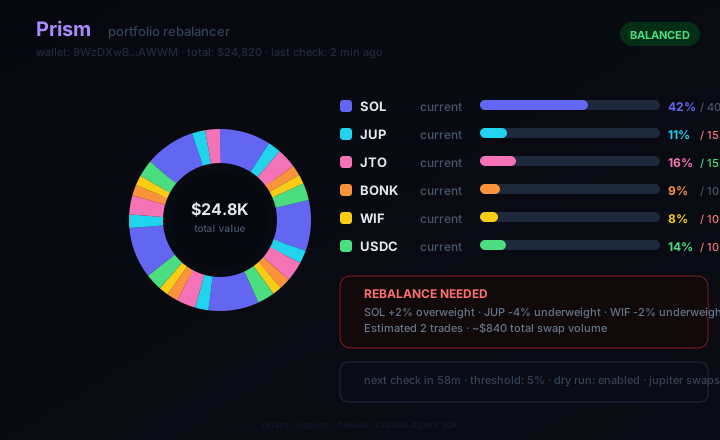
Rebalance Plan
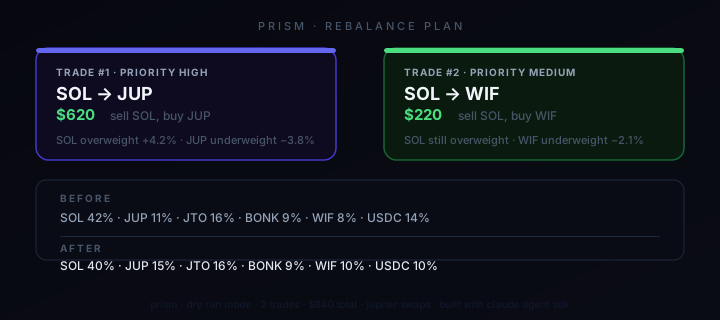
Why Prism Exists
Rebalancing sounds easy when the portfolio is hypothetical. It becomes harder the moment the wallet is real.
One asset runs too far, another becomes too small, the neat target allocation you wanted now conflicts with price impact, dust thresholds, and the need to keep enough SOL to operate. That is the gap Prism is meant to fill.
It is not a passive tracker and it is not a blind auto-trader. It is a portfolio policy engine for operators who want a disciplined way to decide whether drift is worth correcting right now.
Portfolio Policy, Not Just Portfolio Tracking
The value of Prism is not that it knows the wallet composition. Plenty of tools can show that.
The value is that it asks the right question after composition changes:
- is the portfolio still inside policy
- if not, which drift matters first
- what trades would fix it
- which of those trades still make sense after route quality and reserve safety are checked
That framing makes the product much easier to understand for non-dev readers too. The job is not "portfolio visualization." The job is "keep the wallet close to plan without paying stupid friction."
At a Glance
Use case: keeping a Solana wallet close to a target allocation without manual spreadsheet workPrimary input: wallet balances, token prices, target percentages, quote quality, and execution frictionPrimary failure mode: generating mathematically correct rebalances that are not actually worth executingBest for: operators who want discipline around allocation drift, not just portfolio visibility
The Decision Stack
Prism is intentionally opinionated about how a rebalance gets approved.
1. Portfolio Drift
The engine starts by measuring how far each tracked sleeve moved from target.
2. Priority
It then ranks the deviations so obvious overweights and underweights are handled before cosmetic ones.
3. Trade Construction
The planner turns that ranked drift into concrete buy and sell legs.
4. Preflight
Every trade is tested against route quality, trade size, and reserve constraints.
5. Final State
The output is either executable, preview-only, or skipped.
That final distinction is why Prism reads like a real allocator instead of a toy optimizer.
How It Works
Prism follows a five-part loop:
- load current wallet balances and price them in USD
- compare the live portfolio against the configured target allocation
- compute drift for every tracked asset and rank the deviations
- build rebalance orders that move the portfolio back toward target
- preflight the candidate orders for price impact, minimum size, and SOL reserve safety
Only the orders that survive preflight should be treated as real. Everything else is analysis, not permission.
What A Rebalance Must Prove
A good Prism plan is not just one that improves the percentages. It has to prove four things:
- the drift is large enough to matter
- the correction is large enough to justify trading
- the route quality is good enough to avoid burning edge in execution
- the wallet will still be operational after the trades clear
This is what makes Prism more appealing for launch than a generic "rebalance bot" description. The pitch is immediately grounded in constraints people already understand.
What Prism Does On Purpose
- promotes a small number of meaningful corrections over many tiny trades
- protects reserve balance instead of over-optimizing every percentage point
- demotes routes that look too expensive to justify execution
- leaves a plan in preview when the drift is real but the trade quality is weak
That behavior is important. A rebalancer that is always eager to trade is usually just good at generating fees.
Example Output
PRISM // REBALANCE PLAN

wallet value        $12,440
largest drift       SOL +8.2%
mode                dry-run

1. sell SOL -> buy USDC   $620   executable
2. sell BONK -> buy JTO   $180   executable
3. buy JUP using USDC      $95   skipped: below min trade
Default Sleeve Design
| Token | Target | Role in the portfolio |
|---|---|---|
| SOL | 40% | core Solana exposure |
| JUP | 15% | DEX infrastructure |
| JTO | 15% | liquid staking |
| BONK | 10% | community beta |
| WIF | 10% | meme sleeve |
| USDC | 10% | reserve and dry powder |
Customize the target mix in src/targets.ts.
When Prism Should Hold Fire
There are plenty of cases where the right answer is no trade.
- the drift is real but too small to justify friction
- the intended correction would leave too little SOL in reserve
- the route quality is too weak for the size involved
- the order improves percentages but not enough to matter economically
This is a big part of the product story. People trust allocator tools more when they can see that restraint is part of the design.
Risk Controls
rebalance threshold: ignores small drift that is not worth paying to correctminimum trade size: stops dust-level corrections from cluttering the planprice impact cap: marks expensive routes as non-executableSOL reserve floor: protects the wallet from rebalancing away too much operating balancedry-run mode: lets operators inspect the plan before allowing execution
Prism should be trusted as a disciplined allocator, not as a license to overtrade the wallet every time prices move.
Quick Start
git clone https://github.com/PrismRebalance/Prism
cd Prism
bun install
cp .env.example .env
bun run dev
Configuration
ANTHROPIC_API_KEY=sk-ant-...
HELIUS_API_KEY=...
WALLET_ADDRESS=your-wallet
REBALANCE_THRESHOLD_PCT=5
MIN_TRADE_USD=50
MAX_PRICE_IMPACT_PCT=1.5
MIN_SOL_RESERVE=0.1
DRY_RUN=true
CHECK_INTERVAL_MS=3600000
Support Docs
License
MIT
keep the portfolio close to target without pretending friction does not exist.
Yorumlar (0)
Yorum birakmak icin giris yap.
Yorum birakSonuc bulunamadi