projectdavid-core
Health Uyari
- License — License: NOASSERTION
- Description — Repository has a description
- Active repo — Last push 0 days ago
- Low visibility — Only 6 GitHub stars
Code Basarisiz
- rm -rf — Recursive force deletion command in .github/workflows/ci.yml
Permissions Gecti
- Permissions — No dangerous permissions requested
Bu listing icin henuz AI raporu yok.
Self-hostable LLM agent runtime
Project David




Project David is a self-hosted runtime for building stateful LLM and agent systems.
It provides the application infrastructure around model inference: assistants, threads, messages, runs, tool execution, retrieval, persistent state, provider routing, streaming, observability and deployment.
The API follows the resource model introduced by the OpenAI Assistants API, while keeping the runtime independent of any single model provider.
Project David can use hosted model APIs, OpenAI-compatible endpoints and local inference while keeping the surrounding application stack under your control.

What Project David provides
- Stateful Assistants, Threads, Messages and Runs
- Multi-provider model routing
- Tool and function execution
- Multi-agent delegation
- OpenAI-style vector store and retrieval APIs
- File ingestion, chunking, embedding, indexing and search
- Qdrant-backed vector retrieval
- Persistent application state
- Sandboxed code execution using FireJail and PTY isolation
- Web tooling
- Real-time streaming
- Signed file delivery
- API-key based user and service access
- OpenTelemetry and Jaeger tracing
- Redis, MySQL and Qdrant persistence
- Containerized deployment
- Local and private inference support
Project David is intended for systems where the model is one component of the application rather than the application itself.
Architecture
Project David separates model inference from application execution.
Applications interact with a stable runtime API. The runtime owns application state, retrieval, tool execution, provider selection and execution lifecycle independently of the model-serving layer.
A typical execution path is:
Client
  |
  v
Project David API
  |
  v
Assistant / Thread / Run lifecycle
  |
  +--> Persistent application state
  |
  +--> Retrieval / Vector Store
  |
  +--> Tool execution
  |
  +--> Code / Web execution
  |
  v
Provider Router
  |
  +--> Hosted model API
  |
  +--> OpenAI-compatible endpoint
  |
  +--> Local inference
  |
  v
Streaming result
  |
  +--> Persisted execution state
  |
  +--> OpenTelemetry / Jaeger tracing
The model provider is therefore replaceable without requiring the application to be rewritten around a different provider-specific execution model.
Platform stack
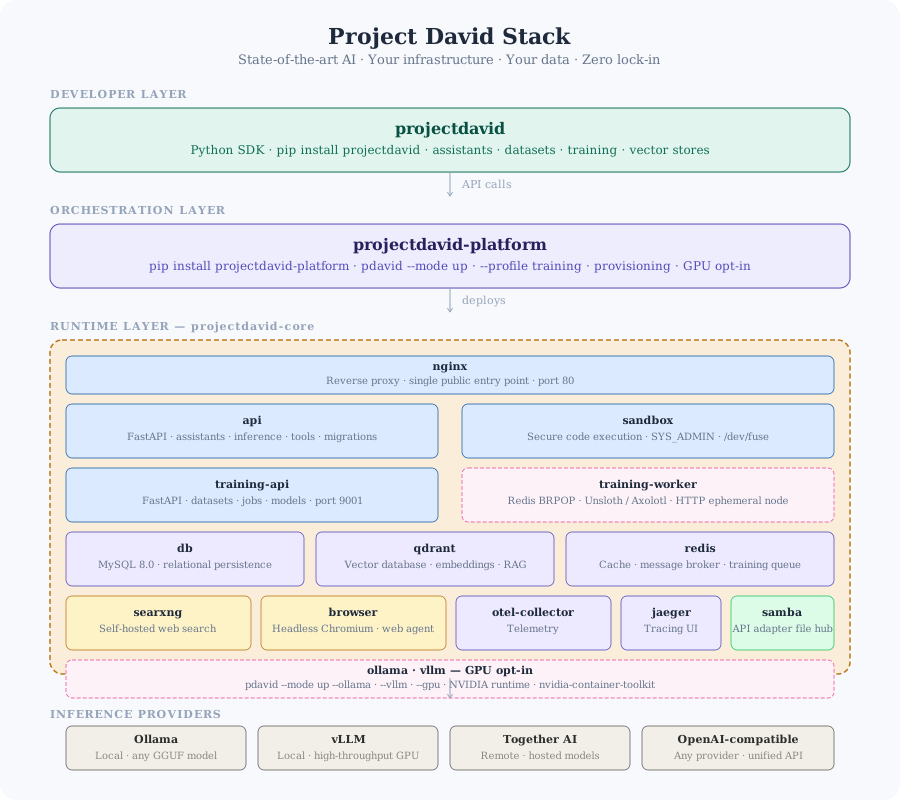
Runtime model
Project David uses explicit resources rather than treating a model call as the application boundary.
Assistants
Assistants define model configuration, instructions, tools and execution behaviour.
Threads
Threads hold durable conversational and application context.
Messages
Messages are persisted independently of the inference provider.
Runs
Runs represent execution. A run can involve model inference, retrieval, tool calls, code execution and additional agent activity before reaching a terminal state.
Tools
Tools are exposed to the runtime as executable capabilities rather than being embedded directly into provider-specific application code.
This separation allows application behaviour, state and execution policy to remain stable while models and providers change underneath it.
Retrieval and vector stores
Project David includes an API-driven retrieval pipeline built around OpenAI-style vector store resources.
The runtime supports the path from file ingestion through retrieval and inference:
File
  |
  v
Ingestion
  |
  v
Parsing / Chunking
  |
  v
Embedding
  |
  v
Indexing
  |
  v
Qdrant
  |
  v
Search / Retrieval
  |
  v
Context assembly
  |
  v
Inference
Files, application state, vector data and retrieval infrastructure can remain inside the deployment boundary.
The retrieval layer is part of the runtime rather than a separate application-specific integration.
Provider-independent inference
Project David isolates provider-specific behaviour behind the runtime.
Current deployments can route inference to:
- Hyperbolic
- Together AI
- Ollama
- OpenAI-compatible endpoints
- Other providers implemented through the provider interface
This allows the same application resources and execution model to be used across different inference backends.
Provider selection can therefore be treated as an infrastructure concern rather than being hard-coded into application logic.
Private and multi-provider deployment
Project David does not require application data to be owned or persisted by a model provider.
The API, application state, files, retrieval infrastructure, vector database, tool execution and observability stack can all run inside infrastructure controlled by the operator.
Deployments can combine local and external inference providers according to security, residency, performance and cost requirements.
For example, a deployment can keep:
- file ingestion
- parsing and chunking
- embeddings
- vector storage
- retrieval
- application state
- tool execution
- tracing
inside its own infrastructure while selectively routing permitted inference workloads to an external provider.
A deployment using local embeddings and local inference can keep the complete retrieval-to-inference path inside the deployment boundary.
Data protection
Project David was designed for privacy-conscious and multi-provider deployments.
Data storage, retrieval, inference and tool execution are separate architectural boundaries. This allows operators to control where application data is stored, which services process it and which inference providers may receive it.
The platform can therefore be used as part of systems designed to meet GDPR, data-residency and organisational security requirements.
Compliance is deployment-specific. It depends on infrastructure, configuration, model providers, retention policies, operating procedures and the wider system in which Project David is used.
Security
Project David has undergone independent security review.
The platform is designed around explicit user credentials, isolated execution, locally generated secrets and deployment-controlled infrastructure.
Relevant controls include:
- separate administrator and user API keys
- one-time display of generated API keys
- locally generated deployment secrets
- secrets excluded from version control
- sandboxed code execution
- signed file URLs
- deployment-controlled persistence
- provider separation
- auditable execution through OpenTelemetry tracing
Details of the security review are available on request.
Observability
Execution is instrumented with OpenTelemetry and can be inspected through Jaeger.
Tracing is intended to make the runtime observable across model calls, tool execution and the surrounding application lifecycle.
This is particularly useful when diagnosing failures that do not originate in the model itself, including:
- provider errors
- failed tool calls
- retrieval failures
- execution state transitions
- network and service failures
- latency across runtime components
Quick start
1. Install the local package
pip install -e .
2. Build and start the Docker stack
platform-api docker-manager --mode both
On first run, the CLI generates the local deployment configuration.
| File | Contents |
|---|---|
.env |
Locally generated secrets including database passwords, DEFAULT_SECRET_KEY, SEARXNG_SECRET_KEY and related deployment configuration |
docker-compose.yml |
A generated Compose definition wired to the local configuration |
Both files are created once and left untouched on subsequent runs.
Verify the CLI:
platform-api --help
Example:
Usage: platform-api [OPTIONS] COMMAND [ARGS]...

Entities API management CLI.

╭─ Commands ───────────────────────────────────────────────────────────────╮
│ configure        Update variables in an existing .env without          │
│                  regenerating secrets.                                 │
│ bootstrap-admin  Provision the default admin user inside the running   │
│                  API container.                                        │
╰─────────────────────────────────────────────────────────────────────────╯
For the complete command reference, see:
3. Provision an administrator
Set SPECIAL_DB_URL before running the bootstrap command.
Linux / macOS:
export SPECIAL_DB_URL=mysql+pymysql://user:password@localhost:3307/entities_db
Windows PowerShell:
Get-Content .env | ForEach-Object {
    if ($_ -match '^\s*([^#][^=]+)=(.*)$') {
        [System.Environment]::SetEnvironmentVariable(
            $matches[1].Trim(),
            $matches[2].Trim()
        )
    }
}
Provision the default administrator:
platform-api bootstrap-admin bootstrap-admin
Or provide the values explicitly:
platform-api bootstrap-admin \
  --db-url "mysql+pymysql://user:password@localhost:3307/entities_db" \
  --email "[email protected]" \
  --name "Default Admin"
Example output:
================================================================
 ✓  Admin API Key Generated
================================================================
 Email   : [email protected]
 User ID : user_abc123...
 Prefix  : ad_abc12
----------------------------------------------------------------
 API KEY : ad_xxxxxxxxxxxxxxxxxxxxxxxxxxxxxxxxxxxxxxxxxxxxxxxx
----------------------------------------------------------------
 This key will NOT be shown again.
================================================================
Store the key immediately. It is shown once and cannot be recovered.
4. Provision a user
Install the SDK:
pip install projectdavid
Create a user with the administrator credential:
import os

from dotenv import load_dotenv
from projectdavid import Entity

load_dotenv()

client = Entity(api_key=os.getenv("ADMIN_API_KEY"))

new_user = client.users.create_user(
    full_name="Kevin Flynn",
    email="[email protected]",
    is_admin=False,
)

print(new_user)
Issue an API key for the user:
api_key = client.keys.create_key_for_user(
    target_user_id=new_user.id,
    key_name="The Grid",
)

print(api_key.plain_key)
# ea_z_5YV4zGly50UHKlenc9BgTCQXtE....
Do not use the administrator key for normal application requests.
Connect using the user credential:
client = Entity(api_key=os.getenv("USER_API_KEY"))
Deployment model
Project David is containerized and intended to run as infrastructure rather than as an embedded library inside an application process.
The runtime is composed of separate services for application execution, persistence, retrieval, observability and supporting infrastructure.
This allows deployments to replace or scale individual components without changing the external application API.
The generated Docker configuration provides the default local deployment path. Production deployments can use the same service boundaries as the basis for wider infrastructure integration.
Repository map
Project David is split across several repositories with deliberately separate responsibilities.
| Repository | Responsibility |
|---|---|
| projectdavid | Python SDK |
| entities-common | Shared utilities, schemas and validation |
| david-core | Docker orchestration and infrastructure |
| reference-frontend | Reference streaming client |
| entities_cook_book | Minimal tested examples |
| projectdavid_docs | Documentation source |
Documentation
| Topic | Link |
|---|---|
| Full documentation | docs.projectdavid.co.uk |
| SDK quick start | SDK Quick Start |
| Docker commands | Docker Commands |
| Providers | Providers |
Design principles
Project David is built around several boundaries that are intended to remain stable as the model ecosystem changes.
Application state should not belong to the model provider
Threads, messages, files, retrieval state and execution state are runtime resources.
Model providers should be replaceable
Applications should not need to be rewritten because inference moves from one provider to another.
Retrieval is application infrastructure
Ingestion, vector storage, search and context assembly are first-class runtime capabilities.
Tools are part of the execution system
Tool calls require lifecycle management, validation, state and failure handling beyond the model response that requested them.
Local and hosted inference are deployment choices
The application model should remain stable whether inference is provided by a remote API or infrastructure controlled by the operator.
Observability belongs in the runtime
Agent and LLM systems fail across multiple layers. Model calls, tools, retrieval, storage, networking and execution state need to be traceable as one system.
Source and licensing
The Project David source is publicly available under the
PolyForm Noncommercial License 1.0.0.
Non-commercial use is permitted under the terms of that licence.
Commercial licensing is available separately.
Yorumlar (0)
Yorum birakmak icin giris yap.
Yorum birakSonuc bulunamadi