agent-systems-handbook
Health Gecti
- License — License: NOASSERTION
- Description — Repository has a description
- Active repo — Last push 0 days ago
- Community trust — 74 GitHub stars
Code Uyari
- process.env — Environment variable access in .github/scripts/enqueue-discord-announcement.mjs
- network request — Outbound network request in .github/scripts/enqueue-discord-announcement.mjs
Permissions Gecti
- Permissions — No dangerous permissions requested
This project is a comprehensive, AI-native handbook covering the design and architecture of production-ready agent systems, workflows, and interoperability protocols.
Security Assessment
Overall risk: Low. As an MDX-based repository, it serves primarily as educational documentation rather than an executable application. There is no evidence of dangerous permissions, hardcoded secrets, or arbitrary shell command execution. The only security warnings originate from a GitHub Actions script (.github/scripts/enqueue-discord-announcement.mjs) that reads environment variables and makes an outbound network request to send Discord notifications. This is standard, safe behavior for a CI/CD pipeline and poses absolutely no risk to the end user.
Quality Assessment
Quality is solid. The repository is highly active, with its most recent push occurring today. It has garnered 74 GitHub stars, which shows a good level of early community trust and engagement from practitioners. The project is well-documented and actively encourages community contribution. The only notable downside is that the license is marked as "NOASSERTION." While this is common for educational resources, the lack of a formally defined open-source license means the legal terms for reuse and modification are technically unclear.
Verdict
Safe to use: A well-maintained, low-risk educational resource that is highly recommended for developers looking to learn about agentic systems, though users should be aware of the undefined license if planning to redistribute the content.
A practical AI agents handbook covering agent systems, agentic workflows, LangGraph, MCP, A2A, context engineering, agent memory, evaluation, observability, and multi-agent architecture.

Agent Systems Handbook by Prompthon

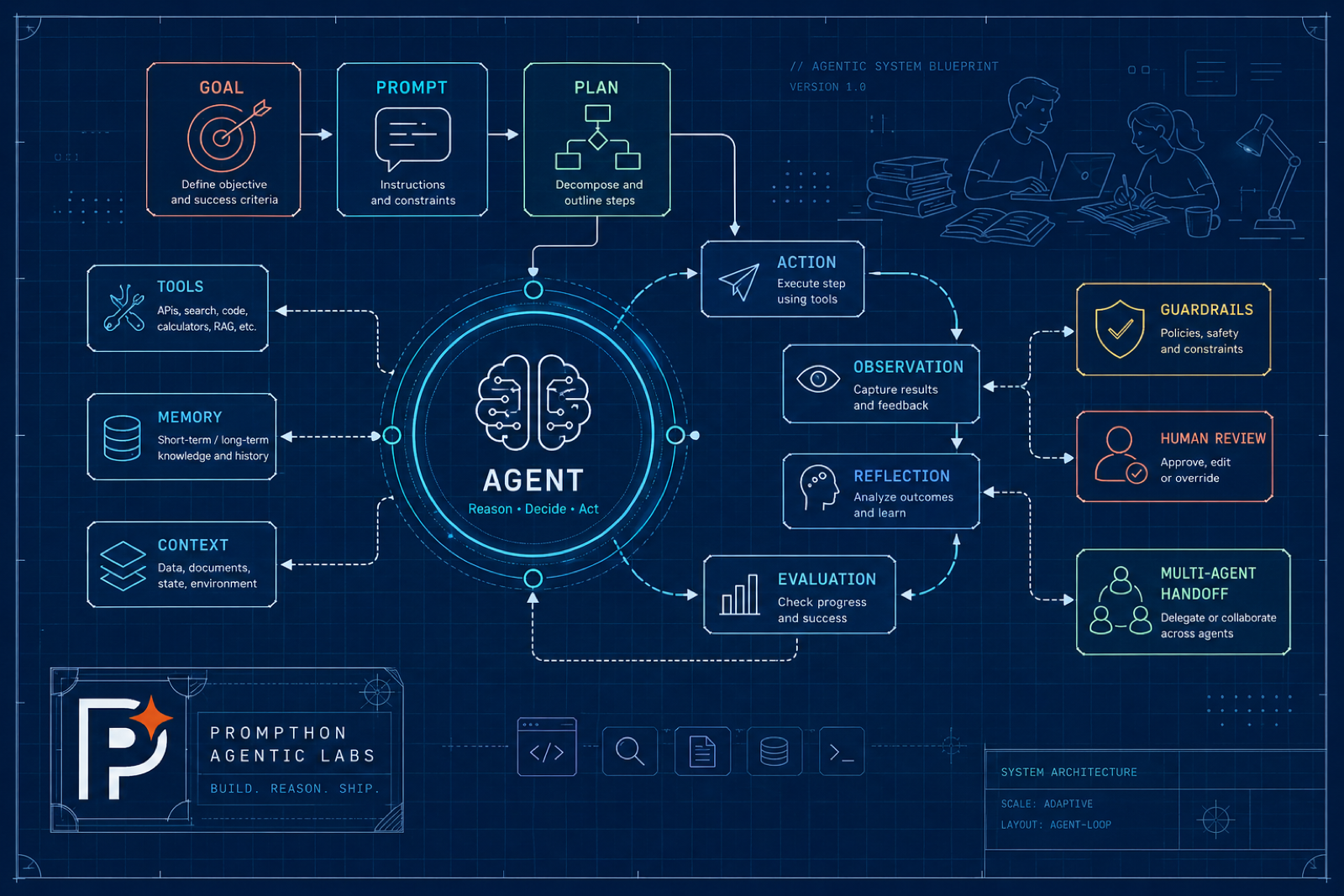
AI-agent demos are easy to find. Production-ready agent systems are harder to understand. This handbook maps the workflows, tools, memory systems, context engineering, MCP/A2A interoperability, evaluation, observability, and multi-agent architecture behind real-world AI agents.
Use it to understand, design, build, and operate production-minded AI agents — from first principles to framework choices and implementation patterns.
Organization · Repository · Star · Watch updates · Contribute source · Issues · Discord



Overview
Prompthon Agentic Labs publishes the Agent Systems Handbook by Prompthon: an AI-native field guide for students, practitioners, and builders exploring modern agent systems from different angles.
Built on learn, question, and innovate, the lab is shaped by learners and grounded in real industry practice. It helps readers understand the space, apply AI effectively, or build real systems through parallel paths rather than a single track.
Why This Lab Fits AI-Native Learners, Practitioners, And Builders
Built on learn, question, and innovate
This repository encourages active learning, critical thinking, and experimentation rather than passive consumption.
Built by learners, not only for learners
Many contributors are learners themselves. That keeps the material close to the questions, habits, and learning paths that students, new grads, and next-generation AI-native builders actually have.
Guided by real industry practice
Through Prompthon programs and industry-facing guidance, the lab remains connected to how frontier teams think, build, iterate, and evaluate in real settings.
AI-native by design
The content is created through an AI-native workflow that combines AI-assisted drafting, synthesis, iteration, and refinement with expert guidance and review.
Designed for different paths, not a single track
The lab is organized for different kinds of learners and different intentions. Some people want broad understanding and trend awareness. Some want to apply AI tools to daily work and study. Some want to build real systems and applications. This repository supports all three without forcing one sequence.
What This Handbook Covers
- AI agent foundations and agent-system mental models
- Agentic workflows, planning, reflection, tool use, and function calling
- Agent memory, retrieval, context engineering, and agentic RAG
- MCP, A2A, protocol interoperability, and agent communication boundaries
- LangGraph, agent frameworks, hosted builders, and low-code platforms
- Multi-agent orchestration, evaluation, observability, reliability, and safety
- Deep research agents, customer-support agents, source projects, and starter examples
Start Here
Choose the path that best matches what you want from AI right now. These are parallel tracks for different types of learners and builders, not a required sequence.
ExplorerFor students, newcomers, and curious AI-native readers who want a broad view of AI, agents, trends, and foundational ideas without needing to become engineers. What you get: a curated set of high-signal reads that help you learn core concepts, follow important shifts, test ideas with your own thinking, and build a grounded first-hand understanding of the space. |
PractitionerFor people who want to use AI tools, agents, and workflows to enhance daily life, study, and real work without needing to become full-time engineers. What you get: a practical path for learning how to apply AI effectively, choose the right tools and workflows, and operate with leverage in real scenarios, including one-person-company style use cases where AI expands what one person can do without requiring full builder depth. |
BuilderFor engineering-minded learners, new grads, and developers who want to build with AI more directly, from agent applications and workflows to startup-style products and technically deeper implementations. What you get: a build-oriented path through concepts, patterns, systems, architecture choices, technical details, and concrete examples for people who want to create their own applications and go deeper into implementation. |
ContributorFor people who want to shape the lab by adding, revising, curating, or maintaining pages, notes, examples, and outward-facing extensions. What you get: a public path into the editorial workflow, templates, review rules, placement standards, and portfolio-relevant open-source contribution. |
Contributor Guide
If you want to contribute to Prompthon Agentic Labs, start from the contributor docs rather than ad hoc internal working material.
Public contributions in this repository currently fit into these paths:
- lab articles in
foundations/,patterns/,systems/,ecosystem/, orcase-studies/ - radar notes in
radar/ - source projects in lane-local
examples/folders - practitioner skill packages in
skills/ - curated reference notes in
contributor-kit/reference-notes/ - publication extensions in
publications/once a
lab page is ready for an outward-facing article or distribution surface
Start with Contributing and the Contributor Kit. Those pages define the public workflow, templates, review standards, and placement rules for lab articles, notes, and code that belong in this repository.
Yorumlar (0)
Yorum birakmak icin giris yap.
Yorum birakSonuc bulunamadi