codexfi
Health Warn
- License — License: MIT
- Description — Repository has a description
- Active repo — Last push 0 days ago
- Low visibility — Only 7 GitHub stars
Code Pass
- Code scan — Scanned 12 files during light audit, no dangerous patterns found
Permissions Pass
- Permissions — No dangerous permissions requested
This tool provides persistent memory for OpenCode AI agents. It automatically extracts key facts from your coding sessions, stores them locally, and silently injects them into future sessions so the agent remembers your past decisions and project context.
Security Assessment
The tool integrates with external AI services (Anthropic, xAI, Google, and Voyage AI) to process data and generate embeddings, meaning it makes outbound network requests and handles your API keys. The README explicitly displays a `curl | bash` installation method, which always warrants caution as it executes remote code directly on your machine. However, a light code scan of 12 files found no dangerous patterns, hardcoded secrets, or requests for dangerous system permissions. Because it routes your code context to third-party AI providers and uses a piped bash installer, overall risk is rated as Medium.
Quality Assessment
The project is actively maintained, with its last code push occurring today. It uses the permissive MIT license, includes a clear description, and is written in TypeScript. However, it has very low community visibility with only 7 GitHub stars, indicating minimal external testing, auditing, or widespread community trust.
Verdict
Use with caution — the code appears safe, but the low community adoption and requirement to expose API keys to a new, untested tool mean you should review the installer script before running it.
Persistent memory for OpenCode AI agents. Embedded LanceDB + Voyage AI embeddings, Bun plugin with CLI and web dashboard.
codexfi
Persistent memory for OpenCode AI agents.
The best memory system is the one that just works. No Docker. No Python. No frontend servers. Just
curl -fsSL https://codexfi.com/install | bashand you're done.










What is this?
OpenCode starts every session from scratch. No memory of past decisions, established patterns, or project context. Every session, you repeat yourself.
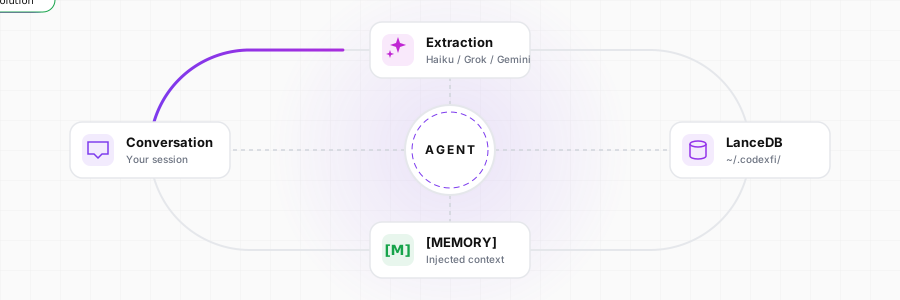
codexfi fixes this. After every assistant turn, key facts are automatically extracted and stored locally. On every new session, relevant memories are silently injected into context. The agent just remembers.
Install
curl -fsSL https://codexfi.com/install | bash
The installer prompts for API keys, registers the plugin, and you're done.
To verify everything is configured correctly before your first session:
bunx codexfi status
Once a session runs, proof it's working: start a second session and ask the agent about something from the first — it will know.
Prerequisites
- Bun runtime
- OpenCode AI coding agent
- One extraction API key: Anthropic (recommended), xAI, or Google
- Voyage AI API key (free tier available)
How it works

- You code normally. No commands, no
/save, nothing to learn. - After every turn, the plugin extracts typed facts from the conversation and stores them locally in LanceDB.
- On every LLM call, a
[MEMORY]block is rebuilt into the system prompt with project context, preferences, and semantically relevant memories. - When you switch topics mid-session, semantic search refreshes to surface different memories.
- Across sessions, the agent picks up where it left off — project decisions, error fixes, your preferences, everything.
All data stays on your machine at ~/.codexfi/. Nothing is sent anywhere except the embedding and extraction APIs.
Features

- Fully automatic — saves after every turn, injects on every call
- 100% local storage — LanceDB embedded in-process
- Multi-provider extraction — Anthropic Haiku (default), xAI Grok, or Google Gemini
- Code-optimised embeddings — Voyage
voyage-code-3 - Typed memory system —
architecture,error-solution,preference,progress, and more - Smart deduplication — cosine similarity prevents duplicates
- Contradiction handling — new facts automatically supersede stale ones
- Compaction-proof — memory lives in the system prompt, never lost to context truncation
- Privacy filter — wrap content in
<private>...</private>to exclude from extraction - Web dashboard —
codexfi dashboardfor live activity, costs, and memory browser - CLI —
codexfi list,search,stats,export,forget,status
Configuration
Config at ~/.config/opencode/codexfi.jsonc:
{
  "extractionProvider": "anthropic",  // "anthropic", "xai", or "google"
  "voyageApiKey": "pa-...",
  "anthropicApiKey": "sk-ant-...",
  "similarityThreshold": 0.45,       // retrieval cutoff (0-1)
  "maxMemories": 10                  // per scope per session
}
Agent instructions (optional)
The plugin works without this, but adding instructions to ~/.config/opencode/AGENTS.md improves agent behavior — it understands the [MEMORY] block, uses the memory tool correctly, and never announces memory operations.
See plugin/README.md for the recommended AGENTS.md snippet.
Privacy
All data stays on your machine. Outbound API calls go only to Voyage AI (embeddings) and your chosen extraction provider (one per turn). Wrap sensitive content in <private>...</private> to exclude it entirely.
More
- Plugin internals — architecture, data flow, extraction providers, development setup
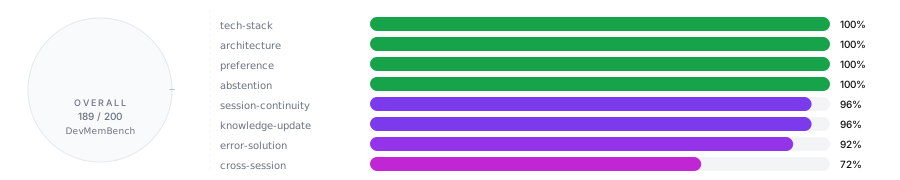
- Benchmark — 94.5% on DevMemBench (200 questions, 8 categories)
- E2E tests — 13 autonomous test scenarios
License
Reviews (0)
Sign in to leave a review.
Leave a reviewNo results found