byebyevibe
Health Uyari
- License — License: MIT
- Description — Repository has a description
- Active repo — Last push 0 days ago
- Low visibility — Only 5 GitHub stars
Code Basarisiz
- rm -rf — Recursive force deletion command in .claude/settings.json
- rm -rf — Recursive force deletion command in .github/workflows/sdd-gates.yml
- network request — Outbound network request in doc/curso/scripts/extract-lessons-batch.py
- network request — Outbound network request in doc/curso/scripts/extract-transcript-console.js
Permissions Gecti
- Permissions — No dangerous permissions requested
Bu listing icin henuz AI raporu yok.
ByeByeVibe — Spec-Driven Development (SDD) install kit from vibe coding to shippable AI engineering. Control plane (OpenSpec + graphs + gates) for Cursor & Claude Code.
ByeByeVibe
From vibe coding to shippable AI engineering.
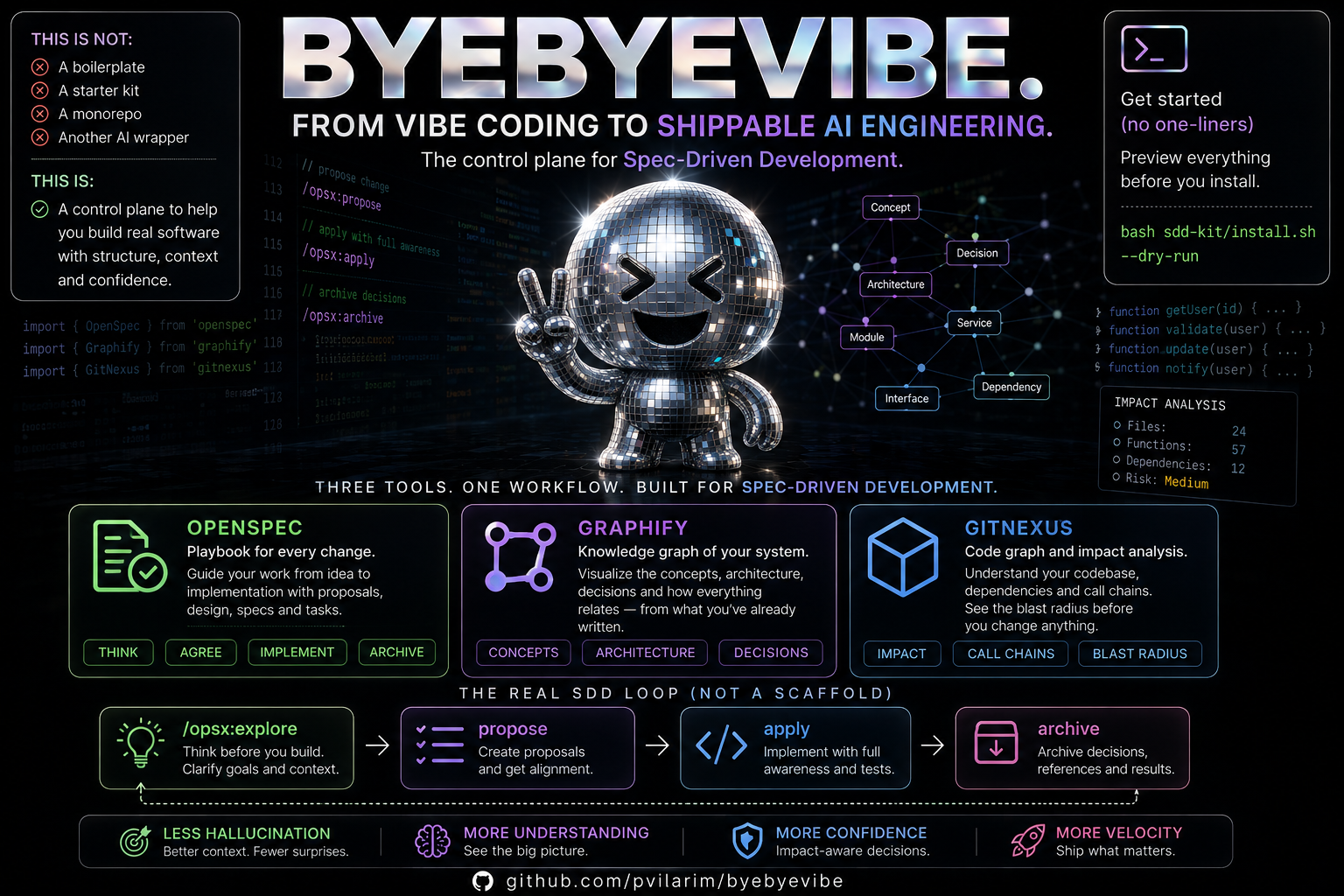



ByeByeVibe is the public name of this project. The install payload lives in sdd-kit/.
An installable toolkit for AI-assisted development on Cursor and Claude Code — the missing operating system between your coding agent and a maintainable repo. Specs, code & knowledge graphs, CI gates, and session discipline, packaged so you don't invent process from scratch.
OpenSpec · GitNexus · Graphify — see Core tools for what each one does.
Vibe coding until the first PR. After that, agentic engineering.
Why install this
- Durable memory — specs and decisions live in
openspec/, not in chat history - Impact before edits — GitNexus maps your code so agents check blast radius first
- Team knowledge reused — Graphify surfaces architecture and past decisions without blind grepping
- Enforced quality — CI
sdd-gatesvalidates specs and task patterns (fail-closed) - Versioned control plane —
sdd-kit/installs and upgrades rules, scripts, and gates withMANIFEST.yaml - Gap-aware — notices when you keep re-teaching the same facts (offers a skill) or narrating manual steps (offers a CLI/MCP integration) — offer-only, never creates or installs anything unprompted
Not another Next.js starter — the SDD control plane
(OpenSpec + graphs + gates) your repo is missing.
Get started (30 seconds)
# Preview what the kit would install (no writes)
bash sdd-kit/install.sh --profile DOCS_SPECS --dry-run

# Or for an application repo:
bash sdd-kit/install.sh --profile APP --dry-run
Profiles: APP · DOCS_SPECS — see sdd-kit/README.md.
The problem
Coding agents forget context, hallucinate APIs, and overwrite each other's AGENTS.md. Chat-only “vibe coding” ships fast — until the repo becomes unmaintainable. Spec-driven development fixes that if the workflow, graphs, and gates are installed and governed.
Core tools
| Tool | What it is | Without it |
|---|---|---|
| OpenSpec | Playbook for a change — think, agree, implement, archive (/opsx:*) |
Chat turns into code; nobody remembers why |
| GitNexus | Map of your repo's code + impact analysis | The AI edits by vibe and breaks the neighborhood |
| Graphify | Knowledge graph — concepts, architecture, relations | The AI reinvents decisions you wrote last month |
sdd-kit/ |
Versioned install payload (rules, scripts, workflows, gates) | Every repo invents the process from scratch |
CI sdd-gates |
Fail-closed validation (openspec validate, task patterns, OSV) |
Specs become decoration |
| Session locks | Safe parallelism across git worktrees | Concurrent agents overwrite each other |
| AGENTS.md | Single curated agent entry point (agents.md) | Install order fights and overwrites agent config |
Full didactic install path: guide §2.1 · first-contact §2.0b.
User-friendly OpenSpec
Discipline without ceremony — friendly onboarding, not theatre.
| Entry | When to use |
|---|---|
/opsx:help |
Day-1 operator map after install — files, phases, confidence (doc/sdd-operator-day1.md) |
/opsx:onboard |
Learn by doing one full OpenSpec cycle (upstream; we don't fork it) |
/opsx:explore |
Think before you build — research only, no code |
/opsx:propose → apply → archive |
Spec-driven change lifecycle |
Suggested order: help (map) → onboard (practice) → real changes.
C1 install uses plain-language banners (What / Why / Without it) so operators understand each step — see guide §2.1–2.4.
Demo — /opsx loop (text)
You:  /opsx:explore "should we add rate limiting?"
Agent: researches → writes research.md (no code yet)

You:  /opsx:propose add-api-rate-limit
Agent: proposal → design → specs → tasks (you review)

You:  /opsx:apply
Agent: implements tasks · marks checkboxes · runs gates

You:  /opsx:archive
Agent: promotes specs · archives the change
Same discipline in Cursor or Claude Code.
Optional modules
Install the core stack first (C1). Add these only when you need them:
| Module | Code | What you get |
|---|---|---|
| UI / design system | C1-UI | Impeccable + shadcn + design pipeline — guide §2.11 |
| Probity (TDD enforce) | G2 | @nizos/probity for APP — guide §2.16 |
| Post-apply reviews | skills | correctness-review · simplify-review — on-demand, manual install |
| SDD metrics | G4 | sdd-metrics.sh — volume, lead time, rework — guide §2.17 |
Calibrate as you go
Built-in SDD retrospectives — sdd-metrics.sh turns your archive history into volume, lead-time, and rework signals. After every few shipped changes, a gentle cadence nudge asks you to run the report and make one process adjustment. The more you ship through the loop, the more signal you have to calibrate your workflow — measurable, not magic. (No ML claims.)
The same posture covers memory and integrations: re-teach the agent the same domain facts and it offers to save a skill; watch it fall back to manual steps for the same external tool twice and it offers a CLI/MCP integration — bash scripts/verify-infra.sh reports which integrations are configured, missing, or declined. Everything is offer-only: nothing is created or installed without your decision.
bash scripts/sdd-metrics.sh
Details (pt-BR): guide §2.17.
Not another starter kit
| You might be looking for… | This kit is… |
|---|---|
| Next.js / auth / DB boilerplate | No — bring your own app stack |
| “Prompt → full app in 30s” | No — we upgrade how agents work in your repo |
| Specs + graphs + gates + install/upgrade | Yes — the control plane |
If you need a vibe template, use one — then install this kit on top.
Who it's for
- Solo / small teams on Cursor or Claude Code leaving chaotic vibe coding for agentic engineering
- Brownfield repos that need agent discipline without a second orchestration framework
- Hubs that distribute SDD payloads (
sdd-kit/) to many consumer repos
Stack & companions
We compose OpenSpec; we don't replace it. Composed CLIs keep their own licenses — see NOTICE.md; GitNexus is PolyForm Noncommercial (not MIT).
- OpenSpec · GitNexus · Graphify · agents.md
- Install kit:
sdd-kit/· Constitution:openspec/project.md
Docs
| Doc | Language | Role |
|---|---|---|
| This README | EN | Discovery / first contact |
doc/byebyevibe-guide.md |
pt-BR | Canonical install & operations guide |
doc/sdd-operator-day1.md |
EN | Day-1 operator map (/opsx:help) |
sdd-kit/README.md |
EN | Kit scenarios & commands |
doc/avaliacoes/2026-07-26-sdd-discovery-positioning.md |
EN | Market / SEO / backlog decisions |
LICENSE |
EN | MIT — this repository |
NOTICE.md |
EN | Licenses of composed tools |
Maintainer
Yorumlar (0)
Yorum birakmak icin giris yap.
Yorum birakSonuc bulunamadi