delegate-router
Health Gecti
- License — License: MIT
- Description — Repository has a description
- Active repo — Last push 0 days ago
- Community trust — 26 GitHub stars
Code Gecti
- Code scan — Scanned 12 files during light audit, no dangerous patterns found
Permissions Gecti
- Permissions — No dangerous permissions requested
Bu listing icin henuz AI raporu yok.
Claude Code and Codex CLI skill: an LLM router that delegates bulk, already-decided coding tasks to another model you already pay for (GPT via Codex, Gemini via agy, a Claude Opus subagent). Task-based model routing, cross-model code review, new-model alerts. Saves tokens and quota; the host verifies every diff.
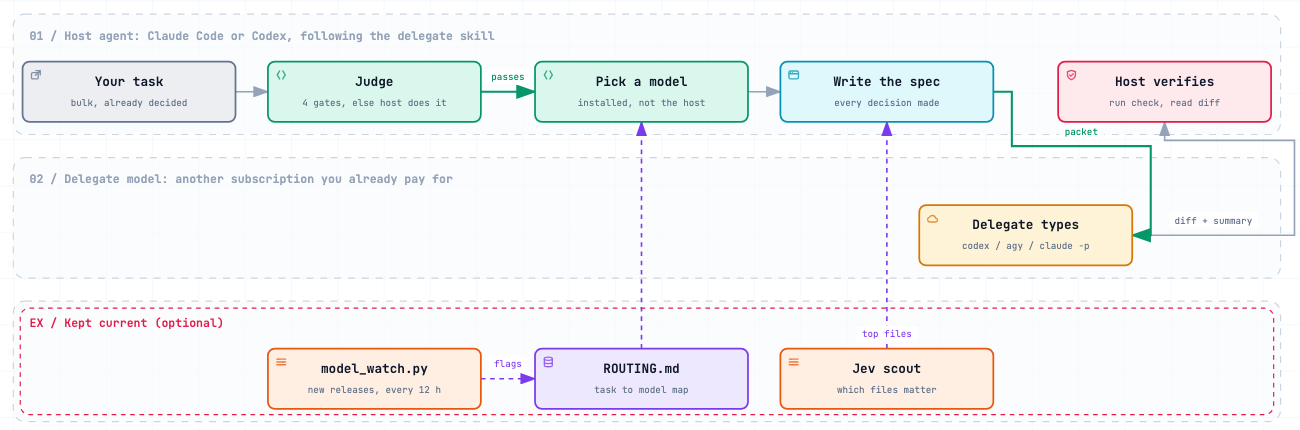
delegate-router: multi-model task delegation for Claude Code and Codex CLI
One agent thinks, another types. delegate-router is an agent skill (SKILL.md, the Agent
Skills format) for Claude Code and OpenAI Codex CLI that works as an LLM router for
coding work. It hands bulky, already-decided work (boilerplate, scaffolding, test stubs,
mechanical edits across many files, reading media and long documents) to another model you
already pay for: Codex (GPT models), Gemini through the Antigravity agy CLI, or a
Claude Opus subagent. The host keeps the design and the verification, and saves its own
quota and context.
- Routing by task, not by habit. ROUTING.md maps each kind of
task to an ordered list of models, chosen from independent benchmarks and cost per task.
It skips any CLI you don't have and never routes back to the host's own model, except an
Opus subagent under an Opus host, which keeps the main context clean. - A judge before every handoff. Four gates (bulk, decided, verifiable, contained) and a
never-delegate list (debugging, architecture, security code, anything under ~40 lines). - The host always verifies. A delegate's "done" isn't evidence: the host runs the check and
reads the diff. - An update path.
model_watch.pynotices new model releases in your CLIs and the
vendors' release notes, and can update the CLI and prove the new model answers.
Interactive diagram: docs/workflow.html (open it locally).
Requirements
- macOS or Linux,
git,python33.9+. - Your main agent is Claude Code (
claude) or
Codex CLI (codex), plus at least one more of Codex,
Gemini through the Antigravity CLI (agy), or Claude. Other
main agents and other providers (DeepSeek, local models) aren't supported yet. Each CLI
needs its own subscription or API access; delegate-router adds no accounts and no API keys. - Optional: uv and a TypeSafe key, only for Jev.
Install
git clone https://github.com/pvjbuilds/delegate-router ~/.delegate-router
~/.delegate-router/install.sh
Clone to a fixed path: the install links to it, so moving the folder later breaks the links.
The installer finds your CLIs, links the skill, and asks a few questions. Enter takes the
default; --yes takes every default. Re-running it keeps your earlier answers.
| Question | Default | What it does |
|---|---|---|
| Install for Claude Code? | yes, if found | Links ~/.claude/skills/delegate; no removes that link |
| Install for Codex CLI? | yes, if found | Links ~/.agents/skills/delegate; no removes that link |
| Background checks for new models? | yes | At most every 12 h, only when the skill runs. No daemon, no cron. |
| Update the CLI and probe a new model? | no | Updates through the channel the CLI came from (Homebrew cask, npm, or its own updater), then sends a one-word, read-only probe |
| Turn on Jev? | no | See Jev |
If claude is installed, the installer also links the opus-implementer agent into~/.claude/agents: both hosts use it to reach Claude Opus.
It never overwrites a file or folder that isn't its own, and never edits your Claude Code or
Codex settings. It prints two optional snippets instead:
Codex as host. Codex's sandbox blocks network by default, so calling the
claudeCLI
from inside Codex asks for approval. Don't approve it: an approved command runs outside the
sandbox. Instead add to~/.codex/config.toml, which keeps the sandbox on:[sandbox_workspace_write] network_access = trueClaude Code session-start notice. A
SessionStarthook that runsmodel_watch.py status,
so new-model notices show when a session opens.
Restart Claude Code or Codex after installing.
Use
Ask the host to delegate, or type /delegate:
Delegate this: add typed stubs for the 14 endpoints in
api/routes.py, one per function,
each raisingNotImplementedError.
The host judges the task, picks the model, writes the spec, runs the delegate, reads the diff
and reports back: what went where, what came back, what it fixed. Name a model to override the
map ("send this to Gemini").
Routing, briefly
| Task | First choice | Fallback |
|---|---|---|
| Bulk code from a spec | GPT-6.1 Sol (Codex) | Claude Opus 5.5 |
| Must be right, or the first pick failed | Claude Opus 5.5 | GPT-6.1 Sol |
| Trivial mechanical edits | GPT-6 Luna (Codex) | Claude Opus 5.5 |
| Images, screenshots, scanned pages | GPT-6.1 Terra (Codex) | Gemini 3.8 Flash |
| PDFs, video, audio, long documents | Gemini 3.8 Flash (agy) | Claude Opus 5.5 |
| Hard reasoning, security review (read-only) | GPT-6 Astra (Codex) | Claude Opus 5.5 |
The reasons, effort levels, caveats and the council protocol for when two models disagree are
in ROUTING.md. Benchmarks are a prior; a check on the real task
beats them.
Staying current
git -C ~/.delegate-router pull
That brings a newer routing map. Between releases, model_watch.py tells you what's new:
python3 ~/.delegate-router/skills/delegate/scripts/model_watch.py status
statusmakes no network calls itself. It lists your delegate CLIs, any new release it
found, and any model your CLIs list that ROUTING.md doesn't cover yet. With background checks
on, it also startsrun --if-duein the background, which goes online at most every 12 h.rundoes the checking: model catalogs (codex debug models,agy models, Anthropic's
models page) and five vendor release-note pages. It's capped at 10 names, and every step,
CLI update and probe included, stops at 15 minutes.ackmarks everything current as reviewed.
State lives in ~/.local/state/delegate-router/, settings in~/.config/delegate-router/config.env (see config.example.env).
Jev (optional)
Jev (TypeSafe) is a very cheap classifier, about $0.0001 per call.
Turned on, it does two jobs:
- Judges release notes. Is a new name a real subscriber release, or API-only or a preview?
- Scouts files before a spec. It ranks which files a task needs, so the host reads 5
files instead of 40.
Data gate: Jev sends text to TypeSafe. Use it only on public or low-sensitivity code.
Never on client work, secrets, credentials or personal data. The scout skips secret-looking
files by name and content, but that's a pattern match, not a guarantee.
Key: TYPESAFE_API_KEY in your environment, or on macOS in the login keychain:
security add-generic-password -a "$USER" -s TYPESAFE_API_KEY -w
The key is never read from a file in this repo, never written to config and never printed.
Safety
- Codex delegates run in Codex's sandbox:
workspace-writeto implement,read-onlyto
review. Never full access, never a--dangerously-bypass-*flag. They skip yourconfig.tomland execpolicy rules and turn apps off; plugins and admin-managed config can
still apply. - Gemini runs through
agyin plan mode with--sandbox. It is still an agent: the
handoff folder isn't a read boundary and your integrations stay on, so send it only packets
you wrote. - Claude Opus as an implementer runs with the Claude Code host's own permissions (turn on
Claude Code's/sandboxfor OS-level confinement), or inside Codex's sandbox when Codex is
the host. As a reviewer it runs--restrictedwith only Read, Grep and Glob. - Every Codex packet says "do not remove or weaken any existing test".
- Security, auth and money code is never typed by a delegate. A strong model may review it,
read-only. - New-model probes send one fixed prompt from an empty temp folder, with your CLI config,
rules and integrations turned off where the CLI allows it, and pass only on an exactok. - Model names read from web pages are validated before they're printed or passed to a CLI.
Uninstall
~/.delegate-router/uninstall.sh
This removes only its own links. Add --purge to also delete the config and state.
How routes are tested (maintainer only)
You don't run this: these runs are the maintainer's and cost you nothing. When a new model ships, the maintainer runs it through the bench against
the model that holds the route now, and the result reaches you in your next git pull.
Benchmarks pick a new model's first route; the bench decides whether it keeps it.
Ten routine tasks, each with a hidden check that grades a temp copy of the model's work:
| Task | What it asks |
|---|---|
| 1-function | Write a function to a spec |
| 2-rename | Rename a function across three files |
| 3-tests | Write tests for a module |
| 4-convert | Convert CSV to JSON |
| 5-extract | Pull four facts from a 2,000-word document |
| 6-bugfix | Fix three bugs whose symptoms show in one file and causes sit in others |
| 7-bisect | Find the first bad commit with git, when some commits can't run at all |
| 8-image | Read a table and a chart from a screenshot |
| 9-semver | Implement a long version-range spec; 73 hidden cases, one miss fails |
| 10-migrate | Change a signature everywhere it's used, including indirect calls |
python3 bench/bench.py codex gpt-6.1-sol high
python3 bench/bench.py --selfcheck
The first runs one model (codex, claude or agy, then the model ID and effort) and
appends pass, seconds and tokens per task to bench/results.tsv. --task 6 runs one task.--selfcheck runs no model: for each task with a reference answer in ref/ (tasks 6–10), it
proves the check fails on the untouched files and passes on that answer.
Latest run (2026-10-27): GPT-6.1 Sol high and GPT-6.1 Terra medium both passed 10/10; Terra
took 307 s to Sol's 467 s. The bench doesn't yet find where trackers put Sol ahead on coding.
Tests
python3 tests/test_model_watch.py && bash tests/test_install.sh && python3 bench/bench.py --selfcheck
uv run -q tests/test_jev.py && uv run -q tests/test_scout.py
All offline: stub CLIs, local pages, a temp HOME. No network, no spend.
FAQ
Why a clone and an install script, not a plugin? Both Claude Code and Codex support
plugins, and the folder is already laid out like one. A plugin can't ask setup questions, and
it would install a separate copy per host. A plugin package may follow; the skill itself won't
change.
Does it work with only one agent installed? It installs, but there's nothing to route to.
Delegation needs a second model.
Will it spend my money? Only through subscriptions you already have, when you delegate.
Background checks read public pages and your CLIs' model lists. Probes and Jev run only if you
turn them on.
Keywords
task delegation · delegate coding tasks · AI code delegation · LLM router · LLM routing · model
router · model routing · multi-model routing · multi-model · multi-LLM · cross-model code review ·
Claude Code skill · Claude Code skills · Codex CLI skill · Codex skills · Agent Skills · SKILL.md ·
Claude Code subagent · subagent · coding agent · AI coding agent · agentic coding · multi-agent ·
save tokens · token optimization · reduce AI coding cost · cost per task · subscription quota ·
model release watcher · new model alerts · OpenAI Codex · Google Gemini · Anthropic Claude ·
Antigravity CLI · agy · Claude Opus 5.5 · GPT-6.1 Sol · GPT-6.1 Terra · GPT-6 Luna · GPT-6 Astra ·
Gemini 3.8 Flash · TypeSafe Jev · model benchmark · LLM eval
License
MIT. See LICENSE.
Yorumlar (0)
Yorum birakmak icin giris yap.
Yorum birakSonuc bulunamadi