ohmywind
Health Uyari
- License — License: AGPL-3.0
- Description — Repository has a description
- Active repo — Last push 0 days ago
- Low visibility — Only 6 GitHub stars
Code Basarisiz
- rm -rf — Recursive force deletion command in .github/workflows/sync-hf-space.yml
Permissions Gecti
- Permissions — No dangerous permissions requested
Bu listing icin henuz AI raporu yok.
MCP server + web app for sailing passage planning, worldwide: per-leg ETA, 1-5 complexity score, multi-model winds (AROME 1.3 km in France). SHOM C2D and MARC PREVIMER tidal atlases on the French Atlantic coast. Free, keyless, open source.
OhMyWind ⛵
Talk to your LLM. Cast off with confidence.
OhMyWind turns any MCP-capable assistant (Claude, Le Chat, Cursor, Goose,
Zed, Continue) into a sailing planner. Ask in plain language, anywhere in
the world: get a per-leg ETA, a 1‑5 complexity score, and a deep-link to
the full plan. On the French Atlantic coast it goes further, swapping the
global current model for the SHOM Atlas C2D and MARC PREVIMER atlases.
Free, keyless, open source.

ohmywind.fr · MCP endpoint · AGPL-3.0 + trademark
[!WARNING]
Decision-support tool, not a navigation instrument. OhMyWind does not
replace the official marine forecast from your national weather service,
up-to-date charts, or the skipper's judgement. Forecast models are sometimes
wrong: you remain responsible for your passage.
Try it in 30 seconds
1. Open your MCP client and add the endpoint:
https://mcp.ohmywind.fr/mcp
2. Ask, in your own words:
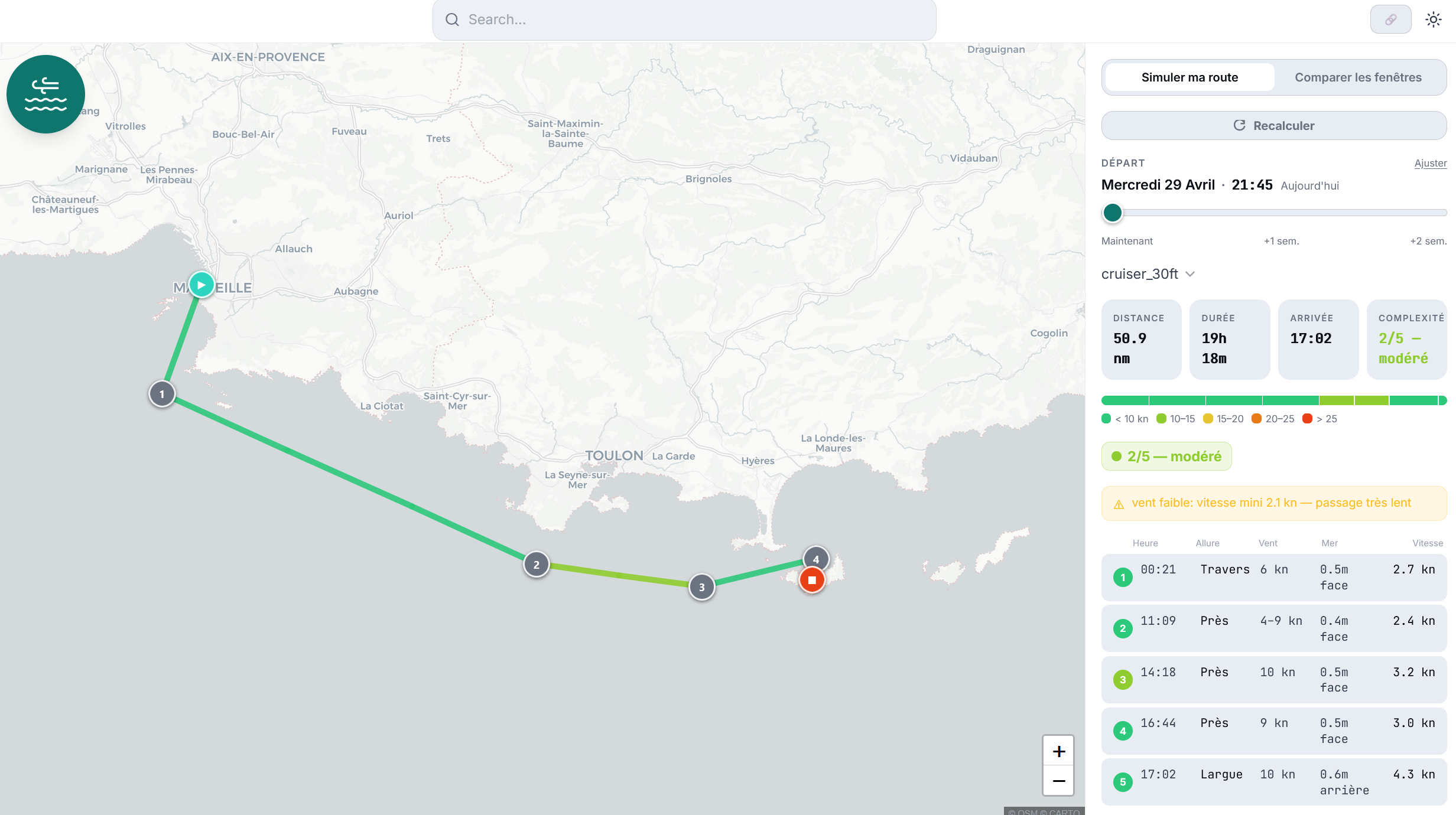
"Demain matin, Marseille → Porquerolles, sur un Sun Odyssey 36. Bonne
idée ? Combien de temps et c'est tendu comment ?"
3. Your assistant calls the OhMyWind tools and answers in plain language.
On hosts that support the MCP Apps spec
(Claude, Claude Desktop, ChatGPT, VS Code Copilot, Goose, Postman, MCPJam) you
also get a live, interactive widget: the ohmywind.fr
plan view rendered inline. On hosts that don't (Cursor, Le Chat, terminal),
the assistant hands you the same plan as an ohmywind.fr
deep-link. No account. No API key. No credit card.
First time with MCP? It takes 2 minutes. Pick your client on
modelcontextprotocol.io/clients,
then follow the
remote-server quickstart.
Claude Desktop users can start with the
user quickstart. In Le Chat,
add it under Connectors → Add connector → Custom MCP connector and paste
the endpoint above.
If your client only speaks stdio
Some hosts cannot reach a remote MCP server directly yet. Bridge it withmcp-remote, which runs locally
and forwards to the endpoint:
{
  "mcpServers": {
    "ohmywind": {
      "command": "npx",
      "args": ["-y", "mcp-remote", "https://mcp.ohmywind.fr/mcp"]
    }
  }
}
Nothing else to configure: no account, no API key, no OAuth, no credit
card. A client that asks you for credentials is guessing rather than reading
the server, and you can leave those fields empty.
Ask it something real
Three prompts, each exercising a different tool:
- "Quels bateaux tu connais ? J'ai un First 27." maps your boat to a polar
archetype. The assistant chooses from the descriptions; there is no
server-side lookup table. - "Le vent au cap Sicié samedi après-midi ?" returns wind and sea at one
point, AROME first, in knots. - "Meilleur créneau cette semaine pour Marseille → Porquerolles ?" walks
every hourly departure up to 14 days out and compares them in one call.
Why OhMyWind
| 🆓 Free, keyless | Wind & sea via Open-Meteo (CC BY 4.0). No account, no API key. |
| 🌍 Works anywhere | Global models (ECMWF, GFS) cover any coast. Over France, AROME 1.3 km takes over and catches thermals, mistral, tramontane. |
| ⛵ Boat-aware | Seven archetypes from 20 ft trailer-cruisers to bluewater 50-footers, real polars, an efficiency parameter for trim and crew level. |
| 🗓️ Window-aware | One call sweeps a 14-day departure range and lets your LLM pick the calmest weekend slot, no math by hand. |
| 🔌 Client-agnostic | One HTTP MCP endpoint. Works in Claude Desktop, Le Chat, Cursor, Goose, Zed, Continue, … |
| 🖼️ Rich on supporting hosts | On Claude / ChatGPT / VS Code Copilot / Goose, an interactive widget renders inline via MCP Apps. Other hosts fall back to a clean text summary + deep-link. |
| 🛠️ Open source, AGPL | Self-host on Fly, Modal, or your own VPS: mcp-core is deployment-agnostic. The HF Space is one wrapper among many. Fork it under your own name and icons, see TRADEMARK.md. |
What the LLM sees
Four MCP tools, all async, all keyless:
| Tool | What it does |
|---|---|
list_boat_archetypes |
Seven descriptive archetypes; the LLM maps "Sun Odyssey 36" → cruiser_30ft itself. |
get_marine_forecast |
Wind + sea around a point/window, multi-model. |
plan_passage |
End-to-end: per-leg timing + 1‑5 complexity + ohmywind.fr deep-link, in one call. Pass latest_departure to compare every hourly window up to 14 days out, and the LLM picks the calmest slot. |
read_me |
Returns OhMyWind's calculation methodology. Call it when the user asks how things are computed. |
plan_passage declares an MCP Apps UI resource (ui://openwind/plan-passage)
on its _meta. Hosts that support MCP Apps
render the live ohmywind.fr/plan?… view in a sandboxed iframe automatically,
with no host-specific CSS and no vendor lock-in. Hosts without MCP Apps support
silently get the structured payload + the openwind_url deep-link.
Architecture
packages/
├── data-adapters/   # pure domain logic (forecast adapters, polars, routing, complexity)
├── mcp-core/        # FastMCP server (cloud-agnostic, no Gradio, no HF deps)
├── hf-space/        # Docker wrapper for Hugging Face Spaces (Starlette + uvicorn)
└── web/             # React 19 + Vite app deployed to Cloudflare Pages (ohmywind.fr)
mcp-core stays deployment-agnostic. Re-deploying on Fly, Modal, or a VPS is
a different Dockerfile calling the same build_server(). See
docs/architecture.md.
Run locally
# Tests + lint (data-adapters & mcp-core, Python via uv)
cd packages/mcp-core
uv sync --all-extras
uv run pytest -x -q
uv run ruff check .

# Local HTTP MCP smoke
cd packages/hf-space
uv run python app.py   # serves :7860, point any MCP client at /mcp

# Web app (ohmywind.fr)
cd packages/web
npm install
npm run dev            # vite dev server
npm run build          # outputs packages/web/dist
V1 scope
Wind, sea (Hs max), per-leg ETA, 1–5 complexity. Tides and currents ignored
on the Med (negligible). No automatic routing optimisation: the LLM and the
human stay in the loop. Roadmap and scope decisions live in a plan/ directory kept
local to the working copy, not published here.
Calculation method
Defaults below are what the MCP server uses unless overridden by tool parameters.
Implementation: packages/data-adapters/src/openwind_data/routing/passage.py.
Polar speed model
- 7 archetypes (
cruiser_20ft,cruiser_25ft,cruiser_30ft,cruiser_40ft,cruiser_50ft,racer_cruiser,catamaran_40ft), each with an ORC-style polar inpackages/data-adapters/src/openwind_data/routing/polars/. - Lookup is bilinear interpolation in (TWS, TWA), clamped at grid edges.
- TWA is symmetric
[0°, 180°]only, no port/starboard distinction.
Boat speed adjustments
- Efficiency factor (default 0.75). ORC polars are theoretical maxima. Real cruising loses ~25% (sail trim, comfort margins, helmsman, untracked currents). Override per call:
0.85racing,0.75cruising,0.65loaded family cruising,0.55heavy seas / fouled hull. - VMG / tacking correction. When the route's TWA is below the boat's optimal upwind angle (typically ~42-48°), the simulator assumes the sailor tacks. Effective speed toward destination is
polar(optimal_TWA) × cos(optimal_TWA − route_TWA). At dead upwind this reduces topolar(opt) × cos(opt) ≈ polar / √2; at TWA=20° with opt=45° the reduction is onlycos(25°) ≈ 0.91. - Wave derate (opt-in).
max(0.5, 1 − 0.05 × Hs^1.75 × cos²(TWA/2)). Disabled by default; sea state feeds the warning bar rather than slowing the boat. - Minimum boat speed. 0.5 kn floor, prevents division blow-up in extreme stalls.
Timing
- Single-pass approximation. A 6 kn heuristic estimates segment mid-times, then real polar speeds are computed at each mid-time's actual wind. No convergence iteration. Bias is bounded by the Mediterranean's multi-hour wind correlation length.
- Routes are split into ~10 nm sub-segments by default for per-segment weather sampling. Drop to 5 nm for tight coastal work; raise to 20 nm for long offshore legs.
Compare-windows mode
plan_passage accepts an optional latest_departure that turns the call into a window comparison: it walks N hourly departures over the same route and returns one entry per window. Weather is fetched once (cache prewarm), simulations are in-memory. Hard cap: 14 d × 24 h = 336 windows. The LLM (not the server) picks the best option qualitatively.
Currents: why SHOM and MARC, not just the global model
Open-Meteo's SMOC current field is global and 8 km wide. On the French Atlantic
coast that is not enough: the passes where a current decides the passage are
narrower than one grid cell. The adapter therefore stacks two coastal sources on
top of it, the SHOM Atlas C2D and the MARC PREVIMER atlases, and falls back to
SMOC outside their coverage.
The gap is measured, not assumed. Over 120 SHOM-covered points and 24 hourly
snapshots each (2880 pairs, seed 42), pairwise speed disagreement in knots:
| Pair | mean | median | p95 | max |
|---|---|---|---|---|
| SHOM vs MARC | 0.293 | 0.177 | 0.951 | 2.879 |
| SHOM vs SMOC | 0.549 | 0.385 | 1.606 | 3.907 |
| MARC vs SMOC | 0.490 | 0.347 | 1.460 | 4.068 |
Read the first row against the second. The MARC harmonic engine tracks the SHOM
reference about twice as closely as the global model does, and direction tells
the same story (7.3° median between SHOM and MARC, 23.6° between SHOM and SMOC).
A p95 spread of 1.6 kn against a 5 kn boat is the difference between carrying a
pass and fighting it. Note what this is not: SMOC adds wind-driven and Stokes
components that SHOM's harmonic atlas leaves out, so the second row mixes
predictor skill with a genuine physical difference and is not a pure error
metric. The third row is the one that decided the 5 GB payload was worth
shipping.
Full report, per-atlas breakdown and method:docs/bench/currents_3way_2026-05-10_1818.md.
Mediterranean defaults
- Tides ignored. < 40 cm in the Med, negligible vs. forecast uncertainty.
- Currents ignored. Liguro-Provençal current too weak / variable for V1.
- Wind model. AROME 1.3 km (≤48 h horizon, captures thermals and local winds). Auto-falls back to ICON-EU (≤5 d) → ECMWF IFS 0.25° (≤10 d) → GFS (≤16 d) when the passage extends past AROME.
- Wave model. Open-Meteo Marine (significant Hs, period, direction).
What's not modelled (V1)
- No automatic routing optimisation: the LLM and human stay in the loop on departure choice.
- No coastal acceleration zones (capes, peninsulas): the caller adds intermediate waypoints.
- No port/starboard polar asymmetry, no spinnaker-specific curves, no hull condition modelling beyond the
efficiencyknob.
Credits
Tidal currents on the French Atlantic coast: SHOM Atlas C2D and MARC PREVIMER
(Ifremer). The prebuilt atlases live in a private HF dataset, and stay
private: the raw MARC NetCDF is used under a no-redistribution commitment, so
the Space pulls them with a read token rather than shipping them here. Building
without that token is supported and falls back to the global current model.
Wind & sea: Open-Meteo (CC BY 4.0). Hosting:
Hugging Face Spaces. Map tiles on
ohmywind.fr: CARTO /
OpenStreetMap.
License and trademark
Code: AGPL-3.0-or-later. That covers everything under packages/,
the web app, the MCP server and the data adapters alike. Forking and
redistribution stay free; if you serve a modified instance over the network
(your own MCP endpoint, a derived web app), you must publish its source.
Versions up to commit f276c3c were MIT-licensed and remain so: see
COPYING.MIT.
Two things the AGPL licence does not cover:
- The name "OhMyWind", filed as a trademark at the INPI, the French
industrial property office. - The visual identity (logo, app icons), which stays under copyright.
Forks are welcome. Publish them under your own name and your own icons. The
full policy, and what counts as a technical figure rather than brand identity,
is in TRADEMARK.md.
Data is licensed separately by each provider: Open-Meteo forecasts under
CC BY 4.0, SHOM Atlas C2D under Licence Ouverte Etalab 2.0, MARC PREVIMER under
a no-redistribution commitment on the raw NetCDF. The per-source table lives in
docs/methodologie.md.
Yorumlar (0)
Yorum birakmak icin giris yap.
Yorum birakSonuc bulunamadi