wiki-book
Health Warn
- License — License: MIT
- Description — Repository has a description
- Active repo — Last push 0 days ago
- Low visibility — Only 5 GitHub stars
Code Warn
- process.env — Environment variable access in cover/render.mjs
Permissions Pass
- Permissions — No dangerous permissions requested
No AI report is available for this listing yet.
金国的 AI 工程实践与开源电子书:记录 LLM、Agent、RAG、MCP 与 AI 编码的学习、实验和判断。
AI Engineering · 《AI 工程》
English · 简体中文
From LLM fundamentals to production-grade agents
An open-source guide to building reliable AI systems — curated from thousands of first-hand sources and updated daily.
Read online · Portrait cover · Learning path · Contributing





This is not an API cheat sheet. It is a learning path that runs from mental models of LLMs, through the agent control loop, to shipping AI systems in production.
Overview
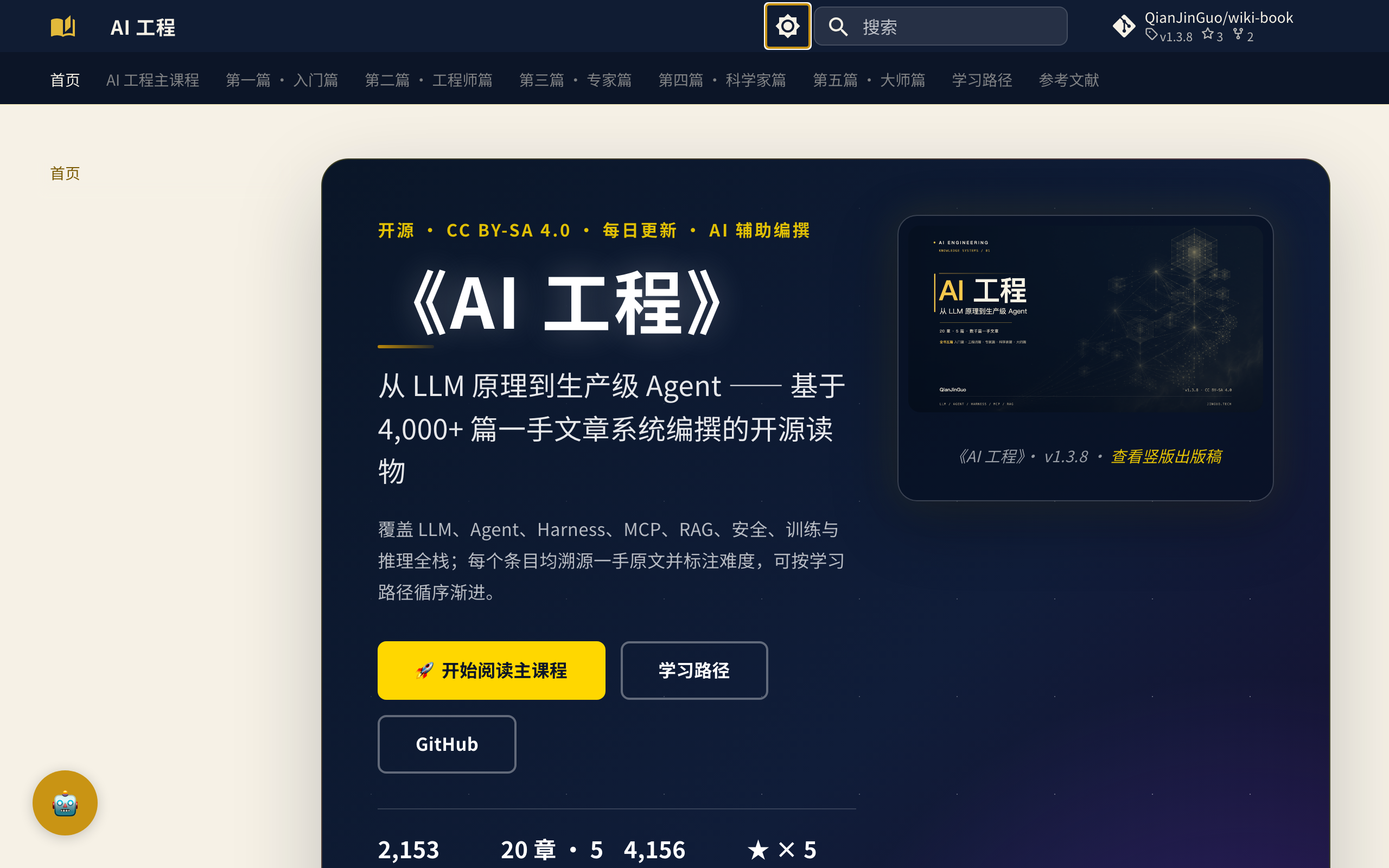
AI Engineering (《AI 工程》) is an open-source, continuously evolving book for engineers and researchers who want to truly understand, build, and deliver AI systems: working mental models of LLMs → the agent control loop → Harness, Tools, Skills, MCP, Memory, and Multi-Agent patterns → RAG, evaluation, tracing, security governance, and production deployment. Content is co-created by the AI community and the Hermes Agent, and every entry keeps its first-hand sources and difficulty rating, so claims stay traceable to evidence.
| 1,732 | 20 chapters · 5 parts | 4,017 | v1.3.8 |
|---|---|---|---|
| Curated entries | Book structure | Public source cards | Current version |
What you will learn
- Build working mental models of LLMs, Transformers, training, and inference.
- Grow from a minimal agent loop to Harness, Tools, Skills, MCP, Memory, and Multi-Agent patterns.
- Design RAG, evaluation, tracing, security governance, and deployment so AI applications reach production reliably.
- Follow the five-part path from beginner to mastery, or read chapters and topics independently.
The book at a glance
| Part | Core question | Chapters | Audience |
|---|---|---|---|
| 01 · Foundations | Understanding AI from zero | Ch01 AI & LLM Fundamentals · Ch02 Prompting & Context Engineering · Ch03 AI Tools & Product Landscape | Everyone |
| 02 · Engineer | Building AI applications | Ch04 Agents · Ch05 Harness · Ch06 Memory · Ch07 Tools / Skills / MCP · Ch08 Multi-Agent · Ch09 AI Coding · Ch10 RAG | Some programming experience |
| 03 · Expert | System architecture in depth | Ch11 Cloud Infrastructure & Deployment · Ch12 Security & Governance · Ch13 MLOps & Evaluation · Ch14 Data Engineering | ML background |
| 04 · Scientist | Research & innovation | Ch15 Training & Fine-Tuning · Ch16 Inference Optimization & Architectures · Ch17 Multimodal & Generation · Ch18 Robotics & Embodied AI | Researchers |
| 05 · Mastery | Philosophy, safety & the future | Ch19 Frontier Research & Theory · Ch20 AI Philosophy, Safety & the Future | Thinkers |
Core capabilities
| Capability | Description |
|---|---|
| Traceable content | Entries keep first-hand source leads with difficulty ratings and reading positions, so every claim can be traced back to evidence. |
| Multi-layer retrieval | A local in-browser index first, backed by BM25, semantic search, a neighbor graph, and a Pages Function fallback. |
| AI Chat | Retrieval before conversation: site knowledge becomes chat context, with RAG served from the Cloudflare environment. |
| Quality loop | Daily sync, score gating, exit curation, index rebuilds, and regression checks form a continuously maintained pipeline. |
The cover
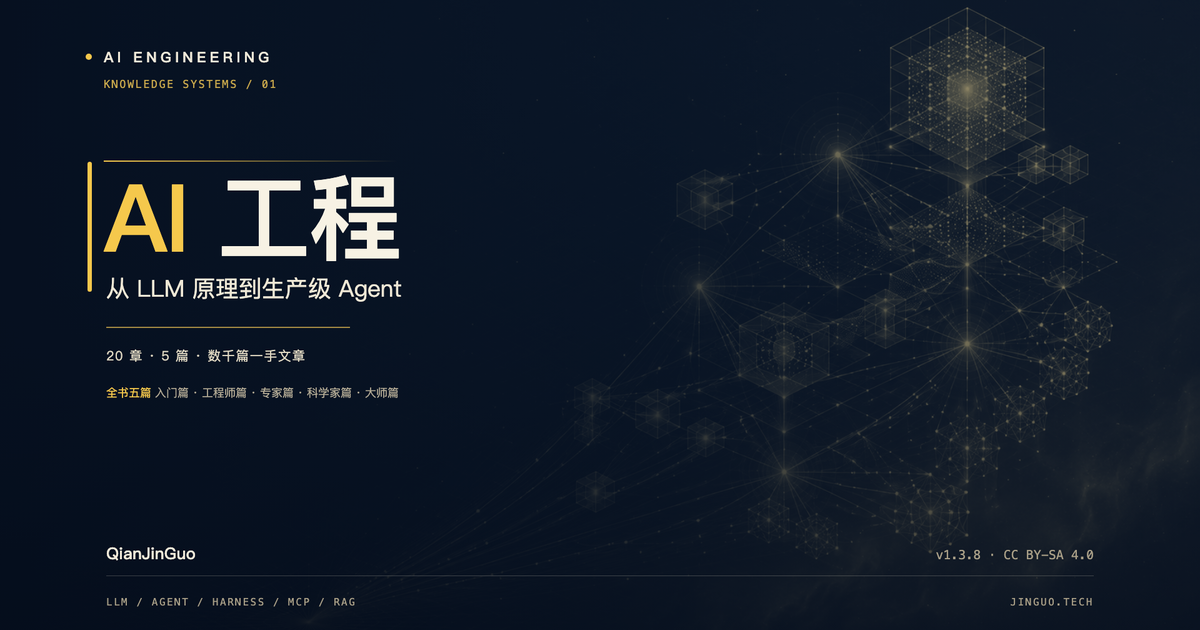
The cover visualizes "a knowledge system that can be engineered": modules, connections, and anchors on the right form an upward knowledge path, echoing the climb from LLM fundamentals to production-grade agents.
Click the cover at the top to view the 1600×2400 portrait edition. The landscape edition is used for the site homepage, social media, and share cards; before actual printing, publisher requirements such as author credit, ISBN, barcode, copyright page, bleed lines, and CMYK files still need to be confirmed.
Quick start
Read directly
Open jinguo.tech to read online, or visit the GitHub Pages mirror for the pure static version.
Local build & Docker
git clone https://github.com/QianJinGuo/wiki-book.git
cd wiki-book

python3 -m venv .venv
.venv/bin/pip install -r requirements.txt

# course / dashboard → MkDocs → slim search index → align neighbor graph
PYTHON=.venv/bin/python bash scripts/build.sh
docker compose up -d --build

# http://localhost:8002
scripts/build.sh is the only recommended build entry. Do not bypass it and deploy an unslimmed search index: index slimming and neighbor-graph generation must keep the same order and data source.
RAG regression
node test-rag.mjs
By default this only checks local Docker; production and GitHub Pages require an explicit target so regression tests are never mistaken for load tests:
node test-rag.mjs                                      # local Docker
RAG_TEST_TARGET=production ALLOW_PRODUCTION_TEST=1 node test-rag.mjs
RAG_TEST_TARGET=github node test-rag.mjs
npm test runs the local auth regression tests.
Deployment targets
| Environment | URL | Role |
|---|---|---|
| Cloudflare Pages | jinguo.tech | Production: Pages Functions + R2 + Vectorize |
| GitHub Pages | wiki.jinguo.tech | Static mirror: GitHub Actions |
| Docker | http://localhost:8002 |
Local development & preview |
# publish to Cloudflare Pages after building
./deploy/cloudflare/deploy.sh

# start Docker locally
docker compose up -d --build
Cloudflare secrets
wrangler.toml only stores resource identifiers for Pages, R2, Vectorize, and D1 — never API keys, tokens, or private keys. Production secrets are configured through Cloudflare Pages Secrets (e.g. SITE_TOKEN, XUNFEI_API_KEY, and USER_DATA_SECRET); when building Vectorize locally, provide least-privilege CLOUDFLARE_API_TOKEN and XUNFEI_API_KEY via environment variables and never commit them to the repository:
npx wrangler pages secret put SITE_TOKEN --project-name ai-engineering
npx wrangler pages secret put XUNFEI_API_KEY --project-name ai-engineering
npx wrangler pages secret put USER_DATA_SECRET --project-name ai-engineering
USER_DATA_SECRET signs learning-progress sync identities; losing a sync key means the client cannot recover that identity, and rotating the server-side key invalidates existing sync keys. See the Cloudflare Secrets documentation.
Project layout
docs/ch01–ch20/                 book chapters and publishable entries
docs/raw/articles/              third-party source cards (no full texts stored)
scripts/build.sh                unified build entry: course, index, MkDocs, neighbor graph
functions/                      Cloudflare Pages Functions and RAG endpoints
overrides/                      MkDocs theme overrides, AI Chat, and cover integration
cover/                          cover SVGs, render scripts, and editable assets
Publishing scope & maintenance boundaries
docs/raw/is excluded from MkDocs and never becomes site pages; the public repo keeps third-party source cards only, never full texts. Full texts, if needed locally, must live in a private source outside the repo.meta/and the rootAGENTS.mdare local maintainer material and not part of the public repo; public design notes and contribution workflows belong in sanitized docs.site/andcover/exports/are generated artifacts; the cover SVGs, render scripts, theme overrides, and source assets are the primary editing surfaces.
Contributing
You can help by:
- Submitting high-quality AI engineering articles — see the contributing guide.
- Reporting issues with content, links, the index, or deployment.
- Improving RAG retrieval, the evaluation system, or the build pipeline.
- Sharing the project so more people can build AI engineering skills.
License
| Content | License |
|---|---|
| Build scripts, RAG frontend/backend & engineering code | MIT |
Original book chapters & project docs (excluding docs/raw/) |
CC BY-SA 4.0 |
docs/raw/articles/ source cards |
No redistribution license is granted for third-party text; the source URL, author, and license fields on each card defer to the original source |
Continuously updated · Open collaboration · AI engineering in practice
v1.3.8 · 2026-09-05 · Maintained by Hermes Agent
Reviews (0)
Sign in to leave a review.
Leave a reviewNo results found