opendesign
Health Gecti
- License — License: NOASSERTION
- Description — Repository has a description
- Active repo — Last push 0 days ago
- Community trust — 64 GitHub stars
Code Uyari
- network request — Outbound network request in admin.js
Permissions Gecti
- Permissions — No dangerous permissions requested
Bu listing icin henuz AI raporu yok.
1,486 real web design systems, extracted into machine-readable specs. An MCP server for AI coding agents — so what they build has taste, not just working code.
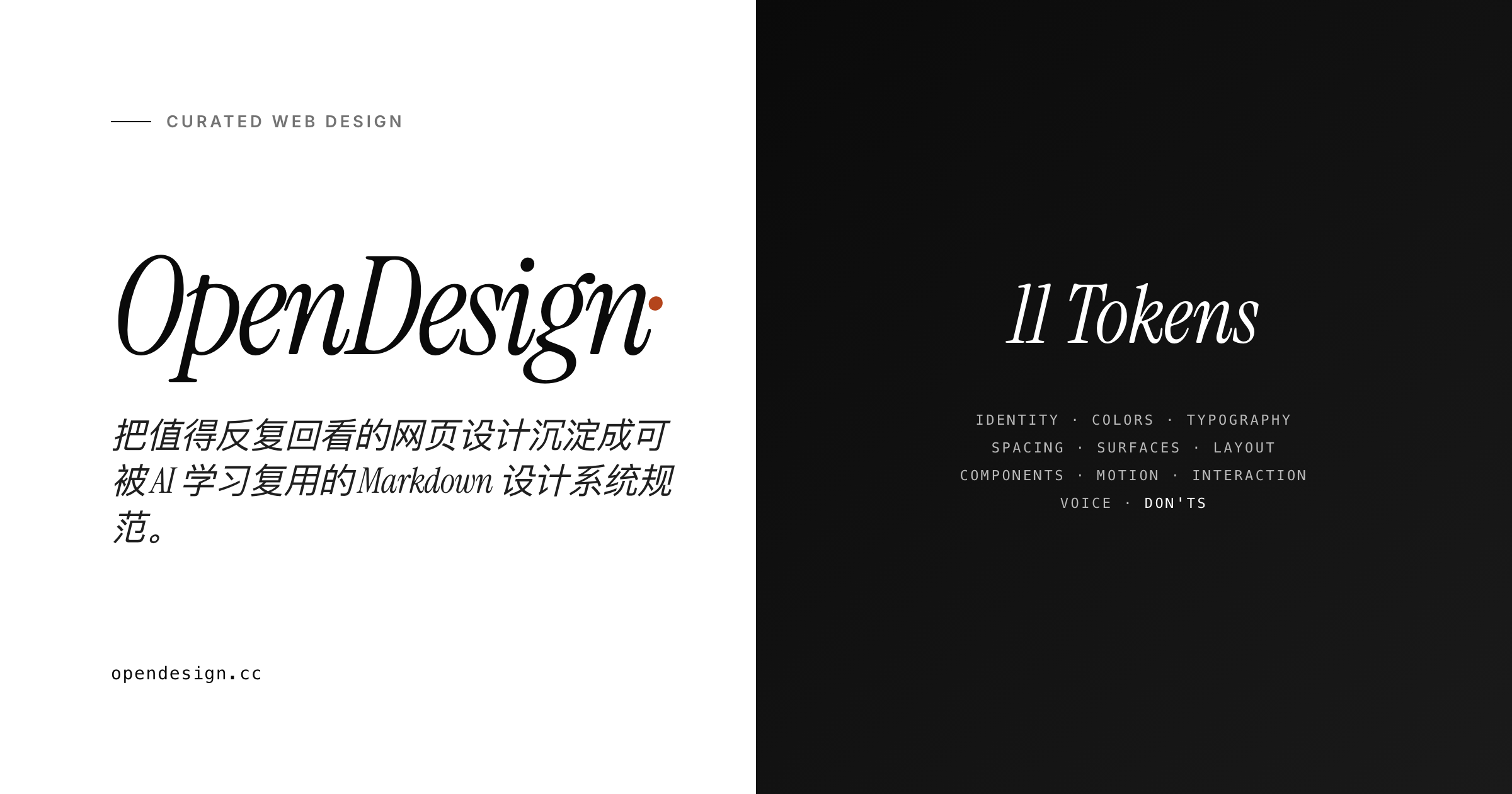
OpenDesign
The taste layer for AI-built software.
1,486 real design systems. Grounded tokens, not vibes. One line to connect.




Live site · MCP setup · Agent protocol · 中文说明
The problem
Ask any AI to build you a landing page. You get Inter, a blue-violet gradient hero, rounded-2xl on everything, a soft shadow on every card.
That's not a bug. It's the mathematical average of the training data — and an average has no brand. Every AI-built page ends up looking like every other AI-built page.
You can't prompt your way out of it. "Make it look premium" isn't executable. Pasting a screenshot isn't verifiable. The model still falls back to the mean.
The fix
Give the agent one real design system's actual values at the moment of generation.
"Build a fintech dashboard that feels trustworthy"
        ↓
  recommend_references()    → 1 primary + 2 alternates, deliberately different aesthetics
        ↓
  get_design_system("...")  → the REAL tokens from that site
        ↓
  { bg: "#08090A", ink: "#F7F8F8", muted: "#62666D",
    line: "rgba(255,255,255,0.08)", scale: [...], motion: {...} }
        ↓
  Every value traces to a design real humans shipped.
Not "Stripe-ish blue." The hex Stripe actually ships.
Connect it
Remote — nothing to install:
{ "mcpServers": { "opendesign": { "url": "https://opendesign.cc/mcp/http" } } }
Local — zero-dependency Node:
{ "mcpServers": { "opendesign": { "command": "npx", "args": ["-y", "opendesign-mcp"] } } }
Works with Claude Desktop, Claude Code, Cursor, Windsurf — any MCP client. No account, no API key, no rate card.
No MCP? Everything is static and public. GET https://opendesign.cc/skill.md turns any agent into a design director; catalog.json, packs/<slug>/spec.json and llms.txt are plain fetches.
The 7 tools
| Tool | What it does |
|---|---|
get_director_protocol |
Read first. The protocol: diagnose → form a POV → route → decompose |
recommend_references |
A brief in, 1 primary + 2 alternates from different aesthetic families — safe / bold / unexpected, enforced in code |
get_design_system |
The core one. A site's real grounded tokens |
search_designs |
Score-ranked search. Tells you which of your terms matched nothing instead of silently returning noise |
list_designs |
Browse the catalog |
fetch_design_spec_markdown |
The full spec as Markdown, 5 languages — drop straight into a prompt |
get_critique_rubric |
The 5-dimension review scorecard for "is this design any good?" |
Why the tokens are trustworthy
Every entry is extracted by driving a real browser (Playwright), reading getComputedStyle off the actual DOM, aggregating by frequency, and grounding a vision model's read against those measurements. The numbers are measured, not remembered.
| Typical inspiration gallery | OpenDesign | |
|---|---|---|
| What you get | A screenshot | Machine-readable token spec |
| Colors | You eyedrop them | Actual hex, frequency-ranked |
| Type | "looks like a grotesk" | Real scale: size / line-height / weight / tracking |
| Motion | — | Duration buckets + easing curves |
| Anti-patterns | — | An explicit don'ts list per site |
| For an agent | Unusable | One fetch = full design context |
1,486 sites · 920 with full Playwright screenshot packs · 5 languages · ~$0.10 marginal cost per site
What's actually in a spec
Two artifacts, two shapes — and the counts below are what you will literally find in the files, not a roadmap.
spec.json — all 1,486 sites, 6 measured token layers:
colors · typography · spacing · surfaces · layout · motion
Every value is read off the live page with Playwright + getComputedStyle, then grounded against the measurements. Nothing here is a model's impression of the site.
DESIGN.md — the 920 sites with full packs, 9 sections:
Overview · Colors · Typography · Layout · Elevation & Depth · Shapes · Components · Do's and Don'ts · System Prompt
The extra sections are the interpretive ones — component recipes, the anti-pattern list, and a paste-ready system prompt — which need the screenshots the pack pipeline produces.
Same shape across every site, so an agent that learns to read one has learned to read all of them. → layer definitions
// GET https://opendesign.cc/packs/linear/spec.json
{
  "colors": { "bg": "#08090A", "ink": "#F7F8F8", "muted": "#62666D",
              "line": "rgba(255,255,255,0.08)",
              "principle": "Extreme contrast for focus, subtle noise and semi-transparent layers for depth." },
  "typography": { "display": "grotesque-sans", "scale": [ /* size / lh / weight / ls */ ] },
  "spacing": { "base": 4, "scale": [4, 8, 16, 24, 32, 48, 64, 96] },
  "motion": { /* durations + easing */ },
  "surfaces": { /* radii, elevation strategy */ }
}
Also usable by humans
Browse opendesign.cc — infinite canvas, 5-language detail pages, downloadable design packs (spec + tokens + real screenshots as a ZIP).
Run your own
git clone https://github.com/qiuyiwu1989-star/opendesign
cd opendesign/extract && ./setup.sh
python3 extract.py https://your-site.com          # drive the browser, measure the DOM
python3 synthesize.py extracts/your-site-com      # → spec.json + DESIGN.md
./pack.sh extracts/your-site-com                  # → downloadable pack
Full pipeline, self-hostable: architecture · deployment · data pipeline
Docs
Concepts — positioning & first principles · layer definitions · design pack standard
Agent integration — MCP setup · agent integration · the director protocol
Operating it — curator workflow · quality gate · lessons learned
Contributing
- Propose a site — open an issue, takes a minute
- Fix a spec — spot a wrong color or a weak don'ts list? PR the entry
- Anything else — tools, docs, translations
Selection bar: a clear design DNA you can grasp in three pages, decomposable into tokens, with an opinion about what it refuses to do. Not: content farms, template SaaS, component-library soup. → CONTRIBUTING.md
License
Code MIT · Curated specs CC BY 4.0 (commercial use fine, keep attribution) · Original sites' assets © respective owners
@misc{opendesign2026,
  title  = {OpenDesign: an open standard for extracting reusable web design
            tokens via browser instrumentation and vision models},
  author = {Qiu, Yiwu and OpenDesign contributors},
  year   = {2026},
  url    = {https://opendesign.cc}
}
Made with ✦ by Qiu Yiwu
Yorumlar (0)
Yorum birakmak icin giris yap.
Yorum birakSonuc bulunamadi