building-ai-agents-with-csharp-and-dotnet-10
Health Uyari
- License — License: MIT
- Description — Repository has a description
- Active repo — Last push 0 days ago
- Low visibility — Only 5 GitHub stars
Code Gecti
- Code scan — Scanned 12 files during light audit, no dangerous patterns found
Permissions Gecti
- Permissions — No dangerous permissions requested
Bu listing icin henuz AI raporu yok.
Building AI Agents with C# and .NET 10, Second Edition: From First Agent to Reliable Production Systems with Microsoft Agent Framework. Companion code: 177 projects across 24 chapters, built on MAF 1.28, .NET 10 and C# 14.
Building AI Agents with C# and .NET 10, Second Edition
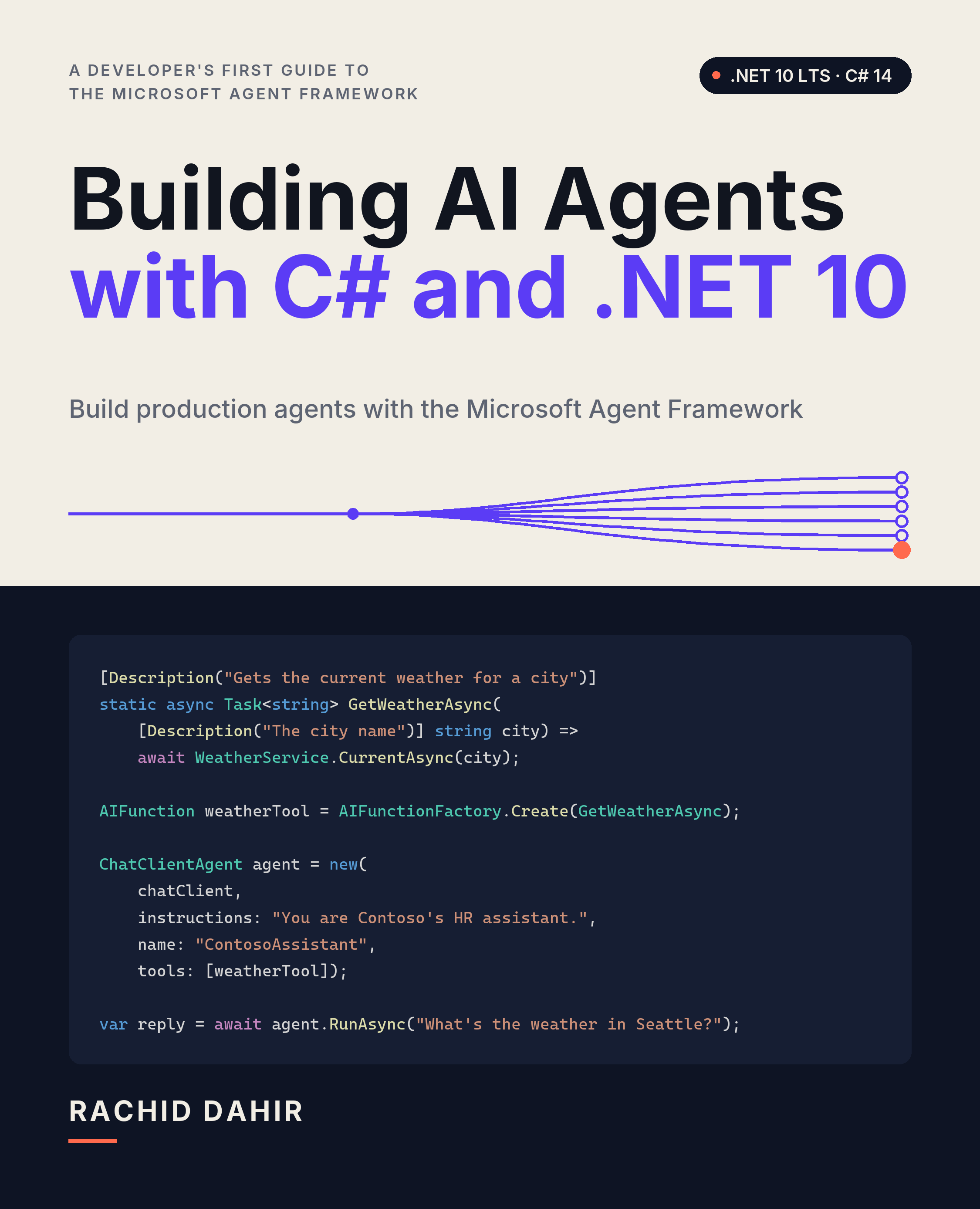
From First Agent to Reliable Production Systems with Microsoft Agent Framework
Companion code, errata and reader feedback for the second edition, by Rachid Dahir. The first edition's code is under the tag v1.1.0-maf-1.28.0 (see First edition).
What's in the book
The book builds AI agents in C# with the Microsoft Agent Framework (MAF) 1.28 on .NET 10 (LTS) and C# 14. It has six parts, 24 chapters and seven appendices, and one running example, Contoso's expense assistant, grows through eight versions (v0 to v7) from a first agent to a qualified release candidate. Payments are simulated: no sample moves real money.
The appendices are: A, C# Essentials for AI Development; B, Package Manifest and Qualification Scope; C, Migrating from Semantic Kernel and AutoGen (the full guides are in docs/migration); D, Glossary; E, Exercise Solutions and Project Mapping; F, Troubleshooting by Symptom; and G, References and Evidence.
Most samples have a --self-test mode. It runs against a scripted chat client, needs no model and no key, prints RESULT n/n and exits non-zero when a check fails, so the build workflow runs them all.
Companion code
177 projects in AgenticAI.slnx:
- 122 under
src/: the samples of 24 chapters, Appendix A, and the shared libraries insrc/Common - 47 worked exercise solutions under
exercises/, in 18 folders - 8 Contoso versions under
contoso/(v0-v7)
171 are runnable and 6 are libraries (AgenticAI.Common, AgenticAI.Common.Anthropic, AgenticAI.Common.Azure, AgenticAI.Common.Foundry, AgenticAI.Testing, Ch17.AspireOrchestration.ServiceDefaults).
Each project is self-contained, so pick the one for the chapter you're reading. Open AgenticAI.slnx once and every project loads together.
Projects by chapter
Folder and project names carry the second-edition chapter number. The Exercises column counts the worked solutions in that chapter's exercises/ChNN.Exercises folder; where a chapter has none, its exercises extend the chapter's projects in place, and Appendix E has the solution notes.
Part I: Understand and Start
10 chapter projects, 7 exercise projects.
| Ch | Chapter | Projects | Exercises |
|---|---|---|---|
| 1 | Choosing the Right Amount of Agency | src/Ch01.Agency (1): Ch01.FirstGlimpse |
0 |
| 2 | Models, Context and Capabilities | src/Ch02.ModelsContext (2): Ch02.CapabilityProfile, Ch02.TokenExplorer |
2 |
| 3 | A Reproducible Development Environment | src/Ch03.DevEnvironment (3): Ch03.AnthropicCall, Ch03.FirstLlmCall, Ch03.FoundryAgent |
2 |
| 4 | Your First Agent and Its First Test | src/Ch04.FirstAgent (4): Ch04.AgentTests, Ch04.BasicAgent, Ch04.MinimalApiAgent, Ch04.StreamingAgent |
3 |
Part II: Contracts and Authorized Actions
23 chapter projects, 12 exercise projects.
| Ch | Chapter | Projects | Exercises |
|---|---|---|---|
| 5 | Typed Responses and Domain Validation | src/Ch05.TypedResponses (5): Ch05.DomainValidation, Ch05.EntityExtraction, Ch05.ResponseFormat, Ch05.RobustExtraction, Ch05.TypedResponses |
3 |
| 6 | Conversations, Memory and Data Ownership | src/Ch06.ConversationsMemory (7): Ch06.AgentSessionDemo, Ch06.ContextBudget, Ch06.ContextProviderDemo, Ch06.PersistentSession, Ch06.ServiceManagedState, Ch06.SessionOwnership, Ch06.StatelessDemo |
5 |
| 7 | Tools and Bounded Execution | src/Ch07.Tools (7): Ch07.CalculatorTool, Ch07.DatabaseLookupTool, Ch07.FileAccess, Ch07.LoopControl, Ch07.ShellTool, Ch07.ToolChoice, Ch07.WeatherTool |
3 |
| 8 | Authorizing and Committing Agent Actions | src/Ch08.AuthorizedActions (4): Ch08.ActionPolicy, Ch08.IdempotentCommit, Ch08.ToolApproval, Ch08.UncertainOutcome |
1 |
Part III: Knowledge and Documents
19 chapter projects, 9 exercise projects.
| Ch | Chapter | Projects | Exercises |
|---|---|---|---|
| 9 | MCP Across Trust Boundaries | src/Ch09.MCP (6): Ch09.KnowledgeBaseMcp, Ch09.McpAccessTests, Ch09.McpConsumer, Ch09.McpHttpServer, Ch09.McpServer, Ch09.ProtectedMcpServer |
4 |
| 10 | Building a Grounded RAG Baseline | src/Ch10.RAGBaseline (5): Ch10.EmbeddingsDemo, Ch10.FaqAgent, Ch10.HostedFilesRag, Ch10.RagPipeline, Ch10.RetrievalEval |
2 |
| 11 | RAG With Permissions, Freshness and Evidence | src/Ch11.RAGPermissions (4): Ch11.AuthorizedSearch, Ch11.HybridRetrieval, Ch11.ScopedCache, Ch11.VersionedIngestion |
0 |
| 12 | Reliable Multimodal Document Processing | src/Ch12.MultimodalDocuments (4): Ch12.ImageToTypedData, Ch12.Multimodal.Tests, Ch12.ReceiptExtraction, Ch12.VisionBasics |
3 |
Part IV: Composition and Durable Execution
29 chapter projects, 5 exercise projects.
| Ch | Chapter | Projects | Exercises |
|---|---|---|---|
| 13 | Choosing a Multi-Agent Topology | src/Ch13.MultiAgentTopology (9): Ch13.ConcurrentOrchestration, Ch13.GroupChatOrchestration, Ch13.HandoffOrchestration, Ch13.MagenticOrchestrator, Ch13.MultiAgent.Tests, Ch13.OrchestratorPattern, Ch13.SequentialPipeline, Ch13.StreamingPipeline, Ch13.TopologyComparison |
2 |
| 14 | Workflows, Branches and Human Review | src/Ch14.Workflows (9): Ch14.AgentWorkflow, Ch14.ApprovalWorkflow, Ch14.CheckpointedApproval, Ch14.ConditionalWorkflow, Ch14.LoopEngineering, Ch14.ParallelAnalysis, Ch14.SequentialWorkflow, Ch14.SubWorkflow, Ch14.WorkflowTests |
2 |
| 15 | Durable Execution and External Effects | src/Ch15.DurableExecution (3): Ch15.DurableReview, Ch15.ExternalEffects, Ch15.RestartTests |
1 |
| 16 | Skills, Harnesses and Capability Lifecycle | src/Ch16.SkillsHarnesses (8): Ch16.AgentSkills, Ch16.CodingAgent, Ch16.HarnessBackgroundAgents, Ch16.HarnessBasics, Ch16.HarnessComposition, Ch16.HarnessFiles, Ch16.HarnessLoop, Ch16.SkillLifecycle |
0 |
Part V: Interfaces, Security and Observation
22 chapter projects, 9 exercise projects.
| Ch | Chapter | Projects | Exercises |
|---|---|---|---|
| 17 | Hosting, Identity and Tenant Isolation | src/Ch17.HostingIdentity (5): Ch17.A2APreview, Ch17.AspireOrchestration.AppHost, Ch17.AspireOrchestration.ServiceDefaults, Ch17.AspNetCoreHost, Ch17.IdentityTests |
3 |
| 18 | Streaming Interfaces and Approval Experiences | src/Ch18.StreamingInterfaces (5): Ch18.AguiClient, Ch18.AguiServer, Ch18.ApprovalUi, Ch18.InterfaceTests, Ch18.SseStatusStream |
0 |
| 19 | Observability, Quality and Incident Diagnosis | src/Ch19.Observability (2): Ch19.IncidentDiagnosis, Ch19.OpenTelemetryAgent |
2 |
| 20 | Security Policies and Governance | src/Ch20.SecurityGovernance (10): Ch20.ConsumptionLimits, Ch20.ContentSafety, Ch20.CriticAgent, Ch20.IndirectInjection, Ch20.InputSanitization, Ch20.MessageInjector, Ch20.MiddlewarePipeline, Ch20.OutputHandling, Ch20.PolicyEnforcement, Ch20.ThreatRegisterTests |
4 |
Part VI: Qualification and Operations
12 chapter projects, 1 exercise project.
| Ch | Chapter | Projects | Exercises |
|---|---|---|---|
| 21 | Evaluation With Evidence and Uncertainty | src/Ch21.Evaluation (6): Ch21.EvalSuite, Ch21.EvalTests, Ch21.EvidenceEval, Ch21.FaqEval, Ch21.JudgeCalibration, Ch21.RedTeam |
0 |
| 22 | Cost, Latency and Capacity Engineering | src/Ch22.CostCapacity (3): Ch22.CostModel, Ch22.LoadProfile, Ch22.ModelRouting |
1 |
| 23 | Qualifying the Contoso Agent System | src/Ch23.Qualification (1): Ch23.QualificationRunner |
0 |
| 24 | Operating and Evolving Agents | src/Ch24.Operations (2): Ch24.KillSwitch, Ch24.RestoreDrill |
0 |
Outside the chapters
| Folder | Projects |
|---|---|
src/AppA.CSharpEssentials, Appendix A |
2: AppA.ConsoleApp, AppA.MinimalApi |
exercises/AppA.Exercises, Appendix A |
4: Ex01.RecordPatterns, Ex02.AsyncFileProcessor, Ex03.MinimalApiCrud, Ex04.JsonRoundTrip |
src/Common, shared libraries |
5: AgenticAI.Common, AgenticAI.Common.Anthropic, AgenticAI.Common.Azure, AgenticAI.Common.Foundry, AgenticAI.Testing |
contoso/, the running example |
8: Contoso.AgentFakeModel, Contoso.OwnedConversation, Contoso.AuthorizedReimbursement, Contoso.FaqEvidence, Contoso.Receipts, Contoso.DurableResume, Contoso.ApiUi, Contoso.Qualified |
Ch13.MagenticOrchestrator and exercises/AppA.Exercises/Ex02.AsyncFileProcessor are in the repository but not printed in the book.
Contoso, v0 to v7
Each version has its own folder under contoso/ and a README. v0, v1 and v2 stand alone. From v3 on, a version references the one it extends: v3 and v4 build on v2, v5 on v4, v6 on v5, and v7 on v6 (and on v3, whose FAQ desks it runs behind its answer contract). Opening v5 brings v4 and v2 along, so any version runs without the earlier chapters.
| Version | Folder | Built in | What it adds |
|---|---|---|---|
| v0 · Agent and fake model | v0-agent-fake-model |
Chapter 4 | The assistant as an agent with instructions, checked against a scripted fake model before any model is called |
| v1 · Owned conversation | v1-owned-conversation |
Chapter 6 | Conversations that survive a restart, belong to one employee and can be deleted |
| v2 · Authorized reimbursement | v2-authorized-reimbursement |
Chapter 8 | The model proposes a reimbursement, application policy decides, and the commit happens once, with an explicit outcome when the result is uncertain |
| v3 · FAQ with evidence | v3-faq-evidence |
Chapters 10 and 11 | Policy answers grounded in handbook passages the employee may see, with citations checked against what was retrieved; no evidence, no answer |
| v4 · Receipts | v4-receipts |
Chapter 12 | Receipt images read into typed fields and validated; an amount nobody can read goes to a reviewer, not to payment |
| v5 · Durable resume | v5-durable-resume |
Chapter 15 | A claim waiting for review survives the loss of its process; the payment happens once or ends as an explicit unknown |
| v6 · API and interface | v6-api-ui |
Chapters 17 and 18 | An HTTP API with a validated identity on every request, and an interface that shows operation state and lets a reviewer approve exact arguments |
| v7 · Qualified version | v7-qualified |
Chapter 23 | v6 frozen as an identifiable candidate, with a candidate manifest, an acceptance matrix, a release dossier and its known limits; the requester assistant with tools by role and an answer contract |
Recommended path
New to agents? Read the book in order: Parts I and II are the base everything else stands on, and Chapter 8 is the one the rest of the book keeps returning to. In the code, start with:
src/Ch03.DevEnvironment/Ch03.FirstLlmCall: one call to a model, and--config-checkto see which settings load.src/Ch04.FirstAgent/Ch04.BasicAgentandCh04.AgentTests: the first agent and its first test.src/Ch05.TypedResponses/Ch05.DomainValidation: a typed result checked first for shape, then against the domain rules.src/Ch06.ConversationsMemory/Ch06.SessionOwnership: a stored conversation that belongs to one person.src/Ch07.Tools/Ch07.LoopControl: the limits on the tool-calling loop.src/Ch08.AuthorizedActions/Ch08.ActionPolicyandCh08.IdempotentCommit: the application decides, and the commit happens once.contoso/v0-agent-fake-modeltocontoso/v2-authorized-reimbursement: the same ideas composed into one assistant.
Run each with --self-test where it has one (all of these except Ch04.BasicAgent), then against a model. The full outputs of the runs printed in the book, self-tests and live runs, are in docs/outputs; the book trims them to fifteen lines.
Build
Prerequisites
- A .NET SDK at or above 10.0.100.
global.jsonasks for10.0.100withrollForward: latestMajor, so the newest installed SDK at or above it builds the code, a .NET 11 SDK included. Every project targetsnet10.0with C# 14 (Directory.Build.props). - For live runs, a model provider. The samples default to Ollama on your own machine, with no key:
llama3.2for chat,nomic-embed-textfor embeddings andllavafor images.
ollama pull llama3.2
ollama pull nomic-embed-text
ollama pull llava
The self-tests need none of this.
Clone, restore and build
git clone https://github.com/RachidD68/building-ai-agents-with-csharp-and-dotnet-10.git
cd building-ai-agents-with-csharp-and-dotnet-10
dotnet restore AgenticAI.slnx --locked-mode
dotnet build AgenticAI.slnx --configuration Release --no-restore -warnaserror
On Windows, if the clone fails with "Filename too long", run git config --global core.longpaths true and clone again.
Every project except the Aspire AppHost commits a packages.lock.json, and --locked-mode fails if the dependency graph has drifted from it. The AppHost has no lock file, because its SDK pulls per-OS packages, and restores normally in the same command. After changing a version in Directory.Packages.props, a plain dotnet restore AgenticAI.slnx refreshes the lock files.
Every package version is pinned once, in Directory.Packages.props (Central Package Management); the .csproj files carry no version numbers. The exception is the Aspire AppHost, which pins its own Aspire packages; the one package not on the 1.28 line is described under Framework exceptions. Appendix B of the book lists every package with its version and status.
Run the self-tests
One project:
dotnet run --project src/Ch08.AuthorizedActions/Ch08.ActionPolicy -- --self-test
The four console test harnesses run with no argument:
dotnet run --project src/Ch12.MultimodalDocuments/Ch12.Multimodal.Tests
dotnet run --project src/Ch13.MultiAgentTopology/Ch13.MultiAgent.Tests
dotnet run --project src/Ch14.Workflows/Ch14.WorkflowTests
dotnet run --project src/Ch21.Evaluation/Ch21.EvalTests
The build workflow does all of it on Windows and Ubuntu: a locked restore, a Release build with warnings as errors, every --self-test it finds by searching for args.Contains("--self-test") (so a new one is picked up without editing the workflow), the four harnesses, a check that AgenticAI.Common resolves only GA packages (pwsh tools/check-ga.ps1), a check that this README's project counts match AgenticAI.slnx (pwsh tools/readme-counts.ps1), and a scan that fails on any vulnerable package. It also runs weekly, because a new NuGet advisory can break a build nobody touched.
Run a sample against a model
dotnet run --project src/Ch04.FirstAgent/Ch04.BasicAgent
What was run, and what was only compiled
The book's Preface and Appendix B state the qualification scope. In short:
- Built: a locked restore and a Release build with warnings as errors, finishing clean.
- Self-tests: run on Windows 11 and, for the samples that could, in a .NET 10 Linux container with its network off.
- Live runs: against a local Ollama only (
llama3.2,nomic-embed-text,llava). Your model will word its answers differently; the checks that matter are in the self-tests. - Compiled but not run: Azure OpenAI, OpenAI, Anthropic, Microsoft Foundry, Azure AI Content Safety and the Azure Monitor exporter compile, and their configuration checks and offline tests run, but no request reached those services. Microsoft Entra ID never issued a token: the hosting tests use tokens minted locally with
dotnet user-jwts. The Aspire AppHost compiles but was not run. macOS was not tested.
Treat the cloud paths as code you still have to qualify against your own subscription.
Framework exceptions
Every Microsoft.Agents.AI* package is on 1.28.0 (the preview packages on 1.28.0-preview.261106.1), with one exception:
- The AG-UI client is on 1.13.0-preview. NuGet has no 1.28 build of
Microsoft.Agents.AI.AGUI;1.13.0-preview.260703.1is the newest published, andCh18.AguiClientuses it. The server side,Microsoft.Agents.AI.Hosting.AGUI.AspNetCore, is1.28.0-preview.261106.1, on the same line asMicrosoft.Agents.AI.Hosting, with no version override.Ch18.AguiClient's self-test runsAGUIChatClient1.13 against that server, and the streamed run, with a server-side tool call, completes. OnlyCh18.AguiServerandCh18.AguiClientreference AG-UI (Ch18.InterfaceTeststhrough them).
Microsoft.Agents.AI.Workflows.Declarative is on 1.28.0 with the rest. Ch14.WorkflowTests records two behaviours that changed from 1.20.0: a reused built workflow no longer carries Global state into the next run, and MaximumExpressionLength is no longer enforced on the expressions it tests (a DEFECT REPRODUCED line). Its DefaultHttpRequestHandler now takes an allow-list of hosts and checks every redirect hop against it.
The comment in Directory.Packages.props records the client exception.
Configuration
Provider settings live in each project's appsettings.json, under LlmProvider. Keys belong in .NET User Secrets or environment variables, never in source control. Every sample shares one user-secrets store, so a value you set once works in every chapter, and no dotnet user-secrets init is needed. Run these from any project folder:
cd src/Ch03.DevEnvironment/Ch03.FirstLlmCall
dotnet user-secrets set "LlmProvider:Provider" "openai"
dotnet user-secrets set "LlmProvider:OpenAI:ApiKey" "YOUR-KEY"
Azure OpenAI works in the samples that reference AgenticAI.Common.Azure (see Shared libraries to add it to any other). It signs in with Microsoft Entra ID by default (run az login once; your account needs the Cognitive Services OpenAI User role on the resource). An API key is optional:
dotnet user-secrets set "LlmProvider:Provider" "azure"
dotnet user-secrets set "LlmProvider:AzureOpenAI:Endpoint" "https://YOUR-RESOURCE.openai.azure.com/"
dotnet user-secrets set "LlmProvider:AzureOpenAI:Model" "YOUR-DEPLOYMENT-NAME"
User secrets load in the Development environment, which each sample's launch profile sets (dotnet run and Visual Studio both use it). Environment variables work everywhere: LlmProvider__Provider, LlmProvider__OpenAI__ApiKey, and for Anthropic either LlmProvider__Anthropic__ApiKey or ANTHROPIC_API_KEY. Microsoft Foundry signs in through DefaultAzureCredential.
Not sure which settings a sample will use? dotnet run -- --config-check lists each one and where it comes from (appsettings.json, user secrets or an environment variable) without printing values or calling a model.
Shared libraries
The provider wiring is split so the default path stays generally available:
| Library | What it adds | Package status |
|---|---|---|
src/Common/AgenticAI.Common |
AddLlmChatClient with the openai and ollama providers, settings, --config-check, the resilience handler |
GA only, transitive packages included (pwsh tools/check-ga.ps1 proves it from the lock file) |
src/Common/AgenticAI.Common.Azure |
the azure provider: services.AddAzureOpenAIProvider() |
prerelease (Azure.AI.OpenAI is a beta) |
src/Common/AgenticAI.Common.Foundry |
AddFoundryAgent(...), a Microsoft Foundry AIAgent |
preview (Microsoft.Agents.AI.Foundry, Azure.AI.Projects) |
src/Common/AgenticAI.Common.Anthropic |
AddAnthropicAgent(...), a Claude AIAgent |
GA |
src/Common/AgenticAI.Testing |
FakeChatClient and ScriptedToolChatClient, the scripted clients the self-tests run on (the second can ask for tool calls), and RecordingChatClient, which records the calls made to a real client |
GA |
Each sample references only the libraries it uses. To run a sample that references only AgenticAI.Common against Azure OpenAI, add a project reference to src/Common/AgenticAI.Common.Azure and one line next to AddLlmChatClient:
builder.Services.AddAzureOpenAIProvider();   // before or after AddLlmChatClient
builder.Services.AddLlmChatClient(builder.Configuration);
Without it, "Provider": "azure" stops at startup with a message that says exactly this.
First edition
The first edition's companion code, in its v1.1 update on MAF 1.28.0, is under the tag v1.1.0-maf-1.28.0:
git checkout v1.1.0-maf-1.28.0
Its errata are in that tag's ERRATA.md and README.md.
The second edition renumbered the chapters, renamed the folders, and merged, absorbed or retired a few projects. docs/first-edition-map.md lists where each of the first edition's 127 projects went; Appendix E of the book prints the same map. By folder:
| First edition | Second edition |
|---|---|
src/Ch01.FirstGlimpse |
src/Ch01.Agency |
src/Ch02.CSharpEssentials |
src/AppA.CSharpEssentials (now Appendix A) |
src/Ch03.HowLLMsWork |
src/Ch02.ModelsContext |
src/Ch04.DevEnvironment |
src/Ch03.DevEnvironment |
src/Ch05.HelloAgent |
src/Ch04.FirstAgent |
src/Ch06.ConversationsMemory |
src/Ch06.ConversationsMemory (Ch06.HistoryReduction absorbed into Ch06.ContextBudget) |
src/Ch07.StructuredOutput |
src/Ch05.TypedResponses |
src/Ch08.ToolsFunctionCalling |
src/Ch07.Tools; Ch08.ToolApproval moved to src/Ch08.AuthorizedActions |
src/Ch09.MCP |
src/Ch09.MCP |
src/Ch10.IntroRAG |
src/Ch10.RAGBaseline (Ch10.FaqAgent.CustomProvider absorbed into Ch10.FaqAgent) |
src/Ch11.Multimodal |
src/Ch12.MultimodalDocuments |
src/Ch12.MultiAgent |
src/Ch13.MultiAgentTopology (Ch12.ContentPipeline absorbed into Ch13.SequentialPipeline) |
src/Ch13.Workflows |
src/Ch14.Workflows (Ch13.A2AInputRequest retired: A2A task mode is out of scope) |
src/Ch14.Hosting |
src/Ch17.HostingIdentity |
src/Ch15.Observability |
src/Ch19.Observability |
src/Ch16.SafetyGuardrails |
src/Ch20.SecurityGovernance; Ch16.ToolApproval merged into src/Ch08.AuthorizedActions/Ch08.ToolApproval |
src/Ch17.AgentSkills |
src/Ch16.SkillsHarnesses |
src/Ch18.EvalSuite, src/Ch18.EvalTests, src/Ch18.FaqEval |
src/Ch21.Evaluation |
src/Ch19.AgentHarness |
src/Ch16.SkillsHarnesses |
src/Common |
src/Common (split into a GA-only core and add-ons) |
exercises/ChNN.Exercises |
renumbered with their chapters; the map lists each one |
Errata and feedback
Second-edition corrections are in ERRATA.md.
Found a typo, an outdated API, a code sample that doesn't compile, or a factual mistake?
- Open an errata report: a form that asks for the edition, page, chapter and what's wrong.
- Browse known errata before filing a duplicate.
For questions about the companion code or suggestions, use the Issues tab without the errata label.
License
- The companion code in this repository is released under the MIT License.
- The book is sold separately on Leanpub; the copyright page is inside the book.
.NET 10 LTS · C# 14 · Microsoft Agent Framework 1.28
Yorumlar (0)
Yorum birakmak icin giris yap.
Yorum birakSonuc bulunamadi