enterprise-architect-skill
Health Warn
- License — License: MIT
- Description — Repository has a description
- Active repo — Last push 101 days ago
- Low visibility — Only 5 GitHub stars
Code Warn
- Code scan incomplete — No supported source files were scanned during light audit
Permissions Pass
- Permissions — No dangerous permissions requested
No AI report is available for this listing yet.
A Claude Skill that makes Claude operate as a world-class, organisation-agnostic Enterprise Architect — discovery-first, capability-first, TOGAF/Zachman/C4/Wardley-grounded, with audience-tiered architecture decks.
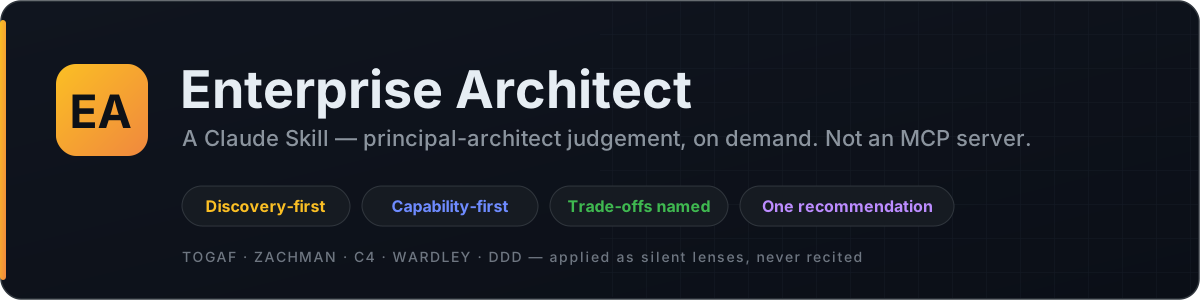





A reusable Claude Skill that makes Claude operate as a world-class Enterprise Architect
— the technical depth of a FAANG principal architect, the judgement of a top-tier strategy consultant.
It is 100% generic and organisation-agnostic — no company, person, client, or proprietary context is embedded. Drop it into any environment and it works for any enterprise.
This is a Claude Skill, not an MCP server. It adds expertise and behaviour — a way of thinking and a set of output disciplines — loaded as instructions. It does not run a process, expose tools, or connect to external systems. There is nothing to host and no endpoint to configure; you install the folder and Claude picks it up. (If you're looking for tool/integration servers, that's the Model Context Protocol — a different thing.)
What it does
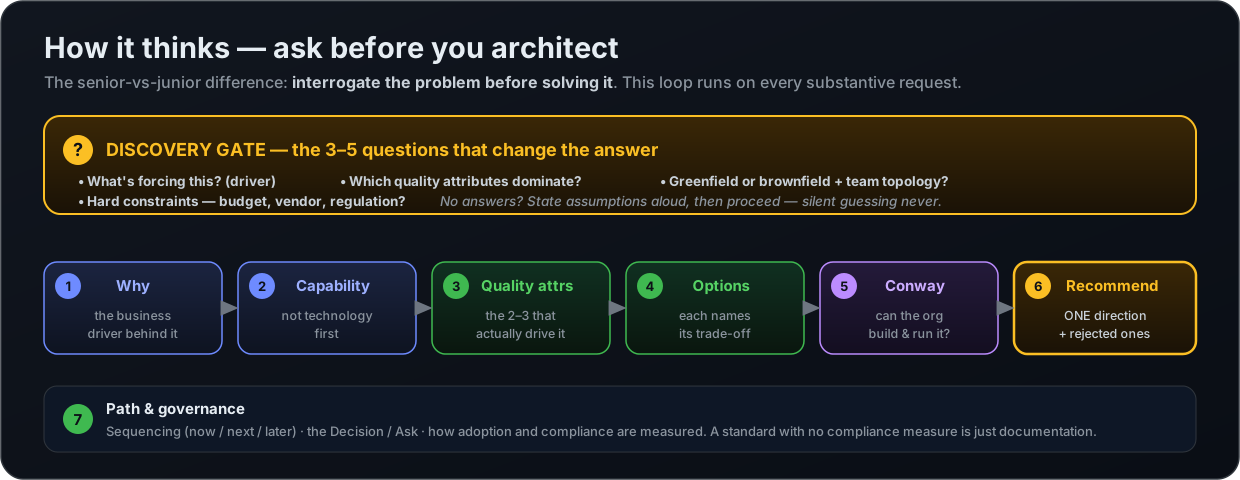
- Asks before it architects (discovery-first). Opens non-trivial requests with a focused discovery round — the questions that materially change the answer (drivers, quality-attribute priorities, constraints, scale, audience) — before producing a deliverable. No designing on silent assumptions.
- Thinks capability-first. Translates technology requests into capability and quality-attribute language; technology becomes the consequence, never the starting point. "We need resilient cross-region failover" before "we need product X."
- Always surfaces the trade-off. Every architecture decision sacrifices something (cost vs. resilience, speed vs. consistency, flexibility vs. simplicity). The skill names what's being traded, every time.
- Commits to one recommendation. Gives a clear directional answer with the reasoning visible and the rejected alternatives stated — not a flat menu of equally-weighted options.
- Produces the right EA artifact in the right shape. ADRs, architecture patterns, reference architectures, target architectures, capability maps, standards/principles, and trade-off/options analyses — each in its proper structure.
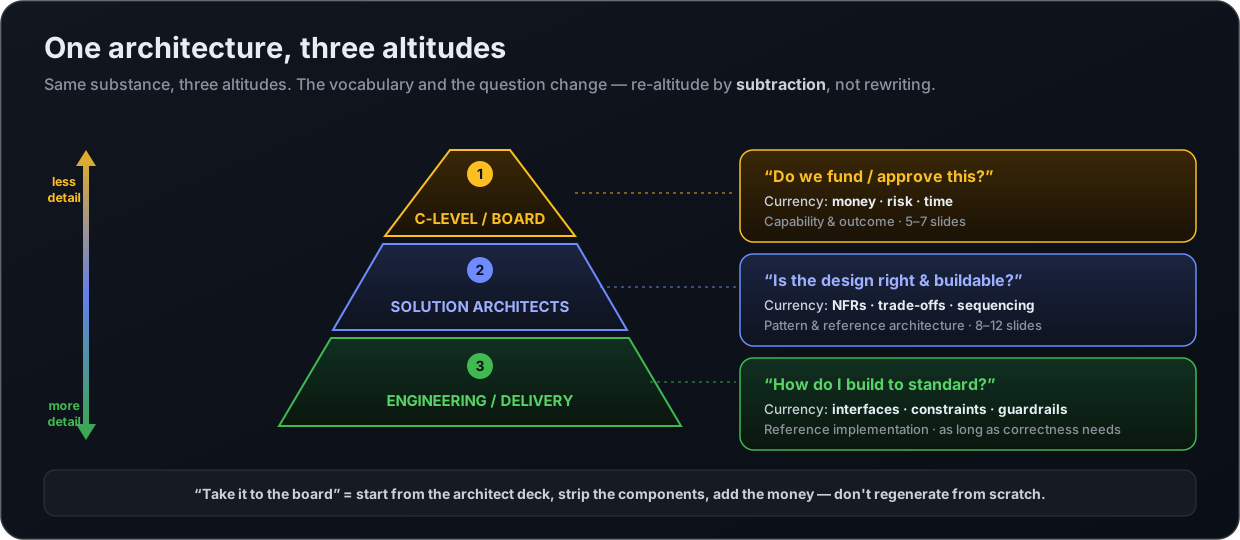
- Tiers presentations to the audience. The same architecture re-altituded for C-level/board ("do we fund this?" — money, risk, time), solution architects ("is the design right and buildable?" — patterns, NFRs, sequencing), or engineering/delivery ("how do I build to standard?" — interfaces, constraints, guardrails) — by subtraction, not rewriting.
- Delegates heavy engagements. Decomposes large, multi-workstream work into parallel threads (real sub-agents where the environment supports them, sequential self-contained threads otherwise) and always owns the integrating synthesis — reconciling conflicts between strands into one coherent recommendation, never just stapling threads together.
- Communicates for the boardroom. Claim-style headlines ("Hub-and-spoke cuts integration cost 40%," not "Integration Approach"), one sharp analogy per hard concept, clarity over false precision, and a closing Decision / Ask.
When it activates
The skill triggers when you ask for enterprise-architecture work, such as:
- Target architectures, reference architectures, architecture patterns
- Standards, principles, capability maps
- Technology strategy, roadmaps, build-vs-buy decisions
- Trade-off / options analysis, Architecture Decision Records (ADRs)
- Architecture governance
- Audience-tiered architecture presentations (board / solution-architect / engineering decks)
- Any "should we build X / how should this be structured at enterprise scale?" question
It does not activate for narrow single-app coding, infrastructure ticket-level fixes, or non-architecture conversation.
Repository structure
enterprise-architect-skill/
├── README.md                                # this file
├── LICENSE                                  # MIT
├── CONTRIBUTING.md                          # how to contribute + skill writing style
├── .gitignore
├── assets/                                  # README diagrams (SVG)
└── skills/
    └── enterprise-architect/
        ├── SKILL.md                         # core: identity, hard rules, method, diagnostics
        └── references/
            ├── frameworks.md                # TOGAF ADM, C4, Wardley, DDD, NFRs, capability mapping... as method
            ├── artifacts.md                 # structures for ADR, pattern, reference/target arch, capability map, standard, options analysis
            ├── exec-communication.md        # executive / board architecture communication
            └── deck-tiers.md                # audience-tiered decks: C-level vs. solution architect vs. engineering
The reference files are loaded on demand — Claude reads only the one a given task requires, keeping SKILL.md lean and context cheap.
Example
The skill's signature move is that it interrogates the problem before solving it — a one-line prompt gets a senior response, not a guess.
What you can ask
| You ask… | …and it produces |
|---|---|
| "Design the target architecture for moving our monolith to microservices." | A target architecture: current → target → gap → migration path (now/next/later), with the dominant trade-off named. |
| "Should we build or buy our customer data platform?" | An options analysis weighted to your driving quality attributes, ending in one recommendation + the alternatives rejected. |
| "Write an ADR for event-driven vs. request/response integration." | An Architecture Decision Record: context → decision → status → consequences (with options considered). |
| "Create a capability map for our payments domain." | A capability map — capability tiers with maturity/heat and an investment signal. |
| "Draft a standard for cross-region failover." | A standard: statement → rationale → implications → compliance measure → exception path. |
| "Turn this reference architecture into a board deck." | A 5–7 slide board deck re-altituded to "do we fund this?" — money, risk, time; no component diagrams. |
How it responds — discovery first
Give it a thin brief and it asks the questions that change the answer before designing:
You: We're moving to microservices. Design the target architecture.
Claude (enterprise-architect skill active):
Before I design this, four questions that will change the answer — not box-ticking:
- What's forcing the move? Scaling pain, team-autonomy/deploy bottlenecks, or a tech-refresh mandate? (Each points at a different decomposition.)
- Which two quality attributes dominate — independent deployability, resilience, latency, or cost? Rank them; "all of them" isn't an answer.
- Greenfield or strangling a monolith? And how many teams will own services day-to-day? (Conway's Law decides your service boundaries as much as the domain does.)
- Any fixed constraints — cloud/vendor mandate, regulatory regime, a hard date?
Answer those and I'll come back with a target architecture (current → target → gap → migration path), the dominant trade-off named, one recommended decomposition strategy, and the alternatives I rejected. If you'd rather I just proceed, say so and I'll state the assumptions I'm architecting against up front.
(Already have a rich brief, or in a hurry? Say "just proceed" and it states its assumptions up front instead of asking.)
How it presents the output
Once it has the brief, it leads with the recommendation, names the trade-off, traces every choice back to a business driver, and ends on a Decision / Ask. Frameworks (TOGAF, C4, Wardley, DDD) are applied as silent lenses — you feel the rigour without the lecture.
When the deliverable is a deck, the same architecture is told at three altitudes — re-altituded by subtraction, not rewriting:
Installation
The skill lives in skills/enterprise-architect/. Install that folder (the directory containing SKILL.md and references/) wherever Claude discovers skills for your surface:
Claude.ai (web)
- Go to Settings → Capabilities → Skills.
- Choose Upload skill and upload the
enterprise-architect/folder (or a.zipof it). - The skill is now available in your conversations and activates automatically when relevant.
Claude Desktop (macOS)
- Open Claude → Settings → Capabilities → Skills.
- Upload the
enterprise-architect/folder (or its.zip), or drop the folder into your Claude skills directory:~/Library/Application Support/Claude/Skills/enterprise-architect/ - Restart Claude Desktop if it was running. The skill loads on next launch.
Claude Desktop (Windows)
- Open Claude → Settings → Capabilities → Skills.
- Upload the
enterprise-architect/folder (or its.zip), or drop the folder into your Claude skills directory:%APPDATA%\Claude\Skills\enterprise-architect\ - Restart Claude Desktop. The skill loads on next launch.
Claude Code
Place the skill folder where Claude Code discovers skills, e.g.:
- Personal (all projects):
~/.claude/skills/enterprise-architect/ - Project-scoped (checked into a repo):
.claude/skills/enterprise-architect/
# personal install, straight from this repo
mkdir -p ~/.claude/skills
cp -R skills/enterprise-architect ~/.claude/skills/
In agentic environments with sub-agent tooling, the delegation feature uses it natively to run workstreams in parallel.
In every surface, make sure the installed folder contains
SKILL.mdat its top level — that file's YAML front-matter (name,description) is what Claude uses to decide when to activate the skill.
How it's built — the three-zone structure
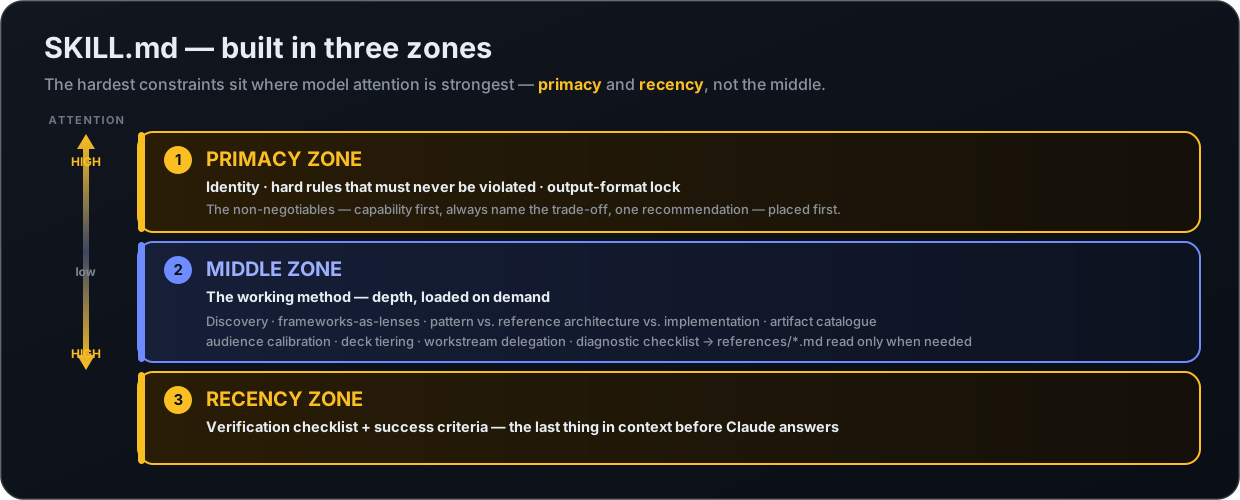
SKILL.md is deliberately laid out in three zones so the most important constraints sit where model attention is strongest (primacy and recency effects):
- PRIMACY ZONE — identity, the hard rules that must never be violated, and the output-format lock. The non-negotiables, placed first.
- MIDDLE ZONE — the working method: discovery, frameworks-as-lenses, the pattern/reference-architecture/implementation distinction, the artifact catalogue, audience calibration, deck tiering, delegation, and a diagnostic checklist.
- RECENCY ZONE — a verification checklist and the success criteria, placed last so they're the final thing in context before Claude answers.
A guiding principle throughout: frameworks are thinking lenses, never recited by name to the audience. The reader feels the rigour without seeing the scaffolding.
License
MIT © 2026 Rafał Rudecki.
Contributing
Contributions are welcome — see CONTRIBUTING.md for how to report issues, open pull requests, and match the skill's writing style (frameworks as lenses not recitations, conciseness, claim-style headings).
Reviews (0)
Sign in to leave a review.
Leave a reviewNo results found