poka-yoke
Health Gecti
- License — License: MIT
- Description — Repository has a description
- Active repo — Last push 0 days ago
- Community trust — 14 GitHub stars
Code Gecti
- Code scan — Scanned 12 files during light audit, no dangerous patterns found
Permissions Gecti
- Permissions — No dangerous permissions requested
Bu listing icin henuz AI raporu yok.
Mistake-proofing for software. Shigeo Shingo's poka-yoke method as a Claude Code plugin: audit code for footguns, design APIs that resist misuse, install guardrails, turn incidents into devices.
Poka-Yoke
An agent will tell you what to fix. It will rarely tell you what its fix makes impossible.
Unprompted, models close a design by naming what it forecloses 42% of the time. With
these skills, 81%, measured across 80 graded verdicts and six model families. That one
habit is most of what this does, and it is the difference between advice you agree with and
a constraint you can rely on.A dependency-free hazard scanner for TypeScript, Python, Go, Rust and SQL; installable
pre-commit / CI / lint / hook devices; and 11 skills that apply the same method while
you design. Shigeo Shingo's method, applied to
code, process, interfaces, infrastructure, and AI.Runs on 19 agent runtimes from one set of skills, 10 with a native manifest.
Benchmarked on Claude Code;
the support tiers are stated honestly.











[!NOTE]
591 blind-graded runs across six runtimes, at the first turn of a fresh session, scored
against pre-written assertions by a grader that never sees which configuration produced a
response. Every model improves on a no-skill baseline by more than noise: Fable 5
+8.3 pp, Opus 5 +3.6 pp, Sonnet 5 +8.6 pp, Haiku 4.5 +12.9 pp: all four 95%
intervals exclude zero. Nine of the 52 cells came out negative, where chance alone would
produce about 18: individual cells hold 1 to 7 runs and are too small to read on their own,
so the scarcity of regressions is the signal rather than their existence.
See the numbers.All 591 runs are verified against the scenario prompts as they stand in this commit.
What this does not yet establish. Blind grading controls bias, not accuracy. The baseline
is no skill, not a different methodology, so whether any structured method in context
would do the same is untested; a control arm is designed and unrun. And every run is a first
turn, which measures the ceiling rather than what survives an afternoon of accumulated
context. The full list of what the numbers cannot tell you.
Contents
- What it trades, read this before installing
- Install · Requirements · Other runtimes · Updating and uninstalling
- The hazard detector, the part that does not decay
- What's inside, 11 skills, starting with
design - The method: the two axes that do the work
- What it looks like · Invocation
- Benchmarks · Caveats · Repo layout · Prior art
- Contributing · Releasing · Changelog · Code of conduct · License
What it trades
Loading a method changes what a model attends to, and attention is finite. Measured across the
same 591 runs, the skills make responses markedly more constructive and slightly worse at
noticing the specific defect already in front of them:
| Behaviour | Baseline | With skill |
|---|---|---|
| Proposes a concrete device per finding, not "add validation" | 62% | 100% |
| Names what the design makes impossible | 42% | 81% |
Notes pre-commit is bypassable and must be backed by CI |
35% | 92% |
| Identifies a raw SQL interpolation as an injection vector | 92% | 69% |
| Explains why a silently wrong number beats a failed pipeline | 54% | 31% |
So: if you want the bug in front of you found, use a reviewer. If you want the shape changed
so that class of bug stops being expressible, use this. Loading it for the first job makes
the model measurably worse at it. That trade is the product, not a caveat about it.
People will always make mistakes. That is not the problem worth solving: the problem is
letting a mistake become a defect.
Shigeo Shingo: the industrial engineer who named poka-yoke and worked it out on the factory
floor, built his quality method on that distinction. Instead of asking workers to be more
careful, he redesigned the work so a mistake could not survive it. Assemblers kept forgetting
a spring inside a switch, so he had them lay both springs in a dish first: a spring still in
the dish was the error announcing itself, before the unit could move on.
This plugin applies that method to software. Not as a metaphor: the taxonomy is the actual
working tool. Every finding is classified by what happens when the mistake occurs and
how the device notices, which is what keeps it from collapsing into generic code review.
The line that does most of the work:
A comment, a docstring, a wiki page, a review checklist, or a line in CLAUDE.md saying
"don't do X" is not a poka-yoke. It is training, and training degrades. A device does
not. If your fix relies on someone remembering something, keep going.
You have already tried writing the rule down. Every repository that needs this has aCLAUDE.md, an AGENTS.md or a CONTRIBUTING.md with a list of things everyone is supposed to
remember, and the list is longer than it was a year ago because the reminders did not hold. That
list is the real alternative to this plugin, not an unassisted model, and the argument here is
about why it decays and what to put in its place.
That is also the honest limit of the current evidence: the benchmark compares skill against
no skill, which is not the comparison you face. The comparison you face is against the rules
file you already wrote, and it has not been run yet.
Install
/plugin marketplace add rainmanjam/poka-yoke
/plugin install poka-yoke@poka-yoke
Invoke the mode you want directly:
/poka-yoke:audit      # or -design, -retro, -ops, -authz, -ux, -data, -llm,
                                # -guardrails, -agent-guardrails
Or just ask for it by name, "poka-yoke this repo", "mistake-proof this API", "run a
poka-yoke audit on src/billing". Both work.
What does not currently work is Claude reaching for these unprompted from a plain
description of a problem. That's measured, not assumed, see
invocation.
Without the marketplace: copy the skills in directly. Use .claude/skills/ rather than~/.claude/skills/ to commit it for the whole team. The second cp lands beside skills/,
not inside it, because every SKILL.md reaches its references and scripts at ../../:
git clone https://github.com/rainmanjam/poka-yoke /tmp/pk
mkdir -p ~/.claude/skills
cp -r /tmp/pk/plugins/poka-yoke/skills/* ~/.claude/skills/
cp -r /tmp/pk/plugins/poka-yoke/{references,scripts,assets} ~/.claude/
Other runtimes: poka-yoke ships native manifests for Codex, Cursor, Devin, Kimi, Hermes,
Gemini CLI, Grok, Qoder and Kiro; pointer files for Copilot, Windsurf, Cline, Junie, Zed,
Aider and Antigravity; and vendoring instructions for opencode and Pi. Codex, Copilot CLI and Gemini CLI can share one install via ~/.agents/skills/.
See docs/install.md, which states the support tiers honestly: Claude Code, Codex and Antigravity are benchmarked, and the other manifests are verified
structurally in CI rather than behaviourally on the runtime.
Requirements
- Nothing for the skills themselves. They are plain Markdown with relative references,
which is what lets them load on 19 runtimes rather than one. - Python 3.9+ for the detector. Standard library only; no dependencies to install, so no
dependency supply chain. - git for diff-aware scanning (
--diff,--staged,--since). Without it, use--paths.
Updating and uninstalling
/plugin marketplace update poka-yoke
/plugin uninstall poka-yoke@poka-yoke
The hazard detector
The plugin ships a dependency-free scanner for textually-detectable hazards across
TypeScript, Python, Go, Rust, and SQL.
Try it on your own code without installing anything. No plugin, no marketplace, no agent:
git clone --depth 1 https://github.com/rainmanjam/poka-yoke.git /tmp/poka-yoke
python3 /tmp/poka-yoke/plugins/poka-yoke/scripts/cli.py detect --paths /absolute/path/to/your/repo
The second path must be absolute, or it resolves against the clone rather than your project.
Standard library only, so there is nothing to install and nothing to uninstall.
Once the plugin is installed, the same scanner is available in-repo:
python3 plugins/poka-yoke/scripts/cli.py detect --diff              # changed lines only
python3 plugins/poka-yoke/scripts/cli.py detect --paths src/ --json
python3 plugins/poka-yoke/scripts/cli.py detect --severity high
Skills reference it by a path relative to the SKILL.md that names it, so it resolves on any
runtime where the plugin directory was copied as a unit: no plugin-root variable, and no
package registry.
It finds adjacent same-type parameters (via real AST parsing for Python), swallowed errors,
unbounded deletes, durations with no unit, money as a float, unvalidated parses, and retryable
effects with no idempotency key, each tagged with its catalog ID, its lens, and the device that
closes it.
The three numbers, and what each counts. They measure different things and are easy to
conflate:
| Count | What it is | |
|---|---|---|
| Catalogued hazard shapes | 28 | The taxonomy in references/hazard-catalog.md. The skills reason about all of them. |
| Shapes the detector reports | 20 | The subset that is textually detectable. The other 8 need judgement and are guidance only. Two of the twenty (C1, F3) come from AST checks rather than the pattern table, which is why counting RULES alone gives 18. |
| Pattern rules | 42 | Several patterns can implement one shape, across five languages. |
| Rules on by default | 19 | Twenty-three of the rules are covered better by a real linter, so the detector names the linter instead. --all runs them anyway. |
Scope. It detects hazards that are visible in the text and surfaces the review question
behind each one. Semantic and interface-design judgements are not textual and stay with a
human, or with the skills. Expect real false positives on the pattern rules; that is the price
of a first pass that needs no configuration and no install.
What's inside
Eleven skills. Start with design: it is the one you reach for while building, and
mistake-proofing is cheapest before the code has callers; every other mode is cleanup by
comparison. Its measured effect is uneven: 81% → 100% on Fable 5, 92% → 96% on
Opus 5, and flat on Sonnet 5 and Haiku 4.5. The largest gains in the suite are elsewhere, ops and build-endpoint on Haiku 4.5, so take this as a recommendation about when
mistake-proofing pays, not a claim that this skill benchmarks best.
/poka-yoke:design # you're about to write it; make misuse unrepresentable
The rest, roughly in the order you meet them across a feature's life:
| Skill | Reach for it when |
|---|---|
design |
Writing an API, schema, or state model, the hero; start here |
poka-yoke |
Anything else, applies the method directly and routes when a mode fits |
ux |
Building a form, a destructive action, a flow users can get wrong |
authz |
Adding anything multi-tenant, permissioned, or IDOR-shaped |
llm |
Shipping an AI feature, structured output, tool gates, evals |
guardrails |
Making a rule stick: pre-commit, CI, lint, database constraints |
ops |
Deploying, migrating, changing infrastructure |
data |
Pipelines and metrics, where failure is silently wrong numbers |
agent-guardrails |
Constraining an AI agent working on your repo |
audit |
Code that already exists, find the footguns, rank by damage |
retro |
Something broke, kill the whole class, not the instance |
Each mode carries the full method for its domain, so only the one you need is ever loaded.
The method
Axis 1, What happens when the mistake occurs?
A strict preference ladder. Always reach for the highest rung you can afford.
| Rung | Software | |
|---|---|---|
| 1 | Control: the mistake is impossible | Type won't compile · NOT NULL / CHECK · required argument · PreToolUse deny · branch protection |
| 2 | Warning: possible, but announced as it happens | Lint error · failing CI gate · runtime assertion · confirmation naming the exact object |
| 3 | Detection: it ships, something finds it later | Tests · monitoring · reconciliation |
| 0 | not a poka-yoke | Docs · comments · training · "be careful" |
Axis 2, How does the device notice?
Shingo's three detection methods, mapped to code. These are inspection lenses: run all
three over an interface and you find hazards a general review misses.
| Method | Factory | Ask code | Devices |
|---|---|---|---|
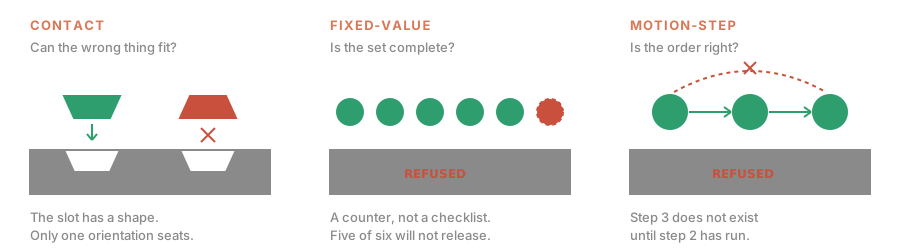
| Contact | the part won't seat unless correctly shaped | Can the wrong thing fit? | distinct types · branded IDs · parse-don't-validate · units in the type · discriminated unions |
| Fixed-value | a counter confirms all 6 screws | Can a wrong count or incomplete set pass? | exhaustive match · required fields · row-count guards · config validated at boot |
| Motion-step | a sensor confirms step 3 before step 4 | Can the steps happen out of order? | typestate · builders · state machines · idempotency keys · RAII / defer |
And: inspect at the source
- Source inspection: check the conditions before the error. Designed in where you
can, enforced at runtime where you cannot. Best. - Self-check: the work checks itself. Runtime. Fail fast.
- Successive check: the next station checks. Review, CI.
A CI gate that catches a bad migration is good. A schema that makes it unwritable is better,
and costs less forever.
What it looks like
Ask for an audit and you get findings classified, not opinions listed:
### 1. Account IDs can be swapped in transfer(): Money movement / Silent
Where:  src/payments/transfer.ts:42
Mistake: Call transfer(dst, src) with the accounts reversed
Consequence: Funds move the wrong way. Compiles, passes review, silent at runtime.
Today:  None
Device: Brand AccountId as SourceAccount / DestinationAccount → Control
Every finding names the mistake, never the mistaken. Not politeness, accuracy. "The
developer should have been more careful" has no implementation.
Invocation
This is an explicit tool. Invoke it with a slash command or by asking for it by name.
That is the supported path and it works.
It does not auto-trigger. Ten realistic queries, among them workspace-deletion UX, tenant
isolation, an agent ignoring CLAUDE.md and a Friday column-drop migration, were put to fresh
agents with the plugin installed and no hint it existed. They are the ten conversational
cases inbenchmarks/trigger-cases.json. None invoked a poka-yoke skill; one reasoned about
skills explicitly and picked hookify instead.
That is the platform, not these descriptions. Skills are documented as model-invoked and
frequently are not: anthropics/claude-code#9716
collects reports of skills ignored even when the query exactly matches the description, and
Scott Spence's write-up
documents the same thing independently. Running the skill-creator description optimizer here
changed nothing across three rewrites.
How the field has responded, and what it costs:
| Approach | Example | Cost |
|---|---|---|
| A forceful meta-skill injected every session | superpowers, "even a 1% chance a skill might apply… you do not have a choice" | Tokens in every session, and it governs all skills, not just yours |
A UserPromptSubmit hook naming the specific skill |
Spence; claude-code-infrastructure-showcase | Needs maintaining; a gentle reminder is provably ignored |
| Explicit invocation only | this plugin's default | You have to remember it exists |
A hook is shipped for the middle option, assets/devices/claude-hooks/suggest_poka_yoke.py.
It matches the prompt against each mode's vocabulary and injects an instruction naming that
skill. Tested: one matching prompt per mode routes correctly, and a shared set of four
unrelated prompts routes to nothing, in tests/test_detector.py. That is a near-miss for the
router, not one per mode. It is
Warning rung, not Control: the injected instruction is still an instruction, and our own
conclusion after living with it is that for anything important you invoke explicitly anyway.
Which is the honest summary of the whole area: for a method you reach for deliberately, the
slash command is the device and everything else is a convenience.
One thing those runs surfaced that is worth knowing before installing anything: the no-skill
baseline is strong. Unprompted, current models already reach for row-level security withFORCE, the pooled-connection trap, expand/contract migrations, soft-delete-with-undo over
confirmation dialogs, and hooks over prose. The benchmarks measure what this
adds on top: model baselines run 58.2% to 92.7%, rising to 71.1% to 97.0%. Real, but an improvement to something already
competent rather than a missing capability.
Benchmarks
Thirteen scenarios run against four Claude models under two configurations, 445 runs,
blind-graded against pre-written assertions. Two non-Claude runtimes add 146 more, reported
separately below; every figure in this section is the
Claude matrix alone. Nine of the thirteen scenarios are a message in which the user has already applied or
proposed a fix that is insufficient, so agreeing with them scores badly. The other four,design and the three build-* prompts, are greenfield: nobody has raised a concern, and
they measure what the model reaches for unprompted. This measures pushback, not recall.
| Model | Baseline | With skill | Delta | 95% CI on the delta | Time |
|---|---|---|---|---|---|
| Fable 5 | 88.7% (sd 11.8) | 97.0% (sd 4.0) | +8.3 pp | [+1.1, +15.5] | 64s → 91s |
| Opus 5 | 92.7% (sd 7.9) | 96.4% (sd 5.5) | +3.6 pp | [+0.2, +7.0] | 130s → 172s |
| Sonnet 5 | 79.8% (sd 12.7) | 88.5% (sd 6.1) | +8.6 pp | [+2.2, +15.1] | 88s → 129s |
| Haiku 4.5 | 58.2% (sd 16.7) | 71.1% (sd 24.1) | +12.9 pp | [+0.9, +24.9] | 40s → 60s |
sd is the standard deviation of pass rates across scenarios: how unevenly a model
performs over the suite. It is not a confidence interval. The CI column is: a 95% interval on
the paired per-scenario difference, which is the statistic that answers "does this help",
because scenarios differ far more in difficulty than runs do in noise.
Across the 52 scenario×model cells: 30 improved, 13 unchanged, 9 regressed, mean
+8.3 pp. See how this compares to other skill benchmarks.
What the numbers say
All four intervals clear zero, and two of them barely. Opus 5's lower bound is +0.2 pp and
Haiku 4.5's is +0.9 pp. The effect is real and, on the frontier models, small.
Benefit tracks available headroom, measurably. Across the 52 cells, a cell's baseline
correlates with its gain at r = −0.52: cells starting below 50% gain +19 pp on average,
cells starting above 95% lose 0.9 pp. Averaged over the suite the skills close 36% of the
remaining headroom. That is what a skill encoding a method looks like, as opposed to one
supplying missing knowledge. It cannot help a model that was already going to do the thing.
The largest movements are on the weakest model and the build scenarios. ops on
Haiku 4.5 goes 29% → 92%, build-endpoint on Fable 5 61% → 100%, and on Sonnet 5agent-guardrails 59% → 91% and guardrails 66% → 96%: the scenarios about
building devices rather than finding hazards.
Consistency improves except where it is worst. Fable 5's spread falls from 11.8 to
4.0 and Sonnet 5's from 12.7 to 6.1, while Haiku 4.5's rises from 16.7 to 24.1.
The skill makes Haiku better on average and less predictable, which is a real cost.
Where it looks worse, and what that is worth
Nine of 52 cells came out negative. Under the null of no effect at all, roughly 18 would:
simulating from the real per-cell run counts and the median of 8 assertions per run puts the
95% range at 12 to 25. Nine is below that range, so the count of regressions is evidence the
effect is consistently positive, not evidence of hidden harm.
These four fell by more than 5 points. They are listed because they are where to look, not
because any one of them is callable on its own:
| Cell | Baseline → skill | runs |
|---|---|---|
build-agent-feature on Haiku 4.5 |
62% → 31% | n=2 |
build-endpoint on Haiku 4.5 |
44% → 33% | n=2 |
audit on Fable 5 |
100% → 94% | n=3 |
authz on Sonnet 5 |
94% → 89% | n=7 |
No individual cell here supports a claim. At these sizes, calling a 30-point effect real
needs about 32 runs and a 10-point effect about 199. The two Haiku build-* results are worth
watching because they point the same way as a mechanism that would make sense, a small model
spending its output on the method rather than the thing, but two runs cannot establish it. That
is a hypothesis for the next sweep, not a finding.
Two instruments that were wrong before the results were
authz on Sonnet 5 was first reported as a 16-point regression. Investigating it found two defects, both
in the measuring apparatus rather than the skill.
The aggregate was reading half the data. aggregate() looped range(1, --runs + 1) and--runs defaults to 3, so re-aggregating after a seven-run sweep counted 264 of 486 runs with
no warning. It now reads the run directories that exist.
One assertion tested layout, not detection. "Notes the SQL injection separately from the
scoping issue" was failing responses that identified the injection in a heading, because they
presented it as a compounding factor within the tenant-scoping finding. It now asks for the
injection to be identified as a hazard distinct in kind, anywhere in the response.
Three tests were added so neither recurs, and a third covers a bug introduced while fixing
them: a regrade that deleted the old grading first destroyed 11 of them when the grader call
failed, and because a missing grading merely shrinks a cell, the summary printed a model short
without complaint. tests/test_portability.py now fails if a cell's n disagrees with the
runs on disk, if any grading was scored against a superseded checklist, or if any stored
response has no grading at all.
agent-guardrails needed one thing more. Haiku's failing runs opened "Nothing. You're doing
nothing wrong", answering the rhetorical question, delivering the skill's thesis, and
stopping. The skill's central insight was quotable enough to crowd out the remedy. Adding
"the diagnosis is not the answer, state it in a sentence, then spend the rest on the
replacement" fixed it.
| at the time of the fix | in the committed aggregate | |
|---|---|---|
ops / Haiku 4.5 |
58% | 92% |
ops / Sonnet 5 |
71% | 88% |
agent-guardrails / Sonnet 5 |
54% | 91% |
agent-guardrails / Opus 5 |
71% | 100% |
agent-guardrails / Haiku 4.5 |
38% | 33% |
The agent-guardrails fix did not hold on Haiku 4.5. It was measured at 88% when the
restructuring landed; the runs committed here score 4/8, 4/8 and 0/8, which is 33% and worse
than the 38% it started from. The other four cells held or improved. The earlier figure is
left in the left-hand column rather than deleted, because a fix that stopped working is worth
more to a reader than a table that only shows the times it did.
llm on Sonnet 5 is flat at 90% → 89% across seven runs each: the earlier four-point
regression there was measurement noise at n=3, not an effect. The live regressions are the
four listed above.
What it costs, and why the gain varies
The skill makes the model read the router, the matching sub-skill, and often a reference file
before answering, then produce a fuller answer. Both show up as cost.
| Task shape | Model | Δ pass rate | Output length | Wall-clock |
|---|---|---|---|---|
| Advice | Fable 5 | +6.3 pp | 1.26× | 1.44× |
| Advice | Opus 5 | +3.0 pp | 1.22× | 1.36× |
| Advice | Sonnet 5 | +8.4 pp | 1.24× | 1.16× |
| Advice | Haiku 4.5 | +19.3 pp | 1.84× | 1.47× |
| Build | Fable 5 | +14.8 pp | 1.31× | 1.45× |
| Build | Opus 5 | +5.6 pp | 1.14× | 1.34× |
| Build | Sonnet 5 | +9.5 pp | 1.30× | 1.90× |
| Build | Haiku 4.5 | −8.6 pp | 1.14× | 2.12× |
Two things to read off this. The build tasks split the fleet. Fable 5 gains most there
(+14.8 pp) while Haiku 4.5 is the only cell in the whole suite that is clearly negative
(−8.6 pp) at more than double the wall-clock, asked to build something, the smallest model
spends its budget on the method and ships less of the thing. And the delta is not bought
with extra output: across all 52 scenario×model cells, the correlation between how much
longer the answer got and how much better it scored is only r = 0.30. Length is not the
mechanism.
What does predict the gain is how much the baseline was missing:
Baseline vs. delta: r = −0.52 across 52 cells. Headroom predicts gain.
Headroom explains most of the variation, but not all of it, and the exception matters. On the
refund-endpoint task Opus 5 goes 83.3% → 100% (+16.7 pp, closing all of its headroom) while
Haiku 4.5 goes 44.4% → 33.3%: the model with the most headroom is the one that gets
worse. Headroom sets the ceiling on what a method can add; it does not guarantee the model can
use the method and still deliver the artifact.
That is the boundary of the claim. On advice-shaped tasks the skills help every model, most
where the baseline is weakest. On build-shaped tasks they help three models and hurt the
smallest one, because reading and applying a method competes with writing the code.
The practical rule: the cost is roughly constant and the benefit is not, so this pays for
itself in proportion to the gap between the model doing the work and what the task demands.
On a frontier model writing a well-trodden endpoint it closes the remaining gap outright
(83.3% → 100.0%). On the fastest model doing the same work it currently costs more than it
returns (44.4% → 33.3%), which is the one configuration this plugin does not recommend.
Measured as output words and wall-clock, not token counts: the harness does not read token
usage back from the CLI, so treat these as proportional rather than exact.
Does it work outside Claude Code?
The plugin ships to 19 runtimes and only Claude Code was ever measured. Two more now are, OpenAI Codex (gpt-5.6-terra, read-only sandbox) and agy (Gemini 3.1 Pro, plan mode), run
through the same harness, the same scenarios, and the same blind grader.
| Runtime | Baseline | With skill | Delta | Scenarios |
|---|---|---|---|---|
| Codex | 74.2% (sd 17.7) | 91.0% (sd 9.8) | +16.8 pp | 13 of 13 |
| agy | 64.6% (sd 13.9) | 78.1% (sd 13.2) | +13.5 pp | 12 of 13 |
These are the two largest gains in the suite, and they fit the same curve. Codex and agy
start at 74.2% and 64.6%: the lowest baselines after Haiku 4.5, and gain the most. The
effect tracking headroom is not a Claude artefact; it holds across three vendors.
They are reported separately rather than folded into the headline mean, for two reasons. agy's
column is short one scenario, for the reason stated in benchmarks/results/benchmark.md. And the
runtimes answer at very different lengths: a Codex reply runs 50–200 words where a Claude
answer runs 400–800, so the same checklist lands differently against each, and only the
delta within a runtime is a fair comparison.
One finding worth more than the numbers: audit cannot run on agy at all. That skill
invokes the bundled detector, and agy's plan mode refuses to execute a command. Any runtime
that blocks execution can use the other ten skills and not that one.
Caveats
Grading is by a model (Haiku 4.5), not a human. Assertions were written by the skill's author, before the runs, not fitted to them, but that is not independence. Cells hold 1–7 runs, so the
per-scenario means behind the intervals are themselves noisy, and three cells hold a single
run: build-agent-feature for Fable 5 baseline and both Opus 5 configurations, where repeated
attempts across three separate windows were lost to API rate limits. A one-run cell has no
variance estimate and still carries full weight in its model's mean. All three sit at 100%,
so a second run could only confirm or lower them. Claude Code, Codex and Antigravity were measured;
the other install targets are untested.
This supersedes earlier benchmark rounds. One reported no gain on Opus from saturated
assertions and a grader that knew which configuration it was scoring; both flaws are fixed.
A later round under-reported Sonnet 5 and invented anauthzregression because the
aggregate was reading three runs per cell out of seven. Where this README and an older
number disagree, this one is computed from the 591 runs currently inbenchmarks/results/.
Every run, grading, and timing is in benchmarks/results/, and the
harness is benchmarks/run.py, re-run it and check the numbers.
Repo layout
.claude-plugin/     marketplace catalog
plugins/poka-yoke/  the plugin: skills, references, scripts, device templates
                    plus a manifest per runtime (.codex-plugin/, .cursor-plugin/, …)
scripts/            repo tooling; generates every platform manifest from one source
docs/               method, install guide, assets
benchmarks/         benchmark prompts, assertions, and fixtures
tests/              the devices that guard the devices
.github/workflows/  validate.yml guards every PR; release.yml turns a tag into a release
AGENTS.md           symlink to CLAUDE.md; the other context files are one-line pointers
plugins/poka-yoke/README.md has the full tree and notes on
editing the skills.
Prior art
- Shigeo Shingo, Zero Quality Control: Source Inspection and the Poka-Yoke System (1986): the origin
- Make illegal states unrepresentable · the counter-argument, which is worth taking seriously
- Don Norman, The Design of Everyday Things, forcing functions
- Applying mistake-proofing to software
- codehackerr/poka-yoke · bryanhunter/poka-yoke
Contributing
New hazards and devices are welcome, see CONTRIBUTING.md and
CODE_OF_CONDUCT.md. The bar for a new catalog entry: a specific wrong
action a person can take, a consequence, and a device with an honest rung.
If you run poka-yoke on a runtime other than Claude Code, a session transcript in an issue is
the most useful thing you can send. Those manifests are verified structurally in CI but not
behaviourally by us.
Releases are cut by pushing a tag; .github/workflows/release.yml does the rest, and
RELEASING.md explains what it refuses and why.
License
MIT, see LICENSE.
Yorumlar (0)
Yorum birakmak icin giris yap.
Yorum birakSonuc bulunamadi