split-orchestrator
Health Warn
- License — License: MIT
- Description — Repository has a description
- Active repo — Last push 0 days ago
- Low visibility — Only 6 GitHub stars
Code Pass
- Code scan — Scanned 7 files during light audit, no dangerous patterns found
Permissions Pass
- Permissions — No dangerous permissions requested
No AI report is available for this listing yet.
An orchestrator for Claude Code: your main model plans, decides and verifies; Sonnet implementer subagents build the clearly scoped slices.
Split Orchestrator
Opus coordinates & reviews. Sol builds, integrates & tests through Farcall.
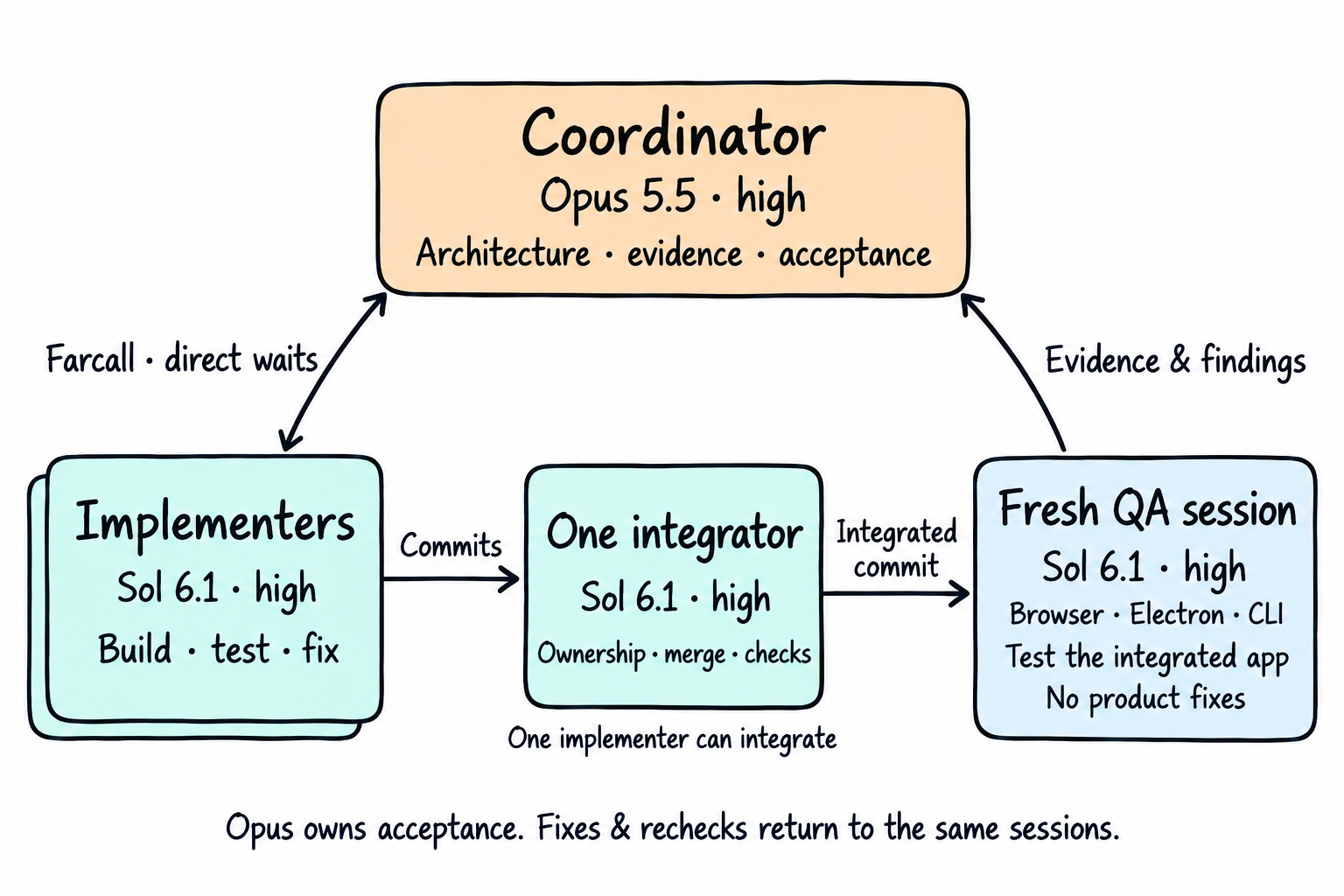
A Claude Code plugin for clearly owned work, direct completion waits & checks against the real application. Use the fewest workers needed. One worker owns integration. A fresh Sol QA session tests the integrated app; Opus owns final acceptance.
The coordinator uses claude-opus-5-5, high. Workers use gpt-6.1-sol, high. No Astra or silent model substitutions.
Install
Install both plugins in Claude Code. Farcall is required.
/plugin marketplace add regenrek/farcall-mcp
/plugin install codex-worker@farcall
/plugin marketplace add regenrek/split-orchestrator
/plugin install split-orchestrator@split-orchestrator
With Node 24+ & a signed-in Codex CLI available, start a new coordinator session from your repository.
CLAUDE_CODE_MCP_AUTO_BACKGROUND_MS=0 MCP_TOOL_TIMEOUT=7200000 \
  claude --model claude-opus-5-5 --effort high
Setup, browser access & upgrading from 0.1.
Try it
/split-orchestrator:orchestrate Build <feature> in <repository>.
Propose a short plan and wait for my approval.
Report what changed, what passed and what remains open.
No push, main merge, deployment or publishing without approval.
The skill handles ownership, isolated checkouts, worker corrections & coordinator acceptance. Add constraints or specific user journeys to the prompt. UI work requires a working browser connection in the QA session to the real application/backend.
Each worker gets its own local clone with installed dependencies (plan several GB per worker); at close, the run removes what it created under the cleanup rules and keeps evidence & resume records.
Why this workflow
In practical builds, Opus coordinated Sol workers through Farcall & returned corrections to their original sessions. The benchmarks also exposed shared-file conflicts, lost drafts & retries that reported success without saving changes. This workflow makes ownership & persisted outcomes explicit. It is not a claim that a model pairing guarantees quality.
Evidence & verification limits.
Docs
Usage · Verification · Development · bb · herdr
Reviews (0)
Sign in to leave a review.
Leave a reviewNo results found