agent-eval-loop
Health Uyari
- License — License: Apache-2.0
- Description — Repository has a description
- Active repo — Last push 0 days ago
- Low visibility — Only 5 GitHub stars
Code Basarisiz
- exec() — Shell command execution in examples/harbor_agent.py
Permissions Gecti
- Permissions — No dangerous permissions requested
Bu listing icin henuz AI raporu yok.
Build evals from traces, code, and coding sessions, then measure and improve AI agent behavior, including your coding agents
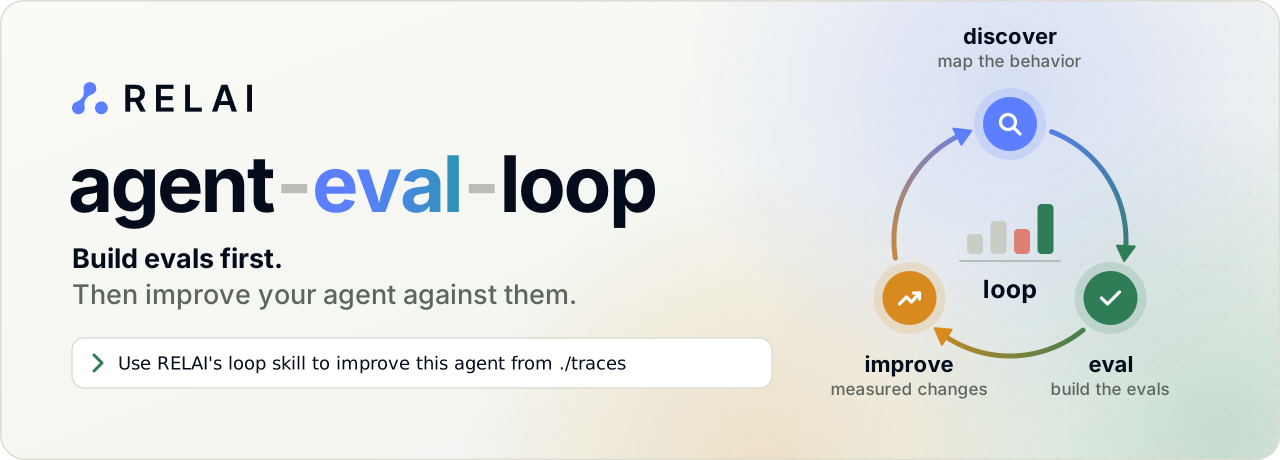
Eval-driven improvement for AI agents.
A plugin for Claude Code, Codex and other coding agents, by RELAI (Reliable AI).






Install · Use cases · How it works · Why RELAI · FAQ · Design
Two ways to use it
🤖 Agent applications and business workflows
The agents you build and deploy, regardless of framework. RELAI creates evals from your agent's traces or generates them from its code, documentation, and potential risks. It then improves prompts, tools, workflows, memory, and model choices, keeping only changes that improve evaluation results while satisfying your guardrails.
Open your agent's repository and ask:
Use RELAI's discover skill to map this agent's behavior and where it can fail
Or start from production traces:
Use RELAI's loop skill to improve this agent from ./traces;
optimize task success and cost
🏭 Coding agents and software factories
The coding agents your team uses: Claude Code, Codex, OpenHands or your own setup of one.
RELAI turns coding sessions, pull requests, and Git history into reproducible evals that any coding agent can run. It then measures whether a new model, CLAUDE.md, skill, or agent configuration actually improves performance on your codebase.
Open an eval project and ask:
Use RELAI's coding-evals skill to mine my repo at {path-to-repo} for tasks
from the last six months, then measure how our coding agent does on them
You can start at any skill without completing the full workflow.
Installation
RELAI supports Claude Code, Codex, and other coding agents. Native installs for Claude Code
and Codex are below; expand Other agents, Skills CLI, and manual installation for
additional options.
Claude Code
From a terminal:
claude plugin marketplace add relai-ai/agent-eval-loop
claude plugin install relai@agent-eval-loop
Codex
From a terminal:
codex plugin marketplace add relai-ai/agent-eval-loop
codex plugin add relai@agent-eval-loop
Start a new session after installing. Codex asks you to review and trust the optional hooks
before they run.
Skills CLI (requires Node.js/npm):
npx skills add relai-ai/agent-eval-loop --skill '*'
Choose your coding agent when prompted. This installs into the current project; add -g for
all projects. Install all seven skills together so their cross-references stay available.
This method includes templates and checkers; for the optional scripts inexamples/ and optional hooks, use a native plugin install or a full clone.
Antigravity:
agy plugin install https://github.com/relai-ai/agent-eval-loop.git
Gemini CLI:
gemini skills install https://github.com/relai-ai/agent-eval-loop.git --path skills
Add --scope workspace for the current project only.
Manual installation — clone once, then copy all seven skill folders into your agent's skills
directory. For agents that read .agents/skills/, run from your project:
git clone https://github.com/relai-ai/agent-eval-loop.git ~/agent-eval-loop
mkdir -p .agents/skills
cp -R ~/agent-eval-loop/skills/* .agents/skills/
Other project directories: .cursor/skills/ (Cursor), .windsurf/skills/ (Windsurf),.opencode/skills/ (OpenCode), .github/skills/ (GitHub Copilot), .kiro/skills/ (Kiro).
Copy each skill's whole folder, including the files next to SKILL.md, then reload your agent.
Updating
Update using the same method and scope you installed with, then start a new session.
Read release notes for migration steps.
| Installation | Update |
|---|---|
| Claude Code plugin | Enable auto-update for agent-eval-loop in the plugin manager's Marketplaces tab (off by default), or run claude plugin marketplace update agent-eval-loop. |
| Codex plugin | Run codex plugin marketplace upgrade agent-eval-loop and verify the installed version; use the plugin manager's install controls if it remains stale. |
| Skills CLI | Run npx skills update; keep all seven RELAI skills together. |
| Manual copy | Run git -C ~/agent-eval-loop pull, then copy the complete skill folders again, preserving local edits. |
The Skills CLI and manual copies need explicit updates. Native refresh policies are described
in the Claude Code and
Codex docs; commands were checked with
Claude Code 2.1.284 and Codex CLI 0.160.0 on 2026-11-11. Internal installs need repository read
access. main can contain unreleased changes; pin a tag where supported for a fixed release.
Plugin updates do not replace existing project files in relai/ or frozen tasks. Use the
project-copy policy to preserve adaptations and evidence.
Why RELAI
- Evals are the hard part. RELAI builds them. Evals come from traces, or are generated from what the agent must do and where it can break, including risks that never appeared as failed runs. You review them; you do not write them.
- Realistic, long-horizon environments. Evals are Harbor-format tasks: the agent runs end to end in a container, with its tools, data and as many steps as the work takes. Your project's own runner works too.
- Scores you can inspect. Code checks and LLM judges are reviewed and frozen before the first run. RELAI reports variation, supports optional held-out evals and separates infrastructure or judge errors from agent results.
- The same evals support improvement and comparison. Run the current agent, record a baseline and compare candidate changes, agents, models or setups against the same frozen evals.
- You stay in charge. You approve the risks, evals, graders, objective and budget. RELAI asks only when your judgment is needed.
How it works
| Step | What happens | What you decide |
|---|---|---|
start |
Routes the request, initializes useful records when justified and shows relevant progress. | Where to begin when the goal is unclear. |
discover |
Builds the EvalsWiki from code, documentation and traces: requirements, ranked risks and open questions. | Which risks matter; answers to open questions. |
trace-review |
Builds or adapts a project-owned app for full traces, keyboard navigation, search, filters and persistent feedback. | Review verdicts and expected behavior. |
eval |
Builds evals from traces, generates them from the wiki's risks or brings in an existing benchmark. Evals use Harbor tasks or suitable project-native equivalents, graded by code checks and LLM judges, then reviewed and frozen. | Which evals to build; whether the graders score the way you would. |
improve |
Runs the agent against the evals and compares scoped changes against the recorded baseline for an agreed behavioral, cost or latency objective. | The objective, what may change and the budget. |
loop |
Repeats discover → eval → improve when new traces, answers or tests arrive. | The goal, scope, budget and limits; then real ambiguity or safety calls. |
coding-evals |
Mines coding sessions, pull requests and git history for tasks any coding agent can run, measures the team's agent on them and, when asked, compares changes, setups or other agents. | Which repositories; which tasks to build; whether the checks score the way you would; what to compare, if anything. |
When RELAI-managed state is useful, relai/STATUS.md shows the current request, relevant progress, what is waiting on you and the recommended next step.
RELAI checks the prerequisites needed for the task, names missing credentials and reuses existing runners and tests. It uses your project's credential mechanism or relai/.env; coding agents never read credential values, while executable helpers use them for authentication and redaction.
Agent applications and business workflows
Discover from code, documentation and traces
discover builds the EvalsWiki: what the agent must do, where it can fail and what remains unclear.
Point it at production traces and the coding agent can use focused checks, existing analytics, direct reading or scalable model triage for the question and budget. External processing requires appropriate data and cost authorization.
The optional triage example groups leads into three lanes:
- Needs your judgment: likely failures whose correct outcome is unclear. Your answer can become a regression eval or risk evidence.
- Coverage gaps: situations real users encounter that no eval covers, ranked by frequency.
- Weak signals: small slips that did not fail a run, informing harder or compound eval proposals.
Durable findings update EvalsWiki when they help future work. The wiki is not a transcript archive or a checklist of artifacts.
Review traces in an app
Use RELAI's trace-review skill to build a review app for ./traces
with hotkeys, filters and feedback on individual steps
The coding agent reuses your project's stack and trace tooling, then builds and verifies an
app you own. Browse complete interactions, search and filter runs, leave feedback, and resume
where you stopped. Traces stay read-only and data stays local by default. The app includes its
own run instructions and inspectable feedback storage; no eval setup or model access is required.
Source-linked feedback can later inform discovery, eval proposals or judge calibration.
Bring your own benchmark
Use RELAI's eval skill to bring in the benchmark at ../bench-x
(its own runner and scorer, train/validation/test)
RELAI first checks a small pilot against the benchmark's own scorer. It respects the benchmark's splits: fixes are learned from train, validation decides what is kept, and test is reserved for final assessment. The benchmark is pinned to its commit and never edited.
Coding agents and software factories
The coding-evals skill turns your team's work into long-horizon tasks that any coding agent can run:
Use RELAI's coding-evals skill to make a test from PR #412 in acme/api
Use RELAI's coding-evals skill to check whether our new CLAUDE.md helps on our tasks
- From your real work. Build tasks from a corrected coding session, pull request, revert or past fix in git history. Each task begins at the commit where the work started; the real fix is kept out of the workspace.
- Any agent can run it. Harbor installs the agent under test; the task brings the repository and its toolchain.
- Your standards. Draft "good" from CLAUDE.md, AGENTS.md, contributing guides, lint configuration and past review comments; you confirm it.
- Hard to game. Use hidden tests, existing tests as regression checks, and checks for edited tests, out-of-scope changes, unsafe work and claims that do not match what happened.
- Comparable results. Report solved rate with its noise, cost per solved task and the tasks that separate the agents or setups being compared.
Coding-agent evals live in an eval project: a repository whose relai/ holds the tasks. Task source can come from the current or other scoped repositories; each evaluated workspace contains only its starting history.
Improve and repeat
An iteration begins with new traces, answers, tests or existing evidence. The coding agent adapts, reorders, combines or skips activities to fit the request:
1. learn    triage new traces → EvalsWiki + proposed evals
2. measure  establish or reuse comparable evidence for the objective and guardrails
3. explore  investigate, measure or make a scoped change
4. check    run scope-based checks and optional held-out evals; review the results
5. record   what was learned, results, fixes kept or rejected, and spend
An experiment can investigate or collect evidence without producing a patch. Baseline reuse requires comparable source and measurement conditions. During an iteration, measurement meaning and relevant comparison conditions stay stable; budget and authorization remain binding. Supporting tooling can improve within the agreed scope. Changes to evaluation meaning, coverage or acceptance criteria need controlled repair and comparable evidence. The coding agent asks before broadening the assignment or resolving a consequential choice your agreement does not cover; a faster feedback runner alone does not establish a faster agent.
The OSS workflow provides scoped evidence for comparison. It does not establish universal correctness or prove that every possible regression has been prevented.
You remain in control
relai/STATUS.md can show:
- what is waiting on you and RELAI's recommended answers;
- every risk and the eval that probes it;
- recent runs, with flaky ones flagged;
- how often each LLM judge agrees with you;
- spend against the approved budget;
- iterations, observed results and the decisions still needed from you.
Questions wait for a natural decision point: the end of discover, the first time LLM judges are scored or the summary of a loop iteration. Only a blocking safety call or conflicting requirement interrupts dependent work.
Built to be inspected
- Evals are frozen before comparison, with fresh-context reviews of the harness, evals and changes.
- Measurement effort is chosen for the decision; "too few attempts to tell" is a valid result.
- Optional held-out evals can be scored without reading their contents while improving the agent.
- Infrastructure and judge errors are reported separately from agent results.
- You preview how each judge grades before freezing it, and agreement is tracked.
- Tests use shared metadata and result contracts through Harbor or a native runner, with instructions for rerunning the suite, including in CI.
Requirements
- Python 3.11+ for bundled checkers and reference scripts; project-native integrations are supported.
- Harbor execution: uv and a locally supported container engine with a Docker-compatible CLI, or Podman. Tasks with a restricted network also need the engine's image builder (
docker buildxon a Docker CLI). - Native execution: the project or benchmark runner's own prerequisites; unused Harbor or container tools are not required.
- Model access for the agent, simulated users and judges, through your project's credential mechanism or
relai/.env.
The generated relai/README.md lists the prerequisites for each runner (see the bundled contract).
FAQ
Does RELAI run my agent on my machine?Containers are the default. Running on the host requires explicit authorization and reviewed sandboxing. Integrations use the real entrypoint and current source.
What is the difference between an open question and feedback?An open question asks how the agent should behave in general. Your answer becomes a requirement in the wiki. Feedback asks about one specific run or judge score. Your answer can become a regression eval or evidence on a risk.
Can coding-agent tasks leak our code?Each task holds the repository up to the commit where it starts. Tasks stay where you specify, private to the eval project by default. Quoted session text is redacted of secrets and personal data. Configured model providers receive relevant agent inputs, traces and trajectories for execution, judging and triage. Separately authorized hosted runners or builders may also receive source, tasks, logs and build material; local execution avoids that hosted transfer. The selected integration makes destinations and side effects explicit. Excerpts kept in the wiki are redacted; executable helpers read named credentials without exposing their values to the coding agent.
What does it cost?You pay for model calls from the agent, simulated users and judges. RELAI estimates the cost before a paid run, and the board tracks spend against the budget you set.
Can I use the results without the plugin?Yes. Tests run through Harbor or a native runner. Bundled checkers are standard-library Python, and the integration records how to rerun the suite.
Will it change my code?improve changes behavior within existing or newly agreed scope, by default on a separate branch for review. Evaluation setup can also make small integration changes, such as recording hooks or tooling exclusions. Material project edits are disclosed and must be covered by your authorization; setup is not permission for unrelated changes.
What's inside
relai/
├── skills/
│   ├── start/         # the relai/ template and checkers
│   ├── discover/      # requirements, risks, open questions, trace triage
│   ├── trace-review/  # project-owned trace review apps and human feedback
│   ├── eval/          # harness, test design, hardening, mocks, benchmarks, running and scoring
│   ├── improve/       # regression checks, agent-chosen experiments, cost and latency
│   ├── loop/          # contract, new evidence, iterations and experiment rounds
│   └── coding-evals/  # agent-neutral tasks for coding agents: sources, checks and comparison
├── examples/          # example launcher, judge, triager and native-runner scripts
├── hooks/             # optional Claude Code and Codex hooks: guard frozen tests, run checkers after edits
├── tests/             # tests for the checkers and examples
├── DESIGN.md          # the design and the reasons behind it
└── README.md
Once set up, the repository gets a relai/ folder. Its contract is in relai/README.md (template: skills/start/template/README.md).
Contributing
Issues and pull requests are welcome. See CONTRIBUTING.md for setup,
validation, and review guidance, and follow our code of conduct.
Report suspected vulnerabilities privately using SECURITY.md.
Ask questions and share examples in Discussions.
Run the checker tests with:
python3 -m unittest discover -s tests
Tests that build images require a running Docker-compatible engine or Podman and are skipped without one. The reasoning behind each design choice is in DESIGN.md.
Yorumlar (0)
Yorum birakmak icin giris yap.
Yorum birakSonuc bulunamadi