consistorium
Health Pass
- License — License: Apache-2.0
- Description — Repository has a description
- Active repo — Last push 0 days ago
- Community trust — 11 GitHub stars
Code Warn
- process.env — Environment variable access in scripts/smoke-readonly.mjs
Permissions Pass
- Permissions — No dangerous permissions requested
No AI report is available for this listing yet.
Local-first MCP server: give ChatGPT & friends grounded, current context on the repos your coding agents work in. Live git, docs, tasks, agent handoffs.
Consistorium


Your strategist AI can't see your codebase. Fix that.
Consistorium is a local-first MCP server that gives any conversational model — ChatGPT included — grounded, current intelligence about the repositories your coding agents are actually working in: live git state, allowlisted documents, durable tasks, and agent-to-agent handoffs.
Use your best reasoning model as the general. Save coding agents for code. Coding-agent time is scarce — metered in five-hour windows, weekly caps, and credit packs — yet much of it is spent re-discovering what already exists: repo structure, branch state, decisions made yesterday. Consistorium reverses the flow: your conversational strategist reads live project state on demand, decides what should happen next, and hands coding agents work so precise they never have to explore.
No more pasting git log output into chat. No more stale summaries. Your coding agents do the work; Consistorium lets your best reasoning model see it.
The problem
Multi-model development has a structural gap:
- Coding agents (Claude Code, Codex, Cursor, Hermes) hold the repository.
- Strategic reasoning often happens elsewhere — a long-running ChatGPT conversation that knows your goals but not your code.
- Today the only bridge is copy-paste: git output, file excerpts, hand-written status reports — all stale the moment they're pasted.
Consistorium closes the gap in the other direction: instead of dragging your strategist into the terminal, it exposes bounded, read-only project intelligence to any MCP client — with every claim labeled as either live_observation (git facts read right now) or agent_record (what a previous agent claimed when it left). Generated memory never masquerades as ground truth.
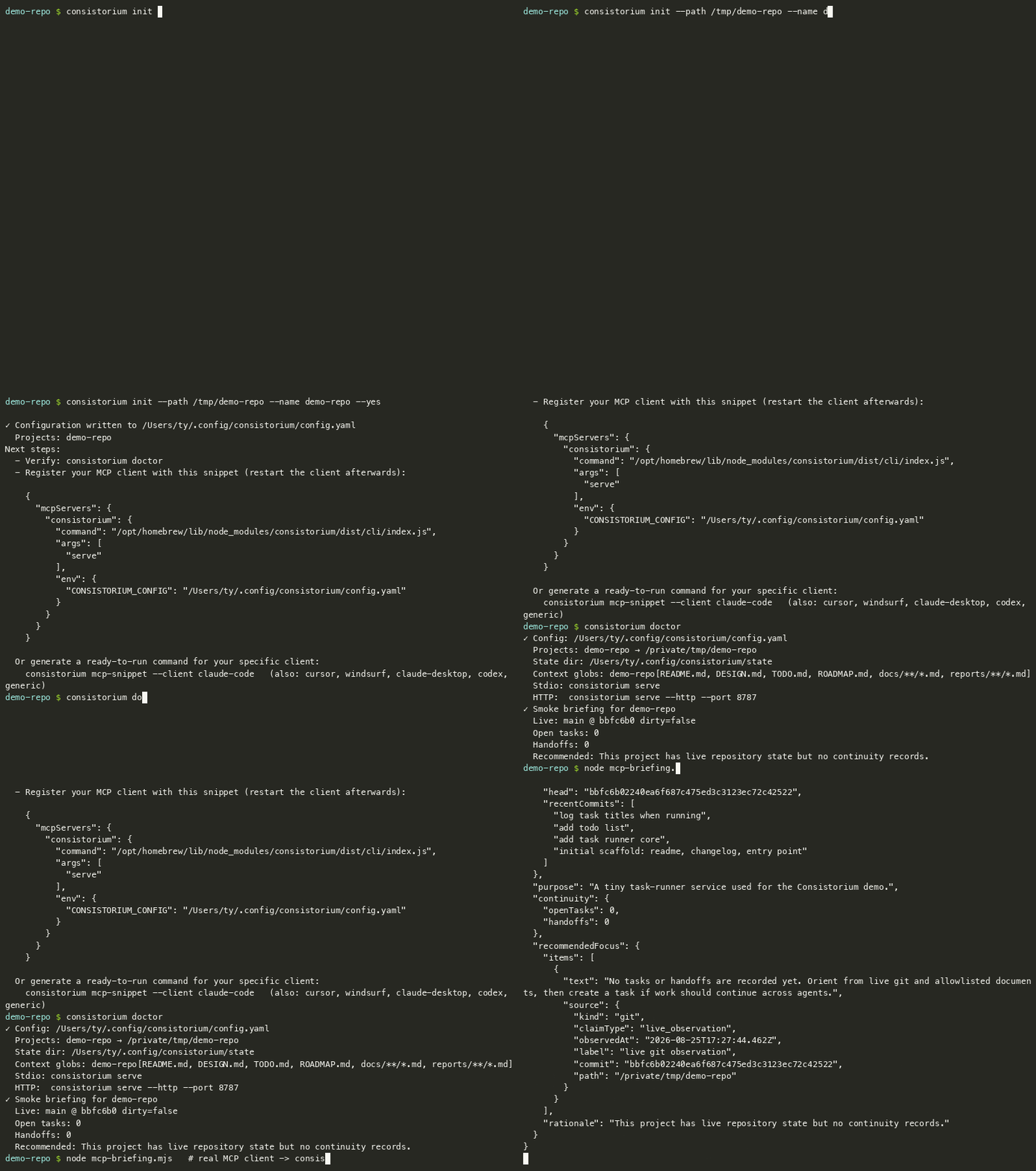
30-second quickstart
Requires Node.js 20+ and
gitonPATH.
npm install -g consistorium

# Allowlist a project (this is the only thing the server can ever inspect)
consistorium init --path ~/dev/my-project --name my-project --yes
consistorium doctor        # verifies config + smokes a live briefing
init prints a ready-to-paste mcpServers snippet (with your absolute config path) and the
one-line claude mcp add equivalent — copy whichever matches your client, restart it, done.
If npm returns E404 before the first registry release, use the source-install fallback in
docs/install.md. Do not confuse npm install inside a checkout (dependencies
only) with npm install -g . (installs the CLI).
Point any stdio MCP client at it:
{
  "mcpServers": {
    "consistorium": {
      "command": "consistorium",
      "args": ["serve"],
      "env": { "CONSISTORIUM_CONFIG": "~/.config/consistorium/config.yaml" }
    }
  }
}
Works with Claude Desktop, Claude Code, Codex, Cursor, Windsurf, Hermes, and any other MCP-compatible client. For ChatGPT (which connects over the network rather than stdio), see docs/chatgpt-setup.md. Full walkthrough for every client, troubleshooting, and uninstall: docs/install.md.
Want an agent to do it? Give a coding agent the appropriate copy-paste handoff in
docs/agent-install.md — or the one-liner above. It installs, preserves
existing configuration, registers the MCP server, and must prove success with a real tool call. For
ChatGPT, the only unavoidable human actions are approving the restricted OpenAI runtime key,
copying it to the local clipboard, and—when browser policy requires it—pressing Send on the
staged verification prompt.
Then ask your client:
What changed in my-project today, what remains before release, and what should I ask my coding agent to do next?
A grounded answer comes back citing live branch state and allowlisted docs — separating observed facts from anything an agent recorded. If the model answers without calling a tool, it's guessing.
One-prompt setup for AI agents
Don't want to touch a terminal? Paste this short handoff into a coding agent with terminal access:
Open https://github.com/Renaissance-AI-Solutions/consistorium/blob/main/docs/agent-install.md.
Use Prompt A to install Consistorium for this repository and your own MCP client. Perform the
steps instead of returning a tutorial, preserve existing configuration, and do not claim success
until context_list_projects and context_project_briefing work through the client.
For ChatGPT as the planning agent, use Prompt B in
docs/agent-install.md. If an existing Project Context card is visible but
not callable, use Prompt C before deleting anything or rotating a key.
What it does
| Tool | Use when |
|---|---|
context_project_briefing |
The hero call — live git + docs + open tasks + latest handoffs + blockers + next actions, provenance-labeled |
context_project_snapshot |
Live repo/worktree/session detail |
context_list_worktrees / context_worktree_snapshot |
Parallel worktrees and multi-agent activity |
context_recent_changes / context_compare |
History and branch divergence |
context_search |
Bounded text search across allowlisted roots |
context_read_context_document |
Read only explicitly allowlisted documents |
context_task_* / context_handoff_* |
Durable task records and structured agent handoffs |
The continuity model: an execution agent calls context_task_upsert when it starts work and context_handoff_create when it leaves — objective, decisions, evidence, blockers, canonical-vs-asserted git state, and a requested next action. A fresh agent with no conversation history calls context_project_briefing and continues without the human reconstructing anything.
Why not just give the model repo access?
Claude Code and Codex already have the repository — that's not the gap. The gap is the model that doesn't: your strategist, reviewer, or planner sitting outside the harness. Cloning the repo into a chat session copies megabytes of context you don't control and can't bound. Consistorium is the deliberate, read-only, allowlisted pipe for exactly the intelligence a strategist needs — nothing more.
And unlike "give ChatGPT your terminal" bridges, Consistorium executes no commands, mutates nothing, and cannot widen its own access. See the security model.
Security model
Private repository text must never become a public endpoint.
- Explicit allowlist — only configured project roots are ever inspected (
realpath-canonicalized; traversal and symlink escapes denied) - Secret denylist —
.env, keys,.ssh/,.aws/, credential-named files are refused even if globs would match - Read-only git — hardened
execFileinvocations only; no shell, no checkout/commit/push, ever - Bounded outputs — capped reads, diffs, search results, and record sizes; truncation is flagged, never silent
- Loopback-only HTTP by default — Streamable HTTP binds
127.0.0.1, requires a bearer token, refuses anonymous non-loopback binds, and hides write tools unless explicitly enabled - Provenance labels —
live_observationvsagent_record, so agent claims can be checked against git reality - No telemetry — nothing leaves your machine except what your own MCP client sends
Full details: THREAT_MODEL.md · SECURITY.md
Connecting clients
Claude Desktop / Claude Code / Cursor / Codex / Windsurf
Use the JSON snippet above. After editing, restart the client.
Hermes
hermes mcp add consistorium \
  --command consistorium \
  --args serve \
  --env CONSISTORIUM_CONFIG=$HOME/.config/consistorium/config.yaml
ChatGPT
ChatGPT connects through OpenAI's Secure MCP Tunnel. The recommended setup lets the tunnel client
launch Consistorium over stdio, leaving only one long-lived runtime to supervise. The complete
walkthrough — tunnel installation, runtime key scoping, developer-mode connector setup, and
troubleshooting — lives in docs/chatgpt-setup.md. Short version:
tunnel-client runtimes connect \
  --alias consistorium \
  --tunnel-id tunnel_YOUR_ID \
  --runtime-api-key file:/ABSOLUTE/PATH/TO/runtime-key \
  --mcp-command "consistorium serve --read-only"
Never paste the runtime key into chat or command text. The tunnel ID identifies the connection; it
is not the key. Secure MCP Tunnel is for a private developer-mode connection and must remain
running for discovery and tool calls. It does not make Consistorium a public Plugin Directory
listing; that would require a separate hosted HTTPS service and per-user authentication.
Environment variables
| Variable | Purpose |
|---|---|
CONSISTORIUM_CONFIG |
Config file path |
CONSISTORIUM_STATE_DIR |
Task/handoff state directory (kept outside project roots by default) |
CONSISTORIUM_TOKEN |
Bearer token for Streamable HTTP |
CONSISTORIUM_HTTP_WRITES=1 |
Allow task/handoff writes on HTTP (off by default) |
Upgrading from v0.3 or earlier? The pre-0.4 CONTEXT_BRIDGE_* variable names and the~/.config/context-bridge/, ~/.local/state/context-bridge/, and ./context-bridge.yaml
locations are still honored automatically — nothing breaks, and consistorium init writes to
the new defaults from now on.
Records are written 0600 under a 0700 state directory; filenames are hashes, IDs never become paths.
Testing
npm test            # 125+ tests: security boundaries, transports, Agent A→B continuity e2e
npm run typecheck
consistorium doctor
Tests run against synthetic temporary repositories — no private checkouts required.
The story
Consistorium was built and battle-tested while operating Corpus — an AI-native legal platform that compiles US law into a free public library and forms companies in all 50 states. Every strategic decision on Corpus runs through this exact loop: coding agents implement, Consistorium reconstructs project state, and a conversational strategist reasons over live engineering reality instead of pasted summaries. The tool exists because we needed it daily.
Documentation
- docs/install.md — complete installation guide for every client
- docs/agent-install.md — prompts that let an AI agent install and verify it
- docs/chatgpt-setup.md — ChatGPT connection via Secure MCP Tunnel
- docs/release-checklist.md — launch gates and clean-machine tests
- DESIGN.md — architecture and data flow
- THREAT_MODEL.md — assets, adversaries, mitigations
- SECURITY.md — reporting policy and safe usage
- ROADMAP.md — shipped vs designed vs explicitly not planned
- CONTRIBUTING.md — ground rules and development setup
- CHANGELOG.md
License
Apache-2.0 — see LICENSE.
Built in public
Follow along: @TritiumAISol (founder — build-in-public receipts) · @AnAIRenaissance (announcements + demos) · The AI Renaissance on YouTube
Reviews (0)
Sign in to leave a review.
Leave a reviewNo results found