draftcat
Health Warn
- License — License: MIT
- Description — Repository has a description
- Active repo — Last push 0 days ago
- Low visibility — Only 5 GitHub stars
Code Pass
- Code scan — Scanned 12 files during light audit, no dangerous patterns found
Permissions Pass
- Permissions — No dangerous permissions requested
No AI report is available for this listing yet.
Governed AI pipelines for service businesses. Deterministic-first, single Go binary, operator-approved.

Draftcat
Governed AI pipelines for service businesses — written in Go.



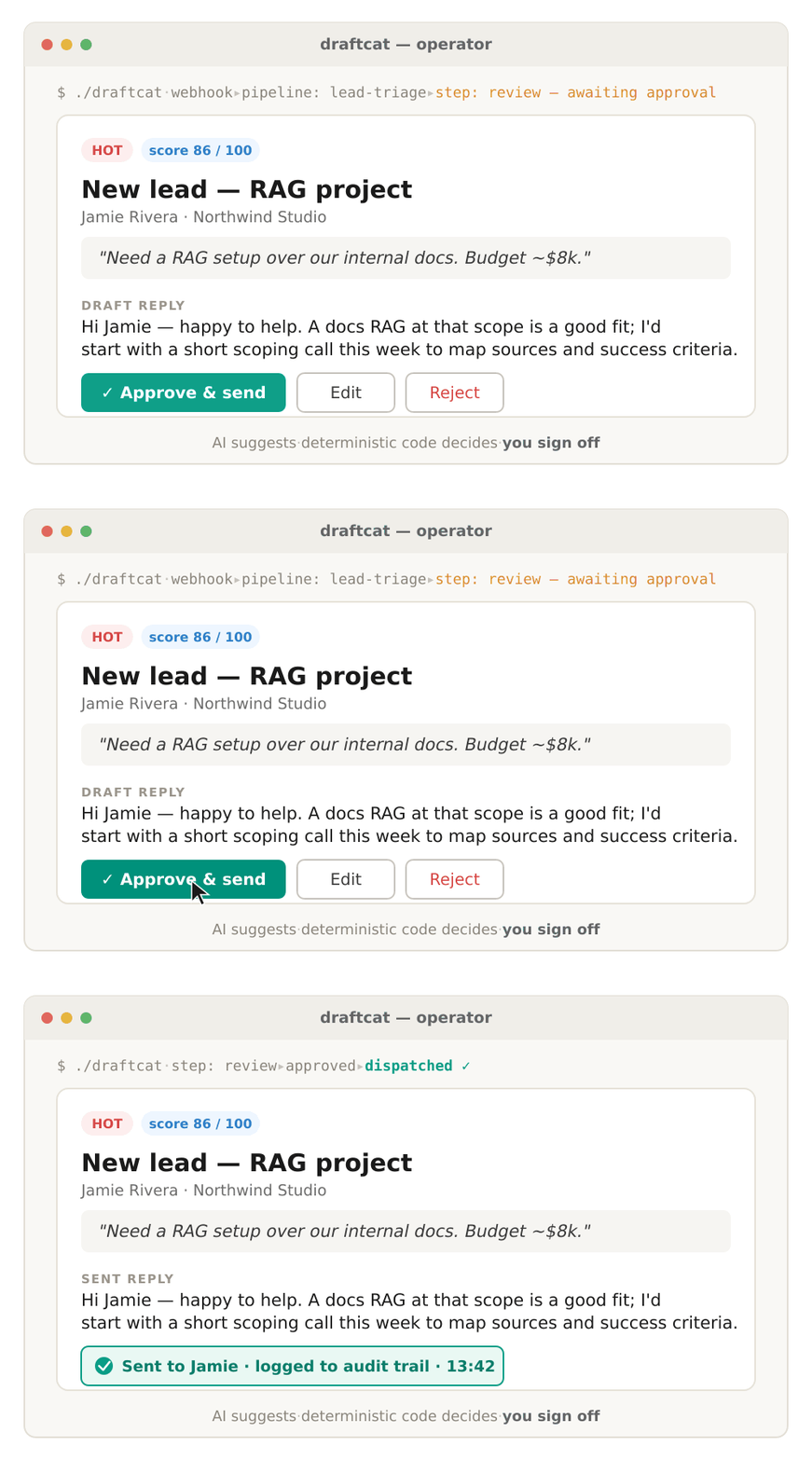
Draftcat runs YAML-defined pipelines that triage email, qualify leads, draft replies, extract data from PDFs, and govern self-hosted voice AI deployments. Every outbound action passes through an operator approval gate; every LLM call is budget-checked; every fetched item is deduped against a SQLite state store. Single Go binary.
AI suggests. Deterministic code decides. The operator signs off.
Voice AI plugin: self-hosted, EU residency, Dograh + Pipecat
Build with -tags voice to add the EU-resident writeback + governance layer for self-hosted voice agents (Dograh, Pipecat, or any orchestrator that posts JSON webhooks). Use cases: AI calling, inbound qualification, sales screening, support deflection in DE / AT / CH, with audio + transcripts never leaving the chosen EU region (STACKIT Frankfurt, PlusServer, IONOS, Hetzner, OVHcloud, Open Telekom Cloud, or a client-owned VPC).
- 5 lifecycle webhook receivers matching the published writeback contract:
session_start,event,session_end,handoff,learning - Pre-call context lookup (sub-300ms p95) enriches the greeting from GHL / custom CRM HTTP before the agent speaks
- 3 harvest + 1 resolve pipeline action feed completed calls, pending handoffs, and Learning-Items into the standard approval > extract > write flow
- 3 admin actions drive Dograh's REST API directly:
git_commit_workflow_update,dograh_staging_smoke,dograh_prod_publish - 7-step Learning-Item review pipeline (
fixtures/voice-dach-screener/guardrail.yaml) before any prompt / workflow / knowledge-base change reaches production - Per-day call + minute budgets enforced at the engine level, parallel to the existing per-token caps
- Bearer-token webhook auth with constant-time compare
- SQLite-backed audit in the same state DB as the rest of draftcat
go build -tags voice -o draftcat
Reference orchestrator: Dograh. The 5-endpoint writeback contract is intentionally orchestrator-agnostic, so Pipecat-direct or any future alternative drops in without rewriting the writeback layer. Full wiring recipe + Dograh-side webhook node templates: docs/voice.md. Runnable fixtures: DACH screening, 7-step guardrail.
Contents
- Why Draftcat vs the alternatives
- Why this exists
- Quickstart — lean + voice builds
- How it works
- Built-in actions — including all
voice_*anddograh_*actions - State & idempotency
- Governance
- Configuration — with
voice:block example - Commands
Why Draftcat vs the alternatives
| Draftcat | n8n | LangChain agents | |
|---|---|---|---|
| Built for | AI-augmented business ops with governance | General workflow automation | Open-ended agent loops |
| AI execution model | Deterministic boundary; AI cannot fire actions | Bolt-on LLM nodes inside visual workflows | Agent decides next action freely |
| Human-in-the-loop | Required on every outbound step | Optional manual nodes | Optional; not the default |
| Token budgets | Per-step / pipeline / day, enforced | None | None |
| Prompt-injection defense | Input sanitization + output schema validation | None | None |
| State & dedup | SQLite-backed; items processed at most once | DB-backed | In-memory |
| Config format | YAML (code-reviewable, gitable) | Visual editor + JSON export | Python code |
| Runtime | Single Go binary | Node.js + Postgres | Python + dependency tree |
| Approval channels | Telegram, Slack (WIP) | Webhook / email | None built-in |
| Voice AI integration | Built-in voice plugin: Dograh webhooks, pre-call lookup, 7-step Learning-Item guardrail |
None | None |
| EU data residency | Self-hosted Go binary, deploys on STACKIT / PlusServer / IONOS / Hetzner / OVHcloud / Open Telekom Cloud / client VPC | Self-host possible | Self-host possible |
Versus n8n, Draftcat treats AI as the gated minority, not the default. n8n is a powerful no-code workflow tool with AI nodes bolted on; Draftcat is a code-first engine where every AI suggestion must pass schema validation and operator approval before it touches a customer. If you want drag-drop integrations across 400+ services, use n8n. If you want deterministic governance on a focused set of business ops, use Draftcat.
Versus LangChain agents, Draftcat refuses to let the LLM choose the next action. There is no agent loop — pipelines are fixed sequences of deterministic / ai / approval steps defined in YAML. The LLM produces structured output; the engine validates it against a schema; the operator approves it. LangChain is for research and open-ended exploration. Draftcat is for production systems where a wrong LLM choice means a real customer gets emailed.
Why this exists
Service businesses run on volume communication — replying to leads, qualifying inbound, chasing stale deals, parsing invoices. AI handles the volume easily but is wrong often enough that you can't let it touch a customer without a human in the path. Draftcat is the smallest engine that makes that pattern routine: deterministic Go code does the fetching, routing, and dedup; AI does the drafting and classification under a token budget; an operator approves on Telegram or Slack before anything goes out. One business per instance, self-hosted, auditable.
Quickstart
git clone https://github.com/renezander030/draftcat.git && cd draftcat
cp secrets.yaml.example secrets.yaml   # operator IDs + API keys
go build -o draftcat . && ./draftcat
Define pipelines in config.yaml, prompts in skills/. The engine opens a SQLite state store at ./state.db on first boot.
To enable the voice AI plugin (Dograh webhook receivers, pre-call lookup, 7-step Learning-Item guardrail, EU residency wiring):
go build -tags voice -o draftcat . && ./draftcat
The lean binary is unchanged when the tag is off. See docs/voice.md for the full setup.
How it works
Each pipeline is a sequence of typed steps:
| Step type | What it does |
|---|---|
deterministic |
Plain Go — fetch emails, parse PDFs, dedup, route, notify |
ai |
LLM inference with a skill template, budget-checked, schema-validated |
approval |
Operator reviews via Telegram / Slack: approve / edit / reject |
pipelines:
  - name: invoice-due-diligence
    schedule: 1h
    steps:
      - name: parse-pdf
        type: deterministic
        action: pdf_extract
        vars: {path: /inbox/invoice.pdf}

      - name: extract-line-items
        type: ai
        skill: extract-line-items

      - name: verify-citations
        type: deterministic
        action: pdf_verify_cite
        vars: {fail_on_unresolved: "true"}

      - name: operator-review
        type: approval
        mode: hitl
        channel: telegram
Built-in actions
| Action | What it does |
|---|---|
gmail_unread |
Fetch unread Gmail messages (deduped per pipeline) |
ghl_new_contacts |
Fetch recent GoHighLevel contacts (deduped) |
ghl_stale_opportunities |
Fetch stalled GHL opportunities (requires vars.pipeline_id) |
ghl_unread_conversations |
Fetch unread GHL conversations (deduped by id + last_message_date) |
pdf_extract |
Parse a PDF into text + per-fragment bounding boxes (pure-Go) |
pdf_verify_cite |
Resolve <cite> tags in AI output against the parsed PDF |
notify |
Send AI output to the operator channel |
voice_calls_completed |
Harvest completed voice calls from the Dograh writeback layer (-tags voice) |
voice_handoffs_pending |
Harvest unresolved handoff requests for human routing (-tags voice) |
voice_handoffs_resolve |
Write ai_output.resolutions[].{handoff_id, target} back to the voice store (-tags voice) |
voice_learnings_new |
Harvest agent-flagged Learning-Items for the 7-step review (-tags voice) |
git_commit_workflow_update |
Write data[content_var] to a workflow file + git add + commit (-tags voice) |
dograh_staging_smoke |
POST to Dograh's outbound-trigger endpoint to smoke-test a workflow version (-tags voice) |
dograh_prod_publish |
PUT a workflow_definition to Dograh prod (Dograh auto-versions on receipt) (-tags voice) |
Add a new action by appending a case to the deterministic switch in main.go and registering its name in validate.go. See gohighlevel.go for the connector pattern and voice_actions.go / dograh_admin.go for the build-tag-gated examples.
State & idempotency
Draftcat persists cross-run state to SQLite at the path set in config.yaml:
state:
  path: ./state.db   # default if omitted
- Dedup. Fetched item IDs (Gmail message IDs, GHL contact IDs, etc.) are recorded in
seen_items. Subsequent runs skip already-processed items. Dedup is per(pipeline, scope)— the same item can be processed by two pipelines without interference. - Run history. Every pipeline run records
pipeline / started_at / ended_at / status / error_texttopipeline_runs. - Crash safety. WAL mode +
synchronous=NORMALfor durable writes without per-write fsync.
Items are marked seen at fetch time — once fetched, they won't be re-processed even if a downstream step fails. Replay manually via the /run <pipeline> operator command.
Governance
- Token budgets — per-step / per-pipeline / per-day caps. Exceeding any budget halts the pipeline immediately.
- Human-in-the-loop — every outbound action requires explicit operator approval.
- Input sanitization — operator input is scrubbed for prompt-injection patterns before reaching the LLM.
- Output validation — AI output is validated against the skill's JSON schema. Invalid output is rejected.
- Rate limiting — per-user, per-minute limits on operator interactions.
- Channel security — allowed-user lists and input-length limits enforced at startup. Engine refuses to start without them.
Configuration
provider:
  type: openrouter
  api_key_env: OPENROUTER_API_KEY

models:
  haiku:       {model: anthropic/claude-haiku-4-5, max_tokens: 1024}
  gpt-4o-mini: {model: openai/gpt-4o-mini,         max_tokens: 1024}

budgets:
  per_step_tokens:     2048
  per_pipeline_tokens: 10000
  per_day_tokens:      100000
  per_day_calls:       200      # voice plugin
  per_day_call_minutes: 1500    # voice plugin

state:
  path: ./state.db
When built with -tags voice, an additional voice: block configures the webhook receivers, the Dograh REST endpoints used by the admin actions, and the pre-call context lookup:
voice:
  enabled: true
  listen_addr: 127.0.0.1:8080
  public_base_url: https://draftcat.client.eu          # Dograh hits this
  auth:
    method: bearer
    token_env: DRAFTCAT_VOICE_TOKEN
  dograh:
    base_url: https://dograh.client.internal            # prod
    staging_url: https://dograh-staging.client.internal # for dograh_staging_smoke
    api_key_env: DOGRAH_API_KEY
  pre_call:
    enabled: true
    timeout_ms: 300
    lookups:
      - {source: ghl}                                   # auto-uses your existing GHL connector
      - {source: custom_http, url: https://crm.client.internal/lookup, header: "Authorization=Bearer {{env.CRM_TOKEN}}"}
    routing_rules:
      - {if: "support_tier == 'enterprise'", workflow: dach-enterprise}
      - {if: "lang == 'de-CH'",              workflow: schweizerdeutsch-screener}
      - {default: standard-de}
Skills are YAML prompt templates in skills/:
# skills/classify-job.yaml
name: classify-job
system: |
  You are a job classifier. Given a job posting, return a JSON object with
  match (boolean), reason (one sentence), and score (0-100).
input_vars: [posting, profile]
output_schema:
  type: object
  required: [match, reason, score]
Commands
draftcat                       # run the engine
draftcat validate [--strict]   # lint config + skills
draftcat test <pipeline>       # dry-run against fixtures/<pipeline>/
draftcat test walks the pipeline using JSON fixtures — never touches real APIs. AI steps return fixture text; approval steps auto-approve. See fixtures/README.md.
Development
Pre-commit hooks (lefthook) run gofmt, go vet, go build, and go test -short in parallel on every staged Go file. Pre-push runs draftcat validate --strict.
make check       # fmt-check + vet + test-fast + build
make test-fast   # short test pass
Patterns explained
The deterministic-boundary architecture is documented in the Production AI Automation Notes gist series. Each entry maps to specific draftcat code:
- #1 Agent Approval Gates — proposed actions, schema validation, audit log
- #2 Token Budgets — per-step, per-pipeline, per-day enforcement (
BudgetTrackerinmain.go) - #5 SQLite Dedup + Crash Safety — WAL mode,
seen_items, run audit (state.go) - #6 Prompt-Injection Defense — input sanitization + output schema validation (
ChannelSecurity+skills/*.yaml) - #7 PDF Cite Verification — auditable LLM extraction with per-fragment bounding boxes (
pdf.go)
Related projects
- capcut-cli — CLI to edit CapCut and JianYing video drafts. Same design DNA: single binary, no API needed, structured JSON boundary between agent and tool.
Status
v0.1 — early access. Single-business, single-operator deployments. Public APIs may change between minor versions until v1.0.
Roadmap signals
Core engine:
- Webhook triggers (currently pipelines are scheduled-only)
- Generic HTTP action (drop-in for any REST integration not yet first-class)
- Per-step retry + circuit breaker
- Slack approval channel (Telegram is shipping today)
- Structured JSON logging + Prometheus metrics endpoint
- Google Sheets connector
Voice plugin v0.2 (planned):
- Outbound calling campaigns with consent gating (TCPA-aware in the US, DSGVO + UWG-aware in DE/AT/CH)
- Recording redaction (PII masking before audio + transcript hit persistent storage)
- MCP bridge so Dograh agents can call draftcat tools mid-conversation (parity with Dograh's recent MCP server release)
- Real-Dograh integration verification against a live instance once a paying deployment lands
Operational deliverables (separate repos, not in draftcat):
dograh-stackit— Terraform + Ansible for reproducible STACKIT / PlusServer / IONOS / Hetzner / OVHcloud / Open Telekom Cloud deployment of the full voice stack (CPU VM for draftcat, GPU VM for Dograh + Whisper + vLLM + XTTS, 300 GB persistent model volume, Caddy TLS, smoke + warm-benchmark + attestation scripts)
Star History
License
MIT. See LICENSE.
Reviews (0)
Sign in to leave a review.
Leave a reviewNo results found