precis-mcp
Health Uyari
- License — License: GPL-3.0
- Description — Repository has a description
- Active repo — Last push 0 days ago
- Low visibility — Only 5 GitHub stars
Code Gecti
- Code scan — Scanned 12 files during light audit, no dangerous patterns found
Permissions Gecti
- Permissions — No dangerous permissions requested
Bu listing icin henuz AI raporu yok.
MCP server giving LLM agents a seven-verb API over papers, documents, code, state, patents, and cached web/Wolfram/YouTube tool calls
precis-mcp





A Model Context Protocol server that
gives language-model agents a small, uniform API for reading, writing,
and searching across papers, documents, personal state, code, and
cached tool calls. Small-model-friendly (7B-class agents are the design
target); stores content in PostgreSQL with pgvector, with a web
interface (see how it works).
See it
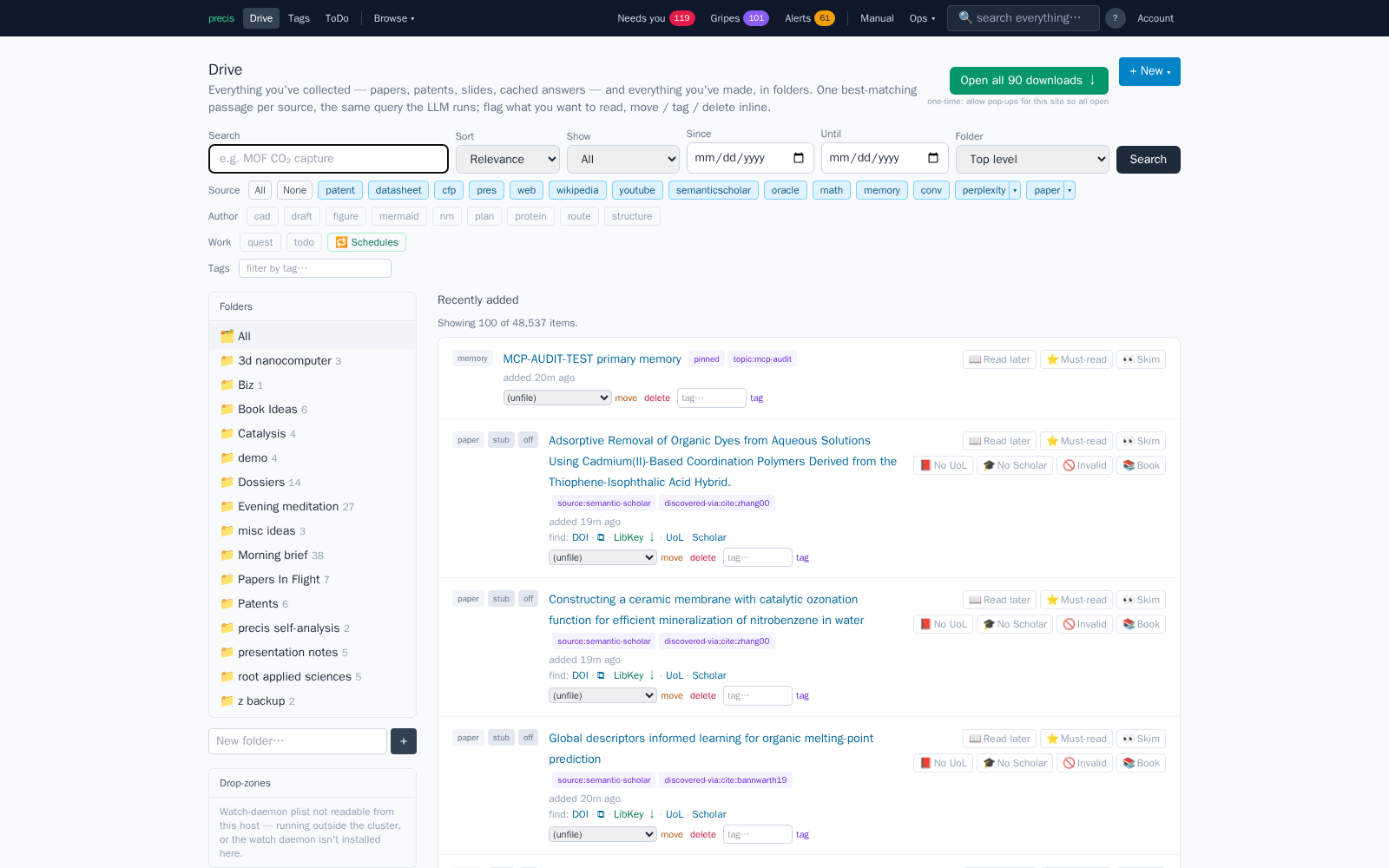
A two-minute tour, section by section, lives right here in the repo at
guide/README.md. A narrated version (audio) lives at
retospect.github.io/precis-mcp
once Pages is enabled. Video: coming.
Set it up: single machine —docs/setup-single-machine.md ·
cluster (multi-host, ansible) — deploy/README.md.
Status. Actively developed on the v8 line. There is no
CHANGELOG —git logis the change story. The kinds catalogue
below is a living set: the authoritative, build-specific
enumeration is alwaysget(kind='skill', id='precis-help')
against a running server (it introspects the live registry),
paired withget(kind='skill', id='precis-overview')for the
guided tour. Agents should start atprecis-toolpath-help
("I want to X — what do I call?").
What it does
One tool surface — eight verbs discriminated by a single kind=
argument — over three categories of content. Ref kinds are addressed
by slug or integer id (output hands you a compact <2-char><id>
handle, e.g. pa5 a paper, me42 a memory); tool kinds take q=
or id= and hand back text.
- Reading & reference —
paper(ingested research PDF),patent(EPO OPS record),cfp(call-for-proposal / spec doc),oracle(curated wisdom entry),conv(past conversation),pres(slide deck),skill(agent how-to — you're reading one). - Files under
PRECIS_ROOT/ code —markdown,plaintext,tex, andpython(symbol- and callgraph-aware repo navigator). - Authored artifacts —
draft(chunk-native document that
exports to LaTeX/PDF/Word),cad(analytic-SDF solid modeling —
designs are probed, not meshed; unit-required DSL),se
(structural-envelope designs: blocks/ports/joints with DRC,
stability + prestress analysis, a fastener engine, STL/3MF/STEP
export),nm(molecular-machine designs on the same block
surface — envelopes bound to atomistic structures, mechanics
ceilings),structure(atomistic cell + bond graph for
DFT/molecular work),pcb(netlist + placement graph →
BOM/CPL/DSN + Freerouting), andfolder(organizational container
for the above). - Personal state & knowledge —
todo(hierarchical todo tree),memory,gripe,anki(spaced-repetition cloze cards → AnkiWeb),citation(verified claim → source quote),finding
(chain-of-evidence over a citation chase),job(offline LLM run,
child of atodo). - Identity, comms & audit —
orcid(researcher-identity hub),cron(push-notification scheduler),message(proactive outbound),alert(machine-detected ops
condition),agentlog(per-run attribution trail),provenance
(derivation audit). - Tool kinds (stateless or cache-backed) —
calc(local SymPy),math(Wolfram),youtube(transcript),web(fetch + extract),wikipedia(on-demand article),websearch/perplexity-reasoning/perplexity-research(Perplexity Sonar
tiers). - Discovery —
random: pick a random indexed block to stumble
into content when you don't know what to ask for.
The active set depends on which optional extras and env vars are
configured (see Install) — a kind whose dependency or
env var is missing simply drops off the surface. This list is a
snapshot; get(kind='skill', id='precis-help') enumerates the kinds
wired in your build, and get(kind='skill', id='precis-overview')
gives the design-rationale tour with an example handle per kind.
Eight verbs
| Verb | Use when |
|---|---|
get |
You know the name (slug, id, file path) — or you're calling a tool. |
search |
You're looking for content by topic or phrase. Hybrid lexical (tsvector) + semantic (pgvector) with RRF fusion. |
put |
Create a new ref. Optionally tag and link on creation. |
edit |
Rewrite a region of a file-kind ref by content anchors (find-replace, append, insert, replace). |
delete |
Soft-delete a numeric ref, or delete a region from a file kind by selector. |
tag |
Add and/or remove tags. Three namespaces: closed (STATUS:done), flag (pinned), open (topic-foo). |
link |
Add or remove a cross-link to another ref. Vocabulary: related-to, blocks, contradicts, cites, derived-from, supports, … |
more |
Fetch the next page of a truncated response (more(cursor='…') — every truncation footer hands you the cursor). |
Address by id= for names, q= for content. No URI selector strings
for ids; region selectors inside files use the compact slug~SELECTOR
shape (e.g. notes--meeting~L42-58).
Install
pip install 'precis-mcp[all]'
Deterministic, no-API tool kinds ship in core — no extra needed: calc
(sympy + pint), plot / figure (matplotlib), mermaid (mermaidx, no
Node/Chromium), docx + tex export (python-docx / latex2mathml / lxml /
resvg), cad STL/3MF export (manifold3d CSG kernel), and structure CIF
I/O + symmetry (ASE + spglib). These are local, deterministic, torch-free
code, so they live in core rather than behind an extra that could go missing.
Extras cover the rest — network/API tools, torch-bound ML, and heavy or
host-specific packs (each enables its kinds; omit any you don't want):
| Extra | Enables | Heavy? |
|---|---|---|
embed |
In-process bge-m3 embedder (sentence-transformers + torch) — needed for search unless you point at a remote embedder |
yes (~2 GB model on first load) |
paper |
paper ingest — Marker PDF → chunks + CrossRef/S2 metadata |
yes (pulls torch via Marker) |
external |
math (Wolfram), youtube, web, Perplexity trio, news |
no |
patent |
patent kind (EPO Open Patent Services) |
no |
edgar |
edgar kind — SEC EDGAR filings (httpx) |
no |
web |
precis web browser UI (FastAPI + Jinja + HTMX) |
no |
cad-step |
cad exact STEP export (OpenCASCADE B-rep) |
yes (~200 MB OCCT libs) |
pcb |
pcb footprint resolution (LCSC → KiCad) |
no |
dft-ml |
structure ML-potential relax (ASE + MACE-torch) |
yes (pulls torch) |
chem |
route kind — retrosynthesis tool-pack (RDKit) |
yes (~150 MB) |
tts |
Audio export — local TTS for voice drafts + the morning brief (Kokoro) | yes (host-specific) |
asa |
asa-bot Discord bridge (discord.py) |
no |
all |
embed + paper + external + patent + edgar + web. Excludes the heavier / specialized cad-step, dft-ml, pcb, chem, tts, asa tiers — install those explicitly. |
yes |
A bare pip install precis-mcp gives you the state kinds (todo,memory, gripe, anki, conv, oracle, skill, random), the
core deterministic tool kinds listed above, and the markdown /plaintext / python / tex file kinds (the file kinds ride onPRECIS_ROOT).
Optional deps surface as InitError at boot: the kind silently drops
off the tool surface with a WARNING, the server stays up.
Database
precis-mcp requires PostgreSQL with the pgvector extension (SQL
extension name: vector). The CLI precis migrate applies the
forward-only numbered SQL migrations in src/precis/migrations/. See0001_initial.sql for the schema.
createdb precis
psql precis -c 'CREATE EXTENSION vector;'

export PRECIS_DATABASE_URL=postgresql://localhost/precis
export PRECIS_EMBEDDER=bge-m3   # or "mock" for tests
precis migrate
Step-by-step single-machine runbook (worker, web UI, secrets):docs/setup-single-machine.md. Cluster
(multi-host, ansible): deploy/README.md.
Run
precis serve speaks MCP over stdio. Wire it into your agent's MCP
config:
{
  "mcpServers": {
    "precis": {
      "command": "precis",
      "args": ["serve"],
      "env": {
        "PRECIS_DATABASE_URL": "postgresql://localhost/precis",
        "PRECIS_EMBEDDER": "bge-m3",
        "PRECIS_ROOT": "/absolute/path/to/notes",
        "PRECIS_PYTHON_ROOTS": "myrepo:/absolute/path/to/myrepo"
      }
    }
  }
}
One-tool profile
Setting PRECIS_MCP_PROFILE=command in the server env collapses the
eight-tool surface into a single precis(command=..., text=None)
tool. command takes the same one-string call syntax the docs
already teach — e.g. get(kind='skill', id='toc') — parsed bysrc/precis/tools/command_parser.py: one call, keyword args only,ast.literal_eval-safe literal values; a bad call gets an
actionable [error:BadInput], not a crash. text= is the escape
hatch for large bodies, so a caller doesn't have to quote-escape
them inside command. The frozen schema is ~850 bytes vs ~22 KB for
the typed per-verb schemas — cheaper cold-start, and a tools/list
block that never changes, so prompt caches keyed on it never
invalidate. Default profile is typed (unset = the per-verb tools
above).
precis eval '<call>' is the CLI twin: it evaluates one call string
against the same parser (--text / --text-file for the large-body
escape hatch) without building the multi-flag precis tools <verb> --flag value form.
Environment variables
| Var | Purpose |
|---|---|
PRECIS_DATABASE_URL |
Postgres DSN (required for all ref kinds). |
PRECIS_OWNER |
Canonical username for the human running this instance — the author stamped on a web "ask a follow-up" and the user:<owner> addressee of an ask-user pause. Defaults to owner. |
PRECIS_EMBEDDER |
"mock" (dev/tests), "bge-m3" (in-process), or "remote" (HTTP client to precis serve-embeddings). |
PRECIS_EMBEDDER_URL |
Required for remote: ordered, comma-separated base URL(s), e.g. http://127.0.0.1:8181. First healthy endpoint wins; rest are fallback. |
PRECIS_ROOT |
Single root dir for markdown / plaintext / tex kinds. The trio is hidden when unset; every read/write is normalised against this path (Path.resolve() + relative_to). |
PRECIS_PYTHON_ROOTS |
alias:/path,alias2:/path2 — exposed Python repos. |
PRECIS_PYTHON_ALLOW_EXEC=1 |
Gate for python runtrace (spawns subprocess). |
EPO_OPS_CLIENT_KEY + _SECRET + PRECIS_PATENT_RAW_ROOT |
Enables patent kind. |
ORCID_CLIENT_ID + _SECRET |
Enables the orcid researcher-identity kind. |
PRECIS_DIGIKEY_CLIENT_ID + _SECRET |
Live supplier stock for component view='stock' (paste on /secrets). |
WOLFRAM_APP_ID |
Enables math kind. |
PERPLEXITY_API_KEY |
Enables websearch / perplexity-reasoning / perplexity-research. |
PRECIS_WEB_AUTH |
off disables the precis web HTTP Basic gate (local dev only). Anything else — including unset — keeps it on: every route requires an account from precis users. |
PRECIS_WEB_PASSWORD_PEPPER |
Vault-resident pepper HMAC'd into web passwords before scrypt, so a shareable logical pg_dump carries no crackable hashes. precis users add mints one on first use; you rarely set this by hand. |
PRECIS_CORPUS_DIR |
Corpus root(s) for the precis web paper viewer. An os.pathsep-separated list is allowed (e.g. /opt/a/corpus:/opt/b/corpus); the web tries each <root>/<letter>/<cite_key>.pdf in order and serves the first that exists. Point it at the same path the ingest watcher writes to. |
LOG_LEVEL |
DEBUG / INFO / WARNING / ERROR. |
PRECIS_MCP_PROFILE |
typed (default, per-verb tools) or command (single precis(command) tool — see One-tool profile). |
This table is the getting-started subset. precis reads ~150 PRECIS_*
variables in all — feature toggles, autonomy modes, budgets, model ids,
compute-routing, paths, and secrets. For the exhaustive catalog —
every var, its code default, the value deployed to each cluster service,
and an assessment of whether that state is right — seedocs/reference/config-variables.md.
The policy for adding a var (the three-tier scheme) isdocs/conventions/env-vars.md.
Design system
The cad / se / nm kinds form one design surface, macro to
molecular, built for LLM authoring:
- Explicit units everywhere. Every dimensioned input states its
unit (3mm,1.4Å,12 N,90deg— pint-backed, hogsheads
included); internals are SI (metres, radians, float64); display is
a neat SI-prefix formatter (2.3 nm,1.2 kN). A bare number
where a unit is required is rejected with a hint echoing the
plausible readings — the zero-counting / exponent-slip failure
modes of LLM-authored geometry die at the parser. Two declared
enclaves keep ecosystem conventions honest (pcbis mm like its
gerber/IPC world;structureis Å/eV like its ASE/CIF world),
self-named and converted at every API boundary. - Structural analysis (
precis.structsolve): force-density
form-finding, Pellegrino–Calladine rigidity + prestress
stability, and an active-set complementarity solver for unilateral
members (tension-only cables, compression-only struts,
must-contact stops — "which members carry, and does every member
stay on its legal sign"), with a two-state bistability probe. A
SIMP topology-optimisation engine (matrix-free, AM overhang
filter, gyroid lattice fill) ships alongside. - Design viewer (web): per-design SVG projection reader —
force-coloured members, part isolation, stepped semantic
abstraction levels (envelope → interfaces → refined → realized) —
plus a three-cad-viewer 3D route with drawn connectivity,
exploded view, and a linked topology graph. - Scale-relative kernel tolerances (an AST-gated no-absolute-epsilon
rule) make the same machinery exact from metres to Ångströms.
Where this is heading — one geometry currency from tolerance boxes
to atoms, situations/verdict tables, pattern groups, cost-aware
optimisation — is mapped indocs/backlog/multiscale-design-architecture.md.
Design highlights
- Eight verbs, one
kind=. The whole surface isget/search/put/edit/delete/tag/link/more. No
per-kind bespoke tools. - Content-anchored edits.
edit(find=..., before=..., after=...)
resolves by literal content match; unique/first/all/nth policy;
fuzzy nearest-line hint on not-found. Pure resolver inprecis.utils.edit_resolve; ships formarkdown,plaintext, andpython. - Hybrid search. Lexical
tsvector+ semanticpgvector(bge-m3)
with Reciprocal Rank Fusion. Block-level; paper chunks, markdown
paragraphs, Perplexity answers, web pages all searchable. - Per-chunk discovery layer (F20). Every body chunk gets
KeyBERT keywords stored onchunks.keywords TEXT[](GIN-indexed
canonical forms) +chunks.keywords_meta JSONB(versioned
short/long pairs with bge-m3 cosine scores), populated by thechunk_keywordsworker. The paper TOC view (view='toc')
DP-clusters those keyword arrays at request time
(src/precis/utils/toc_db.py) — superseding the droppedref_segments/ref_segment_sentencesprecompute. Thecitationkind closes the loop: an agent's writing-thread
workflow can persist verifiedclaim → source quoterecords (seeprecis-citation-help). - Progressive disclosure. Eight verbs and a
kind=argument is
the whole visible surface. Behind it sits a fan-out of ~25
per-kind help skills, dozens of read views, an anchored edit
protocol, args-dict view payloads, and a tag/link vocabulary —
none of which the agent has to know up front. Every response can
emit anext=breadcrumb, every error names the skill that
explains it, andget(kind='skill', id='precis-<kind>-help')
unfolds the manual for whichever capability the agent just
bumped into. Think exploding pocket knife: the tool grows
blades as you reach for them, instead of advertising 20
unfamiliar buttons intools/list. (UX literature calls this
pattern progressive disclosure.) - The todo tree.
kind='todo'is a hierarchical todo graph — a
level gradient (strategic→tactical→subtask, plusrecurring), a PRIO sort key,meta.auto_checkwait-for-condition
leaves, andmeta.schedulerecurring spawn (the Watches
umbrella). It is the unified substrate for intent, execution, and
review;kind='job'(an offline LLM run) always hangs off a todo
viaparent_id, and theminterworker is the canonical path
from a todo'smeta.executorto a queued job. Seeprecis-todo-tree-help. - Two-profile worker. Every background pass runs under one of two
long-running daemons:precis worker --profile=system(embeddings,
keywords, minter, sweepers — safe to run on every node) and--profile=agent(the LLM-heavy review/planner rotation, each pass
self-gated by env + a load-average ceiling). Per-pass daemons are
retired. - HintBus. Any layer can emit deduplicated, novelty-decayed tips
that are rendered after the verb's main output. Keeps slim models
from drowning in self-inflicted reminders. - Slim exception surface.
BadInput/NotFound/Gone/Unsupported/Upstream/RateLimited/Internal, each
carrying a single copy-pasteablenext="breaking hint". psycopg 3sync, raw SQL. No SQLAlchemy, no Alembic, no async
below FastMCP — stdio's serial workload doesn't buy anything from
async.- In-tree handlers, entry-point plugins. Core kinds are
hand-ordered inprecis.dispatch.boot(). Third-party kinds can
register themselves via theprecis.handlersentry-point group
without forking — the contract lives in theprecis.dispatch
docstrings;src/precis_chem/is the richest first-party example.
Extending
Write a plugin handler in 3 steps — the contract is documented in theprecis.dispatch docstrings (_load_plugins), with the
canonical tiny example insrc/precis/handlers/calc.py.
# your plugin's pyproject.toml
[project]
dependencies = ["precis-mcp>=8.0.0"]

[project.entry-points."precis.handlers"]
wikipedia = "precis_wikipedia:WikipediaHandler"
Plugin failures are logged and skipped — one bad plugin cannot brick
the server.
CLI
Routed EasyEDA Pro intake: uv run precis pcb import-epro LOCAL.epro2 --slug PREVIEW
preserves straight/arc tracks and through vias as fixed source copper. Use--dry-run to inspect first or --copper none for measurement-only intake.
precis memory mirror import DIR --namespace NAME imports a flat YAML/Markdown
memory snapshot with conflict checks. precis memory mirror export DEST --namespace NAME preserves original filenames and formatting in a new directory;
it never overwrites an existing destination or retires missing memories.
# Serving
precis serve                       # Start the MCP stdio server.
precis serve-embeddings            # HTTP embedding service (server side of
                                   #   PRECIS_EMBEDDER=remote; /healthz /readyz
                                   #   /model /embed /metrics).
precis web [--host H --port P]      # Browser UI: Tasks / Papers / Console /
                                   #   Conversations / Status tabs (needs the
                                   #   [web] extra; binds 127.0.0.1:9100 behind
                                   #   HTTP Basic — create an account first, or
                                   #   every page answers 503).

# Background processing
precis worker [--profile system|agent]
                                   # Drive the background passes. 'system'
                                   #   (default) = embeddings/keywords/minter/
                                   #   sweepers; 'agent' = the LLM-heavy review
                                   #   + planner rotation. --only X --once for
                                   #   ad-hoc backfills.
precis watch [PATH]                # Watch an inbox dir and ingest dropped PDFs
                                   #   (papers / books / presentations routing).
precis add <pdf|url>               # Ingest one paper on the spot.

# Web accounts (precis web logins; every account is fully authorized)
precis users add <login> --abbrev <ab> [--name N --email E]
                                   # Create an account; password from a no-echo
                                   #   prompt (or --password-stdin). Never argv.
precis users list                  # The roster.
precis users passwd <login>        # THE recovery path — Basic auth has no
                                   #   email reset flow, by design.
precis users disable|enable|rm <login>
precis users feed-token <login>    # Mint + print the private podcast feed URL
                                   #   (?t=… , since podcast apps handle Basic
                                   #   on enclosures inconsistently).
                                   # Signed-in users do the self-service half —
                                   #   password, profile, podcast link — at
                                   #   /account in the web UI. Creating and
                                   #   removing accounts stays here.

# Database
precis migrate                     # Run pending forward-only SQL migrations.
precis db ...                      # Schema utilities (dump-schema, …).
precis schema-doc                  # Generate the Mermaid ER diagram
                                   #   (docs/reference/schema.md) from a DSN.

# Interactive & inspection
precis repl                        # Interactive verb console (tab-complete).
precis draft ...                   # Manage / export draft-kind documents.
precis stats | logs | stubs | verify
                                   # Corpus stats, event logs, stub triage,
                                   #   integrity checks.
precis stats --utilization [--hours N]
                                   # Hourly CPU (host_heartbeat_log) + LLM
                                   #   (llm_call_log) utilization + idle gaps.
precis cron | heartbeat            # Scheduler tick / liveness ping.

# Claim-hub curation (taproot)
precis taproot ...                 # Claim-hub authoring/repair: mint / refine /
                                   #   merge / backfill / backfill-grounding /
                                   #   repair-evidence / direct-mint / lint.
precis taproot verify-edges        # Certify withheld/unverified evidence edges
                                   #   for the publish preflight (stamps the
                                   #   meta.support verdict; dry-run default).
precis taproot reword-sweep        # LLM batch reword of lint-blocked claim hub
                                   #   sentences through the retitle door
                                   #   (dry-run default).

# One-shot jobs
precis jobs ingest[-md|-oracles] ...   # Pre-warm files under PRECIS_ROOT.
precis jobs import-perplexity ...      # Bulk-import Perplexity web-UI answers.
precis jobs {watch,list,run}-patent-watches / sweep-patent-fulltext
                                       # Saved CQL patent watches (patent kind).
precis jobs check-provenance / sync-retraction-watch
                                       # Provenance + retraction audits.
Run any subcommand with --help for the full option list.
Utility scripts
The scripts/ dir holds workspace-side utilities that run against
a precis store but live outside the published CLI surface. Seescripts/README.md for full coverage; the
high-traffic ones:
paper-monitor-ingest-dir— drop-and-go PDF ingest watcher.perplexity-monitor-ingest-dir— bulk-import Perplexity
markdown exports.find-citing-papers— sweep S2 for new papers citing the
precis corpus, with bge-m3 cosine rerank and several noise-
reduction filters; reports land in apaper-ingest/review dir.enrich-paper-identifiers/retrofit-acatome-external-ids
— backfill DOI / arXiv ids on legacy refs.
Roadmap
- The multiscale design programme (shared design core, block
libraries with states, situation rule tables, pattern groups,
cost-aware optimisation) —docs/backlog/multiscale-design-architecture.md
is the living map. book,rmkfile handlers. (texanddocxshipped.)webbookmark mode + Wayback enrichment (gripe:3681 phase 2 + 4 — seedocs/backlog/).voicekind — STT/TTS bound to transcript refs (spec:docs/backlog/voice-kind-spec.md).- SDK extraction (
precis-core) once the plugin API has settled.
Documentation
AGENTS.md— start here to contribute or change code. The canonical guide: conventions, workflow, definition-of-done, ingest guarantees.docs/mission.md— the mission, the pitch narrative, and the current corpus facts (positioning, not architecture — the single source for decks and talks).docs/README.md— the documentation landing index (directory-by-directory map).docs/codebase.md— orientation: invariants, lifecycle, seams, and the generated package map (subsystem detail lives in each package's__init__.pydocstring).docs/reference/schema.md— the generated DB schema diagram (Mermaid ER, produced from the live database — can't drift).docs/reference/config-variables.md— the fullPRECIS_*config catalog: every var, its default, the value deployed to each cluster service, and a correctness assessment.docs/reference/schema.md— generated schema (full ER view:schema-v2.svg).src/precis/data/skills/precis-citation-help.md—citationkind + verifier-workflow agent surface.src/precis/data/skills/precis-toc-help.md— TOC machinery (segments, sentences, matryoshka keywords).- Git history (
git log) — what shipped in each phase (no CHANGELOG file).
Contributing
The repo lives atretospect/precis-mcp.
Coordinated releases use scripts/round gate / deploy: exact release SHA,
fresh CI, then coordinator runtime evidence before immutable tagging and retirement.
Issues and PRs welcome. Development workflow:
For isolated Codex sessions in tmux, see scripts/fleet-codex
and the Codex fleet runbook.
uv sync --all-extras --group dev
uv run pytest
uv run ruff check . && uv run ruff format --check .
uv run mypy src tests
Run the full test suite in the dev container, which bakes every
optional extra and wires the test database:
scripts/dev pytest                       # full suite, all extras
scripts/dev bash -lc "ruff check . && ruff format --check . && mypy src tests && pytest"
A host uv run pytest only sees the torch-free base install, so the
full run there fails with spurious missing-extra errors (sympy,marker, lxml, …) — use it for targeted subsets only.
All tooling goes through uv run (host) or scripts/dev (container)
— see AGENTS.md for the full workflow and
definition-of-done.
License
GPL-3.0-or-later. See the full text at
gnu.org/licenses/gpl-3.0.html.
Yorumlar (0)
Yorum birakmak icin giris yap.
Yorum birakSonuc bulunamadi